Solution:
Concept: The two tangents drawn to a circle from a point outside it are equal in length.
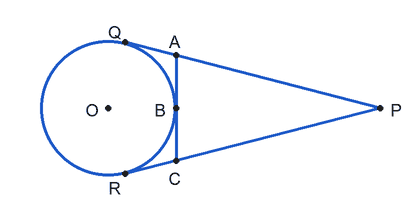
Given: PQ and PR are tangents; AC touches the circle at B.
Step 1 — Part (i).
PQ and PR are the two tangents drawn from the outside point P, so they are equal: PQ = PR.
Step 2 — Part (ii).
From the point A, the two tangents to the circle are AQ and AB, so AQ = AB. Q lies on PA produced, so PQ is made of PA and AQ.
PQ=PA+AQ
PQ=PA+AB
Step 3 — Part (iii).
In the same way, from the point C the tangents CR and CB are equal, so CR = CB.
PR=PC+CR
PR=PC+CB
Step 4 — Part (iv).
We add the results of (ii) and (iii) and group AB and CB, which together make AC (B lies on AC).
PQ+PR=PA+AB+PC+CB
PQ+PR=PA+PC+(AB+BC)
PQ+PR=PA+PC+AC
PA + PC + AC is the perimeter of triangle PAC.
Watch out: AB and AQ are tangents from the same point A; do not pair AB with PQ, which comes from P.
Therefore, PQ = PR, and the results (ii), (iii) and (iv) are proved: PQ + PR equals the perimeter of Δ PAC.