
Question 303 marksMedium
In each figure, given below, O is centre of the circle. Use the given informations to find the value of x :
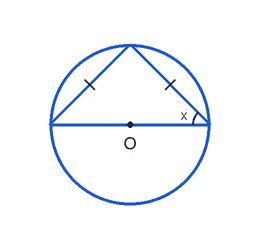
(i)
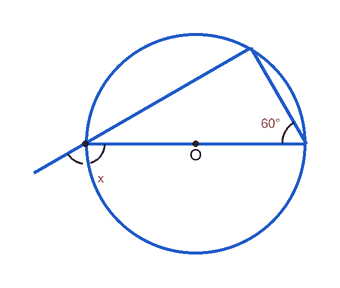
(ii)
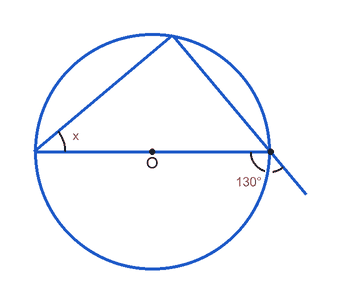
(iii)
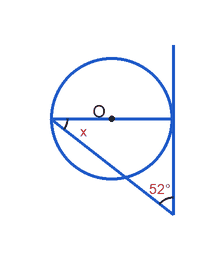
(iv)
(v)
(vi)

Confirming your payment
Sign up now and get 250 free tokens.
Circles · Question 30 of 30
In each figure, given below, O is centre of the circle. Use the given informations to find the value of x :
(i)
(ii)
(iii)
(iv)
(v)
(vi)
Solution:
Concept: The angle in a semicircle is 90°. A tangent is perpendicular to the radius (diameter) at its point of contact. The perpendicular from the centre to a chord makes a right-angled triangle with a radius. Angles on a straight line add up to 180°, and the angles of a triangle add up to 180°.
Step 1 — Figure (i).
The triangle stands on the diameter, so its top angle is 90° (angle in a semicircle). Its two slanting sides are marked equal, so its two base angles are equal; x is one of them.
Step 2 — Figure (ii).
Call the ends of the diameter A (left) and B (right), and the top point C. ∠ACB = 90° (semicircle) and ∠ABC = 60°, so we first find ∠CAB.
The chord CA is produced beyond A, and x lies on the other side of A, between the produced part and AB. So x and ∠CAB make a straight angle.
Step 3 — Figure (iii).
Again call the ends A (left) and B (right) and the top point C. CB is produced beyond B, and the 130° angle lies between the produced part and BA, so ∠CBA makes a straight angle with it.
∠ACB = 90° (semicircle), so the angle sum of triangle ABC gives x = ∠CAB.
Step 4 — Figure (iv).
The vertical line touches the circle at the right end B of the diameter AB, so it is perpendicular to AB: ∠ABT = 90°, where T is the point where the slanting line from A meets it. In triangle ABT the angle at T is 52°.
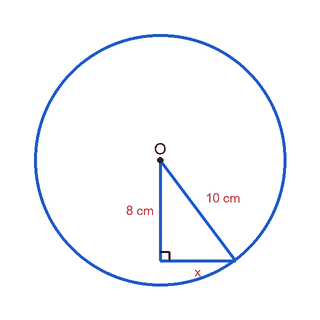
Step 5 — Figure (v).
The 8 cm line from the centre is perpendicular to the chord, and the 10 cm line is a radius to the end of the chord. They form a right-angled triangle with the 10 cm radius as hypotenuse and x as one side.
Step 6 — Figure (vi).
The two chords, 10 cm and 24 cm, meet on the semicircle and stand on the diameter, so the angle between them is 90°, and the diameter is the hypotenuse.
x is the distance from an end of the diameter to the centre O, which is the radius.
Watch out: In (ii) and (iii), check whether the marked angle is inside the triangle or on the produced line outside it.
Therefore, (i) x = 45°; (ii) x = 150°; (iii) x = 40°; (iv) x = 38°; (v) x = 6 cm; (vi) x = 13 cm.