The following questions are Assertion-Reason based questions. Choose your answer based on the codes given below.
Question 131 markMCQEasy
The following questions are Assertion-Reason based questions. Choose your answer based on the codes given below.
(1) Both A and R are correct, and R is the correct explanation for A.
(2) Both A and R are correct, and R is not the correct explanation for A.
(3) A is true, but R is false.
(4) A is false, but R is true.
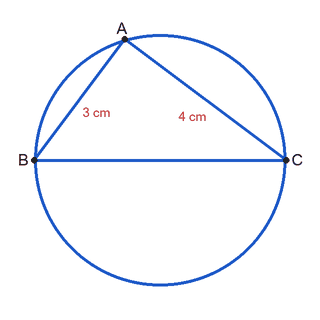
Assertion (A) : A, B and C are three points on the circumference of a circle such that BC is diameter of the circle. If AC = 4 cm and AB = 3 cm, then diameter BC = 4 cm + 3 cm.
Reason (R) : Angle BAC = angle of semi-circle = 90° and so BC² = AB² + AC².
Select your answer
(A) (1)
(B) (2)
(C) (3)
(D) (4)
Correct answer
Answer: (D) (4)
Concept: In an Assertion–Reason item we judge the Assertion (A) on its own, then the Reason (R) on its own, and only when both are true do we ask whether R explains why A is true.
Step 1 — Judge R.
BC is a diameter and A is on the circle, so ∠BAC is the angle in a semicircle and equals 90°. In a right-angled triangle the square on the hypotenuse equals the sum of the squares on the other two sides, so BC² = AB² + AC². R is true.
Step 2 — Find BC.
We use R's rule with AB = 3 cm and AC = 4 cm.
BC2=32+42=9+16=25BC=25=5 cm
Step 3 — Judge A.
A adds the two sides and claims that BC is 7 cm (4 cm + 3 cm). But BC is 5 cm, because the sides of a right-angled triangle combine by Pythagoras' theorem, not by simple addition. So A is false.
Watch out: Use Pythagoras' theorem for the hypotenuse; adding the two sides gives a length that is too big.
Why the other options are wrong:
(A): Code (1) needs A to be true, but BC is 5 cm, not 7 cm.
(B): Code (2) needs A to be true, but BC is 5 cm, not 7 cm.
(C): Code (3) says A is true and R is false; it is the other way round.
Therefore, A is false and R is true, code (4), option (D).