
Opening your dashboard
Class 8 Maths Chapter 20: Symmetry Solutions
70 textbook questions with step-by-step answers, free to read, for ICSE 2026-27.
Get talked through Ch 20, not just shown the answer
Reading a finished solution is not the same as being able to do it. The AI tutor takes one question at a time and works it with you, in your own words, until you can.
- Ask it out loud, in your own words
- It gives you the next step, not the answer
- Stuck on part (ii)? Start there
70 questions with solutions
1–3 marks · Easy difficulty
- 11 mark
Question 1
The number of line(s) of symmetry of a regular pentagon is :
Solve with AIAnswer
(A) 4
- Correct
(B) 5
(C) 0
(D) none of these
Answer: (B) 5
Concept: A regular polygon has all its sides equal and all its angles equal. A regular polygon with sides has exactly lines of symmetry, and every one of them passes through its centre.
Step 1 — Recall the rule.
A regular polygon has as many lines of symmetry as it has sides.
Step 2 — Apply it to the pentagon.
A regular pentagon has 5 equal sides, so it has 5 lines of symmetry. Because 5 is odd, each line joins a vertex to the mid-point of the opposite side.
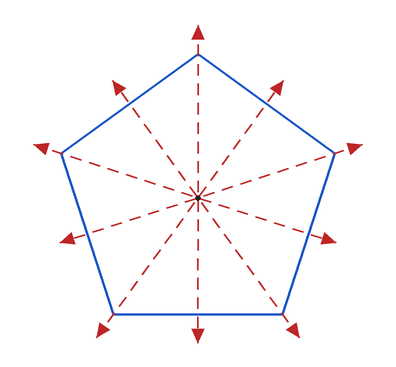
Watch out: Do not count only the lines that look vertical or horizontal; all 5 lines through the centre are equally good.
Why the other options are wrong:
- (A) 4: This is the number of lines of symmetry of a square, which has 4 sides.
- (C) 0: This is wrong, because a regular pentagon folds onto itself along the line from any vertex to the mid-point of the opposite side.
- (D) none of these: This is wrong, because the correct number, 5, is option (B).
Therefore, a regular pentagon has 5 lines of symmetry, option (B).
- 21 mark
Question 2
The number of line(s) of symmetry which a rhombus has :
Solve with AIAnswer
(A) 4
- Correct
(B) 2
(C) 0
(D) none of these
Answer: (B) 2
Concept: A line of symmetry (also called an axis of symmetry) divides a figure into two parts that are mirror images of each other. If the figure is folded along this line, the two parts cover each other exactly.
Step 1 — Know the shape.
A rhombus has all four sides equal, but its angles are not right angles (unless it is a square).
Step 2 — Test the diagonals.
Each diagonal cuts the rhombus into two triangles with the same three sides, and it bisects the angles at its ends. Folding along either diagonal therefore makes the two halves cover each other. That gives 2 lines.
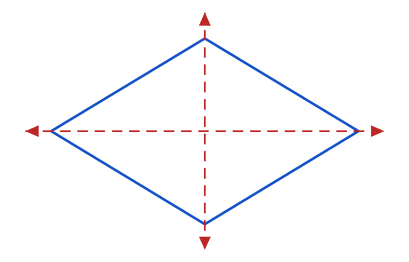
Step 3 — Test the other lines.
The line joining the mid-points of two opposite sides is not a line of symmetry: the fold would put an acute angle on an obtuse angle. So there are no more lines.
Watch out: A rectangle's lines of symmetry join the mid-points of opposite sides, but a rhombus's lines are its diagonals.
Why the other options are wrong:
- (A) 4: This is the number for a square, a rhombus whose angles are all 90°.
- (C) 0: This is wrong, because folding along a diagonal makes the two halves of a rhombus coincide.
- (D) none of these: This is wrong, because the correct number, 2, is option (B).
Therefore, a rhombus has 2 lines of symmetry (its diagonals), option (B).
- 31 mark
Question 3
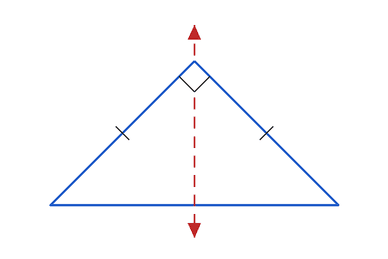
The number of line(s) of symmetry which an isosceles right angled triangle has:
Solve with AIAnswer
(A) 0
(B) 2
- Correct
(C) 1
(D) none of these
Answer: (C) 1
Concept: A triangle has a line of symmetry only when at least two of its sides are equal. An isosceles triangle has 1 (the bisector of the angle between the equal sides), an equilateral triangle has 3, and a scalene triangle has none.
Step 1 — Know the triangle.
An isosceles right-angled triangle has its two legs (the arms of the right angle) equal, and its hypotenuse is longer than either leg.
Step 2 — Find the fold line.
The bisector of the right angle is a line of symmetry. It is also the perpendicular bisector of the hypotenuse, so folding along it puts one leg exactly on the other.
Step 3 — Check for more lines.
A second line of symmetry would need another pair of equal sides. The hypotenuse is longer than the legs, so there is only 1 line.
Watch out: Only an equilateral triangle has more than one line of symmetry.
Why the other options are wrong:
- (A) 0: This is wrong, because the two equal legs give a line of symmetry.
- (B) 2: This is wrong, because a second line would need a second pair of equal sides.
- (D) none of these: This is wrong, because the correct number, 1, is option (C).
Therefore, an isosceles right-angled triangle has 1 line of symmetry, option (C).
- 41 mark
Question 4
The number of line(s) of symmetry which a circle of radius 6 cm has :
Solve with AIAnswer
(A) 2
(B) 4
- Correct
(C) infinite
(D) none of these
Answer: (C) infinite
Concept: A line of symmetry (also called an axis of symmetry) divides a figure into two parts that are mirror images of each other. If the figure is folded along this line, the two parts cover each other exactly.
Step 1 — Test a diameter.
Any diameter divides a circle into two semicircles that are mirror images, so every diameter is a line of symmetry.
Step 2 — Count the diameters.
A circle has infinitely many diameters (one through every point of the circle), so it has infinitely many lines of symmetry. The radius, 6 cm, does not change this.
Watch out: The radius given in the question has nothing to do with the number of lines of symmetry.
Why the other options are wrong:
- (A) 2: This counts only two of the diameters, for example a vertical one and a horizontal one.
- (B) 4: This counts only four of the diameters; every other diameter is a line of symmetry too.
- (D) none of these: This is wrong, because the correct answer, infinite, is option (C).
Therefore, a circle has an infinite number of lines of symmetry, option (C).
- 51 mark
Question 5
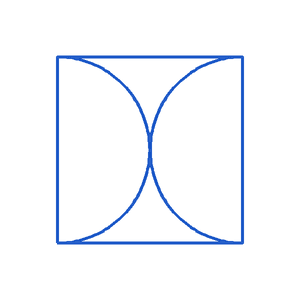
The number of line(s) of symmetry of the figure given alongside is :
 Solve with AI
Answer
(A) 1
- Correct
(B) 2
(C) 4
(D) none of these
Answer: (B) 2
Concept: A line of symmetry (also called an axis of symmetry) divides a figure into two parts that are mirror images of each other. If the figure is folded along this line, the two parts cover each other exactly.
Step 1 — Describe the figure.
The figure is a square with a semicircle drawn inside it on the left side and another on the right side. The two semicircles touch at the centre of the square.
Step 2 — Test the vertical and horizontal lines.
The vertical line through the centre puts the left semicircle exactly on the right one. The horizontal line through the centre folds each semicircle onto itself. Both are lines of symmetry.
Step 3 — Test the diagonals.
A fold along a diagonal would carry the curved left and right sides onto the straight top and bottom sides, so the diagonals are not lines of symmetry. The figure has 2 lines, shown dashed.
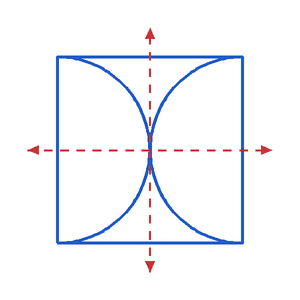
Watch out: A square on its own has 4 lines of symmetry, but the semicircles break the two diagonal ones.
Why the other options are wrong:
- (A) 1: This misses one of the two lines (the vertical and the horizontal line through the centre).
- (C) 4: This would need the diagonals to be lines of symmetry too, but they carry the curved sides onto the straight ones.
- (D) none of these: This is wrong, because the correct number, 2, is option (B).
Therefore, the figure has 2 lines of symmetry, option (B).
- 63 marks
Question 6
State, whether true or false :
The letter B has one line of symmetry.
Solve with AIWritten solution
Solution:
Concept: A line of symmetry of a letter is a fold line that makes its two halves cover each other exactly. Letters are taken in their simple capital form, drawn with straight, even strokes.
Step 1 — Test a horizontal fold.
The horizontal line through the middle of B splits it into an upper bowl and a lower bowl on the same straight stem. In the simple capital B the two bowls are equal, so the fold makes them cover each other.
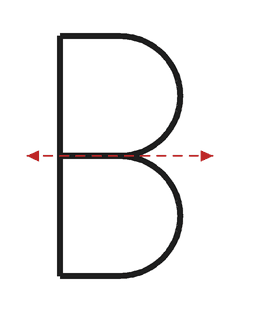
Step 2 — Test a vertical fold.
The left side of B is a straight stem and the right side is curved, so a vertical fold does not work. B therefore has exactly one line of symmetry.
Watch out: In many printed fonts the upper bowl of B is drawn a little smaller, so B is symmetrical only in its simple school form.
Therefore, the statement is true: B has one line of symmetry (horizontal).
- 73 marks
Question 7
State, whether true or false :
The letter F has no line of symmetry.
Solve with AIWritten solution
Solution:
Concept: A line of symmetry of a letter is a fold line that makes its two halves cover each other exactly. Letters are taken in their simple capital form, drawn with straight, even strokes.
Step 1 — Test a vertical fold.
All the arms of F point to the right of the stem, so a vertical fold would put arms where there are none.
Step 2 — Test a horizontal fold.
F has a long arm at the top, a shorter arm in the middle and no arm at the bottom, so a horizontal fold does not work either. No other fold works, so F has no line of symmetry.
Therefore, the statement is true: F has no line of symmetry.
- 83 marks
Question 8
State, whether true or false :
The letter O has only two lines of symmetry.
Solve with AIWritten solution
Solution:
Concept: A line of symmetry of a letter is a fold line that makes its two halves cover each other exactly. Letters are taken in their simple capital form, drawn with straight, even strokes.
Step 1 — Take O as a round letter.
Drawn as a circle, O is symmetrical about every line through its centre, so it has infinitely many lines of symmetry.
Step 2 — Decide.
The statement says O has ONLY two lines of symmetry. A round O has far more than two, so the statement is false.
Note: If O is drawn as an oval that is taller than it is wide, it has exactly two lines of symmetry (one vertical, one horizontal), and then the statement would be true. The expected answer takes O as round.
Therefore, the statement is false: a round O has infinitely many lines of symmetry.
- 93 marks
Question 9
State, whether true or false :
The figure
 has no line of symmetry.Solve with AI
Written solution
Solution:
Concept: A line of symmetry (also called an axis of symmetry) divides a figure into two parts that are mirror images of each other. If the figure is folded along this line, the two parts cover each other exactly.
Step 1 — Describe the figure.
The figure is a rectangle with both short ends rounded in the same way.
Step 2 — Test the folds.
The vertical line through its centre puts one rounded end on the other, and the horizontal line through its centre puts the top edge on the bottom edge. So the figure has 2 lines of symmetry, shown dashed.
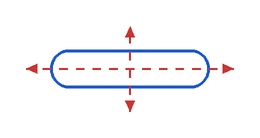
Therefore, the statement is false: the figure has 2 lines of symmetry.
- 103 marks
Question 10
State, whether true or false :
The letter N has one line of symmetry.
Solve with AIWritten solution
Solution:
Concept: A line of symmetry of a letter is a fold line that makes its two halves cover each other exactly. Letters are taken in their simple capital form, drawn with straight, even strokes.
Step 1 — Test a vertical fold.
The slanting stroke of N runs from the top of the left stem down to the bottom of the right stem. A vertical fold would turn it into a stroke from top right to bottom left, so the halves do not match.
Step 2 — Test a horizontal fold.
A horizontal fold also reverses the direction of the slanting stroke, so it fails too. N has no line of symmetry.
Watch out: N looks the same after a half-turn (180°) about its centre, but that is rotational symmetry, not a line of symmetry.
Therefore, the statement is false: N has no line of symmetry.
- 113 marks
Question 11
State, whether true or false :
The figure
 has one line of symmetry.Solve with AI
Written solution
Solution:
Concept: A line of symmetry (also called an axis of symmetry) divides a figure into two parts that are mirror images of each other. If the figure is folded along this line, the two parts cover each other exactly.
Step 1 — Describe the figure.
The figure is a long strip with its left end rounded and its right end square.
Step 2 — Test the folds.
The horizontal line through the middle puts the top edge on the bottom edge and folds each end onto itself, so it is a line of symmetry. A vertical fold would put the rounded end on the square end, so it fails. The figure has exactly 1 line of symmetry, shown dashed.

Therefore, the statement is true: the figure has one line of symmetry.
- 123 marks
Question 12
State, whether true or false :
The letter D has only one line of symmetry
Solve with AIWritten solution
Solution:
Concept: A line of symmetry of a letter is a fold line that makes its two halves cover each other exactly. Letters are taken in their simple capital form, drawn with straight, even strokes.
Step 1 — Test a horizontal fold.
The horizontal line through the middle of D puts the upper half of the curve on the lower half, so it is a line of symmetry.
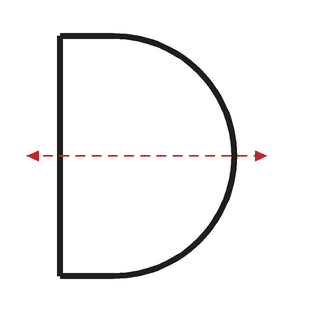
Step 2 — Test a vertical fold.
The left side of D is a straight stem and the right side is a curve, so a vertical fold fails. D has only this one line.
Therefore, the statement is true: D has only one line of symmetry (horizontal).
- 133 marks
Question 13
State, whether true or false :
A scalene triangle has three lines of symmetry.
Solve with AIWritten solution
Solution:
Concept: A triangle has a line of symmetry only when at least two of its sides are equal. An isosceles triangle has 1 (the bisector of the angle between the equal sides), an equilateral triangle has 3, and a scalene triangle has none.
Step 1 — Recall what a scalene triangle is.
A scalene triangle has all three sides of different lengths.
Step 2 — Test the folds.
A fold could only make two halves match if it put one side exactly on another side of the same length. No two sides are equal, so no fold works, and a scalene triangle has no line of symmetry.
Therefore, the statement is false: a scalene triangle has no line of symmetry.
- 143 marks
Question 14
If possible, draw the largest number of lines of symmetry in each case :
 Solve with AI
Written solution
Solution:
Concept: A line of symmetry (also called an axis of symmetry) divides a figure into two parts that are mirror images of each other. If the figure is folded along this line, the two parts cover each other exactly.
Step 1 — Describe the figure.
The figure is a kite whose two lower sides cross and run on to form a small triangle (the tail).
Step 2 — Test the folds.
The vertical line through the top vertex and the crossing point puts the left half exactly on the right half, including the tail. No other fold matches the long kite with its small tail.

Watch out: A line that cuts a figure into two pieces of equal area is not always a line of symmetry. The two pieces must be mirror images, so that they cover each other exactly when folded.
Therefore, the figure has 1 line of symmetry, the vertical line through its top vertex.
- 153 marks
Question 15
If possible, draw the largest number of lines of symmetry in each case :
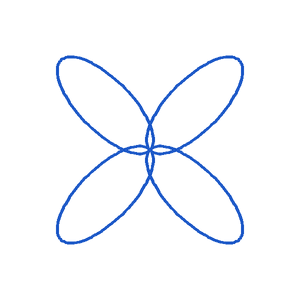 Solve with AI
Written solution
Solution:
Concept: A line of symmetry (also called an axis of symmetry) divides a figure into two parts that are mirror images of each other. If the figure is folded along this line, the two parts cover each other exactly.
Step 1 — Describe the figure.
The flower has 4 equal petals spaced equally, 90° apart, round its centre.
Step 2 — Find the fold lines.
Each line along a pair of opposite petals is a line of symmetry (2 lines). Each line midway between two neighbouring petals is also a line of symmetry (2 more lines).
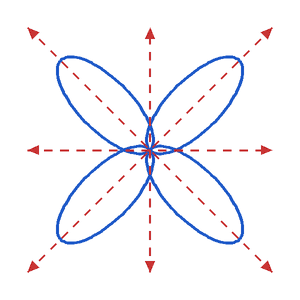
Watch out: The lines between the petals count too, not only the lines along the petals.
Therefore, the figure has 4 lines of symmetry.
- 163 marks
Question 16
If possible, draw the largest number of lines of symmetry in each case :
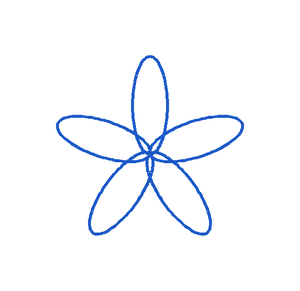 Solve with AI
Written solution
Solution:
Concept: A line of symmetry (also called an axis of symmetry) divides a figure into two parts that are mirror images of each other. If the figure is folded along this line, the two parts cover each other exactly.
Step 1 — Describe the figure.
The flower has 5 equal petals spaced equally, 72° apart, round its centre.
Step 2 — Find the fold lines.
The line along any petal through the centre is a line of symmetry. Because 5 is odd, the same line also passes midway between the two petals on the opposite side. Five petals give 5 such lines.
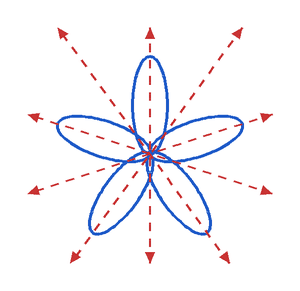
Watch out: With an odd number of petals, a line along one petal does not run along another petal, so do not look for pairs.
Therefore, the figure has 5 lines of symmetry.
- 173 marks
Question 17
If possible, draw the largest number of lines of symmetry in each case :
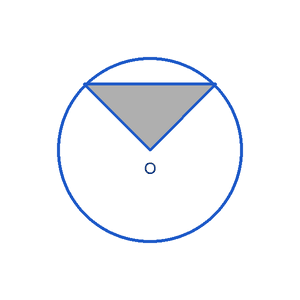 Solve with AI
Written solution
Solution:
Concept: A line of symmetry (also called an axis of symmetry) divides a figure into two parts that are mirror images of each other. If the figure is folded along this line, the two parts cover each other exactly.
Step 1 — Describe the figure.
The shaded triangle has its vertex at the centre O of the circle and its top side is a chord.
Step 2 — Find the fold line.
The two sides from O are radii, so they are equal and the shaded triangle is isosceles. The vertical diameter through O bisects the chord at right angles, so folding along it maps the triangle and the circle onto themselves. No other diameter keeps the shaded triangle in place.
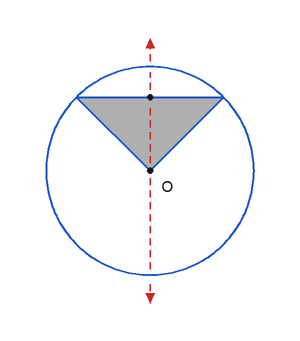
Therefore, the figure has 1 line of symmetry, the vertical diameter through O.
- 183 marks
Question 18
If possible, draw the largest number of lines of symmetry in each case :
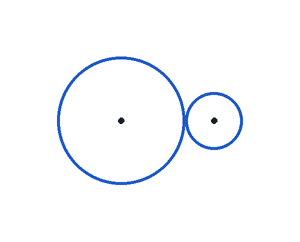 Solve with AI
Written solution
Solution:
Concept: A line of symmetry (also called an axis of symmetry) divides a figure into two parts that are mirror images of each other. If the figure is folded along this line, the two parts cover each other exactly.
Step 1 — Describe the figure.
The figure is a big circle and a small circle side by side.
Step 2 — Find the fold line.
Each circle is symmetrical about every line through its own centre. The only line that passes through both centres is the line joining them, so it is the only line of symmetry of the whole figure.

Therefore, the figure has 1 line of symmetry, the line joining the two centres.
- 193 marks
Question 19
If possible, draw the largest number of lines of symmetry in each case :
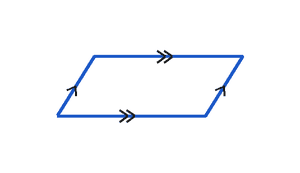 Solve with AI
Written solution
Solution:
Concept: A line of symmetry (also called an axis of symmetry) divides a figure into two parts that are mirror images of each other. If the figure is folded along this line, the two parts cover each other exactly.
Step 1 — Describe the figure.
The figure is a parallelogram whose angles are not right angles and whose adjacent sides are unequal, so it is neither a rectangle nor a rhombus.
Step 2 — Test the folds.
Folding along a diagonal puts a long side on a short side. Folding along the line through the mid-points of opposite sides puts an acute angle on an obtuse angle. No fold makes the halves match.
Watch out: A parallelogram looks the same after a half-turn about its centre, but that is rotational symmetry, not a line of symmetry.
Therefore, it is not possible: this parallelogram has no line of symmetry.
- 203 marks
Question 20
Examine each of the following figures, carefully, and then draw line(s) of symmetry if possible :
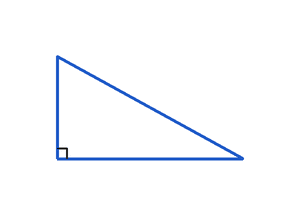 Solve with AI
Written solution
Solution:
Concept: A triangle has a line of symmetry only when at least two of its sides are equal. An isosceles triangle has 1 (the bisector of the angle between the equal sides), an equilateral triangle has 3, and a scalene triangle has none.
Step 1 — Look at the sides.
The two arms of the right angle are clearly unequal, and the hypotenuse is longer than both, so all three sides are different. The triangle is scalene.
Step 2 — Decide.
A scalene triangle has no line of symmetry, so no line can be drawn.
Therefore, no line of symmetry is possible for this triangle.
- 213 marks
Question 21
Examine each of the following figures, carefully, and then draw line(s) of symmetry if possible :
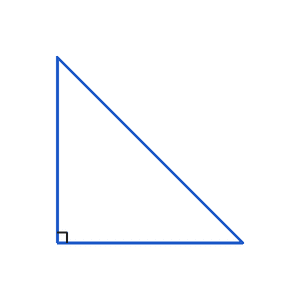 Solve with AI
Written solution
Solution:
Concept: A triangle has a line of symmetry only when at least two of its sides are equal. An isosceles triangle has 1 (the bisector of the angle between the equal sides), an equilateral triangle has 3, and a scalene triangle has none.
Step 1 — Look at the sides.
The two arms of the right angle are equal, so the triangle is an isosceles right-angled triangle.
Step 2 — Draw the line.
Its line of symmetry is the bisector of the right angle, which is also the perpendicular bisector of the hypotenuse.
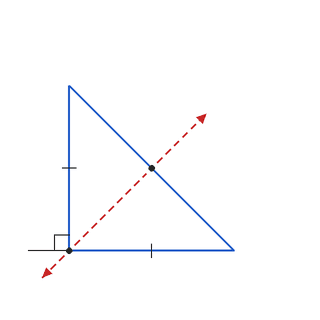
Therefore, the triangle has 1 line of symmetry, the bisector of its right angle.
- 223 marks
Question 22
Examine each of the following figures, carefully, and then draw line(s) of symmetry if possible :
 Solve with AI
Written solution
Solution:
Concept: A triangle has a line of symmetry only when at least two of its sides are equal. An isosceles triangle has 1 (the bisector of the angle between the equal sides), an equilateral triangle has 3, and a scalene triangle has none.
Step 1 — Look at the sides.
All three sides are marked equal, so the triangle is equilateral.
Step 2 — Draw the lines.
The line from each vertex to the mid-point of the opposite side is a line of symmetry, so there are 3 lines. They meet at one point inside the triangle.
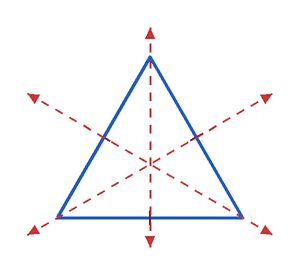
Therefore, the triangle has 3 lines of symmetry.
- 233 marks
Question 23
Examine each of the following figures, carefully, and then draw line(s) of symmetry if possible :
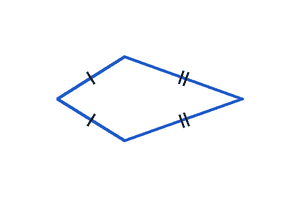 Solve with AI
Written solution
Solution:
Concept: A line of symmetry (also called an axis of symmetry) divides a figure into two parts that are mirror images of each other. If the figure is folded along this line, the two parts cover each other exactly.
Step 1 — Look at the sides.
The tick marks show that the two left sides are equal and the two right sides are equal, but a left side is not equal to a right side. The figure is a kite.
Step 2 — Draw the line.
The diagonal joining the left and right vertices, where the equal pairs meet, puts the top half on the bottom half. The other diagonal would put a short side on a long side, so it fails.
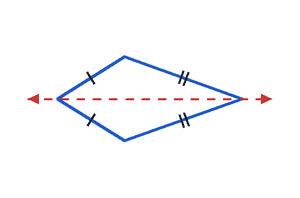
Therefore, the kite has 1 line of symmetry, the diagonal through the vertices where the equal sides meet.
- 243 marks
Question 24
Examine each of the following figures, carefully, and then draw line(s) of symmetry if possible :
 Solve with AI
Written solution
Solution:
Concept: A line of symmetry (also called an axis of symmetry) divides a figure into two parts that are mirror images of each other. If the figure is folded along this line, the two parts cover each other exactly.
Step 1 — Describe the figure.
The figure is two overlapping circles of different sizes.
Step 2 — Draw the line.
Each circle is symmetrical about every line through its own centre, so the line through both centres is a line of symmetry. The circles are of different sizes, so there is no other line.
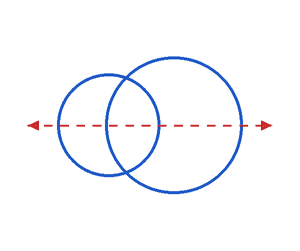
Therefore, the figure has 1 line of symmetry, the line through the two centres.
- 253 marks
Question 25
Examine each of the following figures, carefully, and then draw line(s) of symmetry if possible :
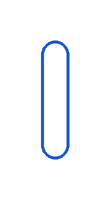 Solve with AI
Written solution
Solution:
Concept: A line of symmetry (also called an axis of symmetry) divides a figure into two parts that are mirror images of each other. If the figure is folded along this line, the two parts cover each other exactly.
Step 1 — Describe the figure.
The figure is an upright strip with both ends rounded alike.
Step 2 — Draw the lines.
The vertical line through its centre puts the left edge on the right edge, and the horizontal line through its centre puts the top end on the bottom end.

Therefore, the figure has 2 lines of symmetry.
- 263 marks
Question 26
Draw line(s) of symmetry for each of the following letters :
C
Solve with AIWritten solution
Solution:
Concept: A line of symmetry of a letter is a fold line that makes its two halves cover each other exactly. Letters are taken in their simple capital form, drawn with straight, even strokes.
Step 1 — Test the folds.
The horizontal line through the middle of C puts its upper curve on its lower curve. A vertical fold fails, because C is open on the right only.
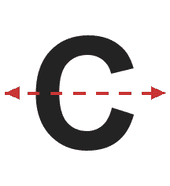
Therefore, C has 1 line of symmetry (horizontal).
- 273 marks
Question 27
Draw line(s) of symmetry for each of the following letters :
E
Solve with AIWritten solution
Solution:
Concept: A line of symmetry of a letter is a fold line that makes its two halves cover each other exactly. Letters are taken in their simple capital form, drawn with straight, even strokes.
Step 1 — Test the folds.
The horizontal line through the middle arm puts the top arm on the bottom arm. A vertical fold fails, because all the arms point to the right.

Therefore, E has 1 line of symmetry (horizontal).
- 283 marks
Question 28
Draw line(s) of symmetry for each of the following letters :
F
Solve with AIWritten solution
Solution:
Concept: A line of symmetry of a letter is a fold line that makes its two halves cover each other exactly. Letters are taken in their simple capital form, drawn with straight, even strokes.
Step 1 — Test the folds.
All the arms of F point to the right, so a vertical fold fails. The top arm has no partner at the bottom, so a horizontal fold fails too.

Therefore, F has no line of symmetry.
- 293 marks
Question 29
Draw line(s) of symmetry for each of the following letters :
K
Solve with AIWritten solution
Solution:
Concept: A line of symmetry of a letter is a fold line that makes its two halves cover each other exactly. Letters are taken in their simple capital form, drawn with straight, even strokes.
Step 1 — Look at the letter.
In the simple capital K, both slanting arms start from the middle of the stem: one goes up to the right and the other goes down to the right, at equal slopes.
Step 2 — Test the folds.
The horizontal line through the middle of the stem puts the upper arm exactly on the lower arm. A vertical fold fails, because both arms are on the right of the stem.
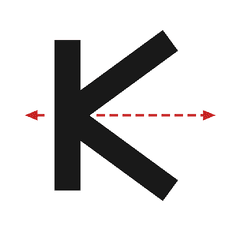
Watch out: In some printed fonts the lower leg of K starts from the upper arm instead of from the stem; a K drawn like that has no line of symmetry.
Therefore, K has 1 line of symmetry (horizontal).
- 303 marks
Question 30
Draw line(s) of symmetry for each of the following letters :
X
Solve with AIWritten solution
Solution:
Concept: A line of symmetry of a letter is a fold line that makes its two halves cover each other exactly. Letters are taken in their simple capital form, drawn with straight, even strokes.
Step 1 — Test the folds.
The vertical line and the horizontal line through the crossing point each put one half of X exactly on the other half.
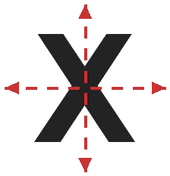
Watch out: If X were drawn with its two strokes at right angles (inside a square), the strokes themselves would also be lines of symmetry, giving 4. The usual capital X is taller than it is wide, so it has 2.
Therefore, X has 2 lines of symmetry (vertical and horizontal).
- 313 marks
Question 31
Draw line(s) of symmetry for each of the following letters :
V
Solve with AIWritten solution
Solution:
Concept: A line of symmetry of a letter is a fold line that makes its two halves cover each other exactly. Letters are taken in their simple capital form, drawn with straight, even strokes.
Step 1 — Test the folds.
The vertical line through the point of V puts the left stroke on the right stroke. A horizontal fold fails, because V is wide at the top and pointed at the bottom.

Therefore, V has 1 line of symmetry (vertical).
- 323 marks
Question 32
Draw line(s) of symmetry for each of the following letters :
M
Solve with AIWritten solution
Solution:
Concept: A line of symmetry of a letter is a fold line that makes its two halves cover each other exactly. Letters are taken in their simple capital form, drawn with straight, even strokes.
Step 1 — Test the folds.
The vertical line through the middle of M puts the left stem and stroke on the right stem and stroke. A horizontal fold fails, because the V-shaped middle is at the top only.

Therefore, M has 1 line of symmetry (vertical).
- 333 marks
Question 33
Draw line(s) of symmetry for each of the following letters :
Y
Solve with AIWritten solution
Solution:
Concept: A line of symmetry of a letter is a fold line that makes its two halves cover each other exactly. Letters are taken in their simple capital form, drawn with straight, even strokes.
Step 1 — Test the folds.
The vertical line through the stem of Y puts the left arm on the right arm. A horizontal fold fails, because the arms are at the top and the stem is at the bottom.

Therefore, Y has 1 line of symmetry (vertical).
- 343 marks
Question 34
Construct a triangle ABC in which AB = AC = 5 cm and BC = 6 cm.
Draw its line(s) of symmetry.
Solve with AIWritten solution
Solution:
Concept: A triangle has a line of symmetry only when at least two of its sides are equal. An isosceles triangle has 1 (the bisector of the angle between the equal sides), an equilateral triangle has 3, and a scalene triangle has none.
Given: AB = 5 cm, AC = 5 cm and BC = 6 cm.
Step 1 — Draw the base.
Draw a line segment BC = 6 cm.
Step 2 — Locate A.
With B as centre and radius 5 cm, draw an arc. With C as centre and the same radius, draw another arc cutting the first at A. Join AB and AC.
Step 3 — Draw the line of symmetry.
With B and C as centres and a radius more than half of BC (more than 3 cm), draw arcs on both sides of BC. Join the two points where they cut. This perpendicular bisector of BC passes through A, because A is equally far (5 cm) from B and C.

Step 4 — Check by measuring.
The line of symmetry meets BC at its mid-point M, 3 cm from B. Pythagoras' theorem in the right triangle AMB gives the height of A above BC, so you can check your drawing with a ruler:
Watch out: An isosceles triangle has only ONE line of symmetry; the lines from B and from C are not lines of symmetry.
Therefore, triangle ABC has exactly one line of symmetry, the perpendicular bisector of BC through A.
- 353 marks
Question 35
Construct a triangle XYZ in which :
XY = YZ = ZX = 4.5 cm.
Draw all its lines of symmetry.
Solve with AIWritten solution
Solution:
Concept: A triangle has a line of symmetry only when at least two of its sides are equal. An isosceles triangle has 1 (the bisector of the angle between the equal sides), an equilateral triangle has 3, and a scalene triangle has none.
Given: XY = 4.5 cm, YZ = 4.5 cm and ZX = 4.5 cm.
Step 1 — Draw one side.
Draw a line segment XY = 4.5 cm.
Step 2 — Locate Z.
With X and Y as centres and radius 4.5 cm, draw two arcs cutting each other at Z. Join XZ and YZ. All three sides are now 4.5 cm.
Step 3 — Draw the lines of symmetry.
Draw the perpendicular bisector of each side. Each one passes through the opposite vertex (it is also the bisector of that angle), and all three meet at one point.
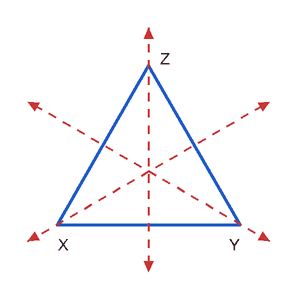
Watch out: Use the full perpendicular bisector of each side; it must pass through the opposite vertex, which is a good check on your drawing.
Therefore, triangle XYZ has 3 lines of symmetry.
- 363 marks
Question 36
Construct a triangle PQR in which :
PQ = QR = 4.2 cm and ∠PQR = 90°.
Draw all its lines of symmetry.
Solve with AIWritten solution
Solution:
Concept: A triangle has a line of symmetry only when at least two of its sides are equal. An isosceles triangle has 1 (the bisector of the angle between the equal sides), an equilateral triangle has 3, and a scalene triangle has none.
Given: PQ = 4.2 cm, QR = 4.2 cm and ∠PQR = 90°.
Step 1 — Draw one arm.
Draw a line segment QR = 4.2 cm.
Step 2 — Make the right angle.
At Q, construct a ray QX at 90° to QR with ruler and compasses. With Q as centre and radius 4.2 cm, cut QX at P. Join PR.
Step 3 — Draw the line of symmetry.
Bisect ∠PQR. Because PQ = QR, the bisector meets PR at its mid-point at right angles, so folding along it puts QP on QR.
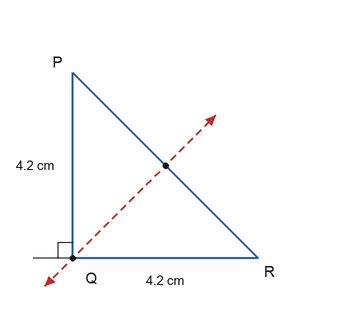
Step 4 — Check by measuring.
Pythagoras' theorem gives the length of PR, which you can check on your drawing:
So PR ≈ 5.94 cm, and the line of symmetry meets it about 2.97 cm from P and from R.
Watch out: The triangle is right-angled AND isosceles, so it has one line of symmetry, not none.
Therefore, triangle PQR has exactly one line of symmetry, the bisector of ∠PQR.
- 373 marks
Question 37
Mark two points A and B 6.4 cm apart. Construct the line(s) of symmetry so that the points A and B are symmetric with respect to this line.
Solve with AIWritten solution
Solution:
Concept: A point and its mirror image are equally far from the mirror line, on a line perpendicular to it. So two points are symmetric with respect to a line exactly when that line is the perpendicular bisector of the segment joining them.
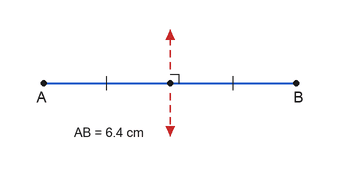
Given: AB = 6.4 cm.
Step 1 — Mark the points.
Mark two points A and B 6.4 cm apart and join them.
Step 2 — Draw the arcs.
With A as centre and a radius more than half of AB, draw arcs above and below AB. With B as centre and the same radius, draw arcs cutting the first two. Half of AB is:
so take a radius more than 3.2 cm, for example 4 cm.
Step 3 — Draw the line.
Join the two points where the arcs cut. This line is the perpendicular bisector of AB: it meets AB at its mid-point, 3.2 cm from each point, at right angles. A and B are mirror images in it.
Watch out: The radius of the arcs must be MORE than half of AB, otherwise the arcs do not cut.
Therefore, the required line of symmetry is the perpendicular bisector of AB, and there is only one such line.
- 383 marks
Question 38
Mark two points P and Q 5.3 cm apart. Construct the perpendicular bisector of the line segment PQ.
Are the points P and Q symmetric with respect to the perpendicular bisector drawn ?
Solve with AIWritten solution
Solution:
Concept: Every point on the perpendicular bisector of PQ is equally far from P and Q, and the bisector meets PQ at right angles at its mid-point. A point and its mirror image are placed exactly like this about a mirror line.
Given: PQ = 5.3 cm.
Step 1 — Mark the points.
Mark two points P and Q 5.3 cm apart and join them.
Step 2 — Draw the arcs.
With P and Q as centres and the same radius, more than half of PQ, draw arcs on both sides of PQ so that they cut at two points. Half of PQ is:
so a radius of 3.5 cm will do.
Step 3 — Draw the bisector.
Join the two points where the arcs cut. This is the perpendicular bisector of PQ.

Step 4 — Answer the question.
The bisector meets PQ at its mid-point at right angles. P and Q are each 2.65 cm from it, on opposite sides along a line perpendicular to it, so folding along the bisector puts P exactly on Q.
Therefore, yes, P and Q are symmetric with respect to the perpendicular bisector of PQ.
- 393 marks
Question 39
Construct a rectangle ABCD in which AB = 7 cm and BC = 5 cm. Draw all its line(s) of symmetry.
Solve with AIWritten solution
Solution:
Concept: A rectangle that is not a square has exactly two lines of symmetry: the two lines that join the mid-points of its opposite sides.
Given: AB = 7 cm and BC = 5 cm.
Step 1 — Draw the base.
Draw a line segment AB = 7 cm.
Step 2 — Draw the sides.
At A and at B, construct right angles. With A and B as centres and radius 5 cm, cut the arms at D and C. Join DC, so that ABCD is a rectangle with BC = 5 cm.
Step 3 — Draw the lines of symmetry.
Draw the perpendicular bisector of AB; it also bisects DC. Draw the perpendicular bisector of BC; it also bisects AD. Folding along either line puts one half of the rectangle exactly on the other.

Watch out: The diagonals of a rectangle are NOT lines of symmetry: a fold along a diagonal puts a 7 cm side on a 5 cm side.
Therefore, rectangle ABCD has 2 lines of symmetry.
- 401 mark
Question 40
The point (5, k) after reflection in x-axis becomes (5, −8). The value of k is :
Solve with AIAnswer
- Correct
(A) 8
(B) −8
(C) 6
(D) none of these
Answer: (A) 8
Concept: When a point is reflected in the x-axis, its x-co-ordinate stays the same and its y-co-ordinate changes sign: .
Step 1 — Reflect the point.
Reflection in the x-axis keeps the x-co-ordinate and changes the sign of the y-co-ordinate:
Step 2 — Compare with the given image.
The image is given as (5, −8), so the y-co-ordinates must be equal:
Watch out: The image's y-co-ordinate is −8, so k itself is +8, not −8.
Why the other options are wrong:
- (B) −8: This is wrong, because k = −8 gives the point (5, −8), whose image is (5, 8).
- (C) 6: This is wrong, because k = 6 gives the image (5, −6).
- (D) none of these: This is wrong, because the correct value, 8, is option (A).
Therefore, k = 8, option (A).
- 411 mark
Question 41
The point (−k, −6) after reflection in y-axis becomes (−4, −6), the value of k is :
Solve with AIAnswer
- Correct
(A) −4
(B) 4
(C) 8
(D) none of these
Answer: (A) −4
Concept: When a point is reflected in the y-axis, its y-co-ordinate stays the same and its x-co-ordinate changes sign: .
Step 1 — Reflect the point.
Reflection in the y-axis changes the sign of the x-co-ordinate and keeps the y-co-ordinate:
Step 2 — Compare with the given image.
The image is given as (−4, −6), so the x-co-ordinates must be equal:
Step 3 — Check.
With k = −4, the point (−k, −6) is (4, −6). Its image in the y-axis is (−4, −6), as given.
Watch out: The point is written as (−k, −6), so its x-co-ordinate is −k, not k.
Why the other options are wrong:
- (B) 4: This is wrong, because k = 4 gives the point (−4, −6), whose image is (4, −6).
- (C) 8: This is wrong, because k = 8 gives the point (−8, −6), whose image is (8, −6).
- (D) none of these: This is wrong, because the correct value, −4, is option (A).
Therefore, k = −4, option (A).
- 421 mark
Question 42
The point (k, −k) after reflection in origin becomes (0, 0); the value of k is :
Solve with AIAnswer
(A) 2
(B) 1
(C) 1
- Correct
(D) none of these
Answer: (D) none of these
Concept: When a point is reflected in the origin, both of its co-ordinates change sign: .
Step 1 — Reflect the point.
Reflection in the origin changes the sign of both co-ordinates:
Step 2 — Compare with the given image.
The image is (0, 0), so each co-ordinate must be 0:
Step 3 — Look at the options.
The value k = 0 is not among (A), (B) and (C), so the answer is (D).
Watch out: Only the origin itself has the image (0, 0) under reflection in the origin.
Note: Options (B) and (C) are both printed as 1; they are kept as printed.
Why the other options are wrong:
- (A) 2: This is wrong, because k = 2 gives the point (2, −2), whose image is (−2, 2).
- (B) 1: This is wrong, because k = 1 gives the point (1, −1), whose image is (−1, 1).
- (C) 1: This is wrong for the same reason as (B): k = 1 gives the image (−1, 1).
Therefore, k = 0, which is not listed, so the answer is option (D).
- 431 mark
Question 43
The point (7, −6) is rotated about origin by 180° in the clockwise direction. The resulting point is :
Solve with AIAnswer
(A) (−7, −6)
(B) (7, 6)
- Correct
(C) (−7, 6)
(D) (0, −6)
Answer: (C) (−7, 6)
Concept: A rotation through 180° about the origin gives the same result clockwise or anticlockwise, and it changes the sign of both co-ordinates: . So it has the same effect as reflection in the origin.
Step 1 — Apply the rule.
A rotation through 180° about the origin changes the sign of both co-ordinates:
Watch out: For 180° the direction does not matter: clockwise and anticlockwise half-turns end at the same point.
Why the other options are wrong:
- (A) (−7, −6): This is the reflection of (7, −6) in the y-axis, where only the x-co-ordinate changes sign.
- (B) (7, 6): This is the reflection of (7, −6) in the x-axis, where only the y-co-ordinate changes sign.
- (D) (0, −6): This is wrong, because no reflection or rotation about the origin can turn the x-co-ordinate 7 into 0.
Therefore, the resulting point is (−7, 6), option (C).
- 441 mark
Question 44
The point (−3, 2) is rotated about origin by 90° in the anticlockwise direction. The resulting point is :
Solve with AIAnswer
(A) (2, 3)
(B) (2, −3)
- Correct
(C) (−2, −3)
(D) (3, 2)
Answer: (C) (−2, −3)
Concept: A rotation through 90° anticlockwise about the origin sends : swap the two co-ordinates, then change the sign of the new first co-ordinate.
Step 1 — Apply the rule.
A rotation through 90° anticlockwise sends (x, y) to (−y, x). Here x = −3 and y = 2:
Step 2 — Check the quadrant.
The point (−3, 2) is in the second quadrant. A quarter-turn anticlockwise moves the second quadrant into the third, where both co-ordinates are negative, which agrees with (−2, −3).
Watch out: Test the rule on the point (1, 0). A quarter-turn anticlockwise moves it up to (0, 1), and a quarter-turn clockwise moves it down to (0, −1). This shows which co-ordinate takes the minus sign.
Why the other options are wrong:
- (A) (2, 3): This is the image after a 90° CLOCKWISE rotation, (x, y) → (y, −x).
- (B) (2, −3): This swaps the co-ordinates but puts the minus sign on the wrong one; (2, −3) is the 90° anticlockwise image of (−3, −2), not of (−3, 2).
- (D) (3, 2): This is the reflection of (−3, 2) in the y-axis.
Therefore, the resulting point is (−2, −3), option (C).
- 453 marks
Question 45
In each of the following cases, write the transformations as required :
Object Image Transformation (i) (4, −3) (−4, −3) Reflection in y-axis (ii) (−4, 3) (−4, −3) .................... (iii) (−4, −3) (4, 3) .................... (iv) (0, −7) (0, 7) .................... (v) (8, −5) (−8, 5) Rotation through 180° about origin or reflection in origin (vi) (−3, 2) (3, −2) .................... (vii) (5, 8) (−8, 5) .................... (viii) (−7, 4) (4, 7) .................... (ix) (8, 0) (0, −8) .................... (x) (3, −2) (−3, 2) .................... Solve with AIWritten solution
Solution:
Concept: Each reflection (in an axis or in the origin) and each rotation about the origin changes the co-ordinates of a point in its own fixed pattern. Comparing the image with the object shows which pattern, and so which transformation, was used.
Step 1 — Know the patterns.
Compare each image with its object and look for one of these patterns:
- only the y-sign changes, : reflection in the x-axis;
- only the x-sign changes, : reflection in the y-axis;
- both signs change, : reflection in the origin, which is the same as rotation through 180° about the origin;
- the co-ordinates swap as : rotation through 90° anticlockwise;
- the co-ordinates swap as : rotation through 90° clockwise.
Step 2 — Parts (ii), (iii) and (iv).
In (ii), (−4, 3) → (−4, −3): only the y-sign changes, so it is reflection in the x-axis.
In (iii), (−4, −3) → (4, 3): both signs change, so it is reflection in the origin (or rotation through 180° about the origin).
In (iv), (0, −7) → (0, 7): the x-co-ordinate is 0, so changing the y-sign alone and changing both signs give the same point. It is reflection in the x-axis, and it is also reflection in the origin (or rotation through 180° about the origin).
Step 3 — Parts (vi) and (x).
In (vi), (−3, 2) → (3, −2), and in (x), (3, −2) → (−3, 2): both signs change each time, so each is rotation through 180° about the origin (or reflection in the origin).
Step 4 — Part (vii).
Here (5, 8) → (−8, 5). The co-ordinates are swapped and the new first one has a minus sign, which is the pattern (x, y) → (−y, x):
So it is rotation through 90° anticlockwise about the origin.
Step 5 — Parts (viii) and (ix).
Here (−7, 4) → (4, 7) and (8, 0) → (0, −8). In both, the old y becomes the new x, and the old x with its sign changed becomes the new y, which is the pattern (x, y) → (y, −x):
So both are rotation through 90° clockwise about the origin.
Watch out: Test the rule on the point (1, 0). A quarter-turn anticlockwise moves it up to (0, 1), and a quarter-turn clockwise moves it down to (0, −1). This shows which co-ordinate takes the minus sign.
Note: The book's printed answer for (viii) is the same as for (vii), that is anticlockwise. But a 90° anticlockwise turn takes (−7, 4) to (−4, −7), so the image (4, 7) comes from a 90° clockwise turn.
Therefore, (ii) reflection in the x-axis; (iii) reflection in the origin or rotation through 180°; (iv) reflection in the x-axis or in the origin (rotation through 180°); (vi) and (x) rotation through 180° about the origin or reflection in the origin; (vii) rotation through 90° anticlockwise; (viii) and (ix) rotation through 90° clockwise about the origin.
- 463 marks
Question 46
Find the co-ordinates of the following points under reflection in x-axis :
(i) (4, 8) (ii) (3, −10) (iii) (−2, 0)
Solve with AIWritten solution
Solution:
Concept: When a point is reflected in the x-axis, its x-co-ordinate stays the same and its y-co-ordinate changes sign: .
Step 1 — Write the rule.
Reflection in the x-axis keeps x and changes the sign of y, so each image is found by changing the sign of the second co-ordinate only.
Step 2 — Apply it to each point.
Changing the sign of each y-co-ordinate gives:
(i)
(ii)
(iii)
Step 3 — Look at part (iii).
The point (−2, 0) lies on the x-axis itself, so it is its own image.
Watch out: −0 is just 0, so a point on the x-axis does not move.
Therefore, the images are (i) (4, −8), (ii) (3, 10) and (iii) (−2, 0).
- 473 marks
Question 47
Find the reflection of the following points in y-axis :
(i) (9, 10) (ii) (9, 0) (iii) (0, 9)
Solve with AIWritten solution
Solution:
Concept: When a point is reflected in the y-axis, its y-co-ordinate stays the same and its x-co-ordinate changes sign: .
Step 1 — Write the rule.
Reflection in the y-axis keeps y and changes the sign of x, so each image is found by changing the sign of the first co-ordinate only.
Step 2 — Apply it to each point.
Changing the sign of each x-co-ordinate gives:
(i)
(ii)
(iii)
Step 3 — Look at part (iii).
The point (0, 9) lies on the y-axis itself, so it is its own image.
Therefore, the images are (i) (−9, 10), (ii) (−9, 0) and (iii) (0, 9).
- 483 marks
Question 48
Find the reflection of the following points in origin :
(i) (5, 4) (ii) (5, −4) (iii) (−5, 4)
(iv) (−5, −4) (v) (0, 4)
Solve with AIWritten solution
Solution:
Concept: When a point is reflected in the origin, both of its co-ordinates change sign: .
Step 1 — Write the rule.
Reflection in the origin changes the sign of BOTH co-ordinates.
Step 2 — Apply it to each point.
Changing both signs gives:
(i)
(ii)
(iii)
(iv)
(v)
Watch out: The sign of 0 does not change, so (0, 4) goes to (0, −4).
Therefore, the images are (i) (−5, −4), (ii) (−5, 4), (iii) (5, −4), (iv) (5, 4) and (v) (0, −4).
- 493 marks
Question 49
Find the co-ordinates of the points obtained on rotating the following points through 180° about the origin :
(i) (3, 4) (ii) (3, −4) (iii) (−3, 4)
(iv) (−3, −4) (v) (0, 4)
Solve with AIWritten solution
Solution:
Concept: A rotation through 180° about the origin gives the same result clockwise or anticlockwise, and it changes the sign of both co-ordinates: . So it has the same effect as reflection in the origin.
Step 1 — Write the rule.
A rotation through 180° about the origin changes the sign of both co-ordinates.
Step 2 — Apply it to each point.
Changing both signs gives:
(i)
(ii)
(iii)
(iv)
(v)
Therefore, the images are (i) (−3, −4), (ii) (−3, 4), (iii) (3, −4), (iv) (3, 4) and (v) (0, −4).
- 503 marks
Question 50
Find the co-ordinates of the points obtained on rotating the following points through 90° about origin in the anticlockwise direction :
(i) (4, 6) (ii) (4, −6) (iii) (−4, 6)
(iv) (−4, −6) (v) (0, 6)
Solve with AIWritten solution
Solution:
Concept: A rotation through 90° anticlockwise about the origin sends : swap the two co-ordinates, then change the sign of the new first co-ordinate.
Step 1 — Write the rule.
A 90° anticlockwise rotation sends (x, y) to (−y, x): the old y, with its sign changed, becomes the new x, and the old x becomes the new y.
Step 2 — Apply it to each point.
Using the rule on each point gives:
(i)
(ii)
(iii)
(iv)
(v)
Watch out: Test the rule on the point (1, 0). A quarter-turn anticlockwise moves it up to (0, 1), and a quarter-turn clockwise moves it down to (0, −1). This shows which co-ordinate takes the minus sign.
Therefore, the images are (i) (−6, 4), (ii) (6, 4), (iii) (−6, −4), (iv) (6, −4) and (v) (−6, 0).
- 513 marks
Question 51
Find the co-ordinates of the points obtained on rotating the following points 90° about origin in the clockwise direction :
(i) (5, 2) (ii) (5, −2) (iii) (−5, 2)
(iv) (−5, −2) (v) (0, 2)
Solve with AIWritten solution
Solution:
Concept: A rotation through 90° clockwise about the origin sends : swap the two co-ordinates, then change the sign of the new second co-ordinate.
Step 1 — Write the rule.
A 90° clockwise rotation sends (x, y) to (y, −x): the old y becomes the new x, and the old x, with its sign changed, becomes the new y.
Step 2 — Apply it to each point.
Using the rule on each point gives:
(i)
(ii)
(iii)
(iv)
(v)
Watch out: Test the rule on the point (1, 0). A quarter-turn anticlockwise moves it up to (0, 1), and a quarter-turn clockwise moves it down to (0, −1). This shows which co-ordinate takes the minus sign.
Therefore, the images are (i) (2, −5), (ii) (−2, −5), (iii) (2, 5), (iv) (−2, 5) and (v) (2, 0).
- 523 marks
Question 52
The point P(−3, 12) is reflected in x-axis to point Q. And point Q is then rotated through 180° about origin to point R. Write the co-ordinates of points Q and R.
Solve with AIWritten solution
Solution:
Concept: When a point is reflected in the x-axis, its x-co-ordinate stays the same and its y-co-ordinate changes sign: . A rotation through 180° about the origin gives the same result clockwise or anticlockwise, and it changes the sign of both co-ordinates: . So it has the same effect as reflection in the origin.
Given: P(−3, 12).
Step 1 — Reflect P in the x-axis.
Reflection in the x-axis changes the sign of the y-co-ordinate only:
Step 2 — Rotate Q through 180°.
A rotation through 180° about the origin changes the sign of both co-ordinates of Q:
Watch out: Apply the transformations in the order given, each one to the image of the previous step.
Therefore, Q = (−3, −12) and R = (3, 12).
- 533 marks
Question 53
The point P(−7, 9) is rotated through 90° about origin in the anticlockwise direction to get point Q. If Q is reflected in y-axis to point R, write the co-ordinates of Q and R.
Solve with AIWritten solution
Solution:
Concept: A rotation through 90° anticlockwise about the origin sends : swap the two co-ordinates, then change the sign of the new first co-ordinate. When a point is reflected in the y-axis, its y-co-ordinate stays the same and its x-co-ordinate changes sign: .
Given: P(−7, 9).
Step 1 — Rotate P through 90° anticlockwise.
The rule (x, y) → (−y, x) with x = −7 and y = 9 gives Q:
Step 2 — Reflect Q in the y-axis.
Reflection in the y-axis changes the sign of the x-co-ordinate only:
Watch out: Test the rule on the point (1, 0). A quarter-turn anticlockwise moves it up to (0, 1), and a quarter-turn clockwise moves it down to (0, −1). This shows which co-ordinate takes the minus sign.
Therefore, Q = (−9, −7) and R = (9, −7).
- 541 mark
Question 54
The number of line(s) of symmetry of a trapezium is :
Solve with AIAnswer
- Correct
(A) 0
(B) 1
(C) 2
(D) none of these
Answer: (A) 0
Concept: A line of symmetry (also called an axis of symmetry) divides a figure into two parts that are mirror images of each other. If the figure is folded along this line, the two parts cover each other exactly.
Step 1 — Know the shape.
A trapezium has one pair of parallel sides of different lengths. In general its two non-parallel sides are unequal and make different angles with the parallel sides.
Step 2 — Test the folds.
The only possible fold line would join the mid-points of the parallel sides, but it puts one non-parallel side on a different, unequal one. So a trapezium in general has no line of symmetry.
Watch out: Only the special isosceles trapezium (equal non-parallel sides) has a line of symmetry.
Why the other options are wrong:
- (B) 1: This is true only for an isosceles trapezium, not for a trapezium in general.
- (C) 2: This is wrong, because two lines of symmetry would need a rectangle or a rhombus, and those are parallelograms, not trapeziums.
- (D) none of these: This is wrong, because the correct number, 0, is option (A).
Therefore, a trapezium (in general) has 0 lines of symmetry, option (A).
- 551 mark
Question 55
The number of line(s) of symmetry of an isosceles trapezium is :
Solve with AIAnswer
(A) 0
(B) 2
(C) 4
- Correct
(D) none of these
Answer: (D) none of these
Concept: A line of symmetry (also called an axis of symmetry) divides a figure into two parts that are mirror images of each other. If the figure is folded along this line, the two parts cover each other exactly.
Step 1 — Know the shape.
An isosceles trapezium has one pair of parallel sides and its two non-parallel sides are equal.
Step 2 — Find the fold line.
The line joining the mid-points of the two parallel sides puts one equal side exactly on the other, so it is a line of symmetry.

Step 3 — Look for more lines.
The parallel sides are of different lengths, so no fold can put one on the other. The figure has exactly 1 line of symmetry, and 1 is not among (A), (B) and (C).
Watch out: A rectangle has 2 lines of symmetry, but an isosceles trapezium has only 1, because its parallel sides are unequal.
Why the other options are wrong:
- (A) 0: This is wrong, because the equal non-parallel sides give one line of symmetry.
- (B) 2: This is wrong, because a second line would have to fold one parallel side onto the other, but they are unequal.
- (C) 4: This is wrong, because 4 lines of symmetry belong to a square.
Therefore, an isosceles trapezium has 1 line of symmetry, which is not listed, so the answer is option (D).
- 561 mark
Question 56
The reflection of point (0, −8) in origin is :
Solve with AIAnswer
(A) (0, −8)
- Correct
(B) (0, 8)
(C) (8, 8)
(D) (−8, 0)
Answer: (B) (0, 8)
Concept: When a point is reflected in the origin, both of its co-ordinates change sign: .
Step 1 — Apply the rule.
Reflection in the origin changes the sign of both co-ordinates. The sign of 0 does not change:
Why the other options are wrong:
- (A) (0, −8): This is the point itself; it is its own image in the y-axis, because it lies on the y-axis.
- (C) (8, 8): This is wrong, because reflection in the origin never changes 0 into another number.
- (D) (−8, 0): This swaps the co-ordinates; it is the image after a 90° clockwise rotation, not a reflection in the origin.
Therefore, the reflection of (0, −8) in the origin is (0, 8), option (B).
- 571 mark
Question 57
The point (−5, −6) is rotated about origin by 90° in the clockwise direction. The resulting point is :
Solve with AIAnswer
- Correct
(A) (−6, 5)
(B) (5, 6)
(C) (0, 5)
(D) (6, −5)
Answer: (A) (−6, 5)
Concept: A rotation through 90° clockwise about the origin sends : swap the two co-ordinates, then change the sign of the new second co-ordinate.
Step 1 — Apply the rule.
A rotation through 90° clockwise sends (x, y) to (y, −x). Here x = −5 and y = −6:
Step 2 — Check the quadrant.
The point (−5, −6) is in the third quadrant. A quarter-turn clockwise moves the third quadrant into the second, where x is negative and y is positive, which agrees with (−6, 5).
Watch out: Test the rule on the point (1, 0). A quarter-turn anticlockwise moves it up to (0, 1), and a quarter-turn clockwise moves it down to (0, −1). This shows which co-ordinate takes the minus sign.
Why the other options are wrong:
- (B) (5, 6): This is the reflection of (−5, −6) in the origin (a 180° turn), not a 90° turn.
- (C) (0, 5): This is wrong, because a rotation about the origin keeps the distance from O, and (0, 5) is much nearer to O.
- (D) (6, −5): This is the image after a 90° ANTICLOCKWISE rotation, (x, y) → (−y, x).
Therefore, the resulting point is (−6, 5), option (A).
- 581 mark
Question 58
The point (−8, 7) is first reflected in x-axis followed by reflection in origin. The resulting point is :
Solve with AIAnswer
(A) (−8, −7)
- Correct
(B) (8, 7)
(C) (8, −7)
(D) (−8, 7)
Answer: (B) (8, 7)
Concept: When a point is reflected in the x-axis, its x-co-ordinate stays the same and its y-co-ordinate changes sign: . When a point is reflected in the origin, both of its co-ordinates change sign: .
Step 1 — Reflect in the x-axis.
Only the sign of the y-co-ordinate changes:
Step 2 — Reflect the result in the origin.
Both signs of (−8, −7) change:
Watch out: Apply the transformations in the order given, each one to the image of the previous step.
Why the other options are wrong:
- (A) (−8, −7): This is only the result of the first step, the reflection in the x-axis.
- (C) (8, −7): This is the reflection of the ORIGINAL point (−8, 7) in the origin, which skips the first step.
- (D) (−8, 7): This is the original point itself.
Therefore, the resulting point is (8, 7), option (B).
- 591 mark
Question 59
Statement 1 : A point P is reflected to P' in a line L, then the line L is the right bisector of PP'.
Statement 2 : A point P is reflected to P' in a line L, then the line PP' is the right bisector of L .
Which of the following options is correct?
Solve with AIAnswer
(A) Both the statements are true.
(B) Both the statements are false.
- Correct
(C) Statement 1 is true, and statement 2 is false.
(D) Statement 1 is false, and statement 2 is true.
Answer: (C) Statement 1 is true, and statement 2 is false.
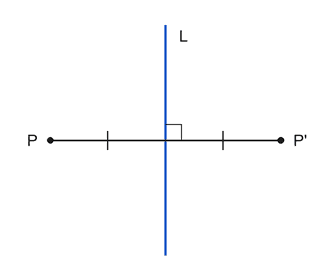
Concept: In a reflection in a line L, the line L is the perpendicular bisector (right bisector) of the segment joining any point to its image.
Step 1 — Recall how an image is formed.
When P is reflected in a line L to P', the line L is perpendicular to PP' and P' is as far behind L as P is in front of it. So L meets PP' at right angles at its mid-point.
Step 2 — Judge Statement 1.
Statement 1 says L is the right (perpendicular) bisector of PP'. This is exactly the property above, so Statement 1 is true.
Step 3 — Judge Statement 2.
Statement 2 says PP' is the right bisector of L. A line has no ends and no mid-point, so it cannot be bisected. PP' is perpendicular to L but does not bisect it, so Statement 2 is false.
Watch out: The two statements use the same words with the roles of L and PP' swapped; read which one is bisected.
Why the other options are wrong:
- (A): This needs Statement 2 to be true, but a line L cannot be bisected.
- (B): This is wrong, because Statement 1 is the defining property of a reflection.
- (D): This has the two statements the wrong way round.
Therefore, Statement 1 is true and Statement 2 is false, option (C).
- 601 mark
Question 60
Assertion (A) : The image of a point A(5, 6) under an anticlockwise rotation of 90° about the origin is A' (−6, 5).
Reason (R) : When a point P is rotated through 90° clockwise about the origin, then abscissa of the given point becomes ordinate with opposite sign of the resultant point and the ordinate of the given point becomes the abscissa of the resultant point.
Solve with AIAnswer
(A) Both A and R are correct, and R is the correct explanation for A.
- Correct
(B) Both A and R are correct, and R is not the correct explanation for A.
(C) A is true, but R is false.
(D) A is false, but R is true.
Answer: (B) Both A and R are correct, and R is not the correct explanation for A.
Concept: In an Assertion–Reason item, first judge A and R separately, then decide whether R is the reason for A. A rotation through 90° anticlockwise about the origin sends : swap the two co-ordinates, then change the sign of the new first co-ordinate. A rotation through 90° clockwise about the origin sends : swap the two co-ordinates, then change the sign of the new second co-ordinate.
Step 1 — Judge the Assertion.
A 90° anticlockwise rotation sends (x, y) to (−y, x):
This is A' (−6, 5), so the Assertion is true.
Step 2 — Judge the Reason.
R describes a 90° CLOCKWISE rotation: the old ordinate becomes the new abscissa, and the old abscissa with its sign changed becomes the new ordinate, that is (x, y) → (y, −x). This is the correct clockwise rule, so the Reason is true.
Step 3 — Decide whether R explains A.
R's clockwise rule applied to A(5, 6) gives a different point:
This is not A' (−6, 5), so R does not explain A.
Watch out: Test the rule on the point (1, 0). A quarter-turn anticlockwise moves it up to (0, 1), and a quarter-turn clockwise moves it down to (0, −1). This shows which co-ordinate takes the minus sign.
Note: The book's printed key says that R explains A. But R's clockwise rule turns A(5, 6) into (6, −5), not into (−6, 5), so it cannot explain A; option (B) is the correct choice.
Why the other options are wrong:
- (A): This is wrong, because R's clockwise rule gives (6, −5), not A' (−6, 5), so R does not explain A.
- (C): This is wrong, because R states the clockwise rule correctly.
- (D): This is wrong, because A is true: (5, 6) → (−6, 5) under a 90° anticlockwise rotation.
Therefore, both A and R are true, but R is not the correct explanation of A, option (B).
- 611 mark
Question 61
Assertion (A) : A shape (say circle) can be rotated from one position to another about its centre.
Reason (R) : A rotation is defined by (i) the angle of rotation (ii) the direction of rotation and the centre of rotation.
Solve with AIAnswer
- Correct
(A) Both A and R are correct, and R is the correct explanation for A.
(B) Both A and R are correct, and R is not the correct explanation for A.
(C) A is true, but R is false.
(D) A is false, but R is true.
Answer: (A) Both A and R are correct, and R is the correct explanation for A.
Concept: A rotation turns a figure about a fixed point, the centre of rotation, through a given angle in a given direction.
Step 1 — Judge the Assertion.
A circle can be turned about its centre through any angle; this moves it from one position to another (each point of it moves round the centre). So the Assertion is true.
Step 2 — Judge the Reason.
A rotation is fixed by three things: the centre of rotation, the angle of rotation and the direction (clockwise or anticlockwise). So the Reason is true.
Step 3 — Decide whether R explains A.
A speaks of rotating the circle about its centre. R tells us what fixes such a rotation (here the centre is the circle's centre, with some angle and direction), so R explains what A describes.
Why the other options are wrong:
- (B): This is wrong, because R gives exactly what is needed to describe the rotation mentioned in A.
- (C): This is wrong, because R correctly lists what defines a rotation.
- (D): This is wrong, because a circle can indeed be rotated about its centre.
Therefore, both A and R are true and R explains A, option (A).
- 621 mark
Question 62
Assertion (A) : An equilateral triangle has a point symmetry.
Reason (R) : A plane figure is said to have a point symmetry about a point, if every line segment drawn in the given figure passing through it is bisected by this point.
Solve with AIAnswer
(A) Both A and R are correct, and R is the correct explanation for A.
(B) Both A and R are correct, and R is not the correct explanation for A.
(C) A is true, but R is false.
- Correct
(D) A is false, but R is true.
Answer: (D) A is false, but R is true.
Concept: A figure has point symmetry about a point O when it looks exactly the same after a half-turn (180°) about O; then every segment of the figure through O is bisected by O.
Step 1 — Judge the Reason.
R says a figure has point symmetry about a point when every segment of the figure through that point is bisected by it. This is the correct meaning of point symmetry (the figure looks the same after a half-turn about the point). So the Reason is true.
Step 2 — Judge the Assertion.
In an equilateral triangle, the segment from a vertex through the centre to the opposite side is not bisected by the centre: the centre is twice as far from the vertex as from the side. Also, a half-turn makes the triangle point the other way. So the Assertion is false.
Watch out: An equilateral triangle has rotational symmetry of order 3 (turns of 120°), but not a half-turn symmetry.
Note: The book's printed key says “A is true, but R is false”. An equilateral triangle has no point symmetry and R is the correct definition, so option (D) is the correct choice.
Why the other options are wrong:
- (A): This needs A to be true, but an equilateral triangle has no point symmetry.
- (B): This needs A to be true, but A is false.
- (C): This is wrong both ways: A is false and R is true.
Therefore, A is false and R is true, option (D).
- 631 mark
Question 63
Assertion (A) : A parallelogram has a rotational symmetry of order 2 about the point of intersection O of its diagonals.
Reason (R) : A plane figure is said to have rotational symmetry, if it alignes with the original position only once while being rotated through 360°.
Solve with AIAnswer
(A) Both A and R are correct, and R is the correct explanation for A.
(B) Both A and R are correct, and R is not the correct explanation for A.
- Correct
(C) A is true, but R is false.
(D) A is false, but R is true.
Answer: (C) A is true, but R is false.
Concept: A figure has rotational symmetry when it fits onto its original outline more than once during a full turn of 360°; the number of times it fits is its order of rotational symmetry.
Step 1 — Judge the Assertion.
The diagonals of a parallelogram bisect each other at O. A half-turn (180°) about O therefore takes A to C, B to D and the parallelogram onto itself. It fits its outline at 180° and again at 360°, so its order of rotational symmetry is 2. The Assertion is true.
Step 2 — Judge the Reason.
Every figure fits its original position once in a full turn of 360°. A figure has rotational symmetry only if it fits MORE than once in a full turn. R, as printed, says “only once”, which describes a figure with no rotational symmetry. So the Reason is false.
Watch out: A full turn always brings a figure back once, so “once in 360°” means NO rotational symmetry.
Note: The book's printed key says “A is false, but R is true”. But A is a standard true fact and R, as worded, describes a figure with no rotational symmetry, so option (C) is the correct choice.
Why the other options are wrong:
- (A): This needs R to be true, but R as printed is false.
- (B): This needs R to be true, but R as printed is false.
- (D): This is wrong, because A is true: a half-turn about O maps the parallelogram onto itself.
Therefore, A is true and R is false, option (C).
- 643 marks
Question 64
Construct a triangle PQR in which :
QR = 4.6 cm, ∠Q = ∠R = 50°.
Draw all its lines of symmetry.
Solve with AIWritten solution
Solution:
Concept: A triangle has a line of symmetry only when at least two of its sides are equal. An isosceles triangle has 1 (the bisector of the angle between the equal sides), an equilateral triangle has 3, and a scalene triangle has none.
Given: QR = 4.6 cm, ∠Q = 50° and ∠R = 50°.
Step 1 — Find the type of triangle.
The angles at Q and R are equal (50° each), and sides opposite equal angles are equal, so PR = PQ. The third angle is:
So PQR is an isosceles triangle, with one line of symmetry.
Step 2 — Draw the base.
Draw a line segment QR = 4.6 cm.
Step 3 — Draw the base angles.
At Q, construct an angle of 50° with a protractor. At R, construct an angle of 50° on the same side of QR. The two arms meet at P.
Step 4 — Draw the line of symmetry.
Draw the perpendicular bisector of QR. It passes through P, because P is equally far from Q and R.

Note: The side given is QR = 4.6 cm, and the two equal angles are ∠Q and ∠R.
Therefore, triangle PQR has exactly one line of symmetry, the perpendicular bisector of QR through P.
- 653 marks
Question 65
Construct a triangle ABC in which :
AB = BC = 4 cm and ∠ABC = 60°.
Draw all its lines of symmetry.
Solve with AIWritten solution
Solution:
Concept: A triangle has a line of symmetry only when at least two of its sides are equal. An isosceles triangle has 1 (the bisector of the angle between the equal sides), an equilateral triangle has 3, and a scalene triangle has none.
Given: AB = 4 cm, BC = 4 cm and ∠ABC = 60°.
Step 1 — Find the type of triangle.
AB = BC, so the angles opposite them are equal: ∠A = ∠C. The angles of a triangle add up to 180°, so each of them is:
All three angles are 60°, so the triangle is equilateral and AC = 4 cm too.
Step 2 — Draw the triangle.
Draw BC = 4 cm. At B, construct ∠CBX = 60° with ruler and compasses, and cut BA = 4 cm on BX. Join AC.
Step 3 — Draw the lines of symmetry.
Draw the bisectors of ∠A, ∠B and ∠C. Each is also the perpendicular bisector of the opposite side, and all three meet at one point.
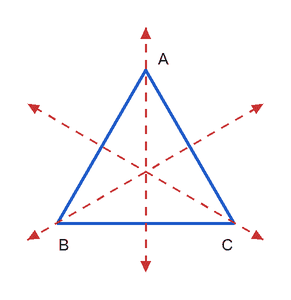
Watch out: Although only AB = BC is given, the 60° angle makes the triangle equilateral, so it has 3 lines of symmetry, not 1.
Therefore, triangle ABC has 3 lines of symmetry.
- 663 marks
Question 66
A point (5, −3) is first reflected in x-axis and the resulting point is reflected in origin. Write the co-ordinates of the final point.
Solve with AIWritten solution
Solution:
Concept: When a point is reflected in the x-axis, its x-co-ordinate stays the same and its y-co-ordinate changes sign: . When a point is reflected in the origin, both of its co-ordinates change sign: .
Given: The point (5, −3).
Step 1 — Reflect in the x-axis.
Only the sign of the y-co-ordinate changes:
Step 2 — Reflect the result in the origin.
Both signs of (5, 3) change:
Watch out: Apply the transformations in the order given, each one to the image of the previous step.
Therefore, the final point is (−5, −3).
- 673 marks
Question 67
The point P(−5, 15) is reflected in origin to point Q. And point Q is then rotated through 90° about origin in the clockwise direction to get point R. Write the co-ordinates of points Q and R.
Solve with AIWritten solution
Solution:
Concept: When a point is reflected in the origin, both of its co-ordinates change sign: . A rotation through 90° clockwise about the origin sends : swap the two co-ordinates, then change the sign of the new second co-ordinate.
Given: P(−5, 15).
Step 1 — Reflect P in the origin.
Both signs of (−5, 15) change:
Step 2 — Rotate Q through 90° clockwise.
The rule (x, y) → (y, −x) with x = 5 and y = −15 gives R:
Watch out: Test the rule on the point (1, 0). A quarter-turn anticlockwise moves it up to (0, 1), and a quarter-turn clockwise moves it down to (0, −1). This shows which co-ordinate takes the minus sign.
Therefore, Q = (5, −15) and R = (−15, −5).
- 683 marks
Question 68
Name any two geometrical figures, which have two lines of symmetry.
Solve with AIWritten solution
Solution:
Concept: A line of symmetry (also called an axis of symmetry) divides a figure into two parts that are mirror images of each other. If the figure is folded along this line, the two parts cover each other exactly.
Step 1 — A rectangle.
A rectangle that is not a square is symmetrical about the two lines joining the mid-points of its opposite sides, so it has two lines of symmetry.

Step 2 — A rhombus.
A rhombus that is not a square is symmetrical about its two diagonals, so it also has two lines of symmetry.
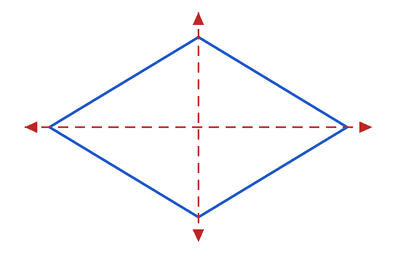
Watch out: A square has 4 lines of symmetry, so say “a rectangle that is not a square”.
Therefore, a rectangle and a rhombus each have two lines of symmetry (an ellipse is another example).
- 693 marks
Question 69
Draw a parallelogram ABCD with AD = BC and ∠B = 60°. If possible draw its line(s) of symmetry.
Solve with AIWritten solution
Solution:
Concept: A line of symmetry (also called an axis of symmetry) divides a figure into two parts that are mirror images of each other. If the figure is folded along this line, the two parts cover each other exactly.
Step 1 — Understand the data.
In every parallelogram the opposite sides are equal, so the condition AD = BC holds automatically. The figure is just a parallelogram whose angle at B is 60°, and its angles are 60°, 120°, 60° and 120°, so it is not a rectangle. The lengths are not given, so take unequal adjacent sides, say BC = 5 cm and BA = 3 cm; then it is not a rhombus either.
Step 2 — Draw the parallelogram.
Draw BC = 5 cm.
At B, construct ∠CBX = 60°, and cut BA = 3 cm on BX.
With A as centre and radius 5 cm, and with C as centre and radius 3 cm, draw arcs meeting at D. Join AD and CD.
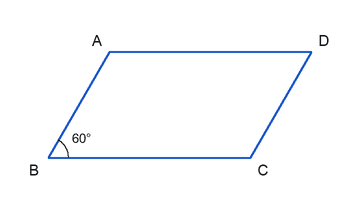
Step 3 — Look for lines of symmetry.
Folding along a diagonal puts a 5 cm side on a 3 cm side, and folding along a line through the mid-points of opposite sides puts a 60° angle on a 120° angle. No fold works, so no line of symmetry can be drawn.
Watch out: If you happen to take AB = BC, ABCD becomes a rhombus, and then its two diagonals are its lines of symmetry.
Therefore, the parallelogram ABCD (with AB ≠ BC) has no line of symmetry, so none can be drawn.
- 703 marks
Question 70
Draw a kite shaped figure ABCD in which AB = BC = 8 cm, AD = CD = 5 cm and angle ∠B = 60°. Draw its line(s) of symmetry.
Solve with AIWritten solution
Solution:
Concept: A kite has two pairs of equal adjacent sides. It is symmetrical about the diagonal that joins the vertices where the equal pairs meet, and this diagonal is the perpendicular bisector of the other diagonal.
Given: AB = 8 cm, BC = 8 cm, AD = 5 cm, CD = 5 cm and ∠B = 60°.
Step 1 — Draw the equal 8 cm sides.
Draw BA = 8 cm.
At B, construct ∠ABX = 60°, and cut BC = 8 cm on BX.
Triangle ABC has two sides of 8 cm with a 60° angle between them, so it is equilateral and AC = 8 cm.
Step 2 — Locate D.
With A and C as centres and radius 5 cm, draw arcs on the side of AC away from B, meeting at D. Join AD and CD. The arcs do meet, because the two radii together (10 cm) are longer than AC, which is 8 cm.
Step 3 — Draw the line of symmetry.
Join BD. B and D are each equally far from A and C, so BD is the perpendicular bisector of AC and folding along it puts triangle BAD on triangle BCD.
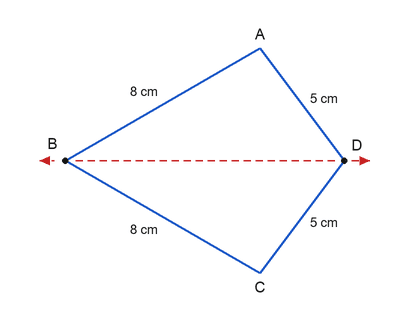
Step 4 — Check by measuring.
BD crosses AC at its mid-point M, 4 cm from A. In the right triangles AMB and AMD:
Adding the two parts gives the length of BD to check on your drawing:
Watch out: The other diagonal, AC, is NOT a line of symmetry, because it would put an 8 cm side on a 5 cm side.
Therefore, kite ABCD has exactly one line of symmetry, the diagonal BD.
What Class 8 Maths Ch 20 covers
The sections of the chapter, in the order the book takes them. Every question above comes from one of these.
- 01Symmetry (Linear Symmetry)
- 02Reflection
- 03Rotation
- 04More About Reflection
More ways to study this chapter
The same chapter asked three other ways. Practise it, revise it, and see what the board has set on Ch 20 before.
Class 8 Maths Ch 20 questions students ask
How many questions are there in Class 8 Maths Ch 20?
70 questions. Every one is solved step by step on this page.
Are these Class 8 Maths solutions free?
Yes. Every question and its full working is free to read, with no account needed.
Can I download the Class 8 Maths Ch 20 solutions as a PDF?
There is no PDF to download. Every solution is on this page instead, which means it is searchable, always the current syllabus, and readable on a phone. Use your browser's print option if you want it on paper.