
Question 693 marksEasy
Draw a parallelogram ABCD with AD = BC and ∠B = 60°. If possible draw its line(s) of symmetry.
Confirming your payment
Sign up now and get 250 free tokens.
Symmetry · Question 69 of 70
Draw a parallelogram ABCD with AD = BC and ∠B = 60°. If possible draw its line(s) of symmetry.
Solution:
Concept: A line of symmetry (also called an axis of symmetry) divides a figure into two parts that are mirror images of each other. If the figure is folded along this line, the two parts cover each other exactly.
Step 1 — Understand the data.
In every parallelogram the opposite sides are equal, so the condition AD = BC holds automatically. The figure is just a parallelogram whose angle at B is 60°, and its angles are 60°, 120°, 60° and 120°, so it is not a rectangle. The lengths are not given, so take unequal adjacent sides, say BC = 5 cm and BA = 3 cm; then it is not a rhombus either.
Step 2 — Draw the parallelogram.
Draw BC = 5 cm.
At B, construct ∠CBX = 60°, and cut BA = 3 cm on BX.
With A as centre and radius 5 cm, and with C as centre and radius 3 cm, draw arcs meeting at D. Join AD and CD.
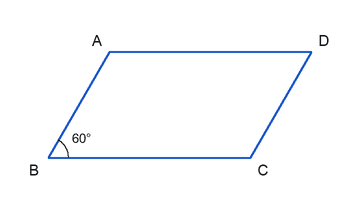
Step 3 — Look for lines of symmetry.
Folding along a diagonal puts a 5 cm side on a 3 cm side, and folding along a line through the mid-points of opposite sides puts a 60° angle on a 120° angle. No fold works, so no line of symmetry can be drawn.
Watch out: If you happen to take AB = BC, ABCD becomes a rhombus, and then its two diagonals are its lines of symmetry.
Therefore, the parallelogram ABCD (with AB ≠ BC) has no line of symmetry, so none can be drawn.