
Question 21 markMCQEasy
The number of line(s) of symmetry which a rhombus has :
Confirming your payment
Sign up now and get 250 free tokens.
Symmetry · Question 2 of 70
The number of line(s) of symmetry which a rhombus has :
(A) 4
(B) 2
(C) 0
(D) none of these
Answer: (B) 2
Concept: A line of symmetry (also called an axis of symmetry) divides a figure into two parts that are mirror images of each other. If the figure is folded along this line, the two parts cover each other exactly.
Step 1 — Know the shape.
A rhombus has all four sides equal, but its angles are not right angles (unless it is a square).
Step 2 — Test the diagonals.
Each diagonal cuts the rhombus into two triangles with the same three sides, and it bisects the angles at its ends. Folding along either diagonal therefore makes the two halves cover each other. That gives 2 lines.
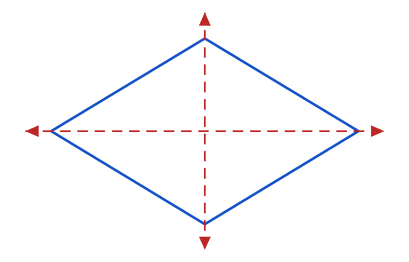
Step 3 — Test the other lines.
The line joining the mid-points of two opposite sides is not a line of symmetry: the fold would put an acute angle on an obtuse angle. So there are no more lines.
Watch out: A rectangle's lines of symmetry join the mid-points of opposite sides, but a rhombus's lines are its diagonals.
Why the other options are wrong:
Therefore, a rhombus has 2 lines of symmetry (its diagonals), option (B).