
Opening your dashboard
Class 8 Maths Chapter 20 Symmetry: Competency-Based Questions (CBQ)
40 questions on Chapter 20, each worked through on its own page with the AI tutor. Class 8 Maths, ICSE 2026-27.
40 questions
1–5 marks · Mixed difficulty
- 11 mark
Question 1
Competency: Understanding
A carrom board is a square. It has four identical pockets, one at each corner, and a circle drawn at its centre.
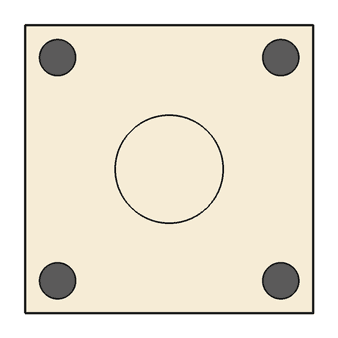
How many lines of symmetry does the board have?
- 21 mark
Question 2
Competency: Application
In a computer game, the surface of a lake lies along the x-axis. A bird hovers above the lake at the point .
The reflection of the bird in the lake is seen at the point
- 31 mark
Question 3
Competency: Application
A clock is drawn on graph paper with its centre at the origin. At a certain moment the tip of the minute hand is at the point .
Where is the tip of the minute hand 15 minutes later?
- 41 mark
Question 4
Competency: Evaluation
Ravi has a sticker in the shape of a parallelogram that is neither a rectangle nor a rhombus. He says, "A diagonal cuts it into two congruent triangles. So if I fold the sticker along the diagonal, the two halves will cover each other exactly."
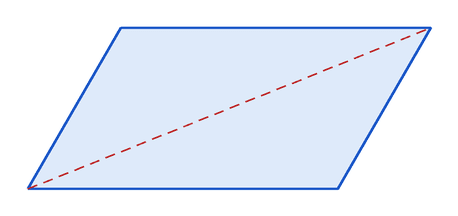
Which is the best judgement of Ravi's statement?
- 51 mark
Question 5
Competency: Understanding
A tree T stands 12 m away from the straight bank AB of a canal. T′ is the reflection of the point T in the line AB.
The distance TT′ is
- 61 mark
Question 6
Competency: Understanding
Assertion (A) : The tip of a toy windmill blade is at . When the blade is turned through 90° clockwise about the origin, the tip reaches .
Reason (R) : A rotation through 90° clockwise about the origin takes the point to the point .
- 72 marks
Question 7
Competency: Analysis
A shop stands beside a still pond. Its name is painted in plain block capital letters on a board, and the board is reflected upside down in the water below it.
Which of these four names will look exactly the same in the water as on the board?
BOOK, MAT, HIDE, TOY
Give the reason.
- 82 marks
Question 8
Competency: Application
A giant wheel is drawn on graph paper with its centre at the origin. A cabin is at the point . The wheel turns anticlockwise.
(a) Where is the cabin after a quarter turn, and after a half turn?
(b) After how many quarter turns from the start does the cabin first reach ?
- 92 marks
Question 9
Competency: Evaluation
Kiran says, "If I reflect any point in the x-axis and then reflect the image again in the x-axis, I always come back to the point I started with."
Test Kiran's claim with the point . Then decide whether it is true for every point .
- 102 marks
Question 10
Competency: Application
On the plan of a playground (scale 1 cm = 1 m), the pivot P of a see-saw and one end A of the see-saw are marked. AP = 2.5 cm. The other end A′ of the see-saw is the reflection of A in the point P.
Write the steps to mark A′ on the plan. What is the actual length of the see-saw?
- 113 marks
Question 11
Competency: Analysis
A designer draws triangle 1 on graph paper. She then uses three different transformations of triangle 1 to get triangles 2, 3 and 4, as shown.
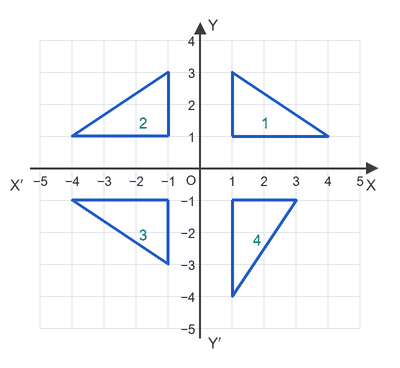
Read the vertices from the graph. Name the single transformation that takes triangle 1 to
(a) triangle 2,
(b) triangle 3,
(c) triangle 4.
Show how the co-ordinates support each answer.
- 123 marks
Question 12
Competency: Creativity
A dance teacher marks the floor like a graph. A dancer starts at the point .
Make up a routine of exactly three different transformations from this chapter (reflections in the axes or the origin, or rotations about the origin) that brings the dancer back to P at the end. Write the dancer's position after each step.
- 133 marks
Question 13
Competency: Analysis & Evaluation
Rahul tests five paper shapes by folding and records the number of lines of symmetry of each.
Shape Rahul's count Rectangle (not a square) 4 Rhombus (not a square) 2 Isosceles trapezium 1 Kite (not a rhombus) 2 Regular hexagon 6 Two of his entries are wrong. Find them, correct them, and explain the mistake he probably made in each.
- 144 marks
Question 14
Competency: Application & Analysis
Case study — The rangoli
Lata draws one quarter of a rangoli on graph paper: the figure OABCD with , , , and , as shown. She completes the rangoli by reflecting this quarter in the y-axis, in the x-axis and in the origin.
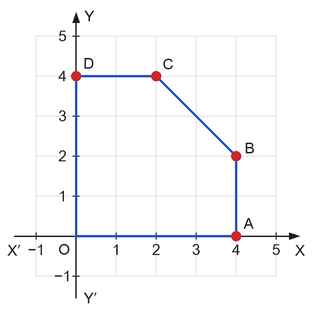
(a) Write the images of B and C when the quarter is reflected in the y-axis.
(b) Write the images of B and C when the quarter is reflected in the origin.
(c) Name two lines of symmetry of the complete rangoli. Then rotate B through 90° anticlockwise about the origin and show that its image is also a corner of the rangoli.
- 155 marks
Question 15
Competency: Analysis & Evaluation
Case study — The ambulance
On the front of an ambulance, the word AMBULANCE is painted as its mirror image. A driver ahead sees the ambulance in a rear-view mirror, and the mirror turns the word the right way round.
(a) A plane mirror placed beside a letter interchanges its left and right. What kind of line of symmetry must a capital letter have to look unchanged in such a mirror?
(b) Which letters of the word AMBULANCE look unchanged in such a mirror?
(c) Sara says, "If every letter of a word looks unchanged in the mirror, the whole word reads the same in the mirror." Test her claim with the words TOM and MOM, and correct it if needed.
- 161 mark
Question 16
Competency: Understanding
A rectangular sheet of paper is folded in half along a vertical crease. A hole is punched through both layers at a point 3 cm from the crease. The sheet is then opened out. The distance between the two holes is
- 171 mark
Question 17
Competency: Understanding
The point is reflected in the origin to the point . Which statement is always true?
- 181 mark
Question 18
Competency: Understanding
Assertion (A): A point is turned through 90° anticlockwise about the origin and then through 90° clockwise about the origin. It returns to its starting position.
Reason (R): A rotation through 90° clockwise about a centre undoes a rotation through 90° anticlockwise about the same centre.
- 191 mark
Question 19
Competency: Application
ABCD is a kite with AB = AD and CB = CD. Its line of symmetry is the diagonal AC. If ∠BAC = 30° and ∠ABC = 112°, then ∠ADC is equal to
- 201 mark
Question 20
Competency: Analysis
The graph shows the point and four other points A, B, C and D.
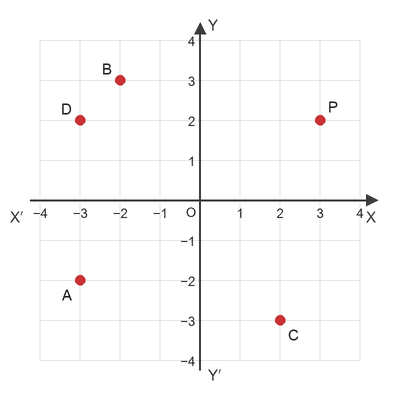
Which of the labelled points is the image of P when P is rotated through 90° anticlockwise about the origin?
- 211 mark
Question 21
Competency: Application
The line segment AB is reflected in the point O, and its image is A′B′. It is given that AB = 6 cm, OA = 5 cm and OB = 4 cm. The perimeter of triangle OA′B′ is
- 221 mark
Question 22
Competency: Evaluation
Assertion (A): A point turned through 180° clockwise about the origin lands at the same place as when it is turned through 180° anticlockwise about the origin.
Reason (R): A rotation through 180° about the origin takes the point to the point .
- 231 mark
Question 23
Competency: Analysis
The point lies in the fourth quadrant, so and . Which transformation sends P to a point in the first quadrant?
- 241 mark
Question 24
Competency: Evaluation
A student records the images of four points under four transformations.
Row Object Image Transformation 1 Reflection in the x-axis 2 Reflection in the y-axis 3 Rotation through 90° clockwise about the origin 4 Rotation through 90° anticlockwise about the origin Exactly one row has a mistake. Which row is it?
- 251 mark
Question 25
Competency: Analysis
An isosceles triangle has one angle equal to 60°. How many lines of symmetry does it have?
- 262 marks
Question 26
Competency: Application
On a map, two villages A and B are 8 cm apart. B is the mirror image of A in a straight road m, so m is the line of symmetry of the pair of points A and B. A well W lies on the road m, 5 cm from A.
(a) How far is the well from B?
(b) Where does the road m cut the segment AB, and at what angle?
- 272 marks
Question 27
Competency: Application
On the plan of a classroom drawn on graph paper, the teacher's table is at the origin O. Two pairs of seats are marked. The two seats in each pair are mirror images of each other.
Pair 1: and .
Pair 2: and .
For each pair, name the mirror: the x-axis, the y-axis or the origin. Give a reason from the co-ordinates.
- 282 marks
Question 28
Competency: Analysis
A toy robot is placed at a point R on a graph-paper floor. It is turned through 90° anticlockwise about the origin, and then reflected in the x-axis. It ends at the point . Find the point R where it started.
- 292 marks
Question 29
Competency: Application
Meera turns the point three times in succession through 90° anticlockwise about the origin. Dev turns the same point P once through 90° clockwise about the origin. Do they reach the same point? Find both points and explain the result.
- 302 marks
Question 30
Competency: Application
P and Q are two points on the same side of a straight mirror line . They lie on one line perpendicular to , with P at a distance of 2 cm from and Q at a distance of 5 cm from . The points P′ and Q′ are the images of P and Q in .
(a) Find PQ and P′Q′.
(b) Find the distance QP′.
- 312 marks
Question 31
Competency: Analysis
(a) Find the image of the point on reflection in the x-axis, and its image on reflection in the origin.
(b) Explain why the two images agree for every point on the y-axis, but not for the point .
- 323 marks
Question 32
Competency: Analysis
Four flags are drawn for a school sports meet. Look only at the shapes and ignore the colours. Each flag is a rectangle that is longer than it is wide.
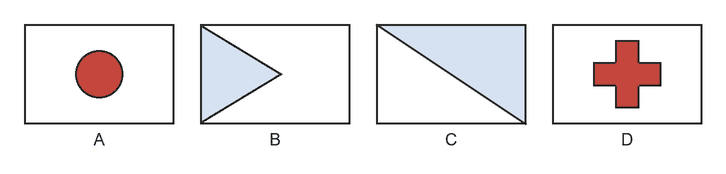
(a) Write the number of lines of symmetry of each flag A, B, C and D.
(b) A plain rectangle of this kind has 2 lines of symmetry. Explain why drawing one diagonal, as in flag C, leaves it with none.
- 333 marks
Question 33
Competency: Analysis
The rectangle ABCD has , , and . It is reflected in the y-axis, and its image is the rectangle A′B′C′D′.
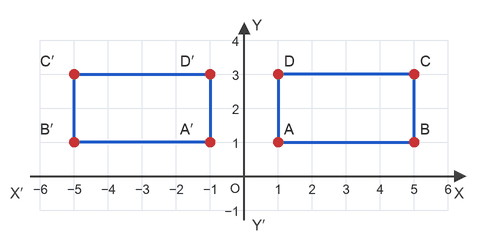
(a) Write the co-ordinates of A′, B′, C′ and D′.
(b) The two rectangles together form one figure. How many lines of symmetry does this whole figure have? Name them.
- 343 marks
Question 34
Competency: Application
A calculator shows each digit with up to seven bars. The ten digits are drawn below, with the unused bars shown faintly.

For this question name the bars as follows: top bar a, upper right bar b, lower right bar c, bottom bar d, lower left bar e, upper left bar f, middle bar g.
Take every line of symmetry through the centre of the whole seven-bar block, and look only at the bars that are lit.
(a) Which digits have a horizontal line of symmetry?
(b) Which digits have a vertical line of symmetry?
(c) Using only digits from your answer to (b), write the largest 3-digit number you can. A digit may be used more than once.
- 353 marks
Question 35
Competency: Evaluation
A square tile has 4 lines of symmetry. A craftsman paints one small dot on the tile. How many lines of symmetry does the tile have now, if the dot is
(a) at the centre of the tile,
(b) on one diagonal, but not at the centre,
(c) not on any of the 4 lines of symmetry of the plain tile?
Give a reason in each case.
- 363 marks
Question 36
Competency: Application
On a plan of a hall (1 unit = 1 m), a banner hangs between the points and . The shiny floor lies along the x-axis, and the banner is reflected in the floor. The image of AB is A′B′.
(a) Write the co-ordinates of A′ and B′.
(b) Find the lengths AB, A′B′ and AA′.
(c) Name the shape of the quadrilateral ABB′A′ and find its area.
- 374 marks
Question 37
Competency: Analysis
Case study — The wall pattern
Neha is making a symmetric wall pattern on graph paper, with the origin O at the centre of the wall. She plots a star at a point P in the first quadrant. She then copies the star three times: once by reflecting P in the x-axis, once by reflecting it in the y-axis and once by reflecting it in the origin. She notes the three copies as I1, I2 and I3, but she forgets which reflection gave which copy, and she rubs out the original star by mistake. (Hypothetical data.)
Copy Co-ordinates I1 I2 I3 (a) Match each copy with the reflection that gave it, and give a reason.
(b) Find the co-ordinates of P.
(c) The points P, I1, I2 and I3 are the corners of a rectangle. Find its length and breadth, and name its two lines of symmetry.
- 384 marks
Question 38
Competency: Application & Analysis
Case study — The one-way sign
A school puts up an arrow sign. On graph paper, its outline is the figure ABCDEFG with , , , , , and .
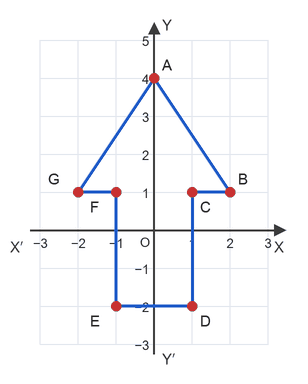
(a) How many lines of symmetry does the sign have? Name the line.
(b) Write the images of B and D when the sign is reflected in the y-axis. Which vertices of the sign are these?
(c) The sign is turned through 180° about the origin, so that it points downwards. Write the new positions of A and D. How many lines of symmetry does the turned sign have?
- 395 marks
Question 39
Competency: Analysis & Creativity
Case study — The pinwheel
A designer draws one blade of a paper pinwheel on graph paper: the triangle OAB with , and .

She makes the pinwheel by turning the blade about O through 90°, 180° and 270° anticlockwise.
(a) Write the vertices of the three turned blades.
(b) Test the x-axis as a mirror line by finding the image of the blade OAB in it. Then explain why the pinwheel has no line of symmetry.
(c) Design a different blade, with O as one vertex and symmetrical about the x-axis, so that the four turned copies make a figure that does have lines of symmetry. Give its vertices and name two lines of symmetry of your figure.
- 405 marks
Question 40
Competency: Analysis & Evaluation
Case study — The field placing
A captain places four fielders around a right-handed batter standing at the origin O of a plan (1 unit = 5 m). When a left-handed batter comes in, the captain mirrors the whole field in the y-axis, the line along the pitch. (Hypothetical data.)
Fielder Position (right-handed batter) F1 F2 F3 F4 (a) Show that F2 is the position of F1 turned through 90° anticlockwise about O, and that F3 follows from F2 in the same way.
(b) Write the new positions of the four fielders for the left-handed batter.
(c) The captain says, "In the new field, each fielder is again the previous one turned through 90° about O." Is he right? Name the direction of the turn, and explain what reflecting the field has done to the direction.