
Opening your dashboard
Class 8 Chemistry Chapter 7: Hydrogen Solutions
30 textbook questions with step-by-step answers, free to read, for ICSE 2026-27.
Get talked through Ch 7, not just shown the answer
Reading a finished solution is not the same as being able to do it. The AI tutor takes one question at a time and works it with you, in your own words, until you can.
- Ask it out loud, in your own words
- It gives you the next step, not the answer
- Stuck on part (ii)? Start there
30 questions with solutions
1–5 marks · Mixed difficulty
- 11 mark
Question 1
Which of the following metals does not react with water or acid to produce hydrogen gas ?
Solve with AIAnswer
(A) Magnesium
(B) Iron
- Correct
(C) Copper
(D) Zinc
Answer: (C) Copper
Concept: The reactivity series lists metals from the most reactive (potassium, sodium, calcium) at the top to the least reactive (gold, platinum) at the bottom. A metal above hydrogen can displace hydrogen from water or dilute acids; a metal below hydrogen cannot.
Step 1 — Place each metal in the series.
Magnesium, zinc and iron lie above hydrogen in the reactivity series, while copper lies below hydrogen.
Step 2 — Decide which one cannot give hydrogen.
A metal below hydrogen is less reactive than hydrogen, so it cannot push hydrogen out of water or a dilute acid. Copper therefore gives no hydrogen with either.
Watch out: Copper does react with nitric acid and hot concentrated sulphuric acid, but those reactions give oxides of nitrogen or sulphur dioxide, never hydrogen.
Why the other options are wrong:
- (A) Magnesium: This is wrong because magnesium is above hydrogen; it gives hydrogen with dilute acids, hot water and steam.
- (B) Iron: This is wrong because iron is above hydrogen; it gives hydrogen with dilute acids and with steam passed over red-hot iron.
- (D) Zinc: This is wrong because zinc is above hydrogen; it gives hydrogen with dilute acids (the laboratory method) and with steam.
Therefore, the metal that does not react with water or acid to produce hydrogen is copper, option (C).
- 21 mark
Question 2
Which of the following compounds is formed along with hydrogen gas when magnesium reacts with steam ?
Solve with AIAnswer
(A)
- Correct
(B) MgO
(C)
(D)
Answer: (B) MgO
Concept: A heated metal reacts with steam to give the metal oxide and hydrogen; with hot water a reactive metal gives the hydroxide instead.
Step 1 — Write the reaction with steam.
When steam is passed over burning or heated magnesium, the steam gives up its oxygen to the metal and hydrogen is set free:
Step 2 — Name the compound.
The compound formed along with hydrogen is magnesium oxide, .
Watch out: Magnesium with boiling water gives magnesium hydroxide, but with steam it gives magnesium oxide.
Why the other options are wrong:
- (A): This is wrong because magnesium hydroxide is formed with hot (boiling) water, not with steam.
- (C): This is wrong because magnesium hydride is made by heating magnesium with hydrogen gas; it is not formed from steam.
- (D): This is wrong because magnesium chloride needs chlorine, for example from dilute hydrochloric acid; steam contains no chlorine.
Therefore, magnesium oxide is formed along with hydrogen, option (B).
- 31 mark
Question 3
The gas produced at anode when electroysis of water is done is :
Solve with AIAnswer
(A)
- Correct
(B)
(C)
(D) None
Answer: (B)
Concept: In the electrolysis of acidulated water, the cathode (negative electrode) gives hydrogen and the anode (positive electrode) gives oxygen, in the ratio 2 : 1 by volume.
Step 1 — Write the overall change.
The electric current splits water into hydrogen and oxygen:
Step 2 — Decide which gas forms at the anode.
The anode is positive, so it attracts the negative ions, and oxygen is given off there. Hydrogen is given off at the negative cathode.
Watch out: The anode is the positive electrode and gives oxygen; the cathode is the negative electrode and gives hydrogen. Do not swap them.
Note: The word “electroysis” in the question is a misprint for “electrolysis”.
Why the other options are wrong:
- (A): This is wrong because hydrogen is given off at the cathode, not at the anode.
- (C): This is wrong because no sulphur dioxide forms; the little sulphuric acid added only helps the water conduct and is not used up.
- (D) None: This is wrong because a gas, oxygen, is given off at the anode.
Therefore, the gas produced at the anode is oxygen, option (B).
- 41 mark
Question 4
Equal volumes of hydrogen and chlorine are exposed to diffused sunlight to prepare
Solve with AIAnswer
- Correct
(A) hydrogen chloride
(B) water
(C) sodium hydroxide
(D) hydrochloric acid
Answer: (A) hydrogen chloride
Concept: Hydrogen combines directly with chlorine. In diffused sunlight the reaction is steady; in bright sunlight the mixture explodes.
Step 1 — Write the reaction.
One volume of hydrogen and one volume of chlorine combine to give two volumes of hydrogen chloride gas:
Step 2 — Name the product.
The two dry gases give hydrogen chloride, a colourless gas. Only when it dissolves in water does it become hydrochloric acid.
Watch out: Hydrogen chloride is the gas; hydrochloric acid is its solution in water.
Why the other options are wrong:
- (B) water: This is wrong because water would need oxygen, which is not present here.
- (C) sodium hydroxide: This is wrong because sodium hydroxide would need sodium and oxygen, neither of which is present.
- (D) hydrochloric acid: This is wrong because hydrochloric acid is the solution of hydrogen chloride in water; the two dry gases give hydrogen chloride gas.
Therefore, equal volumes of hydrogen and chlorine in diffused sunlight give hydrogen chloride, option (A).
- 51 mark
Question 5
The metal which reacts with cold water to produce hydrogen is
Solve with AIAnswer
(A) magnesium
(B) aluminium
- Correct
(C) calcium
(D) iron
Answer: (C) calcium
Concept: Only the most reactive metals (potassium, sodium and calcium) give hydrogen with cold water; magnesium needs hot water or steam, and metals such as iron need steam.
Step 1 — Pick the metal that reacts with cold water.
Calcium is near the top of the reactivity series, so it reacts with cold water (slowly) to give calcium hydroxide and hydrogen:
Watch out: Calcium reacts with cold water much more gently than sodium or potassium, but it does react.
Why the other options are wrong:
- (A) magnesium: This is wrong because magnesium reacts with cold water only very slightly; it needs hot water or steam.
- (B) aluminium: This is wrong because aluminium is protected by a thin oxide layer and reacts only with steam.
- (D) iron: This is wrong because iron gives hydrogen only when steam is passed over red-hot iron.
Therefore, the metal which reacts with cold water to produce hydrogen is calcium, option (C).
- 61 mark
Question 6
In metal reactivity series, the more reactive metals are at
Solve with AIAnswer
- Correct
(A) top
(B) bottom
(C) middle
(D) none of these
Answer: (A) top
Concept: The reactivity series arranges metals in decreasing order of reactivity.
Step 1 — Recall the order.
Potassium, the most reactive metal, is at the top; gold and platinum, the least reactive, are at the bottom. So the more reactive metals are at the top.
Why the other options are wrong:
- (B) bottom: This is wrong because the least reactive metals, such as gold and platinum, are at the bottom.
- (C) middle: This is wrong because the middle holds metals of moderate reactivity, such as zinc, iron and lead.
- (D) none of these: This is wrong because the more reactive metals do have a fixed place in the series, at the top.
Therefore, in the metal reactivity series the more reactive metals are at the top, option (A).
- 71 mark
Question 7
Hydrogen is responsible for producing
Solve with AIAnswer
(A) heat and light
(B) hydrogenated oil
(C) fertilizers
- Correct
(D) all of the above
Answer: (D) all of the above
Concept: Hydrogen is the fuel of the sun, it hardens vegetable oils, and it is a raw material for ammonia, from which fertilizers are made.
Step 1 — Heat and light.
In the sun and the stars, hydrogen nuclei join (fuse) to form helium, releasing the heat and light that reach us. Burning hydrogen also gives a great deal of heat.
Step 2 — Hydrogenated oil.
Hydrogen passed through hot vegetable oil with a nickel catalyst turns it into a solid fat (vanaspati ghee).
Step 3 — Fertilizers.
Hydrogen combines with nitrogen to give ammonia, which is used to make fertilizers such as urea and ammonium salts:
Step 4 — Combine.
Each of the first three options is true, so the complete answer is all of them.
Watch out: The sun's energy comes from fusion of hydrogen nuclei, not from hydrogen burning in oxygen.
Why the other options are wrong:
- (A) heat and light: This is wrong because heat and light alone is incomplete; hydrogen is also needed for the other two.
- (B) hydrogenated oil: This is wrong because hydrogenated oil alone is incomplete; hydrogen also gives heat and light and fertilizers.
- (C) fertilizers: This is wrong because fertilizers alone is incomplete; hydrogen also gives heat and light and hydrogenated oil.
Therefore, hydrogen is responsible for producing all of the above, option (D).
- 81 mark
Question 8
Hydrogen is
Solve with AIAnswer
- Correct
(A) combustible
(B) non-combustible
(C) supporter of combustion
(D) neither supporter nor combustible
Answer: (A) combustible
Concept: A combustible substance burns itself; a supporter of combustion (like oxygen) helps other things burn.
Step 1 — Test both properties.
A jet of hydrogen catches fire and burns with a pale blue flame, so hydrogen is combustible. A burning splinter pushed into a jar of hydrogen goes out, so hydrogen does not support combustion.
Watch out: The splinter goes out inside the jar, but the hydrogen at the mouth of the jar catches fire: it burns, but it does not help other things burn.
Why the other options are wrong:
- (B) non-combustible: This is wrong because hydrogen does burn, so it is not non-combustible.
- (C) supporter of combustion: This is wrong because a burning splinter goes out in hydrogen, so it does not support combustion.
- (D) neither supporter nor combustible: This is wrong because hydrogen is combustible, so “neither supporter nor combustible” is false.
Therefore, hydrogen is combustible, option (A).
- 91 mark
Question 9
Water gas is a mixture of
Solve with AIAnswer
(A) carbon monoxide and oxygen
- Correct
(B) carbon monoxide and hydrogen
(C) hydrogen and oxygen
(D) hydrogen and nitrogen.
Answer: (B) carbon monoxide and hydrogen
Concept: Water gas is made by passing steam over red-hot coke at about 1000 °C. It is the first stage of the Bosch process for making hydrogen.
Step 1 — Write the reaction.
Carbon takes the oxygen from steam and hydrogen is set free:
Step 2 — Name the mixture.
The products are carbon monoxide and hydrogen, so water gas is a mixture of these two gases.
Why the other options are wrong:
- (A) carbon monoxide and oxygen: This is wrong because water gas contains no free oxygen.
- (C) hydrogen and oxygen: This is wrong because a mixture of hydrogen and oxygen is an explosive mixture, not water gas.
- (D) hydrogen and nitrogen: This is wrong because hydrogen and nitrogen (3 : 1 by volume) is the mixture used to make ammonia.
Therefore, water gas is a mixture of carbon monoxide and hydrogen, option (B).
- 101 mark
Question 10
Assertion (A) : On the earth, hydrogen is mostly found in the form of compounds.
Reason (R) : Hydrogen is a highly reactive element.
Solve with AIAnswer
- Correct
(A) Both A and R are true and R is the correct explanation of A.
(B) Both A and R are true but R is not the correct explanation of A.
(C) A is true but R is false.
(D) A is false but R is true.
Answer: (A) Both A and R are true and R is the correct explanation of A.
Concept: An element that combines readily with others is found mostly in compounds rather than free.
Step 1 — Judge the Assertion.
On the earth hydrogen occurs mostly combined: in water, acids, alkalis, and the organic compounds of living things. The Assertion is true.
Step 2 — Judge the Reason.
Hydrogen combines with oxygen, chlorine, nitrogen, sulphur and many metals; it reacts readily when heated, sparked or lit. The Reason is true as the book intends it.
Step 3 — Does the Reason explain the Assertion?
Yes. Because hydrogen combines readily with other elements, little of it stays free, so it is found mainly in compounds.
Watch out: For an Assertion–Reason item, judge the Assertion first, then the Reason, and only then ask whether the Reason explains the Assertion.
Note: At room temperature hydrogen is in fact rather slow to react (its two atoms hold together strongly), and free hydrogen is also scarce because this very light gas escapes from the atmosphere. The book's key, that its reactivity explains why it is found combined, is kept.
Why the other options are wrong:
- (B): This is wrong because the readiness of hydrogen to combine does explain why it is found mainly in compounds.
- (C): This is wrong because the Reason is taken as true: hydrogen combines with many elements.
- (D): This is wrong because the Assertion is true: hydrogen on the earth is mostly combined.
Therefore, both A and R are true and R is the correct explanation of A, option (A).
- 111 mark
Question 11
Assertion (A) : In the laboratory preparation of hydrogen, granulated zinc is reacted with dilute acid.
Reason (R) : Granulaled zinc contains copper as an impurity.
Solve with AIAnswer
(A) Both A and R are true and R is the correct explanation of A.
- Correct
(B) Both A and R are true but R is not the correct explanation of A.
(C) A is true but R is false.
(D) A is false but R is true.
Answer: (B) Both A and R are true but R is not the correct explanation of A.
Concept: Zinc gives hydrogen with dilute acids because it is above hydrogen in the reactivity series. Granulated zinc is used because its copper impurity speeds up the reaction.
Step 1 — Judge the Assertion.
In the laboratory, hydrogen is made from granulated zinc and dilute hydrochloric (or sulphuric) acid. The Assertion is true:
Step 2 — Judge the Reason.
Granulated zinc does contain a little copper as an impurity, and this copper makes the reaction faster. The Reason is true.
Step 3 — Does the Reason explain the Assertion?
No. Zinc reacts with dilute acid because it is more reactive than hydrogen; pure zinc reacts too, only more slowly. The copper impurity explains why granulated zinc is preferred, not why zinc and acid give hydrogen.
Watch out: For an Assertion–Reason item, judge the Assertion first, then the Reason, and only then ask whether the Reason explains the Assertion.
Note: “Granulaled” in the Reason is a misprint for “Granulated”.
Why the other options are wrong:
- (A): This is wrong because the copper impurity only speeds up the reaction; it does not explain why zinc and dilute acid give hydrogen.
- (C): This is wrong because the Reason is true: granulated zinc contains copper as an impurity.
- (D): This is wrong because the Assertion is true: granulated zinc and dilute acid are used.
Therefore, both A and R are true but R is not the correct explanation of A, option (B).
- 121 mark
Question 12
Assertion (A) : Pure hydrogen burns with a pop sound in air.
Reason (R) : Hydrogen forms an explosive mixture with air.
Solve with AIAnswer
(A) Both A and R are true and R is the correct explanation of A.
(B) Both A and R are true but R is not the correct explanation of A.
(C) A is true but R is false.
- Correct
(D) A is false but R is true.
Answer: (D) A is false but R is true.
Concept: Pure hydrogen burns quietly with a pale blue flame. The pop is a tiny explosion of hydrogen that is already mixed with air.
Step 1 — Judge the Assertion.
Pure hydrogen, lit at a jet, burns silently with a pale blue flame. The Assertion says pure hydrogen burns with a pop, so it is false.
Step 2 — Judge the Reason.
A mixture of hydrogen and air explodes when lit; a small amount of it gives the pop sound of the test for hydrogen. The Reason is true.
Watch out: The pop test works because the hydrogen in a test tube mixes with air before it is lit.
Why the other options are wrong:
- (A): This is wrong because the Assertion is false; pure hydrogen burns without a pop.
- (B): This is wrong because the Assertion is false; pure hydrogen burns without a pop.
- (C): This is wrong because it is the Assertion that is false and the Reason that is true, the opposite of this choice.
Therefore, A is false but R is true, option (D).
- 131 mark
Question 13
Assertion (A) : Hydrogen is used for the extraction of less reactive metals like copper and lead.
Reason (R) : Hydrogen is a good reducing agent.
Solve with AIAnswer
- Correct
(A) Both A and R are true and R is the correct explanation of A.
(B) Both A and R are true but R is not the correct explanation of A.
(C) A is true but R is false.
(D) A is false but R is true.
Answer: (A) Both A and R are true and R is the correct explanation of A.
Concept: A reducing agent removes oxygen from a compound. Hydrogen removes oxygen from the heated oxides of less reactive metals and leaves the metal.
Step 1 — Judge the Assertion.
Hydrogen passed over heated copper oxide or lead monoxide leaves copper or lead behind, so it can be used to obtain these metals. The Assertion is true as the book intends it:
Step 2 — Judge the Reason.
Hydrogen takes oxygen from the oxide and is itself oxidised to water, so it is a good reducing agent. The Reason is true.
Step 3 — Does the Reason explain the Assertion?
Yes. Hydrogen can extract these metals precisely because it removes oxygen from their oxides.
Watch out: For an Assertion–Reason item, judge the Assertion first, then the Reason, and only then ask whether the Reason explains the Assertion.
Note: In industry copper and lead are mostly produced by other methods (smelting, carbon reduction); hydrogen is used for metals such as tungsten. The book's key is kept.
Why the other options are wrong:
- (B): This is wrong because the reducing action of hydrogen is exactly why it can extract these metals.
- (C): This is wrong because the Reason is true: hydrogen is a good reducing agent.
- (D): This is wrong because the Assertion is true: hydrogen reduces the oxides of copper and lead to the metals.
Therefore, both A and R are true and R is the correct explanation of A, option (A).
- 141 mark
Question 14
Assertion (A) : Oxyhydrogen flame is used for cutting and welding metals.
Reason (R) : For cutting and welding metals, a low temperature is required.
Solve with AIAnswer
(A) Both A and R are true and R is the correct explanation of A.
(B) Both A and R are true but R is not the correct explanation of A.
- Correct
(C) A is true but R is false.
(D) A is false but R is true.
Answer: (C) A is true but R is false.
Concept: Hydrogen burning in pure oxygen gives the oxyhydrogen flame, about 2800 °C, hot enough to melt metals.
Step 1 — Judge the Assertion.
The oxyhydrogen flame is used for cutting and welding metals. The Assertion is true.
Step 2 — Judge the Reason.
Cutting and welding need the metal to melt, which needs a very high temperature, not a low one. The Reason is false.
Watch out: The flame is useful because it is very hot; a low temperature could not melt the metal.
Why the other options are wrong:
- (A): This is wrong because the Reason is false, so it cannot be a correct explanation.
- (B): This is wrong because the Reason is false, so “both true” cannot be correct.
- (D): This is wrong because the Assertion is true: the oxyhydrogen flame is used for cutting and welding.
Therefore, A is true but R is false, option (C).
- 155 marks
Question 15
Fill in the blanks :
(a) Hydrogen is ________ than air.
(b) Hydrogen is ________ soluble in water.
(c) Hydrogen burns with a ________ flame and ________ sound is heard.
(d) A metal ________ hydrogen in the reactivity series gives hydrogen with ________ .
(e) Hydrogen reacts with metal oxides to form ________ and ________ .
(f) Oxidation is the removal of ________ or addition of ________ .
(g) In redox reactions, oxidation and reduction occur ________ .
Solve with AIWritten solution
Solution:
Concept: The blanks test the physical properties of hydrogen, its reactions, and the meaning of oxidation and reduction.
Step 1 — (a) and (b) Physical properties.
Hydrogen is the lightest gas, and very little of it dissolves in water.
- (a) Hydrogen is lighter than air.
- (b) Hydrogen is sparingly (slightly) soluble in water.
Step 2 — (c) Burning.
Lit hydrogen burns with a pale blue flame; mixed with air, it burns with a small explosion.
- (c) Hydrogen burns with a pale blue flame and a pop sound is heard.
Step 3 — (d) and (e) Reactions.
A metal more reactive than hydrogen displaces it from acids, and hydrogen takes oxygen from metal oxides:
- (d) A metal above hydrogen in the reactivity series gives hydrogen with dilute acids.
- (e) Hydrogen reacts with metal oxides to form metal and water.
Step 4 — (f) and (g) Oxidation and reduction.
Oxidation and reduction are opposite changes that always happen together:
- (f) Oxidation is the removal of hydrogen or addition of oxygen.
- (g) In redox reactions, oxidation and reduction occur simultaneously.
Watch out: The pop is heard when hydrogen is mixed with air; pure hydrogen burns quietly.
Therefore, the answers are (a) lighter, (b) sparingly, (c) pale blue and pop, (d) above and dilute acids, (e) metal and water, (f) hydrogen and oxygen, and (g) simultaneously.
- 165 marks
Question 16
Indicate which of the following statements are true and which are false and correct the false statements :
(a) Hydrogen molecule is monovalent.
(b) The removal of hydrogen from a substance is called reduction.
(c) Nitric acid cannot be used to prepare hydrogen by its action on active metals.
(d) The reaction between hydrogen and nitrogen to form ammonia is reversible.
(e) Zinc can liberate hydrogen from water, acid and alkali solution.
(f) Hydrogen is combustible as well as a supporter of combustion.
(g) Hydrogen gas is easily liquefiable.
Solve with AIWritten solution
Solution:
Concept: Check each statement against the properties of hydrogen and the meanings of oxidation and reduction; rewrite every false one so that it becomes true.
Step 1 — (a) Hydrogen molecule monovalent?
Valency belongs to an atom: a hydrogen atom combines with one other atom, so it is monovalent. The molecule is made of two atoms (diatomic).
False. Correct statement: the hydrogen atom is monovalent; the hydrogen molecule is diatomic.
Step 2 — (b) Removal of hydrogen.
Removing hydrogen from a substance is oxidation; adding hydrogen is reduction.
False. Correct statement: the removal of hydrogen from a substance is called oxidation.
Step 3 — (c) Nitric acid and hydrogen.
Nitric acid is a strong oxidising agent even when dilute, so it oxidises the hydrogen formed to water and gives oxides of nitrogen instead.
True.
Step 4 — (d) Reversibility of the ammonia reaction.
Nitrogen and hydrogen (1 : 3 by volume) combine over iron at about 450 °C and 200 atm, and the ammonia formed partly breaks back into its elements:
True.
Step 5 — (e) Zinc with water, acid and alkali.
Zinc gives hydrogen with steam, with dilute acids and with hot caustic soda solution:
True (with water only as steam).
Step 6 — (f) Combustible and supporter?
Hydrogen burns, but a burning splinter goes out in it.
False. Correct statement: hydrogen is combustible but it is a non-supporter of combustion.
Step 7 — (g) Ease of liquefaction.
Hydrogen boils at −253 °C. It cannot be liquefied by pressure at all until it is cooled below about −240 °C.
False. Correct statement: hydrogen gas is not easily liquefied; it must be cooled below about −240 °C and compressed (or cooled to −253 °C at ordinary pressure).
Watch out: Very dilute (about 1 %) nitric acid does give hydrogen with magnesium or manganese; the statement in (c) holds for the nitric acid used in ordinary work.
Therefore, (a) false, (b) false, (c) true, (d) true, (e) true, (f) false and (g) false, with the corrections given above.
- 175 marks
Question 17
Match the statements in Column A with the words in Column B.
Column A Column B (a) A metal which reacts with cold water to form hydrogen. (i) Reduction (b) A gas which is inflammable and a non-supporter of combustion. (ii) Hydrogenation (c) A process in which vanaspati ghee is prepared from vegetable oils. (iii) Oxidation (d) The removal of hydrogen or addition of oxygen. (iv) Sodium (e) The addition of hydrogen or removal of oxygen. (v) Hydrogen Solve with AIWritten solution
Solution:
Concept: Pair each description with the one word in Column B that fits it exactly.
Step 1 — (a) and (b) The metal and the gas.
Sodium is reactive enough to give hydrogen with cold water, and hydrogen burns but does not let other things burn.
- (a) A metal which reacts with cold water to form hydrogen — (iv) Sodium
- (b) A gas which is inflammable and a non-supporter of combustion — (v) Hydrogen
Step 2 — (c) Making vanaspati ghee.
Adding hydrogen to vegetable oil (with a nickel catalyst) hardens it.
- (c) A process in which vanaspati ghee is prepared from vegetable oils — (ii) Hydrogenation
Step 3 — (d) and (e) Oxidation and reduction.
Gaining oxygen or losing hydrogen is oxidation; gaining hydrogen or losing oxygen is reduction.
- (d) The removal of hydrogen or addition of oxygen — (iii) Oxidation
- (e) The addition of hydrogen or removal of oxygen — (i) Reduction
Watch out: Oxidation and reduction are exact opposites, so check which way the oxygen and hydrogen move.
Therefore, (a) matches (iv), (b) matches (v), (c) matches (ii), (d) matches (iii) and (e) matches (i).
- 185 marks
Question 18
Name the following :
(a) The process in which oxygen is added or hydrogen is removed.
(b) A process by which hydrogen gas is manufactured.
(c) A solid conductor through which current enters or leaves the electrolyte.
(d) The charged particles present in an electrolyte.
(e) A substance which removes oxygen from a compound.
Solve with AIWritten solution
Solution:
Concept: Each description is a term from the chapter on hydrogen and electrolysis.
Step 1 — (a) Oxygen added or hydrogen removed.
Gaining oxygen or losing hydrogen is the definition of oxidation.
Oxidation.
Step 2 — (b) Manufacture of hydrogen.
Hydrogen is made on a large scale from water gas and steam.
Bosch process.
Step 3 — (c) Solid conductor for the current.
The solid plate or rod through which current enters or leaves the electrolyte is an electrode.
Electrode (anode or cathode).
Step 4 — (d) Charged particles in an electrolyte.
An electrolyte conducts because it contains free positive and negative ions.
Ions (cations and anions).
Step 5 — (e) Substance that removes oxygen.
A substance that takes oxygen away from a compound reduces it.
Reducing agent (for example, hydrogen).
Therefore, (a) oxidation, (b) Bosch process, (c) electrode, (d) ions and (e) reducing agent.
- 195 marks
Question 19
Give examples :
(a) Two metals which give hydrogen with cold water.
(b) A metal which liberates hydrogen only when steam is passed over red hot metal.
(c) A metallic oxide which can be reduced into metal by hydrogen.
(d) An electrolyte.
(e) A metal of which an electrode is made.
Solve with AIWritten solution
Solution:
Concept: Use the reactivity series for (a)–(c) and the terms of electrolysis for (d) and (e).
Step 1 — (a) Metals that give hydrogen with cold water.
The most reactive metals, at the top of the series, react with cold water. Sodium and potassium (calcium also reacts, slowly):
Step 2 — (b) A metal that needs steam over the red-hot metal.
Iron gives hydrogen with water only when steam is passed over red-hot iron (a reversible reaction):
Step 3 — (c) An oxide reduced by hydrogen.
Oxides of metals below hydrogen are reduced by it, e.g. copper oxide (lead monoxide is another):
Step 4 — (d) An electrolyte.
An electrolyte conducts electricity in solution or when molten and is decomposed by it: dilute sulphuric acid (acidulated water); sodium chloride solution is another.
Step 5 — (e) A metal for electrodes.
An electrode metal should conduct well and not be attacked by the products: platinum (graphite, a non-metal, is also used).
Therefore, the examples are (a) sodium and potassium, (b) iron, (c) copper oxide, (d) dilute sulphuric acid and (e) platinum.
- 205 marks
Question 20
Complete and balance the following equations:
(a) + ________ 2HCl
(b) + S ________
(c) Zn + ________ +
(d) CuO + ________ Cu + ________
(e) Fe + ________ + ________
(f) K + ________ + ________
Solve with AIWritten solution
Solution:
Concept: Write the missing formula from what you know of the reaction, then balance the atoms of each element on both sides with coefficients.
Step 1 — (a) Hydrogen and chlorine.
Hydrogen chloride comes from hydrogen and chlorine; one supplies the two Cl atoms:
Step 2 — (b) Hydrogen and sulphur.
Hydrogen passed through boiling sulphur gives hydrogen sulphide:
Step 3 — (c) Zinc and an acid giving zinc chloride.
The chlorine in zinc chloride must come from hydrochloric acid; two HCl give 2 H and 2 Cl:
Step 4 — (d) Copper oxide reduced.
Hydrogen takes the oxygen from heated copper oxide and forms water:
Step 5 — (e) Iron and steam.
Steam over red-hot iron gives iron(II, III) oxide, (triferric tetroxide), and hydrogen. Balancing 3 Fe and 4 O gives:
Step 6 — (f) Potassium and cold water.
Potassium reacts violently with cold water to give potassium hydroxide and hydrogen:
Watch out: The iron–steam reaction gives , not ; balance iron first (3), then oxygen (4).
Therefore, the completed equations are those shown above, with (a) , (b) , (c) , (d) and , (e) and , (f) and .
- 215 marks
Question 21
Define :
(a) catalytic hydrogenation
(b) oxidation
(c) reduction
(d) redox reaction
(e) electrolysis
(d) electrolyte
Solve with AIWritten solution
Solution:
Concept: Each term is defined in words, with one example, as used in this chapter.
Step 1 — (a) Catalytic hydrogenation.
Catalytic hydrogenation is the process of passing hydrogen gas through hot vegetable oil in the presence of a catalyst such as finely divided nickel, which turns the liquid oil into a solid fat (vanaspati ghee).
Step 2 — (b) Oxidation.
Oxidation is a chemical change in which oxygen is added to a substance or hydrogen is removed from it. For example, carbon is oxidised to carbon dioxide:
Step 3 — (c) Reduction.
Reduction is a chemical change in which hydrogen is added to a substance or oxygen is removed from it. For example, copper oxide is reduced to copper by hydrogen:
Step 4 — (d) Redox reaction.
A redox reaction is one in which oxidation and reduction take place at the same time. In the reaction above, copper oxide is reduced to copper while hydrogen is oxidised to water.
Step 5 — (e) Electrolysis.
Electrolysis is the decomposition of a compound, in the molten state or in solution, by passing an electric current through it. For example, acidulated water is split into hydrogen and oxygen.
Step 6 — (f) Electrolyte.
An electrolyte is a compound that conducts electricity when molten or dissolved in water, because it contains free ions, and is decomposed by the current. Examples: dilute sulphuric acid, sodium chloride solution.
Watch out: In a redox reaction one substance is oxidised and another is reduced; neither change happens alone.
Note: The last part is printed as a second “(d)”; it is answered here as (f).
Therefore, the terms are defined as above: hydrogenation hardens oils, oxidation and reduction are opposite changes that occur together in a redox reaction, and electrolysis is decomposition of an electrolyte by current.
- 222 marks
Question 22
How would you show that hydrogen gas is neutral in nature ?
Solve with AIWritten solution
Solution:
Concept: An acidic gas turns moist blue litmus red, a basic gas turns moist red litmus blue, and a neutral gas changes neither.
Step 1 — Set up the test.
Put a strip of moist blue litmus paper and a strip of moist red litmus paper into a jar of hydrogen. The papers are moistened because a gas acts as an acid or a base only in the presence of water.
Step 2 — Observe.
Neither paper changes colour: the blue stays blue and the red stays red.
Step 3 — Conclude.
Hydrogen is neither acidic nor basic, so it is neutral to litmus.
Watch out: Dry litmus can fail to show a change even with an acidic gas, so always use moist papers.
Therefore, hydrogen leaves both moist blue and moist red litmus unchanged, which shows that it is neutral.
- 235 marks
Question 23
Give reasons for the following :
(a) Hydrogen can be used as a fuel.
(b) Though hydrogen is lighter than air it cannot be collected by downward displacement of air.
(c) A pop sound is produced when hydrogen gas is burnt.
(d) Helium has replaced hydrogen in weather forecasting balloons.
(e) Nitric acid is not used for the preparation of hydrogen gas.
Solve with AIWritten solution
Solution:
Concept: Each reason follows from one property of hydrogen: it burns giving much heat, it forms an explosive mixture with air, and it is easily oxidised to water.
Step 1 — (a) Hydrogen as a fuel.
Hydrogen burns in air or oxygen giving out a large amount of heat for its mass, and the only product is water, so burning it gives no carbon dioxide or smoke. Liquid hydrogen is used as a rocket fuel.
Step 2 — (b) Not collected by downward displacement of air.
Collecting hydrogen over air would leave it mixed with air, and a hydrogen–air mixture explodes when lit. Hydrogen is only sparingly soluble in water, so it is collected safely by downward displacement of water.
Step 3 — (c) The pop sound.
Hydrogen in a test tube is mixed with some air. When lit, this small amount of hydrogen–air mixture explodes, and the tiny explosion is the pop. Pure hydrogen burns quietly with a pale blue flame.
Step 4 — (d) Helium in weather balloons.
Hydrogen is highly inflammable and forms an explosive mixture with air, so a hydrogen balloon is a fire risk. Helium is also much lighter than air but is inert and does not burn, so it is safe.
Step 5 — (e) Nitric acid not used.
Nitric acid is a strong oxidising agent even when dilute. It oxidises the hydrogen formed to water (and gives oxides of nitrogen), so hydrogen gas is not obtained.
Watch out: Helium is about twice as heavy as hydrogen, so it lifts slightly less, but its safety is worth this.
Therefore, hydrogen is a good fuel, is collected over water, pops when mixed with air, has been replaced by helium in balloons, and cannot be made with nitric acid, for the reasons given above.
- 245 marks
Question 24
The chemical equation given below represents a redox reaction.
(a) Name the reactant which gets :
(i) reduced (ii) oxidised.
(b) Which of the reactants acts as an oxidising agent ?
Solve with AIWritten solution
Solution:
Concept: The substance that loses oxygen is reduced and the one that gains oxygen is oxidised. The substance that gives oxygen to another is the oxidising agent (and is itself reduced).
Step 1 — Look at what happens to each reactant.
In the reaction, lead monoxide gives up its oxygen and becomes lead, while hydrogen takes that oxygen and becomes water:
Step 2 — (a) Name the reduced and oxidised reactants.
The reactant that loses oxygen is reduced, and the one that gains oxygen is oxidised:
- (i) Reduced: lead monoxide , which loses oxygen and becomes lead.
- (ii) Oxidised: hydrogen , which gains oxygen and becomes water.
Step 3 — (b) Name the oxidising agent.
Lead monoxide supplies the oxygen that oxidises hydrogen, so lead monoxide is the oxidising agent; hydrogen is the reducing agent.
Watch out: The oxidising agent is the substance that is itself reduced.
Therefore, (a)(i) lead monoxide is reduced, (a)(ii) hydrogen is oxidised, and (b) lead monoxide is the oxidising agent.
- 255 marks
Question 25
(a) Name a process by which hydrogen gas is manufactured.
(b) Give equations for the reactions.
(c) How is hydrogen separated from carbon dioxide and carbon monoxide ?
Solve with AIWritten solution
Solution:
Concept: In the Bosch process, water gas is made from coke and steam, its carbon monoxide is turned into carbon dioxide with more steam (giving more hydrogen), and the carbon dioxide and leftover carbon monoxide are then removed.
Step 1 — (a) Name the process.
Hydrogen is manufactured on a large scale by the Bosch process.
Step 2 — (b) Make water gas.
Steam is passed over red-hot coke at about 1000 °C. Heat is absorbed (endothermic), and a mixture of carbon monoxide and hydrogen, water gas, is formed:
Step 3 — (b) Convert the carbon monoxide.
Water gas is mixed with excess steam and passed over the catalyst iron(III) oxide with the promoter chromium(III) oxide at about 450 °C. The carbon monoxide takes oxygen from the steam and more hydrogen is set free (heat is given out):
Step 4 — (c) Remove the carbon dioxide.
The gas mixture is passed through water under pressure, in which carbon dioxide dissolves while hydrogen hardly does. Any carbon dioxide left can be absorbed in caustic potash solution:
Step 5 — (c) Remove the carbon monoxide.
The remaining gas is passed through ammoniacal copper(I) (cuprous) chloride solution, which absorbs carbon monoxide and leaves hydrogen.
Watch out: The promoter is chromium(III) oxide, ; chromium trioxide is a different compound, .
Therefore, hydrogen is made by the Bosch process from water gas and steam, and it is freed from carbon dioxide by water under pressure (or caustic potash) and from carbon monoxide by ammoniacal cuprous chloride.
- 263 marks
Question 26
Hydrogen is a good reducing agent. What do you understand by the above statement ? Explain with the help of copper oxide as an example.
Solve with AIWritten solution
Solution:
Concept: A reducing agent removes oxygen from (or adds hydrogen to) another substance, and is itself oxidised.
Step 1 — State the meaning.
“Hydrogen is a good reducing agent” means that hydrogen can remove oxygen from the heated oxides of less reactive metals and leave the metal; in doing so hydrogen itself is oxidised to water.
Step 2 — Describe the experiment with copper oxide.
Dry hydrogen is passed over heated black copper oxide in a hard glass tube:
Step 3 — Note the observations.
The black copper oxide turns into reddish-brown copper, and droplets of water collect on the cooler parts of the tube.
Step 4 — Explain the observations.
Copper oxide loses oxygen, so it is reduced to copper. Hydrogen gains that oxygen, so it is oxidised to water. Hydrogen brought about the reduction, so it is the reducing agent (copper oxide is the oxidising agent); the reaction is a redox reaction.
Watch out: Keep hydrogen flowing until the copper cools, or the hot copper will be oxidised again by air.
Therefore, hydrogen is a good reducing agent because it removes oxygen from heated copper oxide, leaving reddish-brown copper, and is itself oxidised to water.
- 273 marks
Question 27
State four uses of hydrogen.
Solve with AIWritten solution
Solution:
Concept: The uses of hydrogen come from its high heat of combustion, its reducing action and its ability to combine with other substances.
Step 1 — Use 1: cutting and welding.
Hydrogen burnt in oxygen gives the oxyhydrogen flame, about 2800 °C, hot enough to melt metals for cutting and welding.
Step 2 — Use 2: as a fuel.
Hydrogen gives much heat when it burns, and the only product is water. Liquid hydrogen is a rocket fuel, and water gas (carbon monoxide and hydrogen) is an industrial fuel.
Step 3 — Use 3: hydrogenation of oils.
Hydrogen passed through hot vegetable oils with a nickel catalyst turns them into vanaspati ghee.
Step 4 — Use 4: making chemicals.
Hydrogen is used to make ammonia (for fertilizers and nitric acid), as well as hydrochloric acid and methanol.
Step 5 — Other uses.
It is used as a reducing agent to obtain some metals from their oxides, and it was once used to fill weather balloons (now helium is used).
Therefore, four uses of hydrogen are the oxyhydrogen flame for cutting and welding, as a fuel, for the hydrogenation of oils and for making ammonia and other chemicals.
- 285 marks
Question 28
Give three differences between :
(a) Cathode and anode
(b) Cation and anion.
Solve with AIWritten solution
Solution:
Concept: The cathode is joined to the negative terminal and attracts cations; the anode is joined to the positive terminal and attracts anions.
Step 1 — (a) Cathode and anode.
Compare the two electrodes point by point:
Cathode Anode 1. The electrode joined to the negative terminal of the battery. 1. The electrode joined to the positive terminal of the battery. 2. The (conventional) current leaves the electrolyte through it. 2. The (conventional) current enters the electrolyte through it. 3. Cations move to it and are discharged there. 3. Anions move to it and are discharged there. Step 2 — (b) Cation and anion.
Compare the two kinds of ions point by point:
Cation Anion 1. A positively charged atom or group of atoms. 1. A negatively charged atom or group of atoms. 2. During electrolysis it moves to the cathode. 2. During electrolysis it moves to the anode. 3. Examples: , , , . 3. Examples: , , , . Watch out: Opposite charges attract: positive cations go to the negative cathode, negative anions to the positive anode.
Therefore, the cathode is negative and receives cations while the anode is positive and receives anions; cations are positive ions and anions negative ions.
- 295 marks
Question 29
(a) Name the chemicals required to prepare hydrogen gas in the laboratory.
(b) Give a balanced chemical equation for the reaction.
(c) Draw a neat and well-labelled diagram for the laboratory preparation of hydrogen.
(d) How is hydrogen gas collected ? Why ?
(e) Give one chemical test for hydrogen.
Solve with AIWritten solution
Solution:
Concept: Granulated zinc reacts with dilute hydrochloric acid to give hydrogen, which is collected over water.
Step 1 — (a) Name the chemicals.
Zinc is above hydrogen in the reactivity series, so it displaces hydrogen from a dilute acid. The chemicals are granulated zinc and dilute hydrochloric acid (dilute sulphuric acid may be used instead).
Step 2 — (b) Write the equation.
Zinc displaces hydrogen from the acid and zinc chloride stays in solution:
Step 3 — (c) Draw the apparatus.
The acid is poured through the thistle funnel, whose stem dips below the acid so that no gas escapes. The delivery tube starts just below the cork and carries the gas to a gas jar filled with water and inverted on a beehive shelf in a trough:
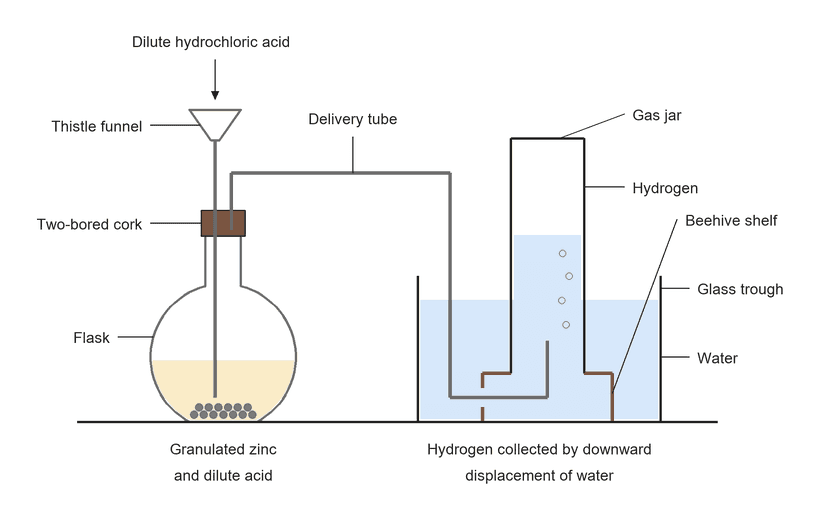
Let the first few bubbles escape (they are the air of the flask), and keep flames away from the apparatus.
Step 4 — (d) How and why it is collected.
Hydrogen is collected by downward displacement of water, because it is only sparingly soluble in water. It is not collected by displacing air, although it is lighter than air, because it forms an explosive mixture with air.
Step 5 — (e) A test for hydrogen.
Bring a burning splinter near the mouth of a test tube of the gas: the gas burns with a pop sound. (Pure hydrogen burns with a pale blue flame, and the water formed turns white anhydrous copper sulphate blue.)
Watch out: The thistle funnel's stem must dip below the acid level, or the hydrogen escapes through the funnel.
Therefore, granulated zinc and dilute hydrochloric acid give hydrogen, which is collected over water because it is sparingly soluble and explosive with air, and it burns with a pop.
- 305 marks
Question 30
The diagram given below shows electrolysis of water. Answer the following questions :
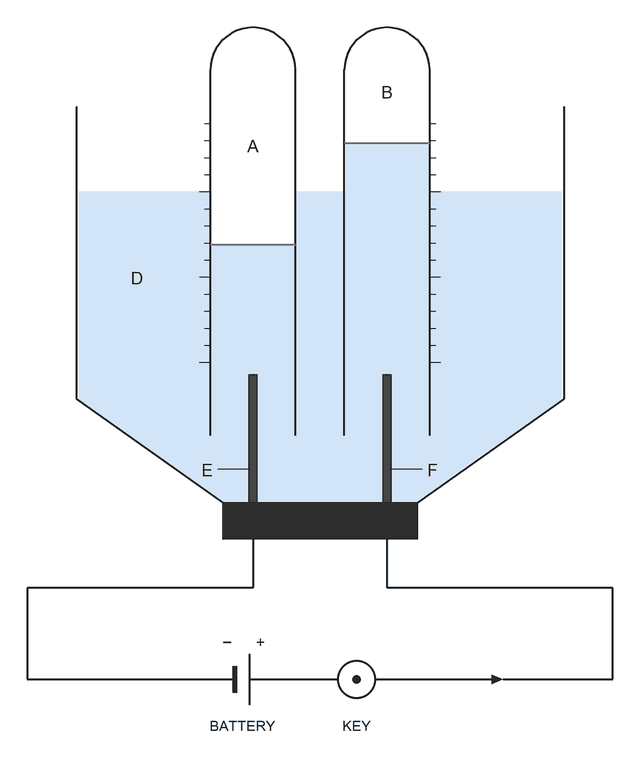
(a) Label A, B, C, D, E and F.
(b) Why is acidulated water used ?
(c) What is the ratio by volume for the gases collected ?
Solve with AIWritten solution
Solution:
Concept: In the electrolysis of acidulated water, hydrogen collects over the cathode (joined to the negative terminal) and oxygen over the anode, in the ratio 2 : 1 by volume.
Step 1 — Write the overall change.
The current splits water into hydrogen and oxygen; the equation shows 2 volumes of hydrogen for every 1 volume of oxygen:
Step 2 — (a) Read the diagram.
Electrode E is wired to the short (negative) plate of the battery, so E is the cathode and F is the anode. The tube over E holds twice as much gas as the tube over F.
- A – hydrogen gas
- B – oxygen gas
- C – no part of the printed diagram is marked C
- D – acidulated water (the electrolyte)
- E – cathode (negative platinum electrode)
- F – anode (positive platinum electrode)
Step 3 — (b) Why acidulated water is used.
Pure water contains very few ions, so it is a very poor conductor. A little dilute sulphuric acid supplies ions, so the water conducts and is decomposed. The acid is not used up.
Step 4 — (c) The ratio of the gases.
Two molecules of water give two molecules of hydrogen and one of oxygen, so the volumes are in the ratio 2 : 1.
Watch out: The larger volume of gas (hydrogen) always collects over the negative electrode.
Note: The question asks for a label C, but the printed diagram does not mark any part C.
Therefore, A is hydrogen, B oxygen, D acidulated water, E the cathode and F the anode; acidulated water is used so that the water conducts; and hydrogen : oxygen = 2 : 1 by volume.
What Class 8 Chemistry Ch 7 covers
The sections of the chapter, in the order the book takes them. Every question above comes from one of these.
- 01Occurrence
- 02Preparation of Hydrogen
- 03Electrolysis and Related Terms
- 04Laboratory Preparation of Hydrogen
- 05Manufacture of Hydrogen
- 06Properties of Hydrogen Gas
More ways to study this chapter
The same chapter asked three other ways. Practise it, revise it, and see what the board has set on Ch 7 before.
Class 8 Chemistry Ch 7 questions students ask
How many questions are there in Class 8 Chemistry Ch 7?
30 questions. Every one is solved step by step on this page.
Are these Class 8 Chemistry solutions free?
Yes. Every question and its full working is free to read, with no account needed.
Can I download the Class 8 Chemistry Ch 7 solutions as a PDF?
There is no PDF to download. Every solution is on this page instead, which means it is searchable, always the current syllabus, and readable on a phone. Use your browser's print option if you want it on paper.