Solution:
Concept: Granulated zinc reacts with dilute hydrochloric acid to give hydrogen, which is collected over water.
Step 1 — (a) Name the chemicals.
Zinc is above hydrogen in the reactivity series, so it displaces hydrogen from a dilute acid. The chemicals are granulated zinc and dilute hydrochloric acid (dilute sulphuric acid may be used instead).
Step 2 — (b) Write the equation.
Zinc displaces hydrogen from the acid and zinc chloride stays in solution:
Zn+2HCl→ZnCl2+H2↑
Step 3 — (c) Draw the apparatus.
The acid is poured through the thistle funnel, whose stem dips below the acid so that no gas escapes. The delivery tube starts just below the cork and carries the gas to a gas jar filled with water and inverted on a beehive shelf in a trough:
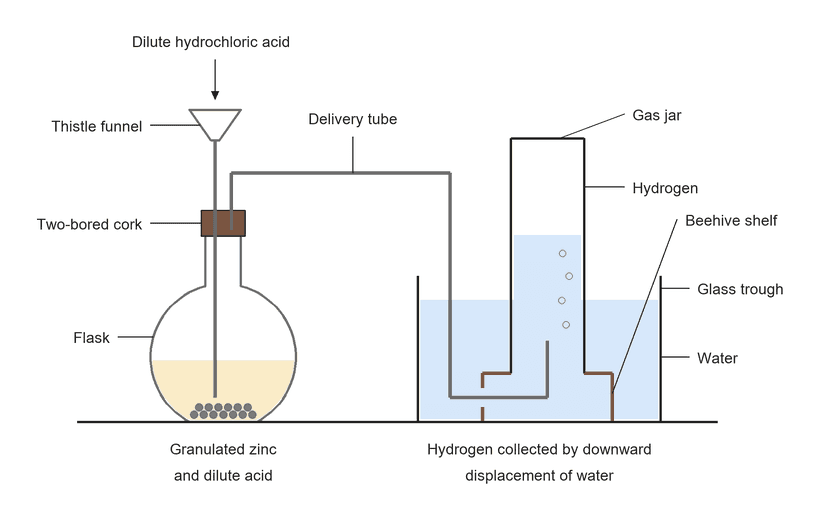
Let the first few bubbles escape (they are the air of the flask), and keep flames away from the apparatus.
Step 4 — (d) How and why it is collected.
Hydrogen is collected by downward displacement of water, because it is only sparingly soluble in water. It is not collected by displacing air, although it is lighter than air, because it forms an explosive mixture with air.
Step 5 — (e) A test for hydrogen.
Bring a burning splinter near the mouth of a test tube of the gas: the gas burns with a pop sound. (Pure hydrogen burns with a pale blue flame, and the water formed turns white anhydrous copper sulphate blue.)
Watch out: The thistle funnel's stem must dip below the acid level, or the hydrogen escapes through the funnel.
Therefore, granulated zinc and dilute hydrochloric acid give hydrogen, which is collected over water because it is sparingly soluble and explosive with air, and it burns with a pop.
