
Question 305 marksEasy
The diagram given below shows electrolysis of water. Answer the following questions :
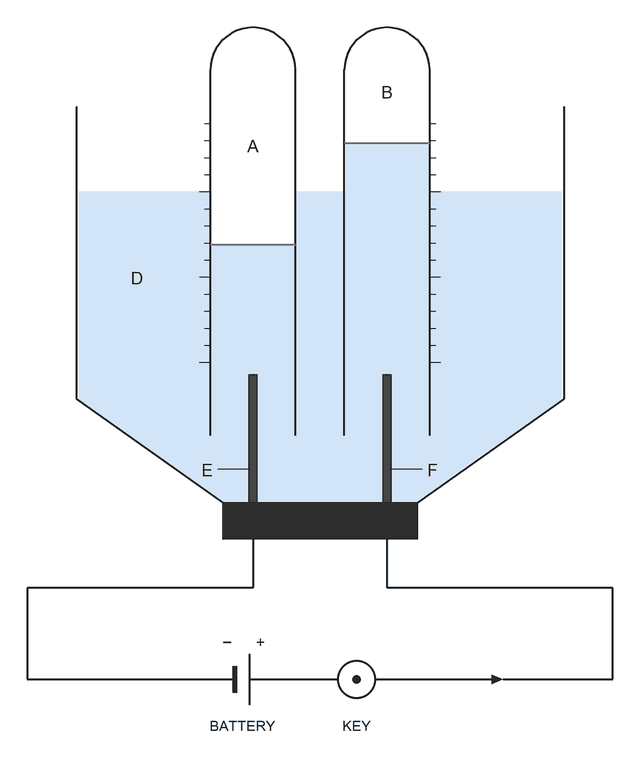
(a) Label A, B, C, D, E and F.
(b) Why is acidulated water used ?
(c) What is the ratio by volume for the gases collected ?
Confirming your payment
Sign up now and get 250 free tokens.
Hydrogen · Question 30 of 30
The diagram given below shows electrolysis of water. Answer the following questions :
(a) Label A, B, C, D, E and F.
(b) Why is acidulated water used ?
(c) What is the ratio by volume for the gases collected ?
Solution:
Concept: In the electrolysis of acidulated water, hydrogen collects over the cathode (joined to the negative terminal) and oxygen over the anode, in the ratio 2 : 1 by volume.
Step 1 — Write the overall change.
The current splits water into hydrogen and oxygen; the equation shows 2 volumes of hydrogen for every 1 volume of oxygen:
Step 2 — (a) Read the diagram.
Electrode E is wired to the short (negative) plate of the battery, so E is the cathode and F is the anode. The tube over E holds twice as much gas as the tube over F.
Step 3 — (b) Why acidulated water is used.
Pure water contains very few ions, so it is a very poor conductor. A little dilute sulphuric acid supplies ions, so the water conducts and is decomposed. The acid is not used up.
Step 4 — (c) The ratio of the gases.
Two molecules of water give two molecules of hydrogen and one of oxygen, so the volumes are in the ratio 2 : 1.
Watch out: The larger volume of gas (hydrogen) always collects over the negative electrode.
Note: The question asks for a label C, but the printed diagram does not mark any part C.
Therefore, A is hydrogen, B oxygen, D acidulated water, E the cathode and F the anode; acidulated water is used so that the water conducts; and hydrogen : oxygen = 2 : 1 by volume.