
Opening your dashboard
Class 8 Chemistry Chapter 7 Hydrogen: Competency-Based Questions (CBQ)
40 questions on Chapter 7, each worked through on its own page with the AI tutor. Class 8 Chemistry, ICSE 2026-27.
40 questions
1–5 marks · Mixed difficulty
- 11 mark
Question 1
Cognitive domain: Analysis
Tanvi is given small pieces of three metals, X, Y and Z, and records what each one does.
Metal In cold water When steam is passed over the heated metal In dilute hydrochloric acid X darts about on the surface and reacts violently; the water then turns red litmus blue not tried not tried (too dangerous) Y no visible change a gas that burns with a pop is given off; a solid oxide is left brisk bubbles of the same gas Z no change no change no change Which option could identify X, Y and Z correctly?
- 21 mark
Question 2
Cognitive domain: Application
Riya joins two graphite rods to a battery and a torch bulb. She dips the rods, in turn, into three liquids P, Q and R and watches the bulb.
Liquid Bulb P glows brightly Q glows dimly R does not glow The three liquids are sugar solution, sodium hydroxide solution and vinegar (acetic acid in water), but not in this order. Which option matches the liquids correctly?
- 31 mark
Question 3
Cognitive domain: Application
Kabir sets up a flask with granulated zinc, a thistle funnel and a delivery tube leading to a gas jar inverted over water. He pours in a little dilute hydrochloric acid. The zinc fizzes briskly, but the lower end of his thistle funnel stays above the surface of the acid in the flask. Almost no gas collects in the jar.
What is the most likely reason?
- 41 mark
Question 4
Cognitive domain: Understanding
In a plant that makes hydrogen by the Bosch process, gas samples can be drawn at four points. Water gas, formed in the first step, contains roughly equal volumes of carbon monoxide and hydrogen.
One sample is found to contain:
Gas Hydrogen Carbon monoxide Carbon dioxide Amount very large small none At which point was this sample drawn?
- 51 mark
Question 5
Cognitive domain: Understanding
Assertion (A): When steam is passed over red-hot iron, the iron is oxidised.
Reason (R): In this reaction, hydrogen is added to the iron.
- 61 mark
Question 6
Cognitive domain: Understanding
Assertion (A): In the Bosch process, the mixture of gases leaving the catalyst chamber can be passed through caustic potash solution.
Reason (R): Caustic potash solution reacts with carbon dioxide and so removes it from the mixture.
- 71 mark
Question 7
Cognitive domain: Understanding
In a demonstration, an electric current is passed through molten lead bromide, which is a strong electrolyte. Fill in the blanks.
The lead ions, , move towards the ________, which is the electrode joined to the ________ terminal of the battery. Ions that move to this electrode are called ________.
- 81 mark
Question 8
Cognitive domain: Recall
An astronomer tells a class, "The outer atmospheres of the sun and the stars consist largely of one element. Yet on the earth this element is found in the free state only in very small quantities, mainly in volcanic gases."
Name the element, and state why so little of it is found free on the earth.
- 91 mark
Question 9
Cognitive domain: Application
Anu drops a piece of magnesium ribbon into dilute sulphuric acid in a test tube. It fizzes. She holds a burning splinter at the mouth of the test tube.
Predict what she will observe. What would she observe if she repeated the test with a strip of copper in place of magnesium?
- 102 marks
Question 10
Cognitive domain: Application
After the summer holidays, a laboratory assistant finds that most of the kerosene in the bottle of sodium has evaporated. The top pieces of sodium are no longer covered, and the monsoon air is very damp.
(a) Explain, with an equation, why this is dangerous.
(b) What should he do at once, and why does this work?
- 112 marks
Question 11
Cognitive domain: Analysis
A teacher passes dry ammonia gas over heated black copper oxide. The black solid slowly turns reddish-brown, and drops of water collect in the cooler part of the tube.
(a) Which substance is reduced in this reaction? Give the reason.
(b) Riya says, "Ammonia is the reducing agent here, and it is itself oxidised." Use the equation to show that she is right.
- 122 marks
Question 12
Cognitive domain: Evaluation
A small company extracts copper by passing hydrogen over hot copper oxide. Its brochure says:
"We will soon use the very same method to obtain aluminium from aluminium oxide, on a large scale, cheaply and safely."
Evaluate this claim. Consider (a) whether the method will work for aluminium oxide, and (b) whether a large-scale plant of this kind can be called safe.
- 134 marks
Question 13
Cognitive domain: Analysis
Class 8 of a school prepares hydrogen in two flasks. Each flask has 5 g of zinc and 50 mL of the same dilute hydrochloric acid, at the same room temperature. Flask A has pure zinc and flask B has granulated zinc. In each case the gas is led through a delivery tube to a gas jar full of water, inverted over a beehive shelf in a trough of water. The group with flask B starts collecting the gas at the very first bubble and fills three jars, one after another.
Flask Zinc Time taken to fill one gas jar A pure zinc 12 minutes B granulated zinc 4 minutes (a) Name this method of collecting a gas. Which property of hydrogen makes it possible?
(b) The mass of zinc and the acid are the same. Explain why flask B fills a jar so much faster.
(c) When tested with a burning splinter, the first jar from flask B gives a loud pop, but the third jar burns quietly with a pale blue flame. Account for the difference, and state what the group should have done.
- 144 marks
Question 14
Cognitive domain: Application
In the 1930s, passengers crossed the Atlantic Ocean in airships, which were giant balloons filled with hydrogen. On 6 May 1937, the German airship Hindenburg caught fire while landing at Lakehurst in the USA and was destroyed in less than a minute. Hydrogen is still used to fill some weather balloons, which carry no people. Airships and balloons used near people are now filled with helium instead.
Gas Mass of 1 litre (about) Does it burn in air? Hydrogen 0.09 g yes Helium 0.18 g no Air 1.30 g — The load that 1 litre of a gas can lift in air = mass of 1 litre of air − mass of 1 litre of the gas.
(a) Which property of hydrogen made it useful for airships, and which property led to the disaster? Write the equation for the burning of hydrogen.
(b) Calculate the load that a 1000-litre weather balloon can lift when it is filled with hydrogen, and when it is filled with helium.
(c) Mihir says, "Helium is twice as heavy as hydrogen, so a helium balloon can lift only half the load." Use your answer to (b) to judge his statement, and explain why helium is now preferred for airships and for balloons used near people.
- 155 marks
Question 15
Cognitive domain: Creativity
The reactivity series places magnesium above zinc, and zinc above iron. Design an investigation to check this order in the school laboratory, using the fact that all three metals liberate hydrogen from dilute hydrochloric acid.
You are given magnesium ribbon, zinc foil, iron foil, a copper strip, sandpaper, dilute hydrochloric acid, three small flasks with one-holed stoppers and delivery tubes, a trough of water, measuring cylinders, a stopwatch and a balance.
Your plan should show:
(a) how you will set up the experiment, and what you will keep the same for the three metals;
(b) what you will measure, and how;
(c) the results you expect, with the equations;
(d) what you expect to see if the copper strip is tested in the same way, and one safety precaution with its reason.
- 161 mark
Question 16
Cognitive domain: Application
Because hydrogen is highly reactive, on the earth it occurs mainly in the combined state, as a part of compounds such as water, acids, alkalis and organic compounds. Arjun picks up four substances from his kitchen: water, common salt (sodium chloride), sugar (an organic compound made by plants) and vinegar (which contains acetic acid).
Which of the four substances contains no hydrogen, either free or combined?
- 171 mark
Question 17
Cognitive domain: Analysis
A student electrolyses acidulated water. She collects the gas over each electrode in a separate graduated tube and plots the volume of each gas against time. Gas Q is collected over the electrode that is joined to the positive terminal of the battery. (Hypothetical data.)
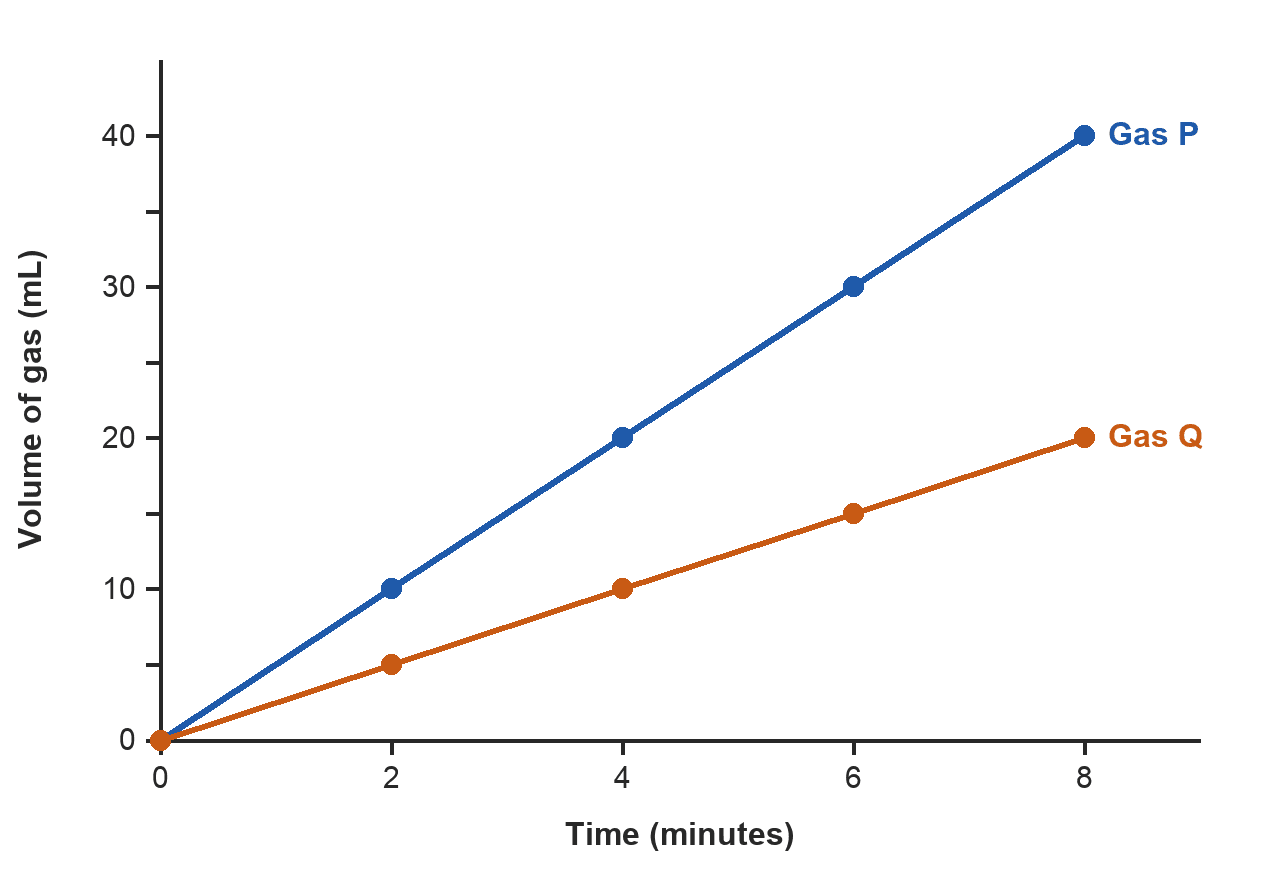
Which option correctly names gas P and gives the volumes of gas P and gas Q after 6 minutes?
- 181 mark
Question 18
Cognitive domain: Evaluation
A student writes four steps in her plan for preparing hydrogen in the laboratory from granulated zinc and dilute hydrochloric acid, collecting the gas over water.
Step What she plans to do A Fix the thistle funnel so that its lower end dips below the surface of the acid in the flask. B Fill the gas jar completely with water and invert it over the beehive shelf in the trough. C Let the first few bubbles of gas escape before placing the gas jar over the shelf. D Hold a burning splinter near the open end of the delivery tube all the time, to see when hydrogen starts to come out. Which step is unsafe and must be removed from the plan?
- 191 mark
Question 19
Cognitive domain: Application
In a demonstration, 500 mL of hydrogen is bubbled slowly into 2 litres of water at ordinary temperature and pressure. The gas is kept in contact with the water until no more of it dissolves. One litre of water dissolves about 20 mL of hydrogen under these conditions.
Which statement is correct?
- 201 mark
Question 20
Cognitive domain: Analysis
In diffused sunlight, hydrogen combines with an equal volume of greenish-yellow chlorine gas to form colourless hydrogen chloride gas. Three gas jars are filled with mixtures of the two gases in the volumes shown, measured under the same conditions. The jars are kept in diffused sunlight until the reaction stops. (Hypothetical data.)
Jar Hydrogen (mL) Chlorine (mL) P 40 40 Q 50 30 R 30 50 Which jar will still look greenish-yellow when the reaction has stopped?
- 211 mark
Question 21
Cognitive domain: Understanding
Assertion (A): In the second step of the Bosch process, the water gas is mixed with excess of steam before it is passed over the hot catalyst at 450 °C.
Reason (R): Steam reacts with the carbon monoxide of the water gas to form carbon dioxide and more hydrogen.
- 221 mark
Question 22
Cognitive domain: Analysis
When a solution of sodium chloride is mixed with a solution of silver nitrate, a white solid, silver chloride, forms. This is a double displacement reaction:
Assertion (A): This reaction is a redox reaction.
Reason (R): In a redox reaction, oxidation and reduction take place together.
- 231 mark
Question 23
Cognitive domain: Analysis
A student studies three reactions in which oxygen or hydrogen is added to a substance:
Reaction I
Reaction II
Reaction III
Which statement about these reactions is correct?
- 241 mark
Question 24
Cognitive domain: Application
Hydrogen and oxygen combine in the ratio of 2 volumes to 1 volume, which is the same ratio in which they are collected when water is electrolysed. The mixture of the two gases in this ratio is called the detonating mixture. About one-fifth of the volume of air is oxygen.
A gas jar contains 20 mL of hydrogen, and air is allowed to mix with it. What volume of air contains just enough oxygen to burn all the 20 mL of hydrogen?
- 251 mark
Question 25
Cognitive domain: Application
Hydrogen is used on a large scale to make ammonia, which in turn is used to produce fertilisers. In the presence of iron as a catalyst, at 450 °C and 200 atmospheres, hydrogen and nitrogen combine in the ratio 3 : 1 by volume. A fertiliser plant has 90 m³ of hydrogen and 40 m³ of nitrogen, measured under the same conditions. (Hypothetical data.)
Assume that the two gases go on combining until one of them is used up. Which statement is then correct?
- 262 marks
Question 26
Cognitive domain: Understanding
Neha writes three notes about hydrogen in her notebook.
Note 1: Hydrogen was given its name, meaning "water producer", by Henry Cavendish.
Note 2: A molecule of hydrogen has only one atom, so its formula is .
Note 3: Hydrogen is the lightest of all the elements.
Two of the three notes contain a mistake. Find the two notes and correct them.
- 272 marks
Question 27
Cognitive domain: Application
Water gas, the mixture of carbon monoxide and hydrogen made in the first step of the Bosch process, is itself used as a fuel.
(a) Write a balanced equation for the burning of each of its two gases in oxygen.
(b) A newspaper says that burning water gas is as free from pollution as burning pure hydrogen. Use your equations to say whether this is correct.
- 282 marks
Question 28
Cognitive domain: Application
Hydrogen cannot be easily liquefied. It changes into a colourless liquid only when it is cooled to about −240 °C or below and, at the same time, compressed to about 20 atmospheres. At ordinary atmospheric pressure (1 atmosphere), it becomes a liquid only at about −253 °C. A research laboratory keeps hydrogen in three closed cylinders under the conditions shown. (Hypothetical data.)
Cylinder Temperature Pressure X −245 °C 20 atmospheres Y −200 °C 50 atmospheres Z −245 °C 1 atmosphere (a) In which cylinder is the hydrogen a liquid?
(b) Explain why the hydrogen in each of the other two cylinders is still a gas.
- 292 marks
Question 29
Cognitive domain: Application
Water is the most important compound of hydrogen on the earth, and it covers more than 70 % of the earth's surface. A bottle holds 900 g of water. (H = 1, O = 16)
(a) Find the mass of hydrogen combined in the 900 g of water.
(b) All the water is split completely by electrolysis into hydrogen and oxygen. Find the mass of oxygen obtained, and show that the masses agree with the law of conservation of mass.
- 302 marks
Question 30
Cognitive domain: Analysis
In a teacher's demonstration, a shiny reddish-brown copper wire is heated strongly in air and turns black. After all the air in the tube has been driven out by hydrogen, the hot black wire is heated in a stream of dry hydrogen. It turns reddish-brown again, and drops of a colourless liquid collect on the cool part of the tube.
(a) Name the black substance and write the equation for its formation. Is copper oxidised or reduced in this step?
(b) Write the equation for the second step, using the same number of copper atoms as in part (a). Add the two equations to find the overall change. Which substance is finally oxidised, and what has happened to the copper at the end?
- 312 marks
Question 31
Cognitive domain: Application
A workshop owner wants to cut and weld pieces of four metals with an oxyhydrogen flame, which has a temperature of about 2800 °C to 3000 °C. The approximate melting points of the metals are given in the table.
Metal Melting point (°C) Aluminium 660 Copper 1085 Iron 1538 Tungsten 3422 (a) Which of these metals can be cut or welded with this flame? Give the reason.
(b) Why can the flame not be used for the other metal?
- 323 marks
Question 32
Cognitive domain: Evaluation
A student electrolyses acidulated water in a cell with two electrodes, A and B. A graduated tube is inverted over each electrode. Electrode A is joined to the negative terminal of the battery and electrode B to the positive terminal. After the current has flowed for some time, tube A holds 20 mL of gas and tube B holds 10 mL of gas.
Without removing the tubes, she then interchanges the two connections to the battery, so that electrode A is joined to the positive terminal and electrode B to the negative terminal, and passes the current for the same length of time again. Ignore any gas that dissolves in the water, and assume that the gases in a tube do not react with each other. (Hypothetical data.)
(a) Name the gas in each tube at the end of the first period.
(b) Name the gas formed in each tube during the second period, and give its volume.
(c) Evaluate the student's decision: what does each tube hold at the end, and why should no burning splinter be brought near either tube?
- 333 marks
Question 33
Cognitive domain: Analysis
A yellow oxide of lead, lead monoxide, is heated in a stream of dry hydrogen until it has changed completely into grey lead. The lead formed has a mass of 20.7 g, and 1.8 g of water is collected in the cool part of the apparatus. (H = 1, O = 16, Pb = 207)
(a) All the oxygen in the water came from the lead monoxide. Find the mass of this oxygen.
(b) Find the mass of lead monoxide that was heated.
(c) Show that the masses of lead monoxide, lead and water agree with the equation, and name the substance that is reduced.
- 343 marks
Question 34
Cognitive domain: Evaluation
A state wants to make hydrogen on a large scale for its fertiliser plants. Two proposals are placed before an expert committee.
Proposal 1 Proposal 2 Method Bosch process Electrolysis of acidulated water Starting materials Coke and steam Water with a little sulphuric acid, and electricity Conditions Furnace at 1000 °C, then a catalyst chamber at 450 °C An electric current passed through the water (a) Name the other gases that are formed along with hydrogen in each proposal.
(b) State one chemical advantage of Proposal 2 over Proposal 1.
(c) Evaluate the two proposals and recommend one, giving a reason based on the chemistry.
- 353 marks
Question 35
Cognitive domain: Application
A class needs hydrogen to fill 8 gas jars of 250 mL each. The teacher uses granulated zinc and dilute hydrochloric acid. Under the conditions in the laboratory, 1 litre of hydrogen has a mass of 0.08 g. (H = 1, Cl = 35.5, Zn = 65)
(a) Find the volume of hydrogen needed in litres, and its mass.
(b) Find the least mass of zinc needed.
(c) Find the least mass of hydrogen chloride needed.
- 363 marks
Question 36
Cognitive domain: Creativity
Your teacher asks you to build a model, using two colours of beads, to show how water is split by electrolysis. Use a white bead for a hydrogen atom, a red bead for an oxygen atom, and a short piece of string to join two atoms in a molecule.
(a) How many beads of each colour and how many pieces of string do you need to show two molecules of water?
(b) Describe how you would rearrange the beads to show the products of the electrolysis. How many molecules of each product does your model show?
(c) Use your model to explain why the number of atoms of each kind does not change, and why the volumes of hydrogen and oxygen collected are in the ratio 2 : 1. (Equal volumes of gases at the same temperature and pressure contain equal numbers of molecules.)
- 374 marks
Question 37
Cognitive domain: Application
Some space rockets use liquid hydrogen as the fuel and liquid oxygen, called LOX, to burn it. The two liquids are carried in tanks inside the rocket. When they are fed to the engine, they burn, and the very hot steam that is formed rushes out of the nozzle and pushes the rocket upwards. A test stage of a rocket burns 4000 kg of liquid hydrogen. (Hypothetical data.) (H = 1, O = 16)
(a) Write the balanced equation for the burning of hydrogen in oxygen, and say why this reaction is suitable for a rocket.
(b) Find the mass of liquid oxygen needed to burn the 4000 kg of hydrogen, and the mass of steam formed. Show that the masses obey the law of conservation of mass.
(c) Engineers take great care to stop any leak from the tanks. Explain why a leak is dangerous, and name one thing that must be kept away from the tanks.
- 384 marks
Question 38
Cognitive domain: Evaluation
In a factory, groundnut oil is changed into vanaspati ghee by passing hydrogen through the hot oil in the presence of finely divided nickel. In a trial, technicians used the same amount of oil, the same temperature and the same flow of hydrogen each time. They weighed the nickel before the trial and weighed what they could recover afterwards. (Hypothetical data.)
Trial Mass of nickel added (g) Time taken Mass of nickel recovered (g) 1 0 Not complete even after 48 hours not applicable 2 2.0 6 hours 2.0 3 4.0 3 hours 4.0 (a) Name the process by which oil is changed into vanaspati ghee, and name two other metals that can be used as the catalyst in place of nickel.
(b) State two conclusions about the nickel that you can draw from the table.
(c) A student says: "Nickel is used up in the reaction and becomes part of the ghee, so fresh nickel has to be added every time." Evaluate this statement using the data.
- 395 marks
Question 39
Cognitive domain: Analysis
Four strips of equal size, one each of copper and of three other metals, M1, M2 and M3, are dropped into separate test tubes holding the same dilute hydrochloric acid at the same temperature. The gas given off is collected over water, and the volume of hydrogen is plotted against time. The three other metals are magnesium, zinc and iron, but not necessarily in this order. (Hypothetical data.)
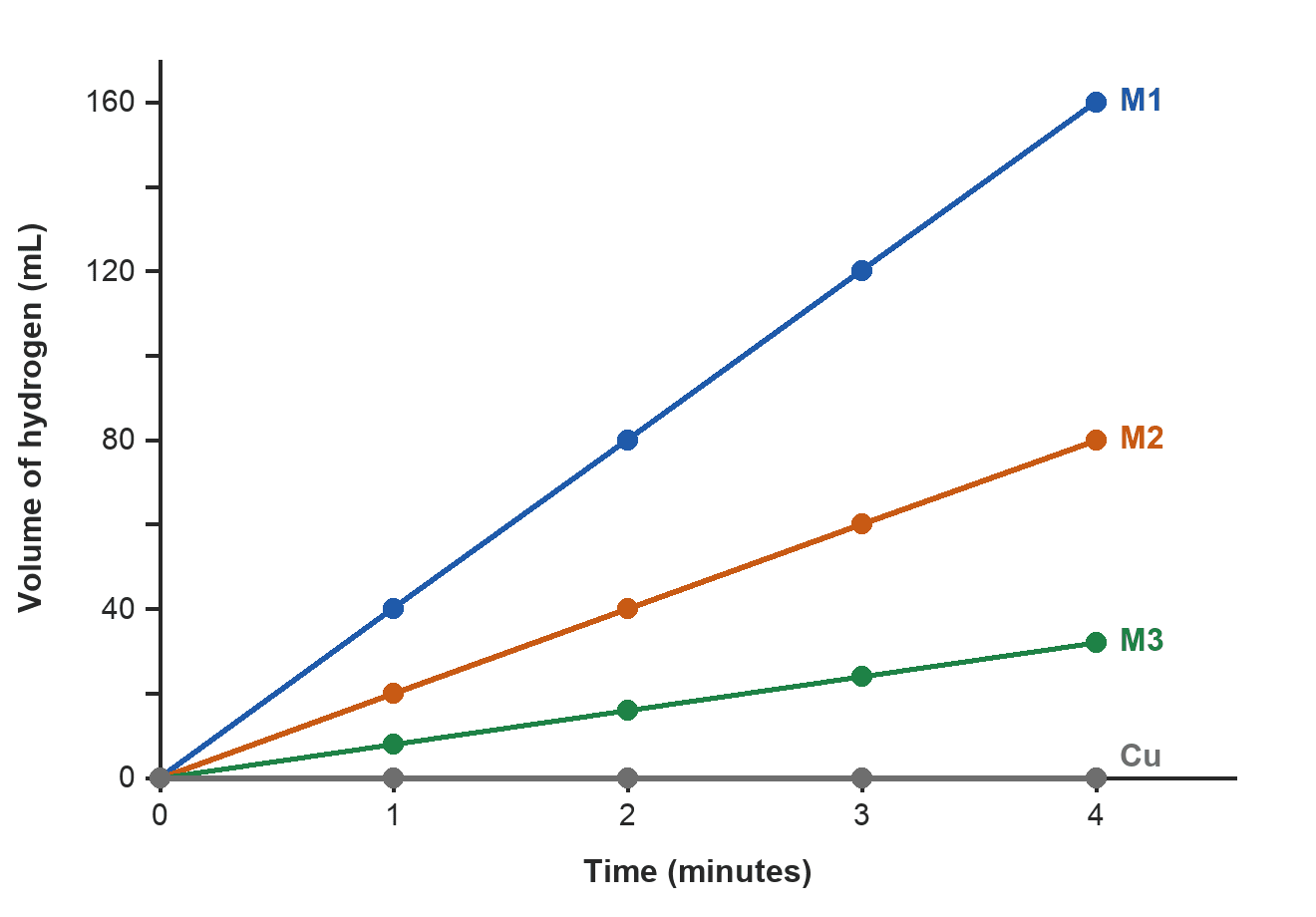
(a) Arrange the four metals in the order of decreasing reactivity with the acid.
(b) Identify M1, M2 and M3, giving your reason.
(c) Find the rate at which M2 gives hydrogen, in mL per minute. How long will M1 take to collect 100 mL of hydrogen at its rate?
(d) Explain why the line for copper lies along the time axis, and write the balanced equation for the reaction of M3 with dilute hydrochloric acid.
- 405 marks
Question 40
Cognitive domain: Creativity
Your school laboratory has run out of dilute acid. It has magnesium ribbon, sandpaper, a Bunsen burner, a hard glass test tube, mineral wool, water, a trough with a beehive shelf, gas jars, a stopper with a delivery tube, a clamp stand and safety goggles. Plan an experiment to prepare hydrogen from steam and magnesium.
Your plan should show:
(a) how you will arrange the apparatus: where the steam comes from, and where the magnesium is placed;
(b) the steps you will follow, from setting up the apparatus to collecting the gas;
(c) what you expect to see, and the balanced equation for the reaction, naming the solid left behind;
(d) two safety precautions, each with its reason, and how you will test the gas.