
Opening your dashboard
Class 8 Biology Chapter 3: Reproduction in Humans Solutions
26 textbook questions with step-by-step answers, free to read, for ICSE 2026-27.
Get talked through Ch 3, not just shown the answer
Reading a finished solution is not the same as being able to do it. The AI tutor takes one question at a time and works it with you, in your own words, until you can.
- Ask it out loud, in your own words
- It gives you the next step, not the answer
- Stuck on part (ii)? Start there
26 questions with solutions
1–12 marks · Mixed difficulty
- 11 mark
Question 1
The testes are located within the :
Solve with AIAnswer
(A) Penis
- Correct
(B) Scrotum
(C) Ureter
(D) Urinary bladder
Answer: (B) Scrotum
Concept: In the male, sperms are made in the testes (inside the scrotum), stored in the epididymis, carried by the sperm duct (vas deferens) and leave through the urethra in the penis. The seminal vesicles, prostate gland and Cowper's glands add fluids that form semen.
Step 1 — Recall where the testes lie.
The pair of testes lies outside the abdomen in a skin pouch called the scrotum.
Step 2 — Why there.
In the scrotum the testes are kept about 2–3 °C cooler than the body, which suits sperm formation. So the answer is option (B).
Watch out: The testes are not inside the abdomen; only the scrotum holds them.
Why the other options are wrong:
- (A) Penis: the penis carries the urethra; it does not hold the testes.
- (C) Ureter: the ureter is a tube of the excretory system that carries urine from a kidney to the bladder.
- (D) Urinary bladder: the urinary bladder stores urine; it is part of the excretory system, not where the testes lie.
Therefore, the testes are located within the scrotum, option (B).
- 21 mark
Question 2
Amoeba most commonly reproduces by :
Solve with AIAnswer
(A) Budding
(B) Regeneration
- Correct
(C) Binary fission
(D) Multiple fission
Answer: (C) Binary fission
Concept: Binary fission means splitting into two: the parent cell divides into two daughter cells, first its nucleus and then its cytoplasm. It is the usual way a single-celled organism like Amoeba reproduces.
Step 1 — Recall how Amoeba reproduces.
When it is fully grown and food is plentiful, an Amoeba divides into two daughter amoebae.
Step 2 — Name the process.
This splitting into two is binary fission, option (C).
Watch out: Multiple fission also happens in Amoeba, but only now and then, inside a cyst in bad conditions.
Why the other options are wrong:
- (A) Budding: budding is seen in Hydra and yeast, where a small outgrowth forms on the parent.
- (B) Regeneration: regeneration is the growth of a new individual from a body piece, as in Planaria; it is not Amoeba's usual method.
- (D) Multiple fission: multiple fission (many daughters at once) happens only sometimes, in unfavourable conditions; it is not the most common method.
Therefore, Amoeba most commonly reproduces by binary fission, option (C).
- 31 mark
Question 3
Which of the following is a stage formed after the fertilisation of the egg by a sperm ?
Solve with AIAnswer
(A) Ovule
(B) Foetus
(C) Embryo
- Correct
(D) Zygote
Answer: (D) Zygote
Concept: Fertilisation is the fusion of a sperm with an egg. The single cell it forms is the zygote, which then divides to form the embryo, and the embryo grows into the foetus.
Step 1 — Recall what fertilisation forms.
When the sperm nucleus fuses with the egg nucleus, one new cell is formed straight away: the zygote.
Step 2 — Pick the option.
The zygote is the stage formed right after fertilisation, option (D).
Watch out: Order the stages: zygote → embryo → foetus → baby.
Why the other options are wrong:
- (A) Ovule: an ovule is a part of a flower's ovary; it is not a stage in human development.
- (B) Foetus: the foetus is a much later stage that grows from the embryo.
- (C) Embryo: the embryo forms from the zygote by repeated cell division, so it comes after the zygote.
Therefore, the stage formed after fertilisation is the zygote, option (D).
- 41 mark
Question 4
Internally, the uterus opens into :
Solve with AIAnswer
(A) Urethra
- Correct
(B) Vagina
(C) Oviduct
(D) Vulva
Answer: (B) Vagina
Concept: In the female, the ovaries make eggs (ova); an oviduct (fallopian tube) carries each egg towards the uterus; the lower narrow neck of the uterus is the cervix, which opens into the vagina.
Step 1 — Follow the uterus downwards.
The lower, narrow part of the uterus is the cervix.
Step 2 — See where it opens.
The cervix opens into the vagina, a muscular tube that leads to the outside. So the answer is option (B).
Watch out: The oviducts open into the uterus at its upper end; the uterus itself opens below into the vagina.
Why the other options are wrong:
- (A) Urethra: the urethra carries urine from the bladder; the uterus does not open into it.
- (C) Oviduct: the oviducts open into the uterus at its upper end; the uterus does not open into them.
- (D) Vulva: the vulva is the external region; the uterus reaches it only through the vagina.
Therefore, internally, the uterus opens into the vagina, option (B).
- 51 mark
Question 5
There are many specific cellular structures involved in the process of reproduction in humans, like :
-
Gametes
-
Foetus
-
Zygote
-
Embryo
Which of these start resembling with the parents ?
Solve with AIAnswer
(A) Only 1
(B) Only 2 and 3
- Correct
(C) Only 2
(D) Only 3 and 4
Answer: (C) Only 2
Concept: After fertilisation, the zygote divides to form the embryo, a ball of cells. As its organs form, the embryo becomes a foetus, and only then does it begin to look like a small human, resembling its parents.
Step 1 — Check each structure.
Gametes (1) and the zygote (3) are single cells. The early embryo (4) is a ball of cells with no body shape yet.
Step 2 — Find the one with a body form.
At the foetus stage (2), the body parts are formed and the young one starts to look like its parents. So the answer is option (C).
Watch out: A single cell or a ball of cells cannot "look like" the parents; a body form is needed.
Why the other options are wrong:
- (A) Only 1: gametes (sperm and egg) are single cells and do not resemble the parents.
- (B) Only 2 and 3: the foetus does, but the zygote is a single cell and does not.
- (D) Only 3 and 4: the zygote is a single cell and the early embryo is only a ball of cells; neither resembles the parents.
Therefore, only the foetus starts resembling the parents, option (C).
-
- 61 mark
Question 6
Which of the following statements is incorrect ?
Solve with AIAnswer
(A) Eggs and sperms are the reproductive gametes.
(B) Fertilization occurs before implantation.
(C) Epididymis is the highly coiled structure found on the upper side of the testis.
- Correct
(D) Gestation period in humans is 820 days.
Answer: (D) Gestation period in humans is 820 days.
Concept: The question asks for the incorrect statement, so check each statement and pick the false one. In humans the gestation period (the time the baby develops in the uterus) is about 280 days (about 9 months).
Step 1 — Check the number in (D).
The statement gives 820 days, which is more than two years. The real gestation period is about 280 days, so (D) is false; the digits look swapped.
Step 2 — Pick the option.
Since the question asks for the incorrect statement, the answer is option (D).
Watch out: In a "which is incorrect" question, the correct statements are the wrong choices.
Why the other options are wrong:
- (A) Eggs and sperms are the reproductive gametes: this statement is correct: eggs and sperms are the gametes.
- (B) Fertilization occurs before implantation: this statement is correct: the zygote is formed in the oviduct and only later implants in the uterus wall.
- (C) Epididymis is the highly coiled structure found on the upper side of the testis: this statement is correct: the epididymis is a highly coiled tube lying on the upper side of the testis.
Therefore, the incorrect statement is (D): the gestation period is about 280 days, not 820, option (D).
- 71 mark
Question 7
Assertion (A): Reproduction is a kind of life process which is not necessary for the survival of humans in their own lifetime.
Reason (R): The process of reproduction helps in the continuation of species on earth, not an individual.
Solve with AIAnswer
- Correct
(A) (1) Both A and R are true and R is the correct explanation of A.
(B) (2) Both A and R are true but R is not the correct explanation of A.
(C) (3) A is true but R is false.
(D) (4) A is false but R is true.
Answer: (A) (1) Both A and R are true and R is the correct explanation of A.
Concept: In an assertion-reason item, first judge the Assertion (A) and the Reason (R) separately as true or false; only when both are true do we ask whether R correctly explains A.
Step 1 — Judge the Assertion.
A is true. An individual can live its whole life without reproducing; breathing, feeding and excretion keep it alive, but reproduction does not.
Step 2 — Judge the Reason.
R is true. Reproduction makes new individuals, so it keeps the species going on earth after the old individuals die.
Step 3 — Does R explain A?
Yes. Reproduction is not needed by the individual because its purpose is the continuation of the species. So the answer is option (A).
Watch out: Reproduction is a life process for the species, not for the survival of one individual.
Why the other options are wrong:
- (B) (2) Both A and R are true but R is not the correct explanation of A: R does explain A: it gives the reason reproduction is not needed for the individual's survival.
- (C) (3) A is true but R is false: R is true: reproduction does continue the species.
- (D) (4) A is false but R is true: A is true: an individual can survive without reproducing.
Therefore, both A and R are true and R is the correct explanation of A, option (A).
- 81 mark
Question 8
Assertion (A): Budding is a type of asexual reproduction which occurs only in some plants.
Reason (R): Both Yeast and Hydra, reproduce by the process of budding.
Solve with AIAnswer
(A) (1) Both A and R are true and R is the correct explanation of A.
(B) (2) Both A and R are true but R is not the correct explanation of A.
(C) (3) A is true but R is false.
- Correct
(D) (4) A is false but R is true.
Answer: (D) (4) A is false but R is true.
Concept: In an assertion-reason item, first judge the Assertion (A) and the Reason (R) separately as true or false; only when both are true do we ask whether R correctly explains A.
Step 1 — Judge the Assertion.
A is false. Budding is asexual, but it does not happen only in some plants: the animal Hydra also reproduces by budding.
Step 2 — Judge the Reason.
R is true. Yeast and Hydra both reproduce by budding.
Step 3 — Pick the option.
A is false and R is true, so the answer is option (D).
Watch out: Watch for the word "only": one example from another group makes the statement false.
Note: Yeast is grouped with plants in older books, but it is a fungus.
Why the other options are wrong:
- (A) (1) Both A and R are true and R is the correct explanation of A: A is false, so both cannot be true.
- (B) (2) Both A and R are true but R is not the correct explanation of A: A is false, so both cannot be true.
- (C) (3) A is true but R is false: this says A is true and R is false; in fact A is false and R is true.
Therefore, A is false but R is true, option (D).
- 91 mark
Question 9
Assertion (A): Only one egg is produced by each ovary in human females every month.
Reason (R): Usually, both ovaries do not release egg in the same month.
Solve with AIAnswer
(A) (1) Both A and R are true and R is the correct explanation of A.
(B) (2) Both A and R are true but R is not the correct explanation of A.
(C) (3) A is true but R is false.
- Correct
(D) (4) A is false but R is true.
Answer: (D) (4) A is false but R is true.
Concept: In an assertion-reason item, first judge the Assertion (A) and the Reason (R) separately as true or false; only when both are true do we ask whether R correctly explains A.
Step 1 — Judge the Assertion.
A is false. Normally only one egg is released each month in all, by one of the two ovaries; each ovary does not release an egg every month.
Step 2 — Judge the Reason.
R is true. Usually both ovaries do not release an egg in the same month. (Rarely both do, which can give non-identical twins.)
Step 3 — Pick the option.
A is false and R is true, so the answer is option (D).
Watch out: "One egg every month" is the total for both ovaries, not one egg from each.
Why the other options are wrong:
- (A) (1) Both A and R are true and R is the correct explanation of A: A is false, so R cannot explain it.
- (B) (2) Both A and R are true but R is not the correct explanation of A: A is false, so both cannot be true.
- (C) (3) A is true but R is false: this says A is true and R is false; in fact A is false and R is true.
Therefore, A is false but R is true, option (D).
- 101 mark
Question 10
Assertion (A): Sperms are produced in testes and transported to urethra through the fallopian tubes in males.
Reason (R): On their way to urethra, sperms mix with three kinds of fluids released by the male accessory glands to form semen, the reproductive fluid.
Solve with AIAnswer
(A) (1) Both A and R are true and R is the correct explanation of A.
(B) (2) Both A and R are true but R is not the correct explanation of A.
(C) (3) A is true but R is false.
- Correct
(D) (4) A is false but R is true.
Answer: (D) (4) A is false but R is true.
Concept: In an assertion-reason item, first judge the Assertion (A) and the Reason (R) separately as true or false; only when both are true do we ask whether R correctly explains A.
Step 1 — Judge the Assertion.
A is false. Sperms are produced in the testes, but they reach the urethra through the epididymis and the sperm ducts (vasa deferentia). Fallopian tubes are found only in females.
Step 2 — Judge the Reason.
R is true. On the way, the sperms mix with the secretions of three accessory glands, the seminal vesicles, prostate gland and Cowper's glands, to form semen.
Step 3 — Pick the option.
A is false and R is true, so the answer is option (D).
Watch out: The fallopian tube (oviduct) is a female organ; the male tube is the sperm duct.
Why the other options are wrong:
- (A) (1) Both A and R are true and R is the correct explanation of A: A is false, so both cannot be true.
- (B) (2) Both A and R are true but R is not the correct explanation of A: A is false, so both cannot be true.
- (C) (3) A is true but R is false: this says A is true and R is false; in fact A is false and R is true.
Therefore, A is false but R is true, option (D).
- 111 mark
Question 11
Assertion (A): Growth is the characteristic feature of all living beings which occurs for a limited time in animals and throughout lifetime in plants.
Reason (R): Growth means any type of reversible or irreversible change in the size, shape and weight of an individual during the process of development.
Solve with AIAnswer
(A) (1) Both A and R are true and R is the correct explanation of A.
(B) (2) Both A and R are true but R is not the correct explanation of A.
- Correct
(C) (3) A is true but R is false.
(D) (4) A is false but R is true.
Answer: (C) (3) A is true but R is false.
Concept: In an assertion-reason item, first judge the Assertion (A) and the Reason (R) separately as true or false; only when both are true do we ask whether R correctly explains A.
Step 1 — Judge the Assertion.
A is true. Growth is a feature of all living beings. Animals grow only up to a certain age, while plants keep growing throughout their life.
Step 2 — Judge the Reason.
R is false. Growth is a permanent (irreversible) increase in size and weight. A reversible change, such as a cell swelling with water and shrinking again, is not growth.
Step 3 — Pick the option.
A is true and R is false, so the answer is option (C).
Watch out: The key word in R is "reversible": growth cannot be reversed.
Why the other options are wrong:
- (A) (1) Both A and R are true and R is the correct explanation of A: R is false, so it cannot explain A.
- (B) (2) Both A and R are true but R is not the correct explanation of A: R is false, so both cannot be true.
- (D) (4) A is false but R is true: A is true, not false.
Therefore, A is true but R is false, option (C).
- 122 marks
Question 12
Arrange the following terms in a logical sequence.
(a) Gestation, Birth, Fertilization, Implantation
(b) Urethra, Epididymis, Sperm duct, Testis
Solve with AIWritten solution
Solution:
Concept: Put events in the order in which they happen, and organs in the order in which the sperms pass through them.
Step 1 — (a) Events after mating.
First the sperm fuses with the egg (fertilisation); the embryo then fixes itself in the uterus wall (implantation); it develops there for about nine months (gestation); and finally the baby is born (birth).
Step 2 — (b) Path of the sperms.
Sperms are made in the testis, stored in the epididymis, carried by the sperm duct and leave through the urethra.
Watch out: Implantation comes before gestation, because the embryo must be fixed in the uterus before it can develop.
Therefore, (a) Fertilization → Implantation → Gestation → Birth; (b) Testis → Epididymis → Sperm duct → Urethra.
- 134 marks
Question 13
Choose the odd one out and mention the category to which the remaining terms belong.
(a) Testis, Uterus, Vas deferens, Epididymis
(b) Ovary, Uterus, Seminal vesicle, Oviduct
(c) Vagina, Seminal vesicle, Cowper's gland, Prostate gland
(d) Amoeba, Hydra, Paramecium, Bacteria
Solve with AIWritten solution
Solution:
Concept: In each set, three terms belong to one group and one does not. Name the odd term and the group the other three share.
Step 1 — (a).
Testis, vas deferens and epididymis are parts of the male reproductive system. The uterus is a female organ, so it is the odd one out.
Step 2 — (b).
Ovary, uterus and oviduct are parts of the female reproductive system. The seminal vesicle is a male gland, so it is the odd one out.
Step 3 — (c).
Seminal vesicle, Cowper's gland and prostate gland are the accessory glands of the male reproductive system. The vagina is a female organ, so it is the odd one out.
Step 4 — (d).
Amoeba, Paramecium and bacteria are unicellular organisms that reproduce by fission. Hydra is many-celled, so it is the odd one out.
Therefore, the odd ones are (a) uterus (rest male parts), (b) seminal vesicle (rest female parts), (c) vagina (rest male accessory glands), (d) Hydra (rest unicellular).
- 141 mark
Question 14
List the structures, in their correct sequence, through which the sperms must pass from the time they are produced in the testes to the time they leave the urethra.
Solve with AIWritten solution
Solution:
Concept: In the male, sperms are made in the testes (inside the scrotum), stored in the epididymis, carried by the sperm duct (vas deferens) and leave through the urethra in the penis. The seminal vesicles, prostate gland and Cowper's glands add fluids that form semen.
Step 1 — Start where sperms are made.
Sperms are produced in the testes.
Step 2 — Follow the ducts.
They move into the epididymis, where they are stored and mature, then along the sperm duct (vas deferens), and finally through the urethra in the penis to the outside.
Watch out: The urethra is the last tube; the sperm duct joins it, not the other way round.
Therefore, the sequence is testes → epididymis → sperm duct (vas deferens) → urethra.
- 154 marks
Question 15
Define the following terms :
(a) Fertilization
(b) Implantation
Solve with AIWritten solution
Solution:
Concept: Fertilisation joins the two gametes into a zygote; implantation is when the young embryo fixes itself in the uterus wall, where it will develop.
Step 1 — (a) Fertilization.
Fertilization is the fusion of the nucleus of a sperm with the nucleus of an egg (ovum) to form a zygote. In humans it takes place in the oviduct.
Step 2 — (b) Implantation.
Implantation is the fixing of the embryo (the ball of cells formed from the zygote) in the wall of the uterus. Pregnancy begins with it.
Watch out: Fertilisation happens in the oviduct, not in the uterus.
Therefore, fertilisation is the fusion of sperm and egg nuclei to form a zygote, and implantation is the fixing of the embryo in the uterus wall.
- 166 marks
Question 16
Distinguish between the following pairs of terms :
(a) Egg and sperm
(b) Sexual reproduction and asexual reproduction
(c) Budding and regeneration
Solve with AIWritten solution
Solution:
Concept: Compare each pair point by point, writing matching features side by side.
Step 1 — (a) Egg and sperm.
The two gametes differ in where they are made, size and movement.
Egg (ovum) Sperm Female gamete, produced in the ovary. Male gamete, produced in the testis. Large and round; cannot move on its own. Very small, with a tail; swims actively. Step 2 — (b) Sexual and asexual reproduction.
They differ in the number of parents and in the use of gametes.
Sexual reproduction Asexual reproduction Two parents (male and female) are involved. Only one parent is involved. Gametes (sperm and egg) are formed and fuse. No gametes are formed; no fusion takes place. Step 3 — (c) Budding and regeneration.
They differ in how the new individual starts.
Budding Regeneration A bud grows on the parent's body and later separates as a new individual. A new individual (or a lost part) grows from a cut or broken piece of the body. Example: Hydra, yeast. Example: Planaria, Hydra, starfish. Therefore, the egg is large and still while the sperm is small and swims; sexual reproduction needs two parents and gametes while asexual needs one; budding grows a bud while regeneration grows from a body piece.
- 172 marks
Question 17
State the reason why testes lie outside the abdomen in a scrotum ?
Solve with AIWritten solution
Solution:
Concept: Sperms form best at a temperature a little below normal body temperature.
Step 1 — The scrotum is cooler.
Because the scrotum hangs outside the abdomen, the testes inside it stay about 2–3 °C cooler than the body.
Step 2 — Why this matters.
This lower temperature is the most suitable for the production and development of sperms; at full body temperature, sperm formation is poor.
Therefore, the testes lie in the scrotum to keep them 2–3 °C cooler, which sperm formation needs.
- 182 marks
Question 18
Why is it important that a very large number of sperms should be present in the semen ?
Solve with AIWritten solution
Solution:
Concept: Only one sperm is needed to fertilise the egg, but the journey to the egg is long and most sperms are lost on the way.
Step 1 — Most sperms are lost.
Out of the millions of sperms released into the vagina, only a few reach the upper part of the oviduct, where the egg is. The rest die on the way and are absorbed.
Step 2 — Why so many are needed.
A very large number is therefore needed so that at least one sperm reaches and fertilises the egg.
Therefore, a huge number of sperms is needed because most die on the way, and at least one must reach the egg.
- 1910 marks
Question 19
State the functions of the following :
(a) Ovary
(b) Testes
(c) Fallopian tubes
(d) Seminal vesicles
(e) Uterus
Solve with AIWritten solution
Solution:
Concept: Each organ has one main job: making gametes, carrying them, adding fluid to them, or holding and nourishing the developing baby.
Step 1 — (a) Ovary.
The ovaries produce eggs (ova). Usually one egg is released each month, by one of the two ovaries. The ovaries also make female hormones.
Step 2 — (b) Testes.
The testes produce sperms (and the male hormone, testosterone).
Step 3 — (c) Fallopian tubes.
The fallopian tubes carry the egg from the ovary towards the uterus, and fertilisation takes place in them.
Step 4 — (d) Seminal vesicles.
The seminal vesicles produce a fluid that forms most of the semen. It serves as a medium in which the sperms are transported and gives them sugar for energy.
Step 5 — (e) Uterus.
The embryo is implanted in the wall of the uterus and grows and develops there until birth.
Watch out: Fertilisation happens in the fallopian tube, not in the uterus.
Therefore, the ovary makes eggs, the testes make sperms, the fallopian tubes carry the egg and are the site of fertilisation, the seminal vesicles make the fluid that carries the sperms, and the uterus holds the developing baby.
- 203 marks
Question 20
Given here is a section of the female reproductive system in humans.
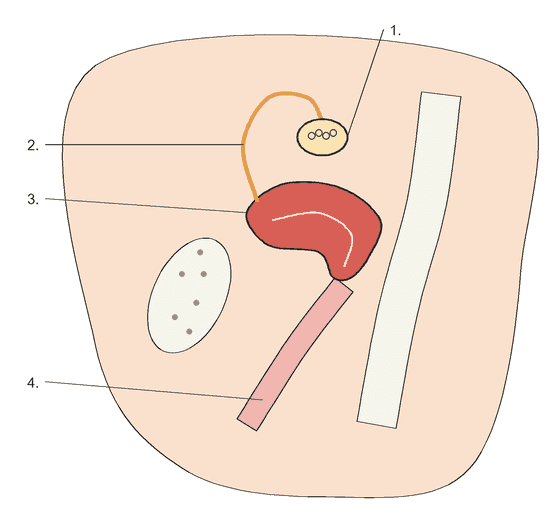
(a) Name the parts labelled 1 to 4
(b) Name the part where fertilisation occurs in the female reproductive system.
Solve with AIWritten solution
Solution:
Concept: In the female, the ovaries make eggs (ova); an oviduct (fallopian tube) carries each egg towards the uterus; the lower narrow neck of the uterus is the cervix, which opens into the vagina.
Step 1 — (a) Identify the numbered parts.
The figure is a side view of the female system. Part 1 is the oval organ at the top, part 2 the thin tube leading from it, part 3 the pear-shaped organ and part 4 the muscular tube below it.
- 1 — Ovary
- 2 — Oviduct (fallopian tube)
- 3 — Uterus
- 4 — Vagina
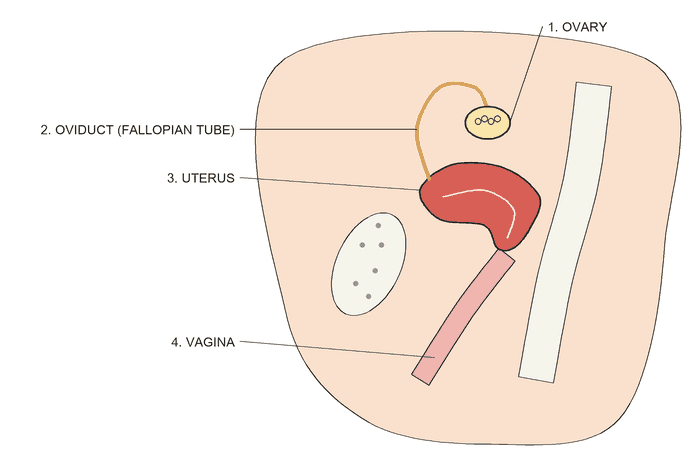
Step 2 — (b) Where fertilisation occurs.
The sperm meets the egg in the oviduct (fallopian tube), the part labelled 2.
Watch out: Fertilisation is in the oviduct; the uterus is where the embryo later implants and grows.
Therefore, (a) 1 ovary, 2 oviduct (fallopian tube), 3 uterus, 4 vagina; (b) the oviduct (part 2).
- 2112 marks
Question 21
Draw neat and labelled diagrams of a sperm and ovum. Answer the following questions :
(a) Is a sperm and an ovum unicellular or multicellular ?
(b) Name the organ of the human body where these gametes are produced.
(c) Name the process of the fusion of these gametes.
(d) Name the organ where the fusion of these gametes take place.
(e) What is formed by the fusion of the sperm and ovum ?
Solve with AIWritten solution
Solution:
Concept: The sperm and the ovum are the human gametes. Each is a single cell; they are made in the testes and ovaries and fuse in the oviduct to form a zygote.
Step 1 — Draw and label the gametes.
The diagrams show a sperm and an ovum (not drawn to scale; the ovum is many times larger than the sperm).

Labels — sperm: head, nucleus, middle piece, tail; ovum: nucleus, cytoplasm, cell membrane, follicle cells.
Step 2 — (a) Unicellular or multicellular.
Both are unicellular: each is a single cell.
Step 3 — (b) Where they are produced.
Sperms are produced in the testes; ova are produced in the ovaries.
Step 4 — (c) The fusion.
The fusion of a sperm with an ovum is called fertilisation.
Step 5 — (d) Where the fusion happens.
Fertilisation takes place in the oviduct (fallopian tube) of the female.
Step 6 — (e) What is formed.
The fusion forms a zygote, the first cell of the new individual.
Watch out: The follicle cells around the ovum are not part of the egg cell itself.
Therefore, (a) unicellular; (b) testes and ovaries; (c) fertilisation; (d) the oviduct; (e) a zygote.
- 224 marks
Question 22
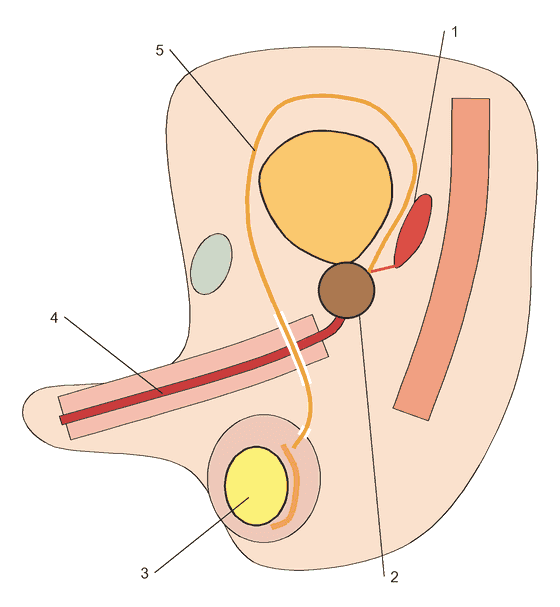
Given below is a diagram of the male reproductive system in humans. Label the parts indicated by numbers 1 to 5, and state their functions.
 Solve with AI
Written solution
Solution:
Concept: In the male, sperms are made in the testes (inside the scrotum), stored in the epididymis, carried by the sperm duct (vas deferens) and leave through the urethra in the penis. The seminal vesicles, prostate gland and Cowper's glands add fluids that form semen.
Step 1 — Identify the numbered parts.
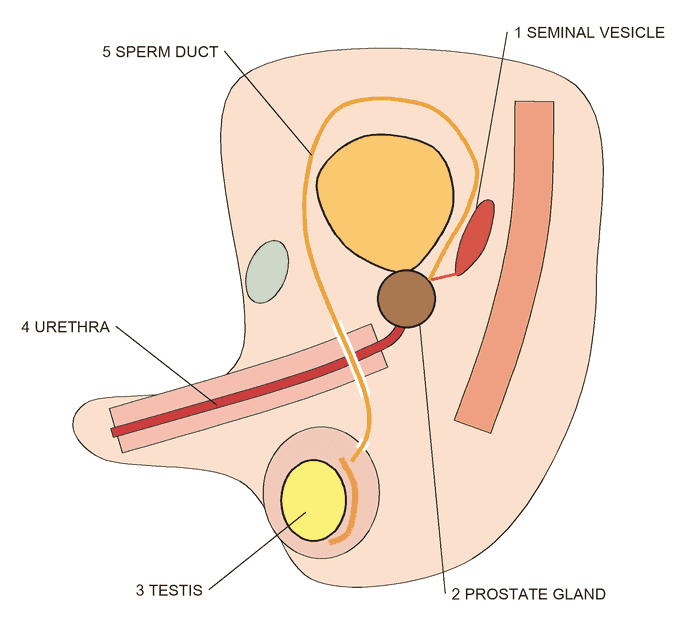
Each number points to one part of the side view.
Step 2 — Part 1 — seminal vesicle.
It lies behind the urinary bladder and produces a fluid that forms most of the semen. This fluid is a medium for transporting the sperms and gives them sugar for energy.
Step 3 — Part 2 — prostate gland.
It surrounds the urethra just below the bladder and adds a thin, milky fluid to the semen that helps the sperms stay active.
Step 4 — Part 3 — testis.
It produces sperms (and the male hormone, testosterone).
Step 5 — Part 4 — urethra.
It passes through the penis and carries either urine or semen out of the body, never both at once.
Step 6 — Part 5 — sperm duct (vas deferens).
It carries sperms from the epididymis to the urethra.
Watch out: The sperm duct loops over the bladder before joining the urethra; follow it from the testis to find part 5.
Therefore, 1 seminal vesicle, 2 prostate gland, 3 testis, 4 urethra and 5 sperm duct, with the functions given above.
- 2312 marks
Question 23
Draw a neat and labelled diagram showing the reproduction in amoeba. Answer the following questions :
(a) Is reproduction in amoeba of the sexual or asexual kind ?
(b) Name the specific kind of reproduction which occurs in amoeba.
(c) How many offsprings are produced from one division?
(d) What kind of cell division occurs during the reproduction in amoeba?
(e) Give one more example of an organism which reproduces by the same mode of reproduction as that of amoeba.
Solve with AIWritten solution
Solution:
Concept: Amoeba is a single-celled animal. It reproduces by binary fission: the nucleus divides first and then the cytoplasm, giving two daughter amoebae.
Step 1 — Draw the stages.
The diagram shows binary fission in Amoeba in four stages.

Labels: nucleus, parent amoeba, nucleus divides, cytoplasm divides, daughter amoebae.
Step 2 — (a) Sexual or asexual.
Only one parent is involved and no gametes are formed, so the reproduction is asexual.
Step 3 — (b) The kind of reproduction.
It is binary fission, splitting into two.
Step 4 — (c) Number of offspring.
One division gives two daughter amoebae.
Step 5 — (d) Kind of cell division.
It is simple (mitotic) cell division: the nucleus divides first, and then the cytoplasm divides.
Step 6 — (e) Another example.
Paramecium also reproduces by binary fission (so do bacteria).
Watch out: The nucleus always divides before the cytoplasm, so that each daughter gets a nucleus.
Therefore, (a) asexual; (b) binary fission; (c) two; (d) simple (mitotic) division, nucleus first; (e) Paramecium.
- 2412 marks
Question 24
Draw a neat and labelled diagram of the human female reproductive system. From the diagram, name the following :
(a) The organ where ovum is produced.
(b) The muscular tube situated between the rectum and the urethra.
(c) A hollow, inverted pear-shaped muscular organ found in the pelvic cavity.
(d) A pair of narrow, muscular long ducts extending from each ovary to the upper part of the uterus.
(e) A small lower constricted part of the uterus.
Solve with AIWritten solution
Solution:
Concept: In the female, the ovaries make eggs (ova); an oviduct (fallopian tube) carries each egg towards the uterus; the lower narrow neck of the uterus is the cervix, which opens into the vagina.
Step 1 — Draw and label the system.
The diagram shows the female reproductive system from the front.
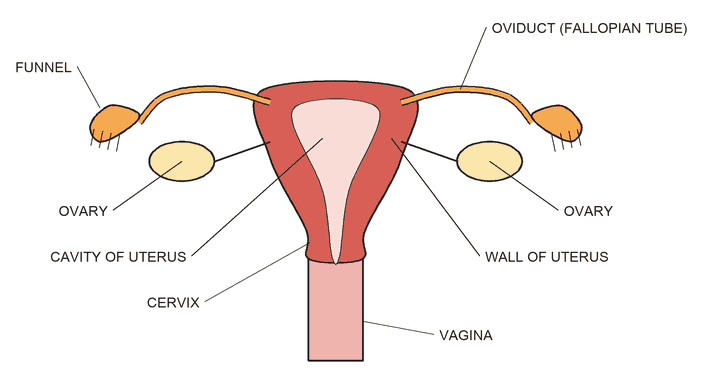
Labels: ovary, oviduct (fallopian tube), funnel, uterus (cavity and wall), cervix, vagina.
Step 2 — (a) Where the ovum is produced.
Ova are produced in the ovary.
Step 3 — (b) Muscular tube between the rectum and the urethra.
This is the vagina.
Step 4 — (c) Hollow, inverted pear-shaped organ.
This is the uterus.
Step 5 — (d) Narrow muscular ducts from near each ovary to the uterus.
These are the oviducts (fallopian tubes); each begins with a funnel close to its ovary.
Step 6 — (e) Small lower narrow part of the uterus.
This is the cervix.
Watch out: The cervix is part of the uterus; the vagina begins below it.
Therefore, (a) ovary, (b) vagina, (c) uterus, (d) oviducts (fallopian tubes), (e) cervix.
- 2510 marks
Question 25
Answer the following questions:
(a) What is budding? Define it.
(b) Is it asexual or sexual mode of reproduction?
(c) Mention one example of a plant and one of an animal that reproduce by budding.
(d) Draw and label the diagram of an animal showing the process of budding.
(e) Write the specific locomotory structures of the animal drawn by you in part (d) above.
Solve with AIWritten solution
Solution:
Concept: Budding is asexual reproduction in which a small outgrowth (bud) grows on the parent's body and develops into a new individual. Hydra is the textbook example.
Step 1 — (a) Definition.
Budding is a kind of asexual reproduction in which a bud (small outgrowth) grows on the outside of the parent's body; when it is big enough, it separates and lives as a new individual.
Step 2 — (b) Asexual or sexual.
Only one parent is involved and no gametes fuse, so it is an asexual mode of reproduction.
Step 3 — (c) Examples.
The book's "plant" example is yeast, and the animal example is Hydra.
Step 4 — (d) Labelled diagram.
The diagram shows Hydra with a bud on the side of its body.
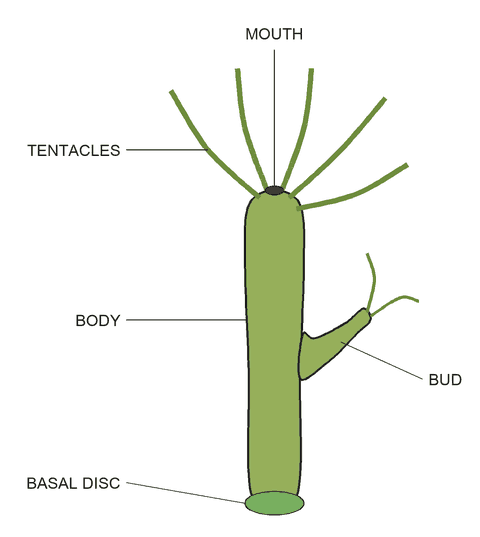
Labels: tentacles, mouth, body, bud, basal disc.
Step 5 — (e) Locomotory structures.
Hydra moves with its tentacles and its basal disc: it glides on the basal disc, or loops and somersaults by gripping alternately with the tentacles and the basal disc.
Watch out: The bud is a young Hydra still attached to its parent, not a separate organ.
Note: Yeast is listed with plants in the book, but it is a fungus; Hydra is the animal example.
Therefore, (a) budding is the growth of a new individual from an outgrowth of the parent; (b) asexual; (c) yeast and Hydra; (d) see the diagram; (e) tentacles and basal disc.
- 264 marks
Question 26
One evening, Abdul spotted a lizard in his room. In an attempt to shoo it away with a broom, the lizard's tail suddenly broke off and kept wriggling on the floor. Abdul got sad, thinking he had hurt the lizard badly. His father explained that many lizards can regrow their tails if they lose them. This ability is called regeneration.
Abdul wondered if this meant a new lizard can grow from the broken tail in the same way some animals reproduce new individuals. However, his biology teacher clarified that regrowing a tail is not reproduction. It only replaces a lost body part. In some simple animals, regeneration can actually produce a whole new organism. But in lizards, regeneration only replaces the lost body part (or tail) and does not create a new lizard.
(a) Name two animals that use regeneration for producing a new organism.
(b) What type of reproduction do the animals named by you above show?
(c) How is this type of reproduction different from how a dog gives birth to puppies?
Solve with AIWritten solution
Solution:
Concept: Regeneration is the regrowth of lost body parts. In some simple animals, a broken piece can grow into a whole new animal, which is a kind of asexual reproduction.
Step 1 — (a) Animals that reproduce by regeneration.
Planaria (a flatworm) and Hydra can grow a whole new animal from a small piece of the body (some starfish can too).
Step 2 — (b) Type of reproduction.
Only one parent is involved and no gametes are formed, so this is asexual reproduction.
Step 3 — (c) Comparison with a dog.
In regeneration a new individual grows from a piece of one parent's body, with no gametes and no fertilisation, so the offspring is a copy of the parent. A dog reproduces sexually: two parents make sperms and eggs, these fuse (fertilisation) to form a zygote, and the puppies develop inside the mother's uterus before birth.
Watch out: A lizard regrowing its tail is regeneration but not reproduction, because no new lizard is formed.
Therefore, (a) Planaria and Hydra; (b) asexual reproduction; (c) regeneration uses one parent and no gametes, while a dog reproduces sexually from two parents through fertilisation.
What Class 8 Biology Ch 3 covers
The sections of the chapter, in the order the book takes them. Every question above comes from one of these.
- 01Asexual Reproduction in Animals
- 02Sexual Reproduction in Animals
- 03Human Reproductive System
- 04Fertilisation
- 05Implantation
- 06Growth
More ways to study this chapter
The same chapter asked three other ways. Practise it, revise it, and see what the board has set on Ch 3 before.
Class 8 Biology Ch 3 questions students ask
How many questions are there in Class 8 Biology Ch 3?
26 questions. Every one is solved step by step on this page.
Are these Class 8 Biology solutions free?
Yes. Every question and its full working is free to read, with no account needed.
Can I download the Class 8 Biology Ch 3 solutions as a PDF?
There is no PDF to download. Every solution is on this page instead, which means it is searchable, always the current syllabus, and readable on a phone. Use your browser's print option if you want it on paper.