
Opening your dashboard
Class 8 Biology Chapter 3 Reproduction in Humans: Competency-Based Questions (CBQ)
40 questions on Chapter 3, each worked through on its own page with the AI tutor. Class 8 Biology, ICSE 2026-27.
40 questions
1–5 marks · Mixed difficulty
- 11 mark
Question 1
Cognitive domain: Application
Starfish were eating the oysters in an oyster farm. To get rid of them, the workers caught the starfish, chopped each one into a few pieces and threw the pieces back into the sea. Some months later there were many more starfish than before. What is the best explanation ?
- 21 mark
Question 2
Cognitive domain: Analysis
The normal temperature of the human body is about . In a science quiz, four temperatures are shown on a card.
Card Temperature P Q R S Which card shows the temperature most likely to be found in the testes, which lie in the scrotum outside the abdominal cavity ?
- 31 mark
Question 3
Cognitive domain: Application
A scientist is studying sperms under a microscope. In one sample the sperms are present in the normal number and each has a head with a nucleus, but their tails cannot move. Why are such sperms unlikely to fertilise an egg ?
- 41 mark
Question 4
Cognitive domain: Analysis
Four changes are described below.
Change P : A balloon becomes bigger when air is blown into it.
Change Q : A dry sponge becomes heavier when it soaks up water.
Change R : A baby that weighed 3 kg at birth weighs 6 kg a few months later, as the cells of its body keep on dividing.
Change S : A wet towel becomes lighter as it dries in the sun.
Which one of these is growth, as the term is used in Biology ?
- 51 mark
Question 5
Cognitive domain: Understanding
Assertion (A): At the time of birth, the baby is pushed out of the mother's body with great force.
Reason (R): The uterus is a muscular organ, and its muscles contract powerfully at the time of birth.
- 61 mark
Question 6
Cognitive domain: Analysis
Assertion (A): Although millions of sperms are released, an egg is fertilised by just one single sperm.
Reason (R): During fertilisation, it is the nucleus of the sperm, carried in its head, that fuses with the nucleus of the egg.
- 71 mark
Question 7
Cognitive domain: Application
At a health exhibition, a chart shows how a human embryo develops week by week. Kiran covers the notes and tries to work out what an embryo is like at the end of the sixth week of pregnancy.
Complete the sentence :
At the end of the sixth week, the embryo already has a ______ and a circulatory system, but its ______ are yet to be formed.
- 81 mark
Question 8
Cognitive domain: Understanding
Aman watches an Amoeba under a microscope. It has stopped moving about, and he can clearly see two nuclei inside its single, undivided body.
Complete the sentence :
The next thing to divide will be the ______ of the Amoeba, and after that ______ daughter amoebae will separate and live as new individuals.
- 91 mark
Question 9
Cognitive domain: Application
In the human female, only one egg is produced every month, and the two ovaries produce it alternately (turn by turn). Suppose the right ovary produces the egg in January and this pattern continues without a break for the 12 months from January to December.
Complete the sentence :
The egg in February is produced by the ______ ovary, and in these twelve months the right ovary alone produces ______ eggs.
- 102 marks
Question 10
Cognitive domain: Evaluation
While revising, Meera says, "An egg and a zygote are the same thing. Both are single cells, so there is no real difference between them."
Is Meera right ? Judge her statement, giving two reasons.
- 112 marks
Question 11
Cognitive domain: Application
A scientist studies how a fertilised egg develops. She looks at it soon after fertilisation, while it is still in the oviduct, and it is a single cell. She looks at it again when it has just reached the uterus.
(a) How will it look different when it reaches the uterus ? What has caused this change ?
(b) What must happen to it next, and what state does this produce ?
- 122 marks
Question 12
Cognitive domain: Understanding
Rohit reads that semen is a milky white fluid and that sperms are extremely tiny. He wonders, "If sperms are produced in the testes, where does all the fluid come from, and what is it for ?"
Answer Rohit's question. Name the glands that add the fluid, and give the use of the secretion of any two of them.
- 135 marks
Question 13
Cognitive domain: Analysis
Case: For a class chart, Tanvi drew four stages, P to S, that come one after another when a new human life begins. She did not write any names on her drawing.
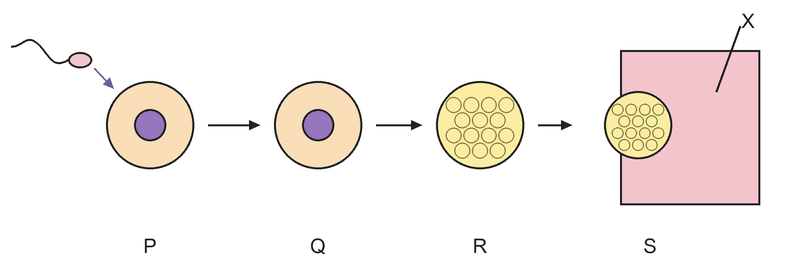
(a) Name the two cells that are meeting in stage P. What is their fusion called, and in which part of the female reproductive system does it take place ?
(b) Name the single cell shown in stage Q. How is its nucleus different from the nucleus of the larger cell in stage P ?
(c) What has happened between stage Q and stage R ?
(d) Name the process shown in stage S and the organ whose wall is marked X. Later, the cells of the embryo become different from one another and form tissues and organs. What is this called ?
- 144 marks
Question 14
Cognitive domain: Evaluation
Case: In a research laboratory, three flatworms (Planaria) of the same size were cut crosswise into pieces. All the pieces were kept in clean pond water. After three weeks the complete worms were counted.
Worm Number of pieces it was cut into Complete worms after three weeks 1 2 2 2 3 3 3 6 6 Three students who read this report made the following statements.
Arnav : "The table shows that Planaria can use regeneration to reproduce."
Bela : "New worms were formed, so this must be sexual reproduction."
Chirag : "So if a person loses a finger, it will grow back in the same way."
(a) How many worms were there at the start and at the end ? Is Arnav's statement supported by the table ?
(b) Judge Bela's statement. Give a reason.
(c) Judge Chirag's statement. Give a reason.
- 154 marks
Question 15
Cognitive domain: Creativity
Case: For the school science exhibition, Class 8 has to make simple models of the two human gametes, the sperm and the ovum, to show how each is built for its job. The class has modelling clay of different colours, beads, a table-tennis ball and pieces of wool.
(a) Plan the two models. Say which material you would use for each part of the sperm and of the ovum.
(b) Draw a table for the display card that matches each part of your models with the job it does.
(c) How would you use the two models to show what happens at fertilisation ? State one way in which your models are not like the real gametes.
- 161 mark
Question 16
Cognitive domain: Analysis
The graph shows the number of cells in a human embryo, counted after each division of the zygote. (Hypothetical, simplified data: every cell divides at each step.)
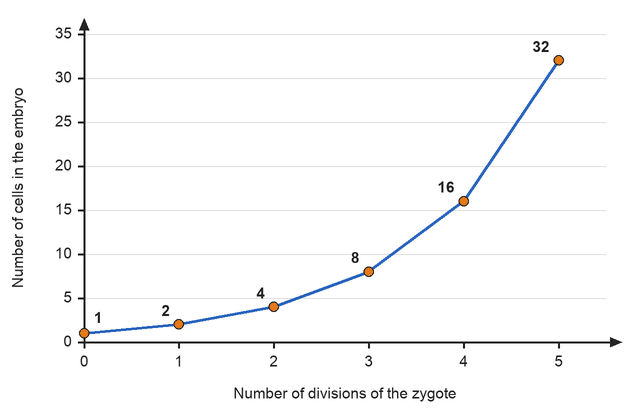
If the pattern in the graph carries on, how many cells will the embryo have after divisions ?
- 171 mark
Question 17
Cognitive domain: Understanding
Column I lists four terms from the chapter, and Column II gives their meanings in a different order.
Column I Column II 1. Fertilisation P. The full term of the development of an embryo in the uterus, about days 2. Implantation Q. The fusion of the nucleus of a sperm with the nucleus of an egg 3. Differentiation R. The fixing of the embryo in the wall of the uterus 4. Gestation S. The specialisation of cells, which gives rise to tissues, organs and organ systems Which option matches the terms with their meanings correctly ?
- 181 mark
Question 18
Cognitive domain: Analysis
Ria makes a model of the male reproductive system for the science fair. She joins each sperm duct straight to the urinary bladder, so that sperms first enter the bladder and are then carried out with the urine. Which statement tells correctly what is wrong with her model ?
- 191 mark
Question 19
Cognitive domain: Analysis
Assertion (A): The binary fission of an Amoeba is classed as an asexual method of reproduction.
Reason (R): In binary fission one parent divides into two daughter cells, and no eggs or sperms take part.
- 201 mark
Question 20
Cognitive domain: Analysis
Assertion (A): All the cells of a growing embryo do the same job, because they all come from the same zygote by repeated division.
Reason (R): In the embryo the division of cells is accompanied by specialisation of cells, which forms the tissues, organs and organ systems.
- 211 mark
Question 21
Cognitive domain: Application
Kabir puts one Amoeba into a clean glass dish of pond water with some food. After a few days the dish has many amoebae. His sister asks, "Could a single human being, left alone, produce a new baby in the same way ?" Which reason best explains why one Amoeba can start a whole population but one human cannot ?
- 221 mark
Question 22
Cognitive domain: Application
A class makes a model of the reproductive system of a man. Which of the following structures must be made only once for the model, and not as a pair ?
- 231 mark
Question 23
Cognitive domain: Understanding
Four statements about reproduction in animals are given.
I. In the binary fission of an Amoeba, the cytoplasm divides first and then the nucleus divides.
II. In budding, a bud grows on the outside of the parent's body and gets separated when it is big enough to live independently.
III. Hydra and starfish can regrow lost parts of the body by regeneration.
IV. In the asexual methods of reproduction in animals, a sperm fuses with an egg to form a zygote.
Which statements are correct ?
- 241 mark
Question 24
Cognitive domain: Evaluation
A student made a table to compare asexual and sexual reproduction in animals. One row of the table has a mistake.
Row Feature Asexual reproduction Sexual reproduction 1 Number of parents needed One Two 2 Eggs and sperms Not involved Involved 3 Zygote Formed Not formed 4 Example in animals Amoeba, Hydra Human beings Which row has the mistake ?
- 251 mark
Question 25
Cognitive domain: Understanding
Four events that lead to the birth of a baby are listed in a mixed-up order.
P : The muscles of the uterus contract powerfully.
Q : The baby is pushed out through the vagina, with the head coming out first.
R : The embryo completes its full term of about days in the uterus.
S : The embryo grows into a baby (foetus).
Which option gives the order in which they happen ?
- 262 marks
Question 26
Cognitive domain: Analysis
Two small Hydra, X and Y, are kept in separate dishes. A tentacle of X is accidentally cut off, and after some days X has grown a new tentacle. Y is cut across into three pieces, and after some days there are three small Hydra.
Both cases show regeneration. Explain why only the case of Y is also an example of reproduction.
- 272 marks
Question 27
Cognitive domain: Application
A human zygote is about mm across, and a newborn baby is about cm long.
(a) Taking the width of the zygote as its size, how many times larger is the length of the newborn baby ?
(b) Name the two processes that, working together, change the single zygote into a baby with different tissues and organs.
- 282 marks
Question 28
Cognitive domain: Analysis
Three glands of the male reproductive system pour their secretions into the passage that carries the sperms from the sperm ducts to the outside: the Cowper's glands, the prostate gland and the seminal vesicles.
Starting from the sperm ducts and moving towards the outside of the body, arrange the three glands in the order in which their openings lie along this passage. Give the reason for the position of the first gland in your order.
- 292 marks
Question 29
Cognitive domain: Understanding
Six statements about the reproduction of animals are given.
1. One parent is enough to form the new individual.
2. A sperm and an egg fuse together.
3. It helps in the continuance of the species.
4. A zygote is formed.
5. Amoeba is an example of an animal that uses it.
6. It gives rise to new individuals of their own kind.
Copy the table below and write the numbers of the statements in the correct columns.
True only for asexual reproduction True only for sexual reproduction True for both - 302 marks
Question 30
Cognitive domain: Application
Under a microscope, a student measures the two human gametes. (Hypothetical, approximate values.) The ovum is mm across. The head of a sperm is mm long.
(a) How many times is the diameter of the ovum greater than the length of the head of the sperm ?
(b) Say how a sperm reaches the egg, and name the part of the sperm that helps it.
- 312 marks
Question 31
Cognitive domain: Recall
Four riddles about the human reproductive system are given. Name what each one describes.
(a) I am the sac in which the testes lie outside the abdominal cavity.
(b) I am the natural way of fixing the embryo in the wall of the uterus.
(c) I am the full term of development of an embryo in the uterus, which lasts about days in humans.
(d) I am the tube that passes through the penis and carries either urine or semen.
- 323 marks
Question 32
Cognitive domain: Evaluation
Case: A hospital register shows the length of the gestation period, in days, of eight babies, counted the way doctors count it. (Hypothetical data.)
Baby 1 2 3 4 5 6 7 8 Days before birth 268 275 280 283 279 285 272 281 Dr Rao says, "Every baby is born after exactly days." Dr Sen says, "A baby is born after about days, a little earlier or a little later."
(a) Find the mean number of days for the eight babies, correct to one decimal place.
(b) How many of the eight babies were born after exactly days ?
(c) Which doctor's statement is better supported by the register ? Give a reason.
- 333 marks
Question 33
Cognitive domain: Application
Each testis has a very long, highly coiled tube lying on its upper side, called the epididymis. (Approximate values.) If one epididymis were straightened out, it would be about m long, but the testis it lies on is only about cm long.
(a) Name the structure into which the epididymis leads.
(b) How many times longer than the testis is the straightened epididymis ?
(c) State one advantage of the epididymis being coiled.
- 343 marks
Question 34
Cognitive domain: Application
Case: Meher makes a model of implantation. She uses a thick slab of soft clay and a marble.
(a) What part of the body does the clay slab represent, and what does the marble represent ?
(b) How will she show, with the marble and the clay, what implantation is ?
(c) State one thing that happens to the embryo after implantation that her model cannot show.
- 353 marks
Question 35
Cognitive domain: Analysis
Case: A scientist estimates how many sperms from one release are present at different places in the female reproductive system. (Hypothetical data.)
Place Number of sperms Vagina, just after release 200 000 000 Uterus 2 000 000 Lower part of the oviducts 20 000 Upper part of the oviducts 200 (a) How many times smaller is the number of sperms in the uterus than in the vagina ? How many times smaller is the number in the upper part of the oviducts than in the vagina ?
(b) What happens to the sperms that do not reach the upper part of the oviducts ?
(c) Only one sperm takes part in fertilisation. Out of how many sperms that were released is this one sperm ?
- 363 marks
Question 36
Cognitive domain: Analysis
Case: On a lonely island lives a species of small animals. Every animal lives for at most four years. Suppose that, from year , none of the animals reproduces. The number of animals is counted every year. (Hypothetical data.)
Year 0 1 2 3 4 Number of animals 800 560 240 60 0 (a) By what percentage did the number fall in year ?
(b) In which year did the number first fall below one-third of the number in year ?
(c) Explain what the table shows about the importance of reproduction for a species.
- 375 marks
Question 37
Cognitive domain: Analysis
Case: A health worker weighs a baby at different ages and draws a graph of the mass of the baby against the age. (Hypothetical data.)
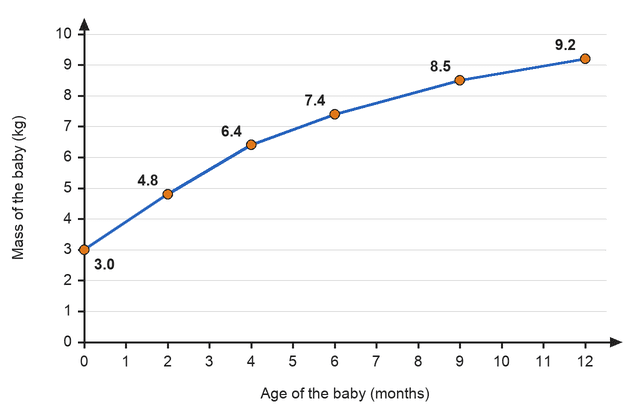
(a) How much mass did the baby gain during the first months ? How many times the mass at birth is the mass at months, correct to one decimal place ?
(b) Which interval shown on the graph has the greatest gain in mass per month ?
(c) The line of the graph rises all the way and never falls. Using the meaning of growth, explain why this is expected, and name the two processes in the body that make the baby grow.
- 384 marks
Question 38
Cognitive domain: Evaluation
Case: A student wrote a letter to the school magazine about human reproduction. Three sentences of the letter are given.
- Sentence 1 : "A man's body makes millions of sperms, and every one of them forms a baby."
- Sentence 2 : "When a sperm fuses with an egg, a zygote is formed, and the zygote grows into an embryo."
- Sentence 3 : "The embryo gets fixed in the wall of the uterus before fertilisation takes place."
(a) Evaluate Sentence 1.
(b) Evaluate Sentence 2.
(c) Evaluate Sentence 3, and give the correct order of fertilisation and implantation with the place where each happens.
- 395 marks
Question 39
Cognitive domain: Creativity
Case: For the school fair, your group has to explain the male reproductive system to Class 6 students, using a factory and its delivery system as an analogy. You may use only these six parts of the analogy: a factory, a winding corridor, a pipeline, mixing tanks, a tank of lubricating oil and an exit pipe.
(a) Match each part of the analogy with one structure of the male reproductive system, and say what each one does.
(b) Write the route of the sperms through your analogy, using the names of the male structures.
(c) State one way in which your analogy does not match the real system, and suggest how you would tell the students about it.
- 404 marks
Question 40
Cognitive domain: Analysis
Case: A student counts the number of Amoeba in a dish every day for five days. (Hypothetical data.)
Day 0 1 2 3 4 5 Number of Amoeba 1 2 4 7 12 20 (a) On which day was the rise in the number of Amoeba during that day the largest ?
(b) On days and the number doubled each day. Did it double on day ? What does this tell you about the amoebae ?
(c) Name the method by which the number of Amoeba increased and say why one parent is enough. Why could the number of people in a family not increase in the same way ?