Solution:
Concept: Budding is asexual reproduction in which a small outgrowth (bud) grows on the parent's body and develops into a new individual. Hydra is the textbook example.
Step 1 — (a) Definition.
Budding is a kind of asexual reproduction in which a bud (small outgrowth) grows on the outside of the parent's body; when it is big enough, it separates and lives as a new individual.
Step 2 — (b) Asexual or sexual.
Only one parent is involved and no gametes fuse, so it is an asexual mode of reproduction.
Step 3 — (c) Examples.
The book's "plant" example is yeast, and the animal example is Hydra.
Step 4 — (d) Labelled diagram.
The diagram shows Hydra with a bud on the side of its body.
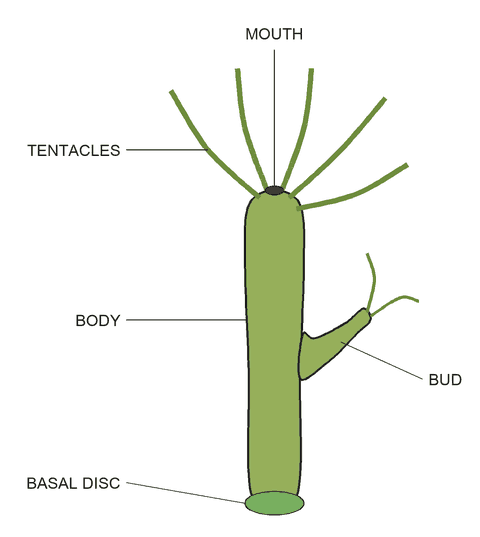
Labels: tentacles, mouth, body, bud, basal disc.
Step 5 — (e) Locomotory structures.
Hydra moves with its tentacles and its basal disc: it glides on the basal disc, or loops and somersaults by gripping alternately with the tentacles and the basal disc.
Watch out: The bud is a young Hydra still attached to its parent, not a separate organ.
Note: Yeast is listed with plants in the book, but it is a fungus; Hydra is the animal example.
Therefore, (a) budding is the growth of a new individual from an outgrowth of the parent; (b) asexual; (c) yeast and Hydra; (d) see the diagram; (e) tentacles and basal disc.
