
Question 224 marksMedium
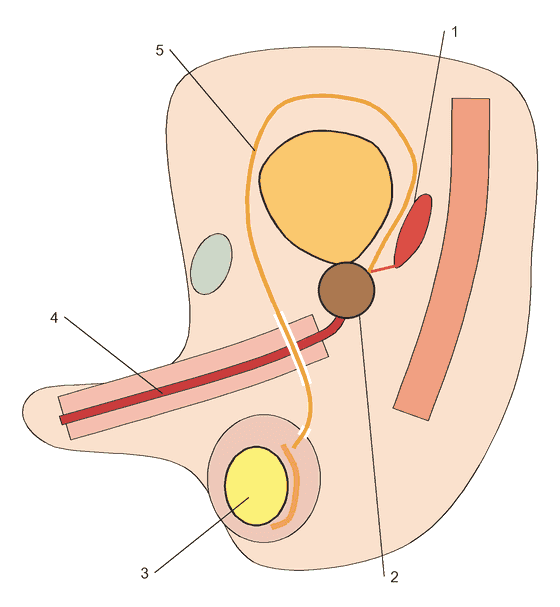
Given below is a diagram of the male reproductive system in humans. Label the parts indicated by numbers 1 to 5, and state their functions.
Confirming your payment
Sign up now and get 250 free tokens.
Reproduction in Humans · Question 22 of 26
Given below is a diagram of the male reproductive system in humans. Label the parts indicated by numbers 1 to 5, and state their functions.
Solution:
Concept: In the male, sperms are made in the testes (inside the scrotum), stored in the epididymis, carried by the sperm duct (vas deferens) and leave through the urethra in the penis. The seminal vesicles, prostate gland and Cowper's glands add fluids that form semen.
Step 1 — Identify the numbered parts.
Each number points to one part of the side view.
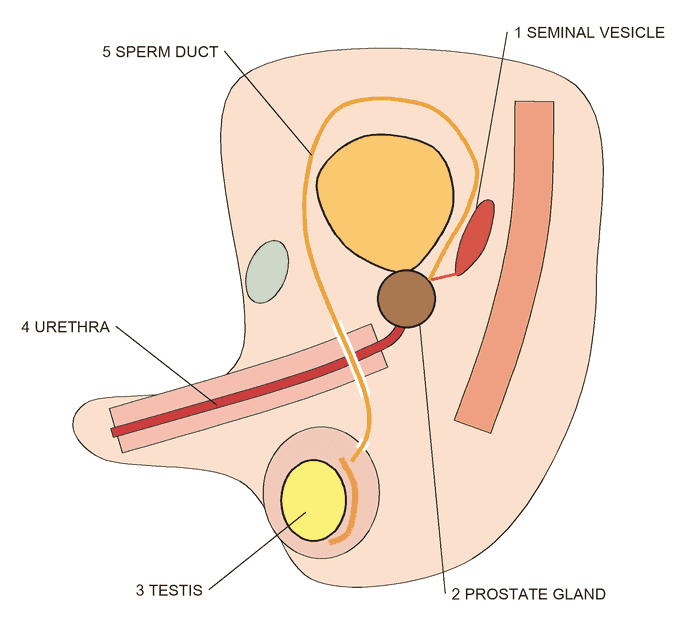
Step 2 — Part 1 — seminal vesicle.
It lies behind the urinary bladder and produces a fluid that forms most of the semen. This fluid is a medium for transporting the sperms and gives them sugar for energy.
Step 3 — Part 2 — prostate gland.
It surrounds the urethra just below the bladder and adds a thin, milky fluid to the semen that helps the sperms stay active.
Step 4 — Part 3 — testis.
It produces sperms (and the male hormone, testosterone).
Step 5 — Part 4 — urethra.
It passes through the penis and carries either urine or semen out of the body, never both at once.
Step 6 — Part 5 — sperm duct (vas deferens).
It carries sperms from the epididymis to the urethra.
Watch out: The sperm duct loops over the bladder before joining the urethra; follow it from the testis to find part 5.
Therefore, 1 seminal vesicle, 2 prostate gland, 3 testis, 4 urethra and 5 sperm duct, with the functions given above.