
Opening your dashboard
Class 7 Physics Chapter 6: Sound Solutions
79 textbook questions with step-by-step answers, free to read, for ICSE 2026-27.
Get talked through Ch 6, not just shown the answer
Reading a finished solution is not the same as being able to do it. The AI tutor takes one question at a time and works it with you, in your own words, until you can.
- Ask it out loud, in your own words
- It gives you the next step, not the answer
- Stuck on part (ii)? Start there
79 questions with solutions
1–4 marks · Mixed difficulty
- 11 mark
Question 1
We can distinguish a shrill sound from a flat sound by its :
Solve with AIAnswer
(A) amplitude
(B) loudness
- Correct
(C) pitch
(D) none of the above.
Answer: (C) pitch
Concept: A sound has three characteristics: loudness (set by the amplitude), pitch (set by the frequency) and quality (set by the wave form).
Step 1 — See what the question asks.
A shrill sound (like a whistle) and a flat sound (like a big drum) differ in how high or low they sound. We must name the characteristic that tells them apart.
Step 2 — Match the characteristic.
The characteristic that tells a shrill sound from a flat sound is pitch. A shrill sound has a high frequency and so a high pitch; a flat sound has a low frequency and a low pitch.
Watch out: Loudness is about loud or feeble, not shrill or flat; a soft whistle is still shrill.
Why the other options are wrong:
- (A) amplitude: Amplitude decides how loud the sound is, not whether it is shrill or flat.
- (B) loudness: Loudness tells a loud sound from a feeble sound, not a shrill sound from a flat one.
- (D) none of the above: Another option is correct, so “none of the above” cannot be the answer.
Therefore, we distinguish a shrill sound from a flat sound by its pitch, option (C).
- 21 mark
Question 2
We can hear sound of frequency :
Solve with AIAnswer
(A) 10 Hz
- Correct
(B) 500 Hz
(C) 100,000 Hz
(D) 50,000 Hz.
Answer: (B) 500 Hz
Concept: The normal human ear can hear sounds of frequency from 20 Hz to 20,000 Hz (the audible range). Sound below 20 Hz is infrasonic and sound above 20,000 Hz is ultrasonic; we cannot hear either.
Step 1 — Recall the audible range.
We can hear only sounds whose frequency lies between 20 Hz and 20,000 Hz.
Step 2 — Test each frequency.
10 Hz is below 20 Hz, while 100,000 Hz and 50,000 Hz are above 20,000 Hz. Only 500 Hz lies inside the range, so it is the one we can hear.
Watch out: A large number is not automatically audible; anything above 20,000 Hz is ultrasonic and cannot be heard.
Why the other options are wrong:
- (A) 10 Hz: 10 Hz is below 20 Hz, so it is infrasonic and we cannot hear it.
- (C) 100,000 Hz: 100,000 Hz is far above 20,000 Hz, so it is ultrasonic; bats can hear such sounds, but we cannot.
- (D) 50,000 Hz: 50,000 Hz is above 20,000 Hz, so it is also ultrasonic and we cannot hear it.
Therefore, we can hear a sound of frequency 500 Hz, option (B).
- 31 mark
Question 3
Sound cannot travel in :
Solve with AIAnswer
(A) gases
(B) liquids
(C) solids
- Correct
(D) vacuum.
Answer: (D) vacuum
Concept: Sound needs a material medium (a solid, a liquid or a gas) to travel. The vibrating particles of the medium pass the vibration on to their neighbours. A vacuum has no particles, so sound cannot travel through it.
Step 1 — Recall how sound travels.
Sound travels when the particles of a medium vibrate and pass the vibration on to the next particles.
Step 2 — Look for the place with no particles.
Gases, liquids and solids all have particles, so sound can travel through each of them. A vacuum has no particles at all, so there is nothing to carry the vibration.
Watch out: Light can cross a vacuum (sunlight reaches us through space), but sound cannot.
Why the other options are wrong:
- (A) gases: Sound travels through gases such as air; this is how we normally hear.
- (B) liquids: Sound travels through liquids; a watch can be heard through a balloon filled with water.
- (C) solids: Sound travels through solids, and faster than through liquids or gases.
Therefore, sound cannot travel in vacuum, option (D).
- 41 mark
Question 4
The minimum distance required between the source and the reflector so as to hear the echo in air is :
Solve with AIAnswer
(A) 10 m
- Correct
(B) 17 m
(C) 34 m
(D) 50 m.
Answer: (B) 17 m
Concept: An echo is the sound heard after reflection from a distant large surface. The sensation of a sound stays in our ear for about 0.1 s, so the echo is heard as a separate sound only if it arrives at least 0.1 s after the original sound.
Step 1 — Find the distance sound covers in 0.1 s.
The echo must arrive at least 0.1 s after the original sound. Taking the speed of sound in air as 330 m s⁻¹, the distance covered in this time is
Step 2 — Halve it for the to-and-fro path.
These 33 m are covered in going to the reflector and coming back, so the reflector must be at least half of this distance away.
Step 3 — Choose the option.
16.5 m is not printed; the nearest option is 17 m. With the speed of sound taken as 340 m s⁻¹ (air at about 15 °C), the same working gives exactly 17 m.
Watch out: 33 m (about 34 m) is the whole path to the reflector and back; the reflector itself need be only half as far.
Why the other options are wrong:
- (A) 10 m: At 10 m the echo returns in less than 0.1 s and mixes with the original sound, so no distinct echo is heard.
- (C) 34 m: 34 m is about the to-and-fro path, not the distance to the reflector; an echo is heard at 34 m, but it is not the least distance.
- (D) 50 m: An echo is heard at 50 m too, but 50 m is not the least distance.
Therefore, the minimum distance between the source and the reflector is about 17 m, option (B).
- 51 mark
Question 5
Wavelength is measured in :
Solve with AIAnswer
(A) kg
(B) second
(C) litre
- Correct
(D) metre
Answer: (D) metre
Concept: Wavelength is the length of one complete wave, for example the distance from one compression to the next compression.
Step 1 — Decide what kind of quantity it is.
Wavelength is a length (a distance).
Step 2 — Choose the unit of length.
The S.I. unit of length is the metre, so wavelength is measured in metre.
Why the other options are wrong:
- (A) kg: This is the unit of mass, not of length.
- (B) second: This is the unit of time, for example of the time period, not of length.
- (C) litre: This is a unit of volume, not of length.
Therefore, wavelength is measured in metre, option (D).
- 61 mark
Question 6
The speed of sound in water is :
Solve with AIAnswer
(A)
- Correct
(B)
(C)
(D)
Answer: (B) 1500 m s⁻¹
Concept: Sound travels fastest in solids, slower in liquids and slowest in gases. Its speed is nearly 330 m s⁻¹ in air, nearly 1500 m s⁻¹ in water and nearly 5960 m s⁻¹ in steel.
Step 1 — Recall the speed in water.
Sound travels through water at nearly 1500 m s⁻¹.
Step 2 — Compare it with the other media.
This is about 4.5 times its speed in air (nearly 330 m s⁻¹), but much less than its speed in steel (nearly 5960 m s⁻¹), because liquids come between gases and solids.
Watch out: 332 m s⁻¹ is close to the speed in air, not in water.
Why the other options are wrong:
- (A): This is about the speed of sound in air, not in water.
- (C): This is of the order of the speed of sound in solids such as iron and steel.
- (D): This value is too small; the speed of sound in water is nearly 1500 m s⁻¹.
Therefore, the speed of sound in water is about 1500 m s⁻¹, option (B).
- 71 mark
Question 7
Sound travels the fastest in :
Solve with AIAnswer
(A) liquids
- Correct
(B) solids
(C) gases
(D) vacuum
Answer: (B) solids
Concept: Sound travels fastest in solids, slower in liquids and slowest in gases. Its speed is nearly 330 m s⁻¹ in air, nearly 1500 m s⁻¹ in water and nearly 5960 m s⁻¹ in steel.
Step 1 — Compare the three states.
Sound is passed on by the particles of the medium. It is fastest in solids, slower in liquids and slowest in gases.
Step 2 — Use the numbers.
Nearly 5960 m s⁻¹ in steel is far more than nearly 1500 m s⁻¹ in water and nearly 330 m s⁻¹ in air, so sound travels fastest in solids.
Why the other options are wrong:
- (A) liquids: Sound is slower in liquids (nearly 1500 m s⁻¹ in water) than in solids.
- (C) gases: Sound is slowest in gases (nearly 330 m s⁻¹ in air).
- (D) vacuum: Sound cannot travel in vacuum at all.
Therefore, sound travels fastest in solids, option (B).
- 81 mark
Question 8
Sound persists in human ear for about :
Solve with AIAnswer
(A) 1 min
(B) 30 sec
(C) 25 sec
- Correct
(D) 0.1 sec
Answer: (D) 0.1 sec
Concept: After a sound stops, its sensation stays in the ear for a short time. This is called the persistence of hearing.
Step 1 — Recall the time.
The sensation of a sound stays in the human ear for about 0.1 s after the sound has stopped.
Step 2 — See why it matters.
This is why a reflected sound must arrive at least 0.1 s later to be heard as a separate echo.
Why the other options are wrong:
- (A) 1 min: One minute is far too long; if sound persisted so long, all sounds would mix and we could not follow speech.
- (B) 30 sec: Thirty seconds is also far too long for the same reason.
- (C) 25 sec: Twenty-five seconds is also far too long; the real time is only about a tenth of a second.
Therefore, sound persists in the human ear for about 0.1 s, option (D).
- 91 mark
Question 9
............. is called the voice box of humans.
Solve with AIAnswer
(A) throat
(B) nose
(C) mouth
- Correct
(D) larynx
Answer: (D) larynx
Concept: Our voice is produced by the vibration of the vocal cords, which lie inside the larynx.
Step 1 — Recall where the voice is made.
The larynx is a box-like part at the top of the windpipe. It holds the vocal cords, which vibrate when air from the lungs is pushed through them.
Step 2 — Name it.
Because it holds the vocal cords that produce our voice, the larynx is called the voice box.
Why the other options are wrong:
- (A) throat: The throat contains the larynx, but the voice box itself is the larynx.
- (B) nose: The nose does not produce the voice; it only changes how some sounds come out.
- (C) mouth: The mouth (lips, tongue and teeth) only shapes the sound into words; it does not make the vibrations.
Therefore, the larynx is called the voice box of humans, option (D).
- 101 mark
Question 10
The following question is Assertion-Reason based. Choose the answer based on the codes given below.
Assertion (A) : For echo, sound should travel a minimum distance of atleast 33 m in air.
Reason (R) : Distinct echo requires a minimum time delay of 0.1 s.
Solve with AIAnswer
- Correct
(A) Both A and R are true and R is the correct explanation of A
(B) Both A and R are true and R is not the correct explanation of A
(C) A is true but R is false
(D) A is false but R is true
Answer: (A)
Concept: An echo is the sound heard after reflection from a distant large surface. The sensation of a sound stays in our ear for about 0.1 s, so the echo is heard as a separate sound only if it arrives at least 0.1 s after the original sound.
Step 1 — Judge the assertion.
To give an echo, sound must go to the reflector and come back. In 0.1 s, sound in air (nearly 330 m s⁻¹) covers
So the sound must travel at least 33 m in all, and the assertion is true.
Step 2 — Judge the reason.
The sensation of a sound stays in the ear for about 0.1 s, so a distinct echo needs a delay of at least 0.1 s. The reason is true.
Step 3 — Check whether R explains A.
The 33 m in the assertion is exactly the distance sound covers in the 0.1 s delay given in the reason. So the reason is the correct explanation of the assertion.
Watch out: The 33 m is the whole to-and-fro path; the reflector itself is only 16.5 m away.
Note: The 33 m uses 330 m s⁻¹ for the speed of sound in air; on a warmer day (about 343 m s⁻¹ at 20 °C) the path is about 34 m.
Why the other options are wrong:
- (B): This says R does not explain A, but the 0.1 s delay is exactly what fixes the 33 m path.
- (C): This says R is false, but a distinct echo does need a delay of about 0.1 s.
- (D): This says A is false, but sound does have to travel at least 33 m (to the reflector and back).
Therefore, both A and R are true and R is the correct explanation of A, option (A).
- 111 mark
Question 11
The following question is Assertion-Reason based. Choose the answer based on the codes given below.
Assertion (A) : Sound travels faster in air than in liquids.
Reason (R) : Particles are loosely packed in air in comparision to liquids.
Solve with AIAnswer
(A) Both A and R are true and R is the correct explanation of A
(B) Both A and R are true and R is not the correct explanation of A
(C) A is true but R is false
- Correct
(D) A is false but R is true
Answer: (D)
Concept: Sound travels fastest in solids, slower in liquids and slowest in gases. Its speed is nearly 330 m s⁻¹ in air, nearly 1500 m s⁻¹ in water and nearly 5960 m s⁻¹ in steel.
Step 1 — Judge the assertion.
Sound travels at nearly 330 m s⁻¹ in air but at nearly 1500 m s⁻¹ in water, so it is slower in air than in liquids. The assertion is false.
Step 2 — Judge the reason.
The particles of air are far apart compared with those of a liquid, so they are loosely packed. The reason is true.
Step 3 — Choose the code.
The assertion is false and the reason is true, which is the last code.
Watch out: The reason is a true statement even though the assertion is false; judge each one on its own.
Note: Sound is faster in water mainly because water is very much harder to compress than air; the loose packing of air goes with this.
Why the other options are wrong:
- (A): This says A is true, but sound is slower in air than in liquids.
- (B): This also says A is true, which it is not.
- (C): This says A is true and R is false, but it is the other way round.
Therefore, A is false but R is true, option (D).
- 121 mark
Question 12
Fill in the blanks :
Sound is produced when a body ................
Solve with AIWritten solution
Solution:
Concept: Sound is produced when a body vibrates, that is, moves rapidly to and fro. When the vibrations stop, the sound also stops.
Step 1 — See what the blank needs.
The blank must say what a body does to produce sound.
Step 2 — Recall the fact.
Every source of sound is a vibrating body: a struck bell, a plucked string and our vocal cords all vibrate. When the vibrations stop, the sound stops too.
Therefore, sound is produced when a body vibrates.
- 131 mark
Question 13
Fill in the blanks :
The number of times a body vibrates in one second is called its ................
Solve with AIWritten solution
Solution:
Concept: For a vibrating body, the amplitude is the greatest distance it moves from its rest (mean) position, the time period is the time of one complete vibration, and the frequency is the number of vibrations in one second, measured in hertz (Hz).
Step 1 — See what the blank needs.
The blank needs the name of the number of vibrations made in one second.
Step 2 — Recall the fact.
This number is called the frequency. It is measured in hertz (Hz); 1 Hz means one vibration per second.
Therefore, the number of times a body vibrates in one second is called its frequency.
- 141 mark
Question 14
Fill in the blanks :
The pitch of a sound depends on its ..........
Solve with AIWritten solution
Solution:
Concept: Pitch tells a shrill sound from a flat (grave) one. It depends on the frequency: the higher the frequency, the higher the pitch and the shriller the sound.
Step 1 — See what the blank needs.
The blank needs the property of the vibration that pitch depends on.
Step 2 — Recall the fact.
Pitch depends on the frequency. A sound of high frequency has a high pitch and is shrill; a sound of low frequency has a low pitch and is flat.
Watch out: Loudness depends on amplitude; pitch depends on frequency.
Therefore, the pitch of a sound depends on its frequency.
- 151 mark
Question 15
Fill in the blanks :
Sound can travel in ................
Solve with AIWritten solution
Solution:
Concept: Sound needs a material medium (a solid, a liquid or a gas) to travel. The vibrating particles of the medium pass the vibration on to their neighbours. A vacuum has no particles, so sound cannot travel through it.
Step 1 — See what the blank needs.
The blank needs what sound can travel in.
Step 2 — Recall the fact.
Sound can travel in a medium: a solid, a liquid or a gas. It cannot travel in a vacuum, because there are no particles there to carry the vibrations.
Therefore, sound can travel in a medium (a solid, a liquid or a gas).
- 161 mark
Question 16
Fill in the blanks :
We can hear sounds of frequency in the range of ................
Solve with AIWritten solution
Solution:
Concept: The normal human ear can hear sounds of frequency from 20 Hz to 20,000 Hz (the audible range). Sound below 20 Hz is infrasonic and sound above 20,000 Hz is ultrasonic; we cannot hear either.
Step 1 — See what the blank needs.
The blank needs the range of frequencies the human ear can hear.
Step 2 — Recall the fact.
The normal human ear hears sounds from 20 Hz to 20,000 Hz. This is called the audible range.
Therefore, we can hear sounds of frequency in the range of 20 Hz to 20,000 Hz.
- 171 mark
Question 17
Fill in the blanks :
Sound requires a .............. for propagation.
Solve with AIWritten solution
Solution:
Concept: Sound needs a material medium (a solid, a liquid or a gas) to travel. The vibrating particles of the medium pass the vibration on to their neighbours. A vacuum has no particles, so sound cannot travel through it.
Step 1 — See what the blank needs.
The blank needs what sound must have in order to travel.
Step 2 — Recall the fact.
Sound needs a medium. An electric bell ringing in a jar becomes fainter and fainter as the air is pumped out, which shows that the sound needs the air to reach us.
Therefore, sound requires a medium for propagation.
- 181 mark
Question 18
Fill in the blanks :
Sound travels faster in ................ than in liquids.
Solve with AIWritten solution
Solution:
Concept: Sound travels fastest in solids, slower in liquids and slowest in gases. Its speed is nearly 330 m s⁻¹ in air, nearly 1500 m s⁻¹ in water and nearly 5960 m s⁻¹ in steel.
Step 1 — See what the blank needs.
The blank needs a medium in which sound is faster than in liquids.
Step 2 — Recall the fact.
Sound is fastest in solids: nearly 5960 m s⁻¹ in steel, compared with nearly 1500 m s⁻¹ in water.
Therefore, sound travels faster in solids than in liquids.
- 191 mark
Question 19
Fill in the blanks :
The sound heard after reflection is .............
Solve with AIWritten solution
Solution:
Concept: An echo is the sound heard after reflection from a distant large surface. The sensation of a sound stays in our ear for about 0.1 s, so the echo is heard as a separate sound only if it arrives at least 0.1 s after the original sound.
Step 1 — See what the blank needs.
The blank needs the name of a reflected sound that we hear.
Step 2 — Recall the fact.
A sound heard after reflection from a distant large surface, such as a cliff or a tall building, is called an echo.
Therefore, the sound heard after reflection is an echo.
- 201 mark
Question 20
Fill in the blanks :
................ produces sensation in ears.
Solve with AIWritten solution
Solution:
Concept: Sound is a form of energy which produces the sensation of hearing in our ears.
Step 1 — See what the blank needs.
The blank needs the thing that makes us hear.
Step 2 — Recall the fact.
Sound reaching the ear makes the eardrum vibrate, and this produces the sensation of hearing.
Therefore, sound produces sensation in ears.
- 211 mark
Question 21
Write true or false for the statement :
Sound can travel in vacuum.
Solve with AIWritten solution
Solution:
Concept: Sound needs a material medium (a solid, a liquid or a gas) to travel. The vibrating particles of the medium pass the vibration on to their neighbours. A vacuum has no particles, so sound cannot travel through it.
Step 1 — Check the statement against the fact.
Sound needs particles to carry its vibrations, and a vacuum has none. In a jar from which the air has been pumped out, a ringing bell can hardly be heard although its hammer is still seen striking the gong.
Step 2 — Give the verdict.
The statement is false.
Therefore, the statement is false: sound cannot travel in vacuum.
- 221 mark
Question 22
Write true or false for the statement :
Sound is a form of energy.
Solve with AIWritten solution
Solution:
Concept: Sound is a form of energy which produces the sensation of hearing in our ears.
Step 1 — Check the statement against the fact.
Sound can make things move: it makes our eardrum vibrate and a loud sound can even rattle a window. Something that can do this carries energy.
Step 2 — Give the verdict.
The statement is true.
Therefore, the statement is true: sound is a form of energy.
- 231 mark
Question 23
Write true or false for the statement :
Sound can only be produced by vibrating bodies,
Solve with AIWritten solution
Solution:
Concept: Sound is produced when a body vibrates, that is, moves rapidly to and fro. When the vibrations stop, the sound also stops.
Step 1 — Check the statement against the fact.
Every source of sound vibrates: a ruler pressed on a table and twanged hums only while it vibrates, and the sound stops when the ruler comes to rest.
Step 2 — Give the verdict.
The statement is true.
Therefore, the statement is true: sound is produced only by vibrating bodies.
- 241 mark
Question 24
Write true or false for the statement :
Larger is the amplitude, feeble is the sound.
Solve with AIWritten solution
Solution:
Concept: Loudness tells a loud sound from a feeble one. It depends on the amplitude of vibration (larger amplitude, louder sound) and on the area of the vibrating body (larger area, louder sound).
Step 1 — Check the statement against the fact.
A string plucked hard moves farther from its rest position (larger amplitude) and gives a louder sound, not a feeble one.
Step 2 — Give the verdict.
The statement is false; the correct statement is: larger is the amplitude, louder is the sound.
Therefore, the statement is false: larger is the amplitude, louder is the sound.
- 251 mark
Question 25
Write true or false for the statement :
The frequency is measured in hertz.
Solve with AIWritten solution
Solution:
Concept: For a vibrating body, the amplitude is the greatest distance it moves from its rest (mean) position, the time period is the time of one complete vibration, and the frequency is the number of vibrations in one second, measured in hertz (Hz).
Step 1 — Check the statement against the fact.
Frequency is the number of vibrations in one second, and its unit is the hertz (Hz).
Step 2 — Give the verdict.
The statement is true.
Therefore, the statement is true: frequency is measured in hertz.
- 261 mark
Question 26
Write true or false for the statement :
Loudness depends on frequency.
Solve with AIWritten solution
Solution:
Concept: A sound has three characteristics: loudness (set by the amplitude), pitch (set by the frequency) and quality (set by the wave form).
Step 1 — Check the statement against the fact.
Loudness changes when a string is plucked harder (larger amplitude), even though its frequency stays the same.
Step 2 — Give the verdict.
The statement is false; loudness depends on the amplitude, and it is the pitch that depends on the frequency.
Therefore, the statement is false: loudness depends on amplitude, not on frequency.
- 271 mark
Question 27
Write true or false for the statement :
Waveforms of two different stringed instruments can be the same.
Solve with AIWritten solution
Solution:
Concept: Quality (timbre) tells apart two sounds of the same pitch and the same loudness. It depends on the wave form, which differs because each source gives out other weaker frequencies along with its main one.
Step 1 — Check the statement against the fact.
A violin and a guitar playing the same note equally loudly still sound different, because their wave forms differ. That is how we recognise each instrument without seeing it.
Step 2 — Give the verdict.
The statement is false.
Therefore, the statement is false: the wave forms of two different stringed instruments are different.
- 281 mark
Question 28
Write true or false for the statement :
Female voice is shriller than the male voice.
Solve with AIWritten solution
Solution:
Concept: Pitch tells a shrill sound from a flat (grave) one. It depends on the frequency: the higher the frequency, the higher the pitch and the shriller the sound.
Step 1 — Check the statement against the fact.
A woman's vocal cords are usually shorter and thinner than a man's, so they vibrate with a higher frequency. Her voice therefore has a higher pitch and is shriller.
Step 2 — Give the verdict.
The statement is true.
Therefore, the statement is true: the female voice is shriller than the male voice.
- 291 mark
Question 29
Write true or false for the statement :
A ticking clock sound is heard late when heard through a metal.
Solve with AIWritten solution
Solution:
Concept: Sound travels fastest in solids, slower in liquids and slowest in gases. Its speed is nearly 330 m s⁻¹ in air, nearly 1500 m s⁻¹ in water and nearly 5960 m s⁻¹ in steel.
Step 1 — Check the statement against the fact.
Sound travels about 15 to 18 times faster in iron or steel (about 5100 to 5960 m s⁻¹) than in air (nearly 330 m s⁻¹), so the ticking reaching the ear through the metal arrives first.
Step 2 — Give the verdict.
The statement is false; the sound is heard earlier through the metal.
Therefore, the statement is false: the ticking is heard earlier, not late, through a metal.
- 301 mark
Question 30
Write true or false for the statement :
Sound waves with frequencies lower than 20 Hz are called ultrasonic sound and sound waves with frequencies above 20,000 Hz are called infrasonic sound.
Solve with AIWritten solution
Solution:
Concept: The normal human ear can hear sounds of frequency from 20 Hz to 20,000 Hz (the audible range). Sound below 20 Hz is infrasonic and sound above 20,000 Hz is ultrasonic; we cannot hear either.
Step 1 — Check the statement against the fact.
“Infra” means below and “ultra” means beyond. So sound below 20 Hz is infrasonic and sound above 20,000 Hz is ultrasonic.
Step 2 — Give the verdict.
The statement is false; the two names have been interchanged.
Therefore, the statement is false: below 20 Hz is infrasonic and above 20,000 Hz is ultrasonic.
- 311 mark
Question 31
Match the following :
Column A : Vibrations cause
Choose from Column B :
Column B (i) absorb sound (ii) second (iii) sound (iv) of high pitch (v) hertz Solve with AIWritten solution
Solution:
Concept: Sound is produced when a body vibrates, that is, moves rapidly to and fro. When the vibrations stop, the sound also stops.
Step 1 — Read the item in Column A.
The item says what vibrations cause.
Step 2 — Pick the matching item in Column B.
A vibrating body produces sound, which is item (iii).
Therefore, vibrations cause sound, so the item matches (iii).
- 321 mark
Question 32
Match the following :
Column A : A shriller sound is
Choose from Column B :
Column B (i) absorb sound (ii) second (iii) sound (iv) of high pitch (v) hertz Solve with AIWritten solution
Solution:
Concept: Pitch tells a shrill sound from a flat (grave) one. It depends on the frequency: the higher the frequency, the higher the pitch and the shriller the sound.
Step 1 — Read the item in Column A.
The item describes a shriller sound.
Step 2 — Pick the matching item in Column B.
A shrill sound has a high frequency, so it is of high pitch, which is item (iv).
Therefore, a shriller sound is of high pitch, so the item matches (iv).
- 331 mark
Question 33
Match the following :
Column A : Unit of frequency
Choose from Column B :
Column B (i) absorb sound (ii) second (iii) sound (iv) of high pitch (v) hertz Solve with AIWritten solution
Solution:
Concept: For a vibrating body, the amplitude is the greatest distance it moves from its rest (mean) position, the time period is the time of one complete vibration, and the frequency is the number of vibrations in one second, measured in hertz (Hz).
Step 1 — Read the item in Column A.
The item asks for the unit of frequency.
Step 2 — Pick the matching item in Column B.
Frequency is counted per second, and its unit is the hertz (Hz), which is item (v).
Therefore, the unit of frequency is the hertz, so the item matches (v).
- 341 mark
Question 34
Match the following :
Column A : Unit of time period
Choose from Column B :
Column B (i) absorb sound (ii) second (iii) sound (iv) of high pitch (v) hertz Solve with AIWritten solution
Solution:
Concept: For a vibrating body, the amplitude is the greatest distance it moves from its rest (mean) position, the time period is the time of one complete vibration, and the frequency is the number of vibrations in one second, measured in hertz (Hz).
Step 1 — Read the item in Column A.
The item asks for the unit of time period.
Step 2 — Pick the matching item in Column B.
The time period is the time of one vibration, so it is measured in second (s), which is item (ii).
Therefore, the unit of time period is the second, so the item matches (ii).
- 351 mark
Question 35
Match the following :
Column A : Curtains
Choose from Column B :
Column B (i) absorb sound (ii) second (iii) sound (iv) of high pitch (v) hertz Solve with AIWritten solution
Solution:
Concept: Soft, porous materials such as curtains, carpets, thermocol and cushions absorb much of the sound falling on them, instead of reflecting it.
Step 1 — Read the item in Column A.
The item names curtains.
Step 2 — Pick the matching item in Column B.
Soft, heavy cloth like curtains takes in much of the sound falling on it, so curtains absorb sound, which is item (i).
Therefore, curtains absorb sound, so the item matches (i).
- 362 marks
Question 36
What do you mean by a vibratory motion ?
Solve with AIWritten solution
Solution:
Concept: A body that moves to and fro about a fixed (mean) position is in to-and-fro (oscillatory) motion. Vibratory motion is a special kind of this motion.
Step 1 — Define vibratory motion.
The to-and-fro motion in which a body takes up a new shape while it moves is called vibratory motion. A part of the body moves to and fro while another part stays fixed.
Step 2 — Give examples.
Each of these bodies is in vibratory motion:
- A ruler pressed at one end on a table and twanged at the other: its free end moves up and down while the pressed end stays fixed.
- A plucked sitar or guitar string: it moves to and fro while its two ends stay fixed.
- The prongs of a struck tuning fork: they move in and out while the stem is held still.
Step 3 — Link it to sound.
Every source of sound is in vibratory motion, so this motion is what produces sound.
Watch out: The swing of a pendulum is to-and-fro motion, but it is not vibratory, because the bob does not change its shape.
Therefore, vibratory motion is the to-and-fro motion of a body in which the body changes its shape, a part of it moving while another part stays fixed.
- 372 marks
Question 37
What is sound ?
Solve with AIWritten solution
Solution:
Concept: Sound is a form of energy which produces the sensation of hearing in our ears.
Step 1 — Define sound.
Sound is a form of energy which produces the sensation of hearing in our ears.
Step 2 — Say how it is produced and how it travels.
Sound is produced when a body vibrates. It needs a medium (a solid, a liquid or a gas) to travel, and in air it travels as longitudinal waves.
Step 3 — Give examples.
The ringing of a school bell, the honking of vehicles and the barking of a dog are all sounds.
Therefore, sound is a form of energy which produces the sensation of hearing in our ears.
- 382 marks
Question 38
How is sound produced ?
Solve with AIWritten solution
Solution:
Concept: Sound is produced when a body vibrates, that is, moves rapidly to and fro. When the vibrations stop, the sound also stops.
Step 1 — State how sound is produced.
Sound is produced when a body vibrates. When the body stops vibrating, the sound also stops.
Step 2 — Give examples.
In each case below the sound comes from something that vibrates:
- When we blow a whistle, the air inside it vibrates.
- When we speak, our vocal cords vibrate in the larynx (voice box).
- When a bell is struck, the bell itself vibrates.
- When a drum is beaten, its skin vibrates; grains of rice placed on it are seen jumping up and down.
Therefore, sound is produced by a vibrating body, and it stops when the vibrations stop.
- 392 marks
Question 39
Name two sources of sound.
Solve with AIWritten solution
Solution:
Concept: Any vibrating body is a source of sound.
Step 1 — Name the first source.
A tuning fork is a source of sound: its prongs vibrate when one prong is struck gently on a rubber pad.
Step 2 — Name the second source.
A musical instrument is a source of sound, for example a sitar (vibrating strings), a flute (vibrating air column) or a drum (vibrating skin).
Note: Human beings, who speak by vibrating their vocal cords, are another source of sound.
Therefore, two sources of sound are a tuning fork and a musical instrument such as a sitar.
- 402 marks
Question 40
How do we produce sound ?
Solve with AIWritten solution
Solution:
Concept: The human voice is produced by the vibration of the vocal cords in the larynx.
Step 1 — Locate the voice box.
Our throat has a larynx, also called the voice box. It is a box-like structure with walls of tough tissue at the top of the windpipe.
Step 2 — Describe the vocal cords.
Inside the larynx are two folds of tissue with a gap between them. These are the vocal cords.
Step 3 — Breathing makes no sound.
When we only breathe, the vocal cords are relaxed and the gap between them is wide, so the air passes without making them vibrate.
Step 4 — Speaking makes them vibrate.
When we talk, shout or sing, the vocal cords become tight and the gap becomes narrow. Air pushed out from the lungs through this gap makes them vibrate, and these vibrations produce sound.
Step 5 — Feel it.
We can feel these vibrations by keeping our fingers on the throat while speaking.
Therefore, we produce sound when air from the lungs makes the tightened vocal cords in the larynx vibrate.
- 412 marks
Question 41
The bees do not have voice-boxes but they still make sound. How ?
Solve with AIWritten solution
Solution:
Concept: Sound is produced when a body vibrates, that is, moves rapidly to and fro. When the vibrations stop, the sound also stops.
Step 1 — See what makes the sound.
A bee has no voice box, but sound only needs something that vibrates.
Step 2 — Name the vibrating part.
A bee moves its wings up and down very fast, a few hundred times a second. The vibrating wings make the air around them vibrate, and we hear this as the buzzing sound.
Therefore, bees make sound by vibrating their wings very rapidly.
- 423 marks
Question 42
What is a longitudinal wave ?
Solve with AIWritten solution
Solution:
Concept: In a longitudinal wave the particles of the medium vibrate to and fro along the same line as the direction in which the wave travels.
Step 1 — Define a longitudinal wave.
A wave in which the particles of the medium vibrate to and fro about their mean positions in the direction of propagation of the wave is called a longitudinal wave.
Step 2 — See how it forms in air.
A vibrating body pushes and pulls the layers of air next to it. So the layers crowd together at some places and spread out at others:
- Compression (C): a region where the air particles are close together.
- Rarefaction (R): a region where the air particles are far apart.

Step 3 — Describe one wave.
One wave stretches from one compression to the next compression (or from one rarefaction to the next). The particles do not travel along with the wave; they only vibrate about their mean positions, while the energy moves forward.
Step 4 — Link it to sound.
Sound travels in air in the form of longitudinal waves.
Therefore, a longitudinal wave is a wave in which the particles of the medium vibrate to and fro along the direction in which the wave travels, forming compressions and rarefactions.
- 433 marks
Question 43
Define the following terms :
Amplitude, Time period, Frequency.
Solve with AIWritten solution
Solution:
Concept: For a vibrating body, the amplitude is the greatest distance it moves from its rest (mean) position, the time period is the time of one complete vibration, and the frequency is the number of vibrations in one second, measured in hertz (Hz).
Step 1 — Define amplitude.
The maximum displacement of a vibrating particle on either side of its mean position is called its amplitude. It is written and measured in metre (m).
Step 2 — Define time period.
The time taken to complete one vibration is called the time period. It is written and measured in second (s).
Step 3 — Define frequency.
The number of vibrations made in one second is called the frequency. It is written and measured in hertz (Hz).
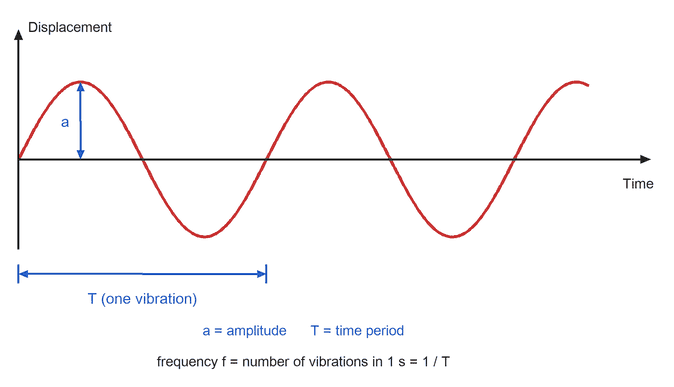
Step 4 — Relate frequency and time period.
If one vibration takes seconds, the number of vibrations in one second is .
For example, a body with a time period of 0.01 s makes 100 vibrations in one second, so its frequency is 100 Hz.
Therefore, amplitude is the maximum displacement from the mean position, time period is the time of one vibration, and frequency is the number of vibrations in one second.
- 442 marks
Question 44
Write the audible range of frequency for the normal human ear.
Solve with AIWritten solution
Solution:
Concept: The human ear cannot hear sounds of every frequency.
Step 1 — State the audible range.
The normal human ear can hear sounds of frequency from 20 Hz to 20,000 Hz. This is called the audible range.
Step 2 — Name the sounds outside it.
Sounds below 20 Hz are infrasonic and sounds above 20,000 Hz are ultrasonic; we cannot hear either kind.
Note: The upper limit falls with age: many adults cannot hear sounds much above 15,000 Hz.
Therefore, the audible range of frequency for the normal human ear is 20 Hz to 20,000 Hz.
- 452 marks
Question 45
What are ultrasonics ? Can you hear the ultrasonic sound ?
Solve with AIWritten solution
Solution:
Concept: The normal human ear can hear sounds of frequency from 20 Hz to 20,000 Hz (the audible range). Sound below 20 Hz is infrasonic and sound above 20,000 Hz is ultrasonic; we cannot hear either.
Step 1 — Define ultrasonics.
Sounds of frequency higher than 20,000 Hz are called ultrasonic sounds (ultrasonics). “Ultra” means beyond, that is, beyond the upper limit of our hearing.
Step 2 — Answer whether we can hear them.
No. Ultrasonic sounds lie above the audible range of 20 Hz to 20,000 Hz, so the human ear cannot hear them.
Step 3 — Name animals that can.
Some animals can hear them: dogs hear up to about 45,000 Hz, and bats and dolphins hear up to about 100,000 Hz or more.
Therefore, ultrasonics are sounds of frequency above 20,000 Hz, and we cannot hear them.
- 462 marks
Question 46
What are infrasonics ? Can you hear them ?
Solve with AIWritten solution
Solution:
Concept: The normal human ear can hear sounds of frequency from 20 Hz to 20,000 Hz (the audible range). Sound below 20 Hz is infrasonic and sound above 20,000 Hz is ultrasonic; we cannot hear either.
Step 1 — Define infrasonics.
Sounds of frequency lower than 20 Hz are called infrasonic sounds (infrasonics). “Infra” means below, that is, below the lower limit of our hearing.
Step 2 — Answer whether we can hear them.
No. They lie below the audible range, so we cannot hear them.
Step 3 — Work out an example.
A clock pendulum that makes one vibration in 2 s has a frequency of
This is far below 20 Hz, so any sound due to its vibrations is infrasonic and cannot be heard.
Watch out: The tick of a clock is heard, but it comes from the escapement striking, not from the slow swing of the pendulum.
Therefore, infrasonics are sounds of frequency below 20 Hz, and we cannot hear them.
- 472 marks
Question 47
How does a bat make use of ultrasonic waves to find its way ?
Solve with AIWritten solution
Solution:
Concept: Ultrasonic waves are reflected from obstacles, and a bat can hear the reflected waves (echoes).
Step 1 — The bat sends out ultrasound.
As a bat flies at night, it gives out short ultrasonic squeaks.
Step 2 — The sound is reflected.
These ultrasonic waves strike any object in the bat's way and come back to it after reflection.
Step 3 — The bat hears the echo.
The bat hears the reflected sound and so learns that an object is there. The time the echo takes tells it how far away the object is.
Step 4 — The bat changes its path.
It then turns to avoid the obstacle, or flies towards it if it is an insect to catch.
Therefore, a bat finds its way by sending out ultrasonic sound and hearing the echoes from objects in its path.
- 482 marks
Question 48
Name the two characteristics of sound which differentiate any two sounds from each other.
Solve with AIWritten solution
Solution:
Concept: A sound has three characteristics: loudness (set by the amplitude), pitch (set by the frequency) and quality (set by the wave form).
Step 1 — Name the first characteristic.
Loudness depends on the amplitude of vibration. It tells a loud sound from a feeble sound.
Step 2 — Name the second characteristic.
Pitch depends on the frequency. It tells a shrill sound from a flat (grave) sound.
Note: A third characteristic, quality, tells apart two sounds of the same loudness and the same pitch.
Therefore, the two characteristics are loudness and pitch.
- 492 marks
Question 49
On what factor does the loudness of a sound depend ?
Solve with AIWritten solution
Solution:
Concept: Loudness tells a loud sound from a feeble one. It depends on the amplitude of vibration (larger amplitude, louder sound) and on the area of the vibrating body (larger area, louder sound).
Step 1 — Name the factor.
The loudness of a sound depends on the amplitude of vibration of the body producing it. The greater the amplitude, the louder the sound.
Step 2 — Give an example.
A sitar string plucked gently moves only a little from its rest position and gives a soft sound. Plucked hard, it moves farther (larger amplitude) and gives a loud sound.
Note: Loudness also increases with the area of the vibrating body.
Therefore, the loudness of a sound depends on the amplitude of vibration.
- 502 marks
Question 50
How does the loudness of sound produced depend on the vibrating area of the body ?
Solve with AIWritten solution
Solution:
Concept: Loudness tells a loud sound from a feeble one. It depends on the amplitude of vibration (larger amplitude, louder sound) and on the area of the vibrating body (larger area, louder sound).
Step 1 — State the rule.
The greater the area of the vibrating body, the louder the sound, because a larger vibrating surface sets more air into vibration.
Step 2 — Give examples.
When a small drum and a big drum are beaten equally hard, the big drum sounds louder. A temple bell with a big case sounds louder than a bell with a small case.
Therefore, the greater the vibrating area of the body, the louder the sound produced.
- 512 marks
Question 51
State the factors on which the pitch of a sound depends.
Solve with AIWritten solution
Solution:
Concept: Pitch tells a shrill sound from a flat (grave) one. It depends on the frequency: the higher the frequency, the higher the pitch and the shriller the sound.
Step 1 — State the main factor.
The pitch of a sound depends on its frequency, the number of vibrations made per second. Anything that changes the frequency of the source changes the pitch.
Step 2 — List what changes the frequency.
For instruments, the frequency (and so the pitch) depends on these:
- Length of the vibrating air column (flute, test tube with water): the shorter the column, the higher the pitch.
- Length of the vibrating part of a string (changed by pressing the string at different places): the shorter the vibrating length, the higher the pitch.
- Tension of the string: the tighter the string, the higher the pitch.
- Thickness of the string: the thinner the string, the higher the pitch.
Watch out: The place where a string is plucked changes its quality a little, not its pitch; the pitch changes only when the vibrating length, tension or thickness changes.
Therefore, the pitch depends on the frequency, which for an instrument depends on the length of the vibrating air column or string, and on the tension and thickness of the string.
- 522 marks
Question 52
Name the characteristic which differentiates two sounds of the same pitch and same loudness.
Solve with AIWritten solution
Solution:
Concept: Quality (timbre) tells apart two sounds of the same pitch and the same loudness. It depends on the wave form, which differs because each source gives out other weaker frequencies along with its main one.
Step 1 — Name the characteristic.
Two sounds of the same pitch and the same loudness are told apart by their quality (timbre).
Step 2 — Explain it.
Such sounds have different wave forms, because each source gives out other weaker frequencies along with its main one. That is why we can recognise a person's voice or a musical instrument without seeing it.
Therefore, the characteristic is the quality (timbre) of the sound.
- 532 marks
Question 53
A musician recognizes the musical instrument by hearing the sound produced by it, even without seeing the instrument. Which characteristic of sound makes this possible ?
Solve with AIWritten solution
Solution:
Concept: Quality (timbre) tells apart two sounds of the same pitch and the same loudness. It depends on the wave form, which differs because each source gives out other weaker frequencies along with its main one.
Step 1 — Name the characteristic.
The characteristic is the quality of sound.
Step 2 — Explain why it works.
Each instrument gives a sound of its own wave form, even when it plays a note of the same pitch and loudness as another instrument. The ear can tell these wave forms apart, so the musician knows the instrument just by hearing it.
Therefore, the quality of sound lets the musician recognise the instrument without seeing it.
- 542 marks
Question 54
How does a musician playing on a flute change the pitch of sound produced by it ?
Solve with AIWritten solution
Solution:
Concept: In a flute the sound is produced by the vibrating air column inside it. The shorter the air column, the higher its frequency and so the higher the pitch.
Step 1 — Say what the musician changes.
The musician changes the length of the vibrating air column by closing and opening the holes of the flute with the fingers.
Step 2 — Opening holes raises the pitch.
When more holes are opened, the vibrating air column becomes shorter, its frequency increases and the sound becomes shriller (higher pitch).
Step 3 — Closing holes lowers the pitch.
When more holes are closed, the air column becomes longer, its frequency decreases and the sound becomes flatter (lower pitch).
Therefore, the flute player changes the pitch by opening and closing the holes, which changes the length of the vibrating air column.
- 552 marks
Question 55
Why are musical instruments provided with more than one string ?
Solve with AIWritten solution
Solution:
Concept: Pitch tells a shrill sound from a flat (grave) one. It depends on the frequency: the higher the frequency, the higher the pitch and the shriller the sound.
Step 1 — See what each string gives.
The strings of an instrument have different thicknesses and are kept at different tensions, so each string gives a sound of a different pitch.
Step 2 — Explain the difference.
A thin string, or one under greater tension, vibrates with a higher frequency and gives a higher pitch. A thick or loose string gives a lower pitch.
Step 3 — See why this helps.
With several strings the musician can play many different notes.
Therefore, instruments have more than one string so that sounds of many different pitches can be produced.
- 562 marks
Question 56
How can the pitch of sound produced in a piano be changed ?
Solve with AIWritten solution
Solution:
Concept: A piano is a stringed instrument. Pressing a key makes a small felt hammer strike a string (or a set of strings), and the pitch depends on the frequency of that string.
Step 1 — Strike different strings.
Each key strikes a different string. The strings differ in length, so pressing different keys gives different pitches: shorter strings give higher notes.
Step 2 — Use strings of different thickness and tension.
The strings also differ in thickness and are kept at different tensions. A thinner or tighter string vibrates faster and gives a higher pitch; a thicker or looser string gives a lower pitch. The tuner adjusts the tension of each string to set its pitch.
Watch out: Striking one string at a different point does not change its pitch; a different pitch needs a string of different length, thickness or tension.
Therefore, the pitch of a piano is changed by striking different strings, which differ in length, thickness and tension.
- 573 marks
Question 57
Write the approximate speed of sound in (i) air, (ii) water and (iii) steel.
Solve with AIWritten solution
Solution:
Concept: Sound travels fastest in solids, slower in liquids and slowest in gases. Its speed is nearly 330 m s⁻¹ in air, nearly 1500 m s⁻¹ in water and nearly 5960 m s⁻¹ in steel.
Step 1 — Write the speeds.
The approximate speeds of sound in the three media are given in the table.
Medium Approximate speed of sound (i) Air nearly 330 m s⁻¹ (ii) Water nearly 1500 m s⁻¹ (iii) Steel nearly 5960 m s⁻¹ Step 2 — Compare them.
Dividing the speed in steel by the speed in air shows how many times faster sound is in steel.
Note: The speed in air rises with temperature; it is about 343 m s⁻¹ at 20 °C.
Therefore, the speed of sound is about 330 m s⁻¹ in air, 1500 m s⁻¹ in water and 5960 m s⁻¹ in steel.
- 582 marks
Question 58
During a thunderstorm, the sound of a thunder is heard after the lightning is seen. Why ?
Solve with AIWritten solution
Solution:
Concept: Light travels much faster than sound: about 300,000 km in one second, against only about 330 m in one second for sound in air.
Step 1 — Both start together.
The lightning (a flash of light) and the thunder (a sound) are produced at the same moment.
Step 2 — Light arrives almost at once.
Light is so fast that it reaches us in a tiny fraction of a second.
Step 3 — Sound arrives later.
Sound covers only about 330 m in one second in air, so it needs much longer to cover the same distance.
Note: Counting the seconds between the flash and the thunder lets us estimate how far away the lightning is: about 1 km for every 3 s.
Therefore, the flash of lightning is seen first and the thunder is heard later, because light travels much faster than sound.
- 592 marks
Question 59
Can sound travel through solids and liquids ? In which of these two does it travel faster ?
Solve with AIWritten solution
Solution:
Concept: Sound needs a material medium (a solid, a liquid or a gas) to travel. The vibrating particles of the medium pass the vibration on to their neighbours. A vacuum has no particles, so sound cannot travel through it.
Step 1 — Answer the first part.
Yes, sound can travel through both solids and liquids.
Step 2 — Give the evidence.
Each of these everyday tests shows it:
- Solid: the ticking of a clock is heard through a metal rod, and a friend's voice is heard through the thread of a toy telephone.
- Liquid: the ticking of a watch is heard through a balloon filled with water.
Step 3 — Compare the speeds.
Sound travels faster in solids: nearly 5960 m s⁻¹ in steel, but only nearly 1500 m s⁻¹ in water.
Therefore, sound can travel through both solids and liquids, and it travels faster in solids.
- 602 marks
Question 60
What do you mean by reflection of sound ?
Solve with AIWritten solution
Solution:
Concept: Sound, like light, is reflected when it strikes a large surface, and it obeys the same laws of reflection.
Step 1 — Define reflection of sound.
When sound strikes a surface and comes back into the same medium, this return of sound is called reflection of sound.
Step 2 — State the laws it obeys.
Reflection of sound obeys the same two laws as light:
- The angle of incidence is equal to the angle of reflection.
- The incident sound, the reflected sound and the normal all lie in one plane.
Step 3 — Say what surface is needed.
The reflecting surface must be large; it may be smooth or rough.
Therefore, reflection of sound is the return of sound after striking a surface.
- 612 marks
Question 61
State one use of reflection of sound.
Solve with AIWritten solution
Solution:
Concept: Sound, like light, is reflected when it strikes a large surface, and it obeys the same laws of reflection.
Step 1 — Name a use.
Reflection of sound is used in the megaphone (speaking tube).
Step 2 — Explain how it works.
Sound from the mouth is reflected again and again from the inner walls of the tube, so it goes forward in one direction instead of spreading out. It can therefore be heard at a large distance.
Note: Other uses are the stethoscope, the sound board behind a speaker, and the echoes bats use to find their way.
Therefore, one use of reflection of sound is the megaphone, which sends the sound forward in one direction.
- 622 marks
Question 62
What is an echo ?
Solve with AIWritten solution
Solution:
Concept: An echo is the sound heard after reflection from a distant large surface. The sensation of a sound stays in our ear for about 0.1 s, so the echo is heard as a separate sound only if it arrives at least 0.1 s after the original sound.
Step 1 — Define echo.
An echo is the distinct sound heard after reflection from a distant large surface, such as a cliff, a hillside or the wall of a big building.
Step 2 — Give an example.
If we stand far from a hillside and clap sharply, we hear two sounds: first the clap itself and, a fraction of a second later, the reflected clap. The second sound is the echo.
Therefore, an echo is the sound heard after reflection from a distant surface, separately from the original sound.
- 632 marks
Question 63
What minimum distance is required between the source of sound and the reflecting surface to hear an echo ? Give reason.
Solve with AIWritten solution
Solution:
Concept: An echo is the sound heard after reflection from a distant large surface. The sensation of a sound stays in our ear for about 0.1 s, so the echo is heard as a separate sound only if it arrives at least 0.1 s after the original sound.
Step 1 — Say how much delay is needed.
The original sound persists in the ear for about 0.1 s, so the reflected sound must arrive at least 0.1 s later. Otherwise the two sounds mix and cannot be told apart.
Step 2 — Find the path covered in 0.1 s.
Taking the speed of sound in air as nearly 330 m s⁻¹, the distance sound covers in 0.1 s is
Step 3 — Halve it for the to-and-fro path.
This 33 m is covered in going to the reflecting surface and coming back, so the surface must be half of this distance away.
Watch out: Do not stop at 33 m; that is the whole path to the surface and back.
Note: On a warmer day sound is a little faster (about 340 m s⁻¹ at 15 °C), and the same working gives about 17 m.
Therefore, the reflecting surface must be at least 16.5 m from the source of sound to hear an echo in air.
- 642 marks
Question 64
List four substances which are good absorbers of sound.
Solve with AIWritten solution
Solution:
Concept: Soft, porous materials such as curtains, carpets, thermocol and cushions absorb much of the sound falling on them, instead of reflecting it.
Step 1 — See what makes a good absorber.
Soft, porous materials take in much of the sound falling on them instead of reflecting it.
Step 2 — List four of them.
Four good absorbers of sound are:
- Carpets
- Curtains
- Thermocol
- Sofa cushions (foam)
Note: Felt, cork and soft fibre board are also good absorbers of sound.
Therefore, four good absorbers of sound are carpets, curtains, thermocol and sofa cushions.
- 653 marks
Question 65
Describe an experiment to show that each source of sound is a vibrating body.
Solve with AIWritten solution
Solution:
Concept: Sound is produced when a body vibrates, that is, moves rapidly to and fro. When the vibrations stop, the sound also stops.
Step 1 — Set up the vibrating ruler.
Press one end of a ruler on a table with one hand. Pull down the free end with the other hand and let it go.
Step 2 — Observe the ruler.
The free end of the ruler vibrates and a humming sound is heard. After a short time the ruler stops vibrating, and at that moment the sound also stops.
Step 3 — Repeat with a tuning fork.
Strike a tuning fork on a rubber pad and bring one prong near a table-tennis ball hanging from a thread. The ball is pushed away again and again, showing that the prongs are vibrating while the fork sounds. When the prongs stop, the ball stops jumping and the sound dies out.
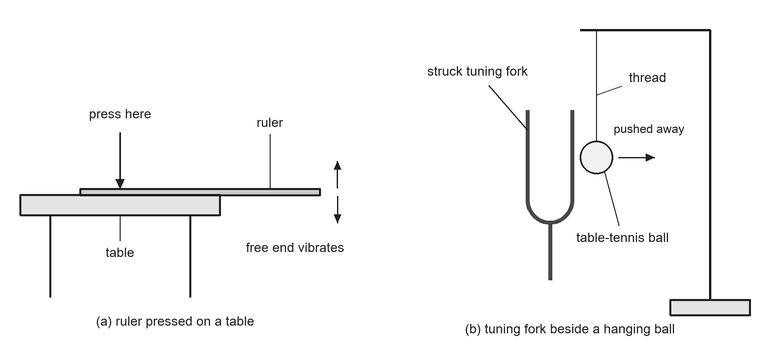
Step 4 — Note other examples.
A plucked sitar string is seen moving to and fro while it sounds, and grains of rice jump on a drum skin while the drum is being beaten.
Step 5 — Draw the conclusion.
Sound is heard only while the body vibrates, and it stops when the vibrations stop. So the sound comes from the vibrations.
Therefore, the vibrating ruler and tuning fork show that each source of sound is a vibrating body.
- 664 marks
Question 66
Can sound travel through a vacuum ? Describe an experiment to explain your answer.
Solve with AIWritten solution
Solution:
Concept: Sound needs a material medium (a solid, a liquid or a gas) to travel. The vibrating particles of the medium pass the vibration on to their neighbours. A vacuum has no particles, so sound cannot travel through it.
Step 1 — Answer the question.
No, sound cannot travel through a vacuum. The bell-jar experiment shows this.
Step 2 — Set up the apparatus.
Hang an electric bell inside an air-tight glass jar (a bell jar) that is connected to a vacuum pump. Connect the bell to a battery through a switch.
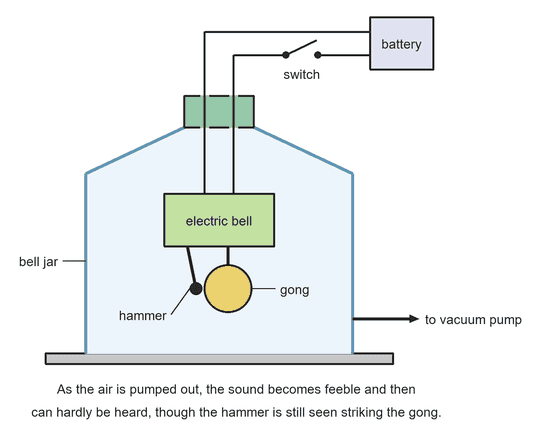
Step 3 — Ring the bell with air in the jar.
Press the switch. The bell rings and its sound is heard clearly, because the sound reaches us through the air in the jar.
Step 4 — Pump out the air.
Now start the vacuum pump to remove the air from the jar. As the air is removed, the sound becomes fainter and fainter, until it can hardly be heard, even though the hammer is still seen striking the gong.
Step 5 — Draw the conclusion.
The bell is still vibrating, but with almost no air left there are almost no particles to carry the sound to us. So sound needs a medium and cannot travel through a vacuum.
Note: In practice a faint sound may still be heard, because a pump cannot remove all the air and a little sound reaches the jar through the bell's supports. This is also why astronauts in space cannot talk to each other directly.
Therefore, sound cannot travel through a vacuum; it needs a material medium.
- 673 marks
Question 67
Describe an experiment to show that sound can travel in water.
Solve with AIWritten solution
Solution:
Concept: If a sound reaches the ear only through water, the water must be carrying it.
Step 1 — Set up the balloon.
Fill a balloon with water and tie its mouth.
Step 2 — Place the ear and the watch.
Hold the balloon against one ear and keep a ticking watch gently on the other side of the balloon.
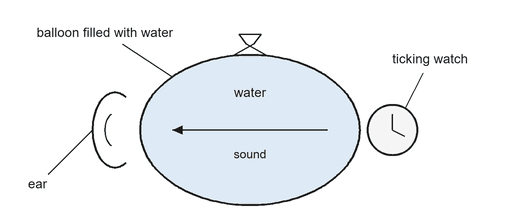
Step 3 — Observe.
The ticking of the watch is heard clearly.
Step 4 — Draw the conclusion.
The sound of the watch reaches the ear by travelling through the water in the balloon, so water can carry sound.
Note: Divers and fishes also hear sounds through water.
Therefore, the water-filled balloon experiment shows that sound can travel in water.
- 683 marks
Question 68
Describe an experiment to show that sound can travel in a solid.
Solve with AIWritten solution
Solution:
Concept: A sound that is too faint to be heard through air can still be heard through a solid.
Step 1 — Use a clock on a table.
Place a clock at one end of a table and put your ear near that end; the ticking is heard. Slowly move the clock away until you can no longer hear it.
Step 2 — Add a metal rod.
Now place one end of a metal rod (or a ruler) under the clock and hold the other end close to your ear.
Step 3 — Observe.
The ticking is heard again. This time the sound reaches the ear through the solid rod.
Step 4 — Repeat with a toy telephone.
Make a small hole in the bottom of each of two paper cups, pass a long thread through them and knot each end. Keep the thread tight and speak into one cup; a friend holding the other cup to the ear hears your voice through the thread.

Step 5 — Draw the conclusion.
In both cases the sound reached the ear through a solid (the rod, the thread).
Therefore, the clock-and-rod and toy-telephone experiments show that sound can travel in a solid.
- 693 marks
Question 69
Differentiate between a high pitch sound and a low pitch sound.
Solve with AIWritten solution
Solution:
Concept: Pitch tells a shrill sound from a flat (grave) one. It depends on the frequency: the higher the frequency, the higher the pitch and the shriller the sound.
Step 1 — Compare the two sounds.
The table sets the two kinds of sound side by side.
High pitch sound Low pitch sound It has a high frequency (more vibrations per second). It has a low frequency (fewer vibrations per second). It is shrill. It is flat (grave). Its graph shows more waves in a given time. Its graph shows fewer waves in the same time. Examples: a girl's voice, the buzz of a mosquito, a whistle. Examples: a man's voice, the roar of a lion, a big drum. Step 2 — See the difference in the graphs.
The wave of a high pitch sound has many more waves in the same time than the wave of a low pitch sound.
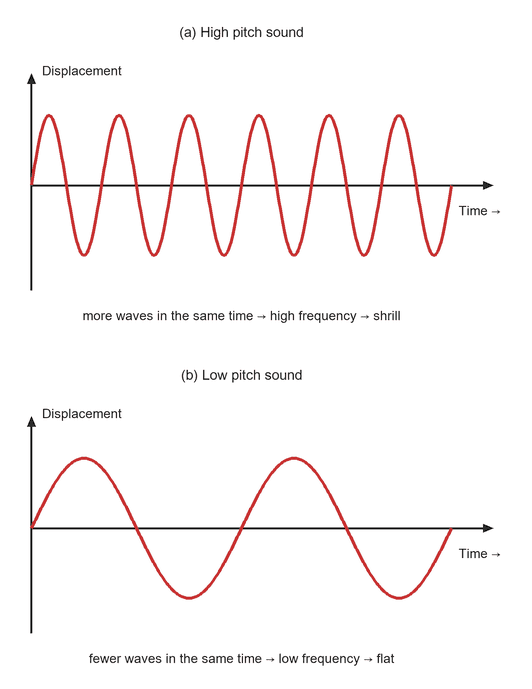
Therefore, a high pitch sound has a high frequency and is shrill, while a low pitch sound has a low frequency and is flat.
- 703 marks
Question 70
You recognize your friend by hearing his voice on a telephone. Explain.
Solve with AIWritten solution
Solution:
Concept: Quality (timbre) tells apart two sounds of the same pitch and the same loudness. It depends on the wave form, which differs because each source gives out other weaker frequencies along with its main one.
Step 1 — Every voice has its own quality.
Every person's voice has its own quality, that is, its own wave form. The wave form depends on the other weaker frequencies present with the main frequency, and these differ from person to person.
Step 2 — Same pitch and loudness are not enough.
So even if two people speak with the same pitch and the same loudness, their voices have different wave forms.
Step 3 — The ear recognises it.
Our ear can tell these wave forms apart, so we know whose voice it is.
Therefore, we recognise our friend's voice on the telephone, without seeing him, by its quality (wave form).
- 714 marks
Question 71
Describe an experiment to show the production of sound having low and high pitch.
Solve with AIWritten solution
Solution:
Concept: The shorter the vibrating air column, the higher its frequency and so the higher the pitch.
Step 1 — Blow into a test tube with a little water.
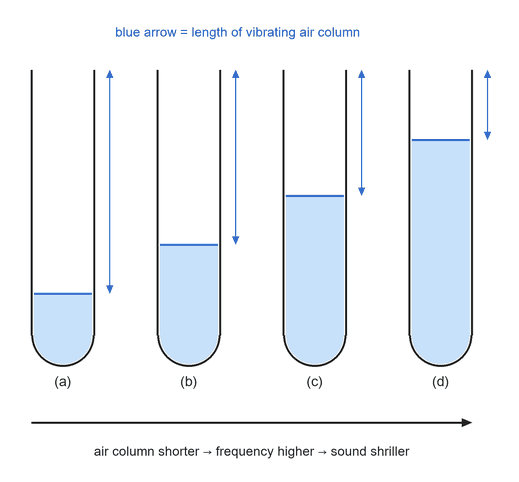
Take a test tube with a little water in it. Put your lip to its mouth and blow across it. A flat (low pitch) sound is heard, because the long air column above the water vibrates slowly (low frequency).
Step 2 — Add water and blow again.
Add more water step by step, so that the air column above the water becomes shorter, and blow across the mouth each time.
Step 3 — Observe.
The sound becomes more and more shrill as the air column becomes shorter.
Step 4 — Draw the conclusion.
A long air column gives a sound of low pitch, and a short air column gives a sound of high pitch, because a shorter column vibrates with a higher frequency.
Step 5 — Try another way.
Rub a postcard slowly over the teeth of a comb: a low pitch sound is heard. Rub it quickly: the card vibrates more times per second and the sound becomes shriller.
Therefore, the test-tube experiment shows that a long air column gives a low pitch sound and a short air column gives a high pitch sound.
- 723 marks
Question 72
Explain why you can predict the arrival of a train by placing your ear on the rails without seeing it.
Solve with AIWritten solution
Solution:
Concept: Sound travels much faster through a solid (steel) than through air.
Step 1 — Sound takes two paths.
The sound of the moving train travels to us both through the steel rails and through the air.
Step 2 — Compare the speeds.
Sound travels at nearly 5960 m s⁻¹ in steel but only nearly 330 m s⁻¹ in air, so it is about 18 times faster through the rails.
Step 3 — Compare the strength.
The sound in the rails also stays strong over a long distance, while the sound spreading through the air soon becomes faint.
Step 4 — Put it together.
So a person with an ear on the rail hears the train through the track much before it can be heard through the air.
Note: Never put your ear on a railway track; it is very dangerous. This is only an explanation.
Therefore, we can predict a train's arrival with an ear on the rails because sound travels faster, and stays stronger, in steel than in air.
- 734 marks
Question 73
Describe an experiment to estimate the speed of sound in air.
Solve with AIWritten solution
Solution:
Concept: Light reaches us almost at once, but sound takes time to travel. Speed of sound = distance ÷ time.
Step 1 — Choose and measure the distance.
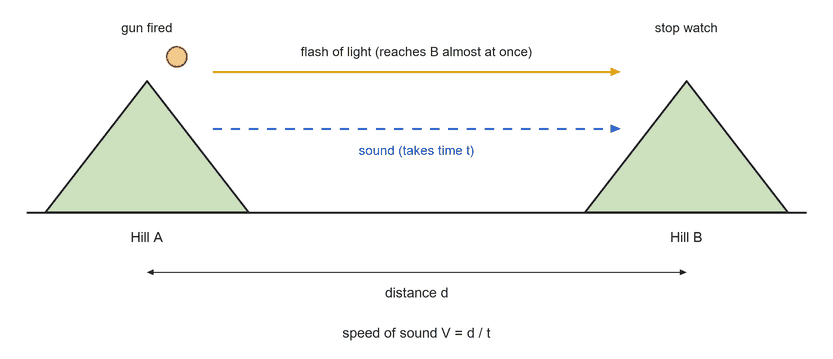
Choose two hills A and B about a kilometre apart and measure the distance between them. Let it be metre.
Step 2 — Fire the gun.
A person on hill A fires a gun.
Step 3 — Time the sound.
A person on hill B starts a stopwatch on seeing the flash and stops it on hearing the sound. Let the time be second.
Step 4 — Calculate the speed.
Light takes a negligible time to go from A to B, so is the time the sound takes to cover the distance . The speed is the distance divided by the time.
Step 5 — Work an example.
Suppose the hills are 660 m apart and the sound takes 2 s. Then
Watch out: Start the stopwatch at the flash, not at the bang; the flash marks the moment the gun is fired.
Therefore, the speed of sound in air is found from V = d ÷ t, and it comes out to be nearly 330 m s⁻¹.
- 743 marks
Question 74
List the measures that you will take when designing a sound-proof room.
Solve with AIWritten solution
Solution:
Concept: A sound-proof room should not let outside sound in or inside sound out, and should not produce echoes inside. Soft, porous materials absorb sound, and closed, sealed openings stop it leaking.
Step 1 — Treat the roof.
Fix sheets of thermocol on the ceiling and cover them with a false ceiling of plaster of paris boards.
Step 2 — Treat the walls.
Cover the walls with soft boards or wooden panels backed by thermocol.
Step 3 — Treat the floor.
Lay thick carpets on the floor.
Step 4 — Remove noisy machines.
Place the noisy machine parts of fans, air conditioners and other equipment outside the room.
Step 5 — Seal the openings.
Cover the doors with thick curtains, keep them closed, and seal the gaps around doors and windows with thick rubber or felt strips.
Note: Absorbers mainly stop echoes inside the room; to keep outside sound out, heavy walls and well-sealed doors and windows matter most.
Therefore, a sound-proof room has an absorbing roof, walls and floor, keeps noisy machines outside, and has thick curtains and sealed doors and windows.
- 753 marks
Question 75
A boy fires a gun and another boy at a distance of 1020 m hears the sound of firing the gun 3 s after seeing its smoke. Find the speed of sound.
Solve with AIWritten solution
Solution:
Concept: Light from the smoke reaches the second boy almost at once, so the 3 s is the time the sound takes to travel 1020 m. Speed is the distance travelled in one second, so speed = distance ÷ time.
Given: Distance between the boys , and time taken by the sound .
Step 1 — Write the formula.
The speed of sound is the distance it covers divided by the time it takes.
Step 2 — Put in the values.
Substitute the distance and the time given in the question.
Step 3 — Divide.
Dividing 1020 by 3 gives the speed.
Watch out: The time starts when the smoke is seen, because the light from the smoke arrives almost at once.
Therefore, the speed of sound is 340 m s⁻¹.
- 763 marks
Question 76
A boy on a hill A fires a gun. Another boy on hill B hears the sound after 4 s. If the speed of sound is , find the distance between the two hills.
Solve with AIWritten solution
Solution:
Concept: Speed is the distance travelled in one second, so multiplying the speed by the time gives the distance travelled.
Given: Speed of sound , and time taken by the sound .
Step 1 — Write the formula.
Since speed is distance divided by time, multiplying the speed by the time gives the distance.
Step 2 — Put in the values.
Substitute the speed of sound and the time taken.
Step 3 — Multiply.
Multiplying 330 by 4 gives the distance.
Therefore, the distance between the two hills is 1320 m.
- 772 marks
Question 77
Can two persons hear each other on moon's surface ? Give reason to support your answer.
Solve with AIWritten solution
Solution:
Concept: Sound needs a material medium (a solid, a liquid or a gas) to travel. The vibrating particles of the medium pass the vibration on to their neighbours. A vacuum has no particles, so sound cannot travel through it.
Step 1 — Answer the question.
No, two persons cannot hear each other directly on the moon's surface.
Step 2 — Give the reason.
The moon has no atmosphere (no air). Without air there is no medium to carry the sound from one person to the other, just as a bell in a jar emptied of air can hardly be heard.
Step 3 — Say how astronauts talk.
Astronauts on the moon talk through radio sets in their helmets, because radio waves can travel through a vacuum.
Note: If their helmets touch, a little sound can pass from one to the other through the solid helmets.
Therefore, two persons cannot hear each other directly on the moon, because there is no air there to carry sound.
- 782 marks
Question 78
The outer case of the bell in a temple is made big. Give a reason.
Solve with AIWritten solution
Solution:
Concept: Loudness tells a loud sound from a feeble one. It depends on the amplitude of vibration (larger amplitude, louder sound) and on the area of the vibrating body (larger area, louder sound).
Step 1 — See what vibrates.
When the bell is struck, its outer case vibrates.
Step 2 — Link the area to the loudness.
A big case has a large vibrating area, so it sets a larger amount of air into vibration.
Step 3 — State the result.
So a bell with a big case gives a much louder sound, which can be heard far away.
Therefore, the outer case of a temple bell is made big so that its large vibrating area produces a loud sound.
- 792 marks
Question 79
How does a man's voice differ from a woman's voice ?
Solve with AIWritten solution
Solution:
Concept: Pitch tells a shrill sound from a flat (grave) one. It depends on the frequency: the higher the frequency, the higher the pitch and the shriller the sound.
Step 1 — Name the difference.
A man's voice and a woman's voice differ mainly in pitch.
Step 2 — Describe a woman's voice.
A woman's vocal cords are usually shorter and thinner, so they vibrate with a higher frequency. Her voice has a higher pitch and is shriller.
Step 3 — Describe a man's voice.
A man's vocal cords are usually longer and thicker, so they vibrate with a lower frequency. His voice has a lower pitch and is flat (grave).
Note: The two voices also differ in quality, which is how we tell one person's voice from another's.
Therefore, a woman's voice has a higher pitch (it is shriller) and a man's voice has a lower pitch (it is flatter).
What Class 7 Physics Ch 6 covers
The sections of the chapter, in the order the book takes them. Every question above comes from one of these.
- 01Sound is Produced Due to Vibrations
- 02Sources of Sound
- 03Sound Needs a Medium for Propagation
- 04Sound Travels in Air in the Form of Longitudinal Waves
- 05Some Terms Related to a Wave
- 06Audible Sound
More ways to study this chapter
The same chapter asked three other ways. Practise it, revise it, and see what the board has set on Ch 6 before.
Class 7 Physics Ch 6 questions students ask
How many questions are there in Class 7 Physics Ch 6?
79 questions. Every one is solved step by step on this page.
Are these Class 7 Physics solutions free?
Yes. Every question and its full working is free to read, with no account needed.
Can I download the Class 7 Physics Ch 6 solutions as a PDF?
There is no PDF to download. Every solution is on this page instead, which means it is searchable, always the current syllabus, and readable on a phone. Use your browser's print option if you want it on paper.