
Question 664 marksMedium
Can sound travel through a vacuum ? Describe an experiment to explain your answer.
Confirming your payment
Sign up now and get 250 free tokens.
Sound · Question 66 of 79
Can sound travel through a vacuum ? Describe an experiment to explain your answer.
Solution:
Concept: Sound needs a material medium (a solid, a liquid or a gas) to travel. The vibrating particles of the medium pass the vibration on to their neighbours. A vacuum has no particles, so sound cannot travel through it.
Step 1 — Answer the question.
No, sound cannot travel through a vacuum. The bell-jar experiment shows this.
Step 2 — Set up the apparatus.
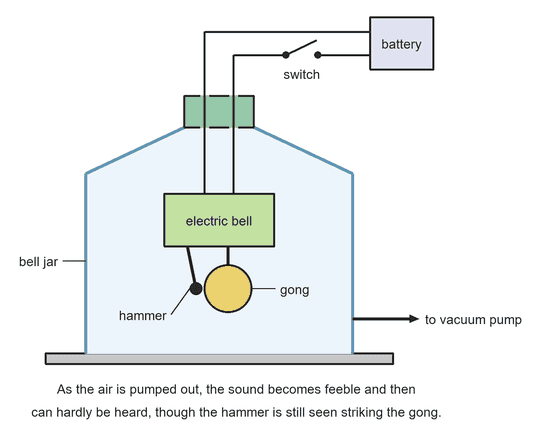
Hang an electric bell inside an air-tight glass jar (a bell jar) that is connected to a vacuum pump. Connect the bell to a battery through a switch.
Step 3 — Ring the bell with air in the jar.
Press the switch. The bell rings and its sound is heard clearly, because the sound reaches us through the air in the jar.
Step 4 — Pump out the air.
Now start the vacuum pump to remove the air from the jar. As the air is removed, the sound becomes fainter and fainter, until it can hardly be heard, even though the hammer is still seen striking the gong.
Step 5 — Draw the conclusion.
The bell is still vibrating, but with almost no air left there are almost no particles to carry the sound to us. So sound needs a medium and cannot travel through a vacuum.
Note: In practice a faint sound may still be heard, because a pump cannot remove all the air and a little sound reaches the jar through the bell's supports. This is also why astronauts in space cannot talk to each other directly.
Therefore, sound cannot travel through a vacuum; it needs a material medium.