
Opening your dashboard
Class 7 Physics Chapter 6 Sound: Practice Questions
40 questions on Chapter 6, each worked through on its own page with the AI tutor. Class 7 Physics, ICSE 2026-27.
40 questions
1–5 marks · Mixed difficulty
- 11 mark
Question 1
Bloom's level: Remember
In a sound wave, the distance from one compression to the next compression is called the :
- 21 mark
Question 2
Bloom's level: Remember
Elephants can make a deep rumbling call of frequency 15 Hz, which people cannot hear. Such a sound is called :
- 31 mark
Question 3
Bloom's level: Understand
A school bell is ringing. When the teacher holds the bell firmly with her hand, the sound stops at once. This is because :
- 41 mark
Question 4
Bloom's level: Apply
When you blow gently across the mouth of an empty glass bottle, a humming sound is heard. Which part vibrates to produce this sound ?
- 51 mark
Question 5
Bloom's level: Apply
During a storm, the thunder is heard 3 s after the flash of lightning is seen. If the speed of sound in air is , how far away did the lightning take place ?
- 61 mark
Question 6
Bloom's level: Analyse
A sound is sent through 3300 m of three different media X, Y and Z. The time it takes is :
Medium X Y Z Time taken 10 s 2.2 s 0.65 s Using the speeds of sound given in your book (air , water , iron ), the media X, Y and Z are most likely :
- 71 mark
Question 7
Bloom's level: Apply
A girl claps her hands while standing 10 m in front of a tall wall. The speed of sound in air is . Will she hear a distinct echo ?
- 81 mark
Question 8
Bloom's level: Evaluate
In the bell-jar experiment, an electric bell rings inside a glass jar. As the air is pumped out, the sound becomes fainter and fainter until it can hardly be heard, although the hammer is still seen striking the gong. Riya concludes, "The bell stops ringing when there is no air." Which is the best judgement of Riya's conclusion ?
- 91 mark
Question 9
Bloom's level: Understand
Your voice sounds loud and booming in an empty new room, but much softer after sofas, curtains and carpets are put in. This is mainly because :
- 101 mark
Question 10
Bloom's level: Understand
Read the Assertion (A) and the Reason (R) and choose the correct option.
Assertion (A): When a bell rings, the particles of air near the bell travel all the way from the bell to the listener's ear.
Reason (R): In wave motion, the particles of the medium vibrate about their mean positions and pass on energy to the neighbouring particles.
- 111 mark
Question 11
Bloom's level: Understand
Read the Assertion (A) and the Reason (R) and choose the correct option.
Assertion (A): When struck equally hard, a big drum produces a louder sound than a small drum.
Reason (R): Greater the area of the vibrating body, louder is the sound produced.
- 121 mark
Question 12
Bloom's level: Understand
Read the Assertion (A) and the Reason (R) and choose the correct option.
Assertion (A): As a bottle is filled with water from a tap, the sound produced becomes more and more shrill.
Reason (R): The vibrating air column above the water becomes shorter, so it vibrates with a higher frequency.
- 132 marks
Question 13
Bloom's level: Remember
Name :
(a) the kind of wave in which sound travels through air,
(b) the two quantities by which a sound wave is characterised,
(c) the part of the human body in which our voice is produced,
(d) two things that can happen to sound when it falls on a surface.
- 142 marks
Question 14
Bloom's level: Remember
Name the part that vibrates to produce sound in each of these : (a) harmonium, (b) tabla, (c) violin, (d) clarinet.
- 152 marks
Question 15
Bloom's level: Apply
A mobile phone is kept inside an air-tight glass jar connected to a vacuum pump, and it is rung from another phone. Predict what you will (a) hear and (b) see as the air is slowly pumped out. What will happen when air is let back into the jar ?
- 162 marks
Question 16
Bloom's level: Apply
A tuning fork makes 2560 vibrations in 10 seconds. Find (a) its frequency and (b) its time period.
- 172 marks
Question 17
Bloom's level: Understand
(a) When you wave your hand to and fro 4 times a second, it makes the air vibrate, yet you hear no sound. Why ?
(b) A dog-trainer's whistle produces a sound of 30,000 Hz. The dog comes running but the people nearby hear nothing. Explain.
- 182 marks
Question 18
Bloom's level: Understand
A sitar player first plucks a string gently and then plucks the same string hard. Later she presses the string at a different place and plucks it again. Which characteristic of the sound changes in each case, and why ?
- 192 marks
Question 19
Bloom's level: Apply
A train is 2980 m away. A man puts his ear on the steel rail while his friend stands beside him. Using the speeds of sound in your book (steel , air ), find how long the sound of the train takes to reach (a) the man through the rail and (b) his friend through the air.
- 202 marks
Question 20
Bloom's level: Apply
A boy shouts in front of a cliff and hears the echo 2 s later. The speed of sound in air is . How far is the cliff from the boy ?
- 212 marks
Question 21
Bloom's level: Evaluate
The manager of a school hall says, "Let us remove the curtains and the carpet from the hall. Bare walls and floor reflect sound, so the speaker's voice will be louder and clearer for everyone." Do you agree ? Justify your answer.
- 222 marks
Question 22
Bloom's level: Analyse
In a sound wave travelling through air, the distance between a compression and the next rarefaction is 0.5 m.
(a) What is the wavelength of the wave ?
(b) At which of these two points are the air particles closest together ? At which are they farthest apart ?
- 233 marks
Question 23
Bloom's level: Analyse
Students measure the time between seeing the smoke of a starter's gun and hearing its sound, standing at different distances :
Distance (in m) 165 330 495 660 Time (in s) 0.5 1.0 1.8 2.0 (a) Calculate the speed of sound from each reading.
(b) Which reading is most likely wrong ? Suggest one reason.
(c) Using the correct readings, find how long the sound would take to reach a student 990 m away.
- 244 marks
Question 24
Bloom's level: Apply
Case study: At the school's annual day in the auditorium, Nisha sings a song, Kabir plays the flute and Arjun plays the tabla. The walls of the auditorium are covered with thick curtains and the floor has a carpet.
(a) Name the part that vibrates to produce the sound of Nisha's song, Kabir's flute and Arjun's tabla.
(b) Explain how the sound of the tabla reaches a person sitting in the last row.
(c) Why are the walls and floor of the auditorium covered with curtains and carpet ?
- 254 marks
Question 25
Bloom's level: Analyse
The figure shows the displacement-time graphs of three sounds P, Q and R, drawn to the same scales.
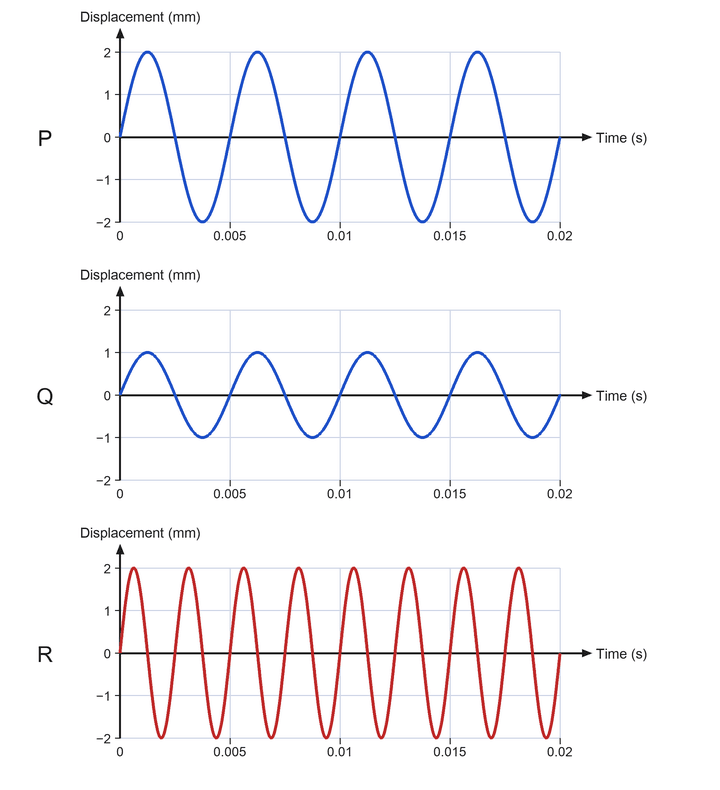
(a) Find the time period and the frequency of sound P and of sound R.
(b) Which two sounds have the same pitch ? Of these two, which is louder ? Give reasons.
(c) Which sound is the shrillest ? Can a person with normal hearing hear all three sounds ?
- 264 marks
Question 26
Bloom's level: Analyse
Case study: A fishing boat has a device that sends a short sound pulse straight down into the sea and picks up the sound reflected back. One day it receives two reflected pulses : a faint one 0.1 s after sending, and a strong one 0.4 s after sending. The speed of sound in sea water is about .
(a) Name the effect on which this device works.
(b) Which pulse comes from the sea-bed ? Find the depth of the sea-bed.
(c) What could have reflected the faint pulse, and how deep is it ? A student used for his working. Why is this wrong ?
- 275 marks
Question 27
Bloom's level: Create
Design an experiment to find out which of these materials absorbs sound best : thermocol sheet, woollen cloth, egg-carton and newspaper. You may use a shoe box, a mobile phone with an alarm tone, a measuring tape and cello-tape. Describe :
(a) how you will set up the apparatus,
(b) how you will measure how well each material absorbs sound,
(c) how you will make it a fair test,
(d) how you will record your results and decide which material is best.
- 284 marks
Question 28
Bloom's level: Create
Using the facts from this chapter, frame two numerical problems and solve them :
(a) one problem in which the speed of sound in air is to be found,
(b) one problem on an echo, in which the time to hear the echo is to be found.
Use your own numbers, give each problem a real-life setting, and check that your answers are sensible.
- 294 marks
Question 29
Bloom's level: Evaluate
A student wrote these revision notes for the chapter. Check each statement. Write Correct or Wrong, and correct each wrong statement.
(a) Sound can travel through a vacuum.
(b) The unit of frequency is hertz (Hz).
(c) The pitch of a sound depends on its amplitude.
(d) Of air, water and steel, sound travels fastest in steel.
(e) A sound of frequency 25,000 Hz can be heard by a normal human ear.
(f) To hear a distinct echo in air, the reflecting surface must be at least 16.5 m away.
(g) Carpets and curtains are good reflectors of sound.
(h) In a longitudinal wave in air, the particles vibrate along the direction in which the sound travels.
- 303 marks
Question 30
Bloom's level: Apply
Case study: Tanvi presses one end of a steel ruler firmly on the edge of her desk and lets the rest stick out. She pulls down the free end and releases it, and a humming sound is heard.
(a) Why does the humming stop after a few seconds ?
(b) She pulls the free end down much farther before releasing it. How does the sound change ? Why ?
(c) She slides the ruler so that a much shorter part sticks out, and twangs it again. The ruler now vibrates much faster. How does the sound change ?
- 311 mark
Question 31
In a flute, the sound is produced by the vibrations of :
- 321 mark
Question 32
A special whistle used for calling dogs gives out a sound of frequency 30,000 Hz. A man standing close to the whistle hears nothing, because this sound is :
- 331 mark
Question 33
The sound of a cracker bursting 1650 m away is heard 5 s after the cracker bursts. The speed of sound in air is :
- 341 mark
Question 34
Fill in the blank :
When sound travels in air, the region in which the particles of air are crowded close together is called a ..............
- 351 mark
Question 35
Write true or false :
Sound can travel through water, but it cannot travel through a solid such as iron.
- 362 marks
Question 36
Give a reason for each of the following :
(a) A big drum gives a louder sound than a small drum when both are beaten equally hard.
(b) The voice of a small child is shriller than the voice of a grown-up person.
- 372 marks
Question 37
The time period of a vibrating wire is 0.005 s.
(a) Calculate the frequency of its vibrations.
(b) How many vibrations does the wire complete in one minute ?
- 384 marks
Question 38
(a) What is an echo ?
(b) A girl standing in front of a tall building claps her hands and hears the echo 1.2 s later. If the speed of sound in air is 330 m s, find the distance of the building from the girl.
(c) The girl now walks 33 m towards the building and claps again. After how much time will she hear the echo ?
- 394 marks
Question 39
The figure shows the displacement-time graph of a sound wave.
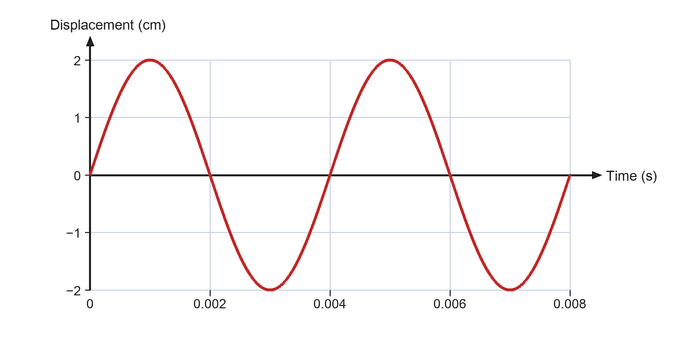
(a) From the graph, write (i) the amplitude and (ii) the time period of the wave.
(b) Calculate the frequency of the sound. Can a normal human ear hear this sound ? Give a reason.
(c) The same source now gives a louder sound of the same pitch. State how the amplitude and the time period of the new wave compare with those of the wave shown.
- 405 marks
Question 40
The table gives the speed of sound in three media.
Medium Speed of sound Air 330 m s Water 1500 m s Steel 5000 m s (a) In which state of matter (solid, liquid or gas) does sound travel (i) the fastest, (ii) the slowest ?
(b) A ship sounds its horn, which sends sound into the air and into the water at the same time. A sailor on another boat and a diver under the water are each 4950 m away from the ship. Calculate the time taken by the sound to reach (i) the diver through water, (ii) the sailor through air. Who hears the horn first, and by how many seconds ?
(c) One end of a long steel pipe is struck once with a hammer. A boy with his ear pressed to the other end hears two sounds, one after the other. Explain why.