
Opening your dashboard
Class 7 Physics Chapter 6 Sound: Competency-Based Questions (CBQ)
40 questions on Chapter 6, each worked through on its own page with the AI tutor. Class 7 Physics, ICSE 2026-27.
40 questions
1–5 marks · Mixed difficulty
- 11 mark
Question 1
Competency: Application
From his balcony, Rohan watches a workman driving a pole into the ground with a heavy hammer. The workman is 165 m away. Rohan sees the hammer hit the pole, but the bang reaches him a little later. Taking the speed of sound in air as , how long after seeing each blow does Rohan hear it ?
- 21 mark
Question 2
Competency: Analysis
The humming of a flying insect is produced by its vibrating wings. A student notes the following data from a science magazine.
Insect Number of wing beats Time taken Honey bee 4600 20 s Housefly 2000 10 s Dragonfly 1200 30 s Mosquito 3000 5 s Which insect produces the shrillest hum ?
- 31 mark
Question 3
Competency: Application
Two astronauts are repairing a panel on the outside of a space station, where there is no air. Their radio sets stop working. Each astronaut has air inside the helmet. Which of these will let one astronaut hear the other speak ?
- 41 mark
Question 4
Competency: Application & Analysis
A heavy machine in a factory makes the floor of the room shake up and down. A sensor fixed on the floor shows that the floor completes one vibration in 0.1 s. The workers can feel the shaking with their feet, but they hear no sound from the floor. Which statement explains this ?
- 51 mark
Question 5
Competency: Understanding
Assertion (A): When a girl and her father sing the same line of a song equally loudly, the girl's voice sounds shriller.
Reason (R): The pitch of a sound becomes higher when the amplitude of vibration becomes larger.
- 61 mark
Question 6
Competency: Analysis
Assertion (A): In a 100 m race, the timekeeper standing at the finishing line should start the stop watch on seeing the smoke of the starter's pistol, and not on hearing its bang.
Reason (R): Sound takes about 0.3 s to travel 100 m in air, while light covers this distance in almost no time.
- 72 marks
Question 7
Competency: Analysis
Anu stretches a thin plastic sheet tightly over the mouth of a steel bowl and sprinkles a few grains of rice on the sheet. She holds a metal tray close to the bowl, without touching it, and strikes the tray with a spoon. The rice grains jump up and down for a moment.
(a) Explain why the grains jump, although nothing touches the bowl or the sheet.
(b) When Anu strikes the tray harder, the sound is louder and the grains jump higher. What does this observation tell about a loud sound ?
- 82 marks
Question 8
Competency: Evaluation
Riya and Kabir make a toy telephone by joining two paper cups with a long cotton string. They stand 12 m apart. Kabir whispers into his cup and Riya holds her cup to her ear. Their observations are given below.
What they did What Riya heard String pulled tight The whisper clearly String left loose Nothing String pulled tight, but pinched in the middle by a friend's fingers Nothing No cups; Kabir whispers from 12 m Nothing Kabir says, "The whisper reaches Riya through the air. The string only keeps the cups in place."
(a) Use the observations to judge Kabir's statement.
(b) Explain why the telephone works only when the string is tight and free.
- 92 marks
Question 9
Competency: Application & Analysis
The paper cone of a loudspeaker moves to and fro while it gives out a steady note. The graph shows the displacement of the cone from its rest position against time.
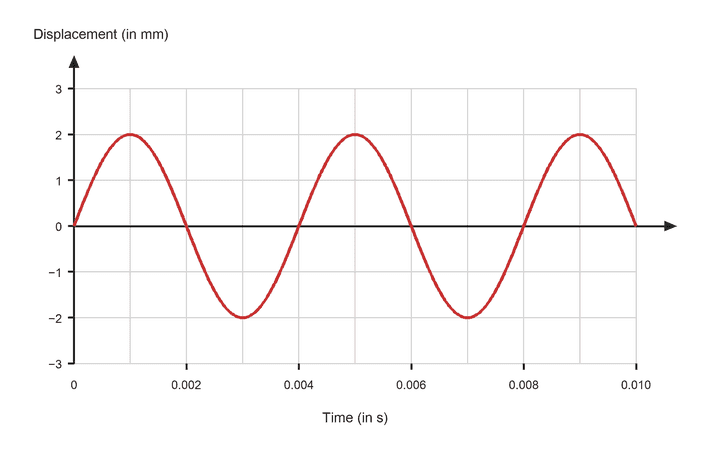
(a) Read the amplitude and the time period of the cone from the graph, and find the frequency of the note.
(b) The volume knob is now turned up, without changing the note. Which one of the three quantities in part (a) changes, and how ?
- 102 marks
Question 10
Competency: Application & Analysis
A bat flying in a cave sends out a short squeak towards a rock wall and hears the reflected squeak 0.04 s later. (Speed of sound in air = .)
(a) How far is the wall from the bat ?
(b) A man stands at the same distance from the wall and claps once. Will he hear a distinct echo of his clap ? Give a reason.
- 114 marks
Question 11
Competency: Analysis & Evaluation
Case study: To study how fast sound travels in water, a team lowers a bell into a lake from boat X. At the instant the bell is struck under water, a lamp on boat X is flashed. On boat Y, a listener with a hearing tube dipped in the water starts a stop watch on seeing the flash and stops it on hearing the bell. Boat Y is then moved and the trial is repeated.
Distance between the boats (in m) 750 1500 2250 3000 Time taken by the sound in water (in s) 0.5 1.0 1.5 2.0 (a) Calculate the speed of sound in water from each reading. What do you notice ?
(b) In one trial the boats are 1650 m apart. A second listener on boat Y hears the same bell through the air (speed of sound in air = ). How much later than the first listener does he hear it ?
(c) A steel pipeline 1490 m long also lies along the bank. Find the time sound would take to travel through the steel from one end to the other (speed of sound in steel = ). A student says, "Sound travels fastest in air, because air is the thinnest and gets in the way the least." Use the results of this question to judge the statement.
- 124 marks
Question 12
Competency: Application & Analysis
Case study: Tanya stands four identical glass tubes P, Q, R and S on a table and pours different amounts of water into them, as shown. She blows across the mouth of each tube in turn and measures the frequency of the note with an app on her phone.

Tube P Q R S Frequency of the note (in Hz) 350 420 700 1050 (a) What vibrates to produce the note ? Find the length of the air column in each tube and name the tube that gives the shrillest note.
(b) For each tube, multiply the frequency by the length of the air column. What pattern do you find ? State how the pitch of the note depends on the length of the air column.
(c) Tanya wants a fifth tube of the same kind to give a note of 525 Hz. What depth of water should she pour into it ?
(d) She blows much harder across tube Q. Which characteristic of the note changes ?
- 133 marks
Question 13
Competency: Analysis & Evaluation
Case study: A new school hall has bare cemented walls and a tiled floor. Before buying fittings, the teacher claps once in the hall and the students measure for how long the sound of the clap can still be heard. The test is repeated as fittings are added.
Condition of the hall Time for which the clap is heard (in s) Empty hall, bare walls and floor 4.0 Thick curtains hung on the walls 2.4 Curtains on the walls and a carpet on the floor 1.6 Curtains, carpet and all seats filled with students 1.0 (a) A clap lasts only for a moment. Why is it heard for as long as 4.0 s in the empty hall ?
(b) Find the fall in the time caused by each of the three additions. Which addition has the greatest effect ? Why do the students sitting in the hall also reduce the time ?
(c) The sound engineer says, "A hall must be tested with the audience sitting in it. A test in the empty hall does not tell how a programme will sound." Use the data to judge this statement.
- 144 marks
Question 14
Competency: Application & Analysis
Case study: Different animals can hear sounds of different ranges of frequency. A wildlife guide gives the following table.
Animal Lowest frequency heard (in Hz) Highest frequency heard (in Hz) Human 20 20,000 Dog 65 45,000 Elephant 15 12,000 Bat 2,000 110,000 Three sources of sound are tested: X, a cleaning machine that vibrates 25,000 times in one second; Y, a rumble of frequency 17 Hz from a distant storm; Z, a tuning fork that completes one vibration in 0.002 s.
(a) Which of the four can hear X ? What name is given to a sound like X ?
(b) Which of the four can hear Y ? What name is given to a sound like Y ?
(c) Find the frequency of Z. Which of the four cannot hear it ?
(d) A farmer wants a whistle to call his dog from a distance without disturbing the people living nearby. Suggest a suitable frequency for the whistle and justify your choice from the table.
- 154 marks
Question 15
Competency: Creation & Application
Your class wants to measure the speed of sound in air using the echo from the high, flat wall of the school building. You have a long measuring tape, a stop watch and two flat wooden blocks to clap together.
(a) Plan the experiment. Write the steps, the two measurements to be taken and how the speed is calculated from them.
(b) A classmate suggests standing 20 m from the wall "to save walking". Why is this a poor choice, even though an echo can be heard from 20 m ?
(c) In a trial the clapper stands 82.5 m from the wall. He claps in a steady rhythm, adjusting it till each new clap falls exactly on the echo of the clap before it. A friend then finds that 21 claps (20 gaps between claps) take 10 s. Calculate the speed of sound.
(d) State one advantage of the method of part (c) over timing the echo of a single clap.
- 161 mark
Question 16
Competency: Understanding
Neha places her fingers lightly on her throat. She feels a gentle trembling when she hums a tune, but she feels no trembling when she breathes out slowly without making any sound. Which statement explains the difference best ?
- 171 mark
Question 17
Competency: Application
A solar flare is a huge explosion on the Sun, far more violent than any explosion on the Earth. Yet we never hear the sound of a solar flare. Which one is the main reason ?
- 181 mark
Question 18
Competency: Analysis
The figure shows thin layers of air at one instant when a sound wave is passing through them. The layers are crowded together at the compressions , , and and are far apart between them. The distance from to is .
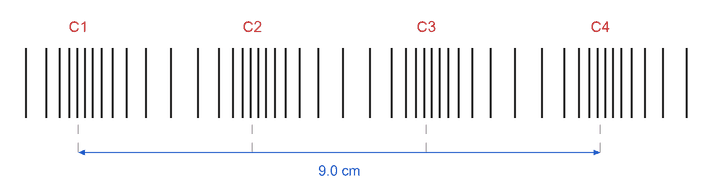
Which statement about the wavelength is correct ?
- 191 mark
Question 19
Competency: Application
A sound-analysis app on a phone records the time period of the note of a tabla as and the time period of the note of a whistle as . Which statement about the two notes is correct ?
- 201 mark
Question 20
Competency: Application
A factory records the sounds of four machines: P, ; Q, ; R, ; and S, . (Here .) A healthy young person stands near the machines. Which of them can this person not hear ?
- 211 mark
Question 21
Competency: Understanding
Assertion (A): A violin and a flute playing the same note at the same loudness still sound different to a listener.
Reason (R): The two sounds differ in their quality, which depends on the shape of the waveform of the sound.
- 221 mark
Question 22
Competency: Analysis
Riya sings in a small bathroom with smooth tiled walls. She stands about from each wall. Take the speed of sound in air as .
Assertion (A): Riya does not hear a separate echo of her voice in the bathroom.
Reason (R): The smooth tiled walls of the bathroom absorb almost all the sound that falls on them.
- 231 mark
Question 23
Competency: Analysis
A student stands at different distances from a bell along a straight, open road and measures with an electronic timer, started by a radio signal when the bell is struck, the time the sound of the bell takes to reach him. (Hypothetical data.)
Distance from the bell (in m) 66 132 198 264 330 Time taken (in s) 0.20 0.40 0.60 0.80 1.10 The air and its temperature stay the same throughout. Which reading is faulty ?
- 241 mark
Question 24
Competency: Analysis
A music teacher wants to know how well some materials absorb sound. She finds what part of the sound that falls on each material is reflected back. (Hypothetical data.)
Material Percentage of the sound that is reflected Polished marble 96 Wooden board 70 Thick curtain 35 Carpet 25 The sound that is not reflected is absorbed. Which statement is correct ?
- 251 mark
Question 25
Competency: Understanding
Four strings P, Q, R and S are made of the same material and have the same length. They are stretched on a wooden frame with the same tension and are plucked with the same force. Their thicknesses are P , Q , R and S . Which statement is correct ?
- 262 marks
Question 26
Competency: Analysis
A mobile phone is kept on silent with its vibration mode on. Meera notes what she hears in three cases.
Where the phone is kept What Meera hears On a wooden table A loud buzz On a thick folded towel A soft buzz On her open palm A very faint buzz (a) The vibrating part inside the phone is small. Explain why the buzz is loud on the table.
(b) Explain why the buzz is soft on the towel.
- 272 marks
Question 27
Competency: Understanding
A phone app shows the graphs of displacement against time for the same note sounded by a tuning fork (X) and played on a violin (Y). Both graphs are drawn on the same scale.
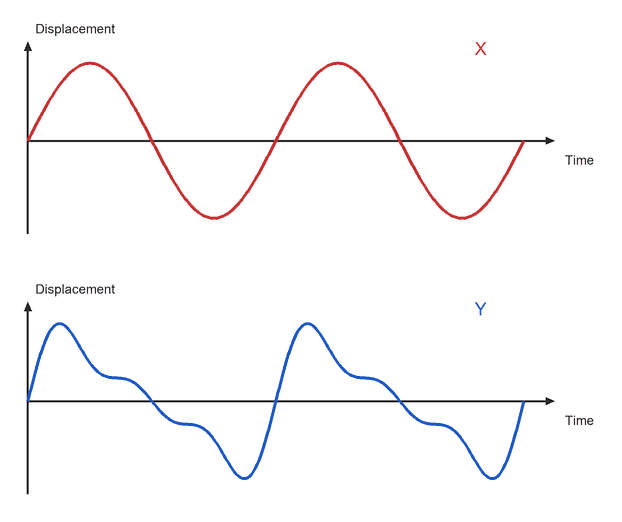
(a) Name the two characteristics of the sound that are the same for X and Y, and say how the graphs show it.
(b) Name the characteristic that is different, and say how a listener is helped by it.
- 282 marks
Question 28
Competency: Evaluation
A grain godown owner buys an 'ultrasonic rat repeller' that gives out a sound of frequency . The shopkeeper says, 'Rats hear this sound and run away, but your workers will not be disturbed.' (A rat can hear sounds up to about and a dog up to about .)
(a) Judge whether the shopkeeper's claim about the workers and the rats is reasonable.
(b) The owner's pet dog sleeps in the godown. Is the repeller certain to be harmless to the dog ? Give a reason.
- 292 marks
Question 29
Competency: Application
A long thin tube has a piston at one end. A tiny speck of smoke floats in the air in the middle of the tube. The piston is pushed in and pulled out again and again, and a sound wave travels along the tube.
(a) Name the region of the air that is formed when the piston moves in, and the region that is formed when the piston moves out.
(b) Describe how the speck of smoke moves while the wave passes, and state which kind of wave this shows.
- 302 marks
Question 30
Competency: Understanding
A siren fixed on top of a tower gives out a steady note. A boy standing near the tower hears it clearly. He then walks straight away from the tower. As he walks away, the siren sounds fainter and fainter.
(a) Name the characteristic of the sound that changes, and the characteristic that stays the same.
(b) Using the idea of amplitude, explain why the sound becomes fainter.
- 312 marks
Question 31
Competency: Application
A cracker bursts on open ground. Arun and Bela stand on the same straight road, Bela farther from the cracker than Arun, with the cracker at the end of the road. Both see the flash at the same instant. Arun hears the bang after the flash and Bela hears it after the flash. The speed of sound in air is and the time taken by light is so small that it can be ignored.
(a) How far is each of the two from the cracker ?
(b) How far apart are they ?
- 323 marks
Question 32
Competency: Analysis
A boy stands on level ground on a straight line between two high, parallel cliffs. He claps loudly once and hears two echoes, one from each cliff. The first echo reaches him after the clap and the second echo after the clap. Take the speed of sound in air as .
(a) How far is the nearer cliff from the boy ?
(b) How far is the farther cliff from the boy ?
(c) What is the distance between the two cliffs ?
- 333 marks
Question 33
Competency: Application
A school band plays a steady note of frequency . The sound travels in air at . The waves produced in each second lie one behind the other along the distance that the sound covers in .
(a) How many complete waves does the source produce in ?
(b) Find the length of one wave (the wavelength).
(c) Find the time period of the note.
- 343 marks
Question 34
Competency: Evaluation
At a wedding, a DJ's large speaker is switched on at full volume. Raju notices that: (1) the glass pane of a window near the speaker rattles, (2) tiny bits of paper kept on a cardboard sheet over the speaker jump up and down, and (3) the pane stops rattling when the music is turned low. His friend says, 'Sound cannot do any work, because it is not made of matter and nothing is moved by it.'
(a) Use observations (1) and (2) to judge the friend's statement.
(b) Explain observation (3).
(c) Name the medium that carries the sound from the speaker to the window, and say what travels through it: the air particles or the vibrations.
- 353 marks
Question 35
Competency: Analysis
A new school auditorium has a hard, smooth wooden panel behind the stage, thick rough padded panels on the back wall and the side walls, a carpet on the floor and cloth-covered seats. At the first rehearsal, the voice of the speaker is clear everywhere and no echo is heard.
(a) Why does the hard smooth panel behind the stage help the audience ?
(b) Why are the back wall panels rough and padded and not hard and smooth ?
(c) The back wall is from the stage. For the annual day, the organisers want to cover the padded back panels with a hard, smooth glass mirror wall. Predict what a listener sitting in the front row, close to the speaker, would notice. (Take the speed of sound in air as ; the ear hears two sounds as separate only if they arrive at least apart.)
- 363 marks
Question 36
Competency: Analysis
At a health camp, Ravi, a 12-year-old boy, is given a hearing test. A machine plays seven tones one after another, and he says whether he hears each of them. (Hypothetical data.)
Frequency of the tone (in Hz) 10 18 25 440 8000 15 000 25 000 Did Ravi hear it ? No No Yes Yes Yes No No (a) Which tones are infrasonic and which are ultrasonic ?
(b) Between which two tones does the highest frequency that Ravi can hear lie ?
(c) The range of hearing of a normal ear is to . Compare Ravi's results with it.
- 374 marks
Question 37
Competency: Analysis
Case: At a school music audition, the teacher asks three students to sing the same line one after the other from the same spot in front of the microphone of a phone app. For each voice, the app counts the vibrations of the air in and measures the greatest displacement of the air particles from their rest position. (Hypothetical data.)
Singer Vibrations in Greatest displacement of the air particles (in arbitrary units) Anil 130 4 Bela 260 4 Charu 130 9 (a) Find the frequency of the voice of each singer.
(b) Which singer has the shrillest voice and which singer has the loudest voice ?
(c) Bela says, 'My voice is twice as loud as Anil's, because my frequency is twice his.' Use the table to judge her statement.
- 384 marks
Question 38
Competency: Evaluation
Case: A teacher speaks from the front of a large old assembly hall that has a very high, flat, hard ceiling. A student in the back row hears the voice by two routes: directly, over a distance of , and by reflection from the ceiling, over a total path of . The student complains that every word is followed by a faint repeat. (Hypothetical data. Speed of sound . The ear hears two sounds as separate only if they arrive at least apart.)
(a) Find the gap in time between the arrival of the direct sound and the reflected sound.
(b) Does the student hear a separate repeat ? Give a reason.
(c) The owner suggests two cures: (i) cover the ceiling with a sound absorbing board, (ii) hang a hard false ceiling lower down so that the reflected path becomes . Show that (ii) also removes the repeat, and say which cure you prefer, with a reason.
- 395 marks
Question 39
Competency: Creativity
Case: The science club of your school will set up a 'Sound Corner' in the science fair. The club has these things: rubber bands of different thicknesses, an empty shoe box without a lid, a metal tray, some tiny bits of paper and a spoon.
Plan three tables for visitors. For each, write what the visitor does, what the visitor sees or hears, and the idea of the chapter that it shows.
(a) Table 1 must show that a sound is produced by a vibrating body.
(b) Table 2 must show that a thinner string gives a note of higher pitch than a thicker one.
(c) Table 3 must show that a louder sound is made by a larger amplitude of vibration.
- 404 marks
Question 40
Competency: Analysis
Case: On a stormy evening, Reena sits on her terrace and counts the seconds between seeing each lightning flash and hearing its thunder. The light of a flash from away reaches her in about , so she treats the flash as seen at the instant it happens. She notes the counts as the storm moves along a straight path towards her. (Hypothetical data. Speed of sound .)
Time p.m. p.m. p.m. Seconds between flash and thunder 9 6 3 (a) Find the distance of the lightning from Reena at each of the three times.
(b) Is the storm coming nearer or going away ? Find how far it moves every minute.
(c) If the storm keeps moving in the same way, at what time will she hear the thunder after the flash, and how far will the lightning then be ?