
Opening your dashboard
Class 7 Physics Chapter 5: Heat Solutions
99 textbook questions with step-by-step answers, free to read, for ICSE 2026-27.
Get talked through Ch 5, not just shown the answer
Reading a finished solution is not the same as being able to do it. The AI tutor takes one question at a time and works it with you, in your own words, until you can.
- Ask it out loud, in your own words
- It gives you the next step, not the answer
- Stuck on part (ii)? Start there
99 questions with solutions
1–4 marks · Mixed difficulty
- 11 mark
Question 1
Choose the correct answer from the multiple choices given below.
If we add a lump of ice to a tumbler containing water :
Solve with AIAnswer
- Correct
(A) heat flows from water to ice
(B) heat flows from ice to water
(C) heat flows from water to ice if water is more
(D) heat flows from ice to water if ice is more.
Answer: (A) heat flows from water to ice
Concept: Heat is a form of energy. It flows from a body at a higher temperature to a body at a lower temperature when they are in contact, and the flow stops when both reach the same temperature. Its S.I. unit is the joule (J).
Step 1 — Compare the two temperatures.
A lump of ice is at 0 °C or below, while the water in the tumbler is warmer than that. So the water is at the higher temperature and the ice at the lower one.
Step 2 — Apply the rule for heat flow.
Heat always flows from the body at the higher temperature to the body at the lower temperature. So heat flows from the water to the ice, and the ice begins to melt.
Step 3 — See whether the amounts matter.
The direction of flow depends only on which body is hotter, not on how much water or ice there is. The amounts only change how long the flow lasts.
Watch out: The bigger body does not decide the direction; the hotter body always gives heat to the colder one.
Why the other options are wrong:
- (B) heat flows from ice to water: The ice is colder than the water, so heat cannot flow from the ice into the warmer water.
- (C) heat flows from water to ice if water is more: The words “if water is more” add a wrong condition; heat flows from water to ice whatever the amount of water.
- (D) heat flows from ice to water if ice is more: Even when there is more ice, the ice is still the colder body, so heat does not flow from it to the water.
Therefore, heat flows from water to ice, option (A).
- 21 mark
Question 2
Choose the correct answer from the multiple choices given below.
The temperature of pure melting ice is :
Solve with AIAnswer
- Correct
(A) 0°C
(B) 100°C
(C) 95°C
(D) 98.6°F
Answer: (A) 0°C
Concept: A temperature scale is fixed by two fixed points: the ice point (pure ice melting) and the steam point (pure water boiling at normal atmospheric pressure). On the Celsius scale they are 0 °C and 100 °C, on the Fahrenheit scale 32 °F and 212 °F, and on the Kelvin scale 273 K and 373 K.
Step 1 — Recall what melting ice fixes.
Pure ice melts at one fixed temperature at normal atmospheric pressure. This temperature is the ice point, the lower fixed point of a thermometer.
Step 2 — Read its value on the Celsius scale.
On the Celsius scale the ice point is marked 0 °C. While the ice is melting, its temperature stays at 0 °C.
Watch out: 98.6 °F is a real temperature but it belongs to the human body, not to melting ice.
Why the other options are wrong:
- (B) 100°C: 100 °C is the steam point, the temperature of pure water boiling at normal atmospheric pressure.
- (C) 95°C: 95 °C is the temperature of hot water; it is not a fixed point of any scale.
- (D) 98.6°F: 98.6 °F (37 °C) is the normal temperature of the human body; melting ice is at 32 °F.
Therefore, the temperature of pure melting ice is 0 °C, option (A).
- 31 mark
Question 3
Choose the correct answer from the multiple choices given below.
A thermometer uses :
Solve with AIAnswer
(A) water
- Correct
(B) mercury
(C) air
(D) none of the above
Answer: (B) mercury
Concept: A laboratory thermometer has a thin glass bulb filled with mercury, joined to a fine-bored capillary tube inside a thick glass stem. On heating, the mercury expands and rises in the capillary, and its level against the scale gives the temperature.
Step 1 — List what a thermometer liquid needs.
The liquid must expand evenly as it gets hotter, stay liquid over a wide range of temperature, take up heat quickly and be easy to see in the narrow tube.
Step 2 — Pick the liquid that fits.
Mercury expands uniformly, stays liquid from about −39 °C to 357 °C, is a good conductor of heat and is shiny and opaque. So the common laboratory thermometer uses mercury.
Note: mercury is poisonous if a thermometer breaks, so many schools and clinics now use alcohol-filled or digital thermometers. The chapter's laboratory thermometer is the mercury type.
Why the other options are wrong:
- (A) water: Water is not used: it expands unevenly (it even contracts from 0 °C to 4 °C), freezes at 0 °C and wets the glass.
- (C) air: Air is used only in special gas thermometers; a common thermometer does not use it because it expands far too much to read in a small tube.
- (D) none of the above: Option (B), mercury, is correct, so “none of the above” cannot be the answer.
Therefore, a thermometer uses mercury, option (B).
- 41 mark
Question 4
Choose the correct answer from the multiple choices given below.
Which statement is correct :
Solve with AIAnswer
(A) Iron rims are cooled before they are placed on cart wheels
(B) A glass stopper gets tight on warming the neck of the bottle
(C) Telephone wires sag in winter, but become tight in summer
- Correct
(D) A little space is left between two rails on a railway track.
Answer: (D) A little space is left between two rails on a railway track
Concept: Most substances expand (grow in size) when heated and contract when cooled. This is called thermal expansion. For the same rise in temperature, solids expand the least, liquids more, and gases the most. When a solid is fixed in place, its expansion in summer and contraction in winter must be allowed for. Otherwise the pushing or pulling can bend, crack or break the structure.
Step 1 — Test statement (D) about the rails.
Steel rails expand on hot days. A small gap is left between two lengths of rail so that each can expand freely. Without the gap the rails would push on each other and bend sideways. So statement (D) is correct.
Step 2 — Test the other three statements.
Each of the other statements reverses what really happens, as the bullets below show. So (D) is the only correct statement.
Watch out: In (A), (B) and (C) the effect of heating has been turned the wrong way round; check each one against “heating makes it expand”.
Why the other options are wrong:
- (A) Iron rims are cooled before they are placed on cart wheels: Iron rims are heated, not cooled. The heated rim expands and slips on, then grips the wheel tightly as it cools and contracts.
- (B) A glass stopper gets tight on warming the neck of the bottle: Warming the neck makes it expand, so the stopper becomes loose, not tight.
- (C) Telephone wires sag in winter, but become tight in summer: It is the other way round: wires sag in summer because they expand, and become tight in winter because they contract.
Therefore, a little space is left between two rails on a railway track, option (D).
- 51 mark
Question 5
Choose the correct answer from the multiple choices given below.
Heat in a liquid is transferred by :
Solve with AIAnswer
(A) conduction
- Correct
(B) convection
(C) radiation
(D) conduction and radiation
Answer: (B) convection
Concept: Heat travels in three ways. In conduction heat passes from particle to particle while the particles stay in place (mainly in solids). In convection the heated particles themselves move and carry the heat (in liquids and gases). In radiation heat travels as heat rays and needs no medium.
Step 1 — Note how well liquids conduct.
Liquids (except mercury) are bad conductors of heat, so very little heat passes through them particle by particle.
Step 2 — See how the liquid really gets hot.
The liquid near the heat source gets warm, becomes less dense and rises. Cooler liquid sinks to take its place. The moving liquid carries the heat, so a liquid is heated mainly by convection.
Why the other options are wrong:
- (A) conduction: Conduction happens in a liquid only to a small extent, because liquids are bad conductors; it is not the main mode.
- (C) radiation: Radiation needs no medium; it is not the way heat passes from one layer of a liquid to the next.
- (D) conduction and radiation: Neither conduction nor radiation is the main mode of heat transfer in a liquid; convection is.
Therefore, heat in a liquid is transferred by convection, option (B).
- 61 mark
Question 6
Choose the correct answer from the multiple choices given below.
In the process of convection, heat travels :
Solve with AIAnswer
(A) sideways
(B) downwards
- Correct
(C) upwards
(D) in all directions
Answer: (C) upwards
Concept: In convection, the part of a liquid or gas near the heat source gets warmer, expands and becomes less dense, so it rises. Cooler, denser fluid sinks to take its place. This circulation is called a convection current, and it carries heat upwards.
Step 1 — Follow the heated part of the fluid.
When a liquid or gas is heated, the warmed part expands and becomes lighter than the fluid around it, so it rises.
Step 2 — See where the heat goes.
The rising fluid takes its heat with it. The cooler fluid that sinks in its place is heated in turn and also rises. So in convection heat is carried upwards.
Watch out: The fluid does move sideways and downwards as part of the circulating current, but the heat itself is carried up by the rising warm fluid.
Why the other options are wrong:
- (A) sideways: Fluid flows sideways only to complete the current; the heat is not carried sideways by convection.
- (B) downwards: It is the cooler, denser fluid that moves down; heat is carried up.
- (D) in all directions: Heat going out in all directions in straight lines is a feature of radiation, not of convection.
Therefore, in convection, heat travels upwards, option (C).
- 71 mark
Question 7
Choose the correct answer from the multiple choices given below.
The vacuum kept in between the walls of a thermos flask reduces the heat transfer by :
Solve with AIAnswer
(A) conduction only
(B) convection only
(C) radiation only
- Correct
(D) conduction and convection.
Answer: (D) conduction and convection
Concept: Conduction and convection both need a medium, but radiation does not. A thermos flask cuts down all three: a vacuum stops conduction and convection, silvered walls reflect radiation, and a stopper made of a bad conductor closes the mouth.
Step 1 — Ask what conduction and convection need.
Conduction needs particles to pass the heat on, and convection needs particles that move. Both need a medium.
Step 2 — Look at the vacuum.
A vacuum has no particles, so neither conduction nor convection can take place across it. The vacuum therefore reduces heat transfer by conduction and convection.
Watch out: Radiation can cross a vacuum (heat reaches us from the sun across space), so the vacuum cannot stop it; the silvered walls do that job.
Why the other options are wrong:
- (A) conduction only: The vacuum stops convection as well as conduction, so “conduction only” is incomplete.
- (B) convection only: The vacuum stops conduction as well as convection, so “convection only” is incomplete.
- (C) radiation only: Radiation passes through a vacuum; it is reduced by the shiny silvered walls, not by the vacuum.
Therefore, the vacuum in a thermos flask reduces heat transfer by conduction and convection, option (D).
- 81 mark
Question 8
The following question is Assertion-Reason based. Choose the answer based on the codes given below.
Assertion (A) : A reading of 32°F on a thermometer equals 0°C.
Reason (R) : The Celsius scale is commonly used in most countries for measuring temperature.
Solve with AIAnswer
(A) Both A and R are true and R is the correct explanation of A
- Correct
(B) Both A and R are true and R is not the correct explanation of A
(C) A is true but R is false
(D) A is false but R is true
Answer: (B) Both A and R are true, but R is not the correct explanation of A
Concept: A temperature scale is fixed by two fixed points: the ice point (pure ice melting) and the steam point (pure water boiling at normal atmospheric pressure). On the Celsius scale they are 0 °C and 100 °C, on the Fahrenheit scale 32 °F and 212 °F, and on the Kelvin scale 273 K and 373 K.
Step 1 — Judge the assertion.
The ice point is marked 0 °C on the Celsius scale and 32 °F on the Fahrenheit scale. Both marks stand for the same temperature, so a reading of 32 °F equals 0 °C. The assertion is true.
Step 2 — Judge the reason.
Most countries use the Celsius scale in daily life and in science, and only a few (such as the USA) still use Fahrenheit widely. The reason is true.
Step 3 — Decide whether the reason explains the assertion.
32 °F equals 0 °C because both mark the ice point. How popular the Celsius scale is has nothing to do with that. So the reason is not the correct explanation.
Watch out: Two true statements are not automatically linked; ask whether the reason gives the cause of the assertion.
Why the other options are wrong:
- (A): Both statements are true, but the reason does not explain why 32 °F equals 0 °C.
- (C): The reason is true, not false.
- (D): The assertion is true, not false.
Therefore, both A and R are true but R is not the correct explanation of A, option (B).
- 91 mark
Question 9
The following question is Assertion-Reason based. Choose the answer based on the codes given below.
Assertion (A) : The bottoms of cooking utensils should be kept smooth and shiny.
Reason (R) : Smooth and shiny surfaces are good reflectors of heat.
Solve with AIAnswer
(A) Both A and R are true and R is the correct explanation of A
(B) Both A and R are true and R is not the correct explanation of A
(C) A is true but R is false
- Correct
(D) A is false but R is true
Answer: (D) A is false but R is true
Concept: Black and dull surfaces are good absorbers of heat radiation and reflect little of it. White, smooth and shiny surfaces are poor absorbers and good reflectors.
Step 1 — Judge the assertion.
A cooking utensil should take in as much heat as possible from the flame and the hot burner. A smooth, shiny bottom reflects much of the heat radiation falling on it, so it is a poor absorber. That is why the bottom of a cooking utensil is painted black. The assertion is false.
Step 2 — Judge the reason.
Smooth and shiny surfaces reflect most of the heat radiation that falls on them. The reason is true.
Step 3 — Choose the code.
The assertion is false and the reason is true, which is code (D).
Watch out: The reason is a true fact, but it argues against the assertion, not for it.
Why the other options are wrong:
- (A): Code (A) needs both statements to be true, but the assertion is false.
- (B): Code (B) also needs both statements to be true, but the assertion is false.
- (C): Code (C) says the reason is false, but the reason is true; it is the assertion that is false.
Therefore, A is false but R is true, option (D).
- 101 mark
Question 10
Fill in the blanks :
Heat is a form of ........
Solve with AIWritten solution
Solution:
Concept: Heat is a form of energy. It flows from a body at a higher temperature to a body at a lower temperature when they are in contact, and the flow stops when both reach the same temperature. Its S.I. unit is the joule (J).
Step 1 — See what the blank needs.
The blank asks what kind of quantity heat is. Heat can do work, for example it can make steam drive an engine.
Step 2 — Fill the blank.
Anything that can do work is a form of energy, so heat is a form of energy. Like every form of energy, it is measured in joules.
Therefore, heat is a form of energy.
- 111 mark
Question 11
Fill in the blanks :
........ determines the degree of hotness or coldness of a body.
Solve with AIWritten solution
Solution:
Concept: Temperature tells us the degree of hotness or coldness of a body. It is measured with a thermometer, and it decides the direction in which heat flows.
Step 1 — See what the blank needs.
The blank asks for the quantity that tells how hot or how cold a body is.
Step 2 — Fill the blank.
That quantity is temperature. A hotter body has a higher temperature and a colder body a lower one.
Watch out: Heat and temperature are different: heat is energy, while temperature tells how hot the body is.
Therefore, temperature determines the degree of hotness or coldness of a body.
- 121 mark
Question 12
Fill in the blanks :
On heating a body, its temperature ........
Solve with AIWritten solution
Solution:
Concept: Heat is a form of energy. It flows from a body at a higher temperature to a body at a lower temperature when they are in contact, and the flow stops when both reach the same temperature. Its S.I. unit is the joule (J).
Step 1 — See what the blank needs.
The blank asks what happens to the temperature of a body when it takes in heat.
Step 2 — Fill the blank.
The heat it absorbs makes its particles move faster, so the body gets hotter. Its temperature rises.
Watch out: While a substance is melting or boiling, the heat goes into changing its state and its temperature stays the same until the change is complete.
Therefore, on heating a body, its temperature rises.
- 131 mark
Question 13
Fill in the blanks :
We use a ........ for measuring the temperature of a body.
Solve with AIWritten solution
Solution:
Concept: Temperature tells us the degree of hotness or coldness of a body. It is measured with a thermometer, and it decides the direction in which heat flows.
Step 1 — See what the blank needs.
The blank asks for the instrument used to measure temperature.
Step 2 — Fill the blank.
Temperature is measured with a thermometer. Our sense of touch can only tell roughly whether a body is hot or cold.
Therefore, we use a thermometer for measuring the temperature of a body.
- 141 mark
Question 14
Fill in the blanks :
The S.I. unit of temperature is ........
Solve with AIWritten solution
Solution:
Concept: A temperature scale is fixed by two fixed points: the ice point (pure ice melting) and the steam point (pure water boiling at normal atmospheric pressure). On the Celsius scale they are 0 °C and 100 °C, on the Fahrenheit scale 32 °F and 212 °F, and on the Kelvin scale 273 K and 373 K.
Step 1 — See what the blank needs.
The blank asks for the unit of temperature in the S.I. system.
Step 2 — Fill the blank.
The S.I. unit of temperature is the kelvin, written as K with no degree sign. Degree Celsius and degree Fahrenheit are other units in common use.
Watch out: Write 310 K, not 310 °K; the kelvin never takes a degree sign.
Therefore, the S.I. unit of temperature is the kelvin (K).
- 151 mark
Question 15
Fill in the blanks :
In a thermometer, the commonly used liquid is ........
Solve with AIWritten solution
Solution:
Concept: A laboratory thermometer has a thin glass bulb filled with mercury, joined to a fine-bored capillary tube inside a thick glass stem. On heating, the mercury expands and rises in the capillary, and its level against the scale gives the temperature.
Step 1 — See what the blank needs.
The blank asks for the liquid usually filled in a laboratory thermometer.
Step 2 — Fill the blank.
That liquid is mercury. It expands evenly, stays liquid over a wide range of temperature and is easy to see in the fine tube.
Note: mercury is poisonous if a thermometer breaks, so many schools and clinics now use alcohol-filled or digital thermometers. The chapter's laboratory thermometer is the mercury type.
Therefore, in a thermometer, the commonly used liquid is mercury.
- 161 mark
Question 16
Fill in the blanks :
The temperature of a normal human body is ........ °C.
Solve with AIWritten solution
Solution:
Concept: A temperature scale is fixed by two fixed points: the ice point (pure ice melting) and the steam point (pure water boiling at normal atmospheric pressure). On the Celsius scale they are 0 °C and 100 °C, on the Fahrenheit scale 32 °F and 212 °F, and on the Kelvin scale 273 K and 373 K.
Step 1 — See what the blank needs.
The blank asks for the normal temperature of a healthy human body on the Celsius scale.
Step 2 — Fill the blank.
The normal body temperature is 37 °C. On the other scales this is 98.6 °F and 310 K.
Note: 37 °C is the standard textbook value. A healthy person's temperature varies a little during the day, roughly between 36.5 °C and 37.5 °C.
Therefore, the temperature of a normal human body is 37 °C.
- 171 mark
Question 17
Fill in the blanks :
A person is said to have fever if his body temperature is more than ........ °F.
Solve with AIWritten solution
Solution:
Concept: A temperature scale is fixed by two fixed points: the ice point (pure ice melting) and the steam point (pure water boiling at normal atmospheric pressure). On the Celsius scale they are 0 °C and 100 °C, on the Fahrenheit scale 32 °F and 212 °F, and on the Kelvin scale 273 K and 373 K.
Step 1 — See what the blank needs.
The blank asks for the body temperature, in °F, above which a person is said to have fever.
Step 2 — Fill the blank.
The normal body temperature is 98.6 °F (37 °C). A body temperature above this normal value is taken as fever in the chapter.
Note: doctors today usually call it a fever when the temperature reaches about 100.4 °F (38 °C), because a healthy body can be a little above 98.6 °F.
Therefore, a person is said to have fever if his body temperature is more than 98.6 °F.
- 181 mark
Question 18
Fill in the blanks :
A hot metallic piece is placed in tap water contained in a bucket. Heat will flow from ........ to ........
Solve with AIWritten solution
Solution:
Concept: Heat is a form of energy. It flows from a body at a higher temperature to a body at a lower temperature when they are in contact, and the flow stops when both reach the same temperature. Its S.I. unit is the joule (J).
Step 1 — See what the blank needs.
The blank asks between which two bodies heat flows: a hot metal piece and tap water at room temperature.
Step 2 — Fill the blank.
The metal piece is at the higher temperature, so heat flows from the metallic piece to the water. The flow goes on until both are at the same temperature.
Therefore, heat will flow from the metallic piece to the water.
- 191 mark
Question 19
Fill in the blanks :
The temperature of boiling water is ........
Solve with AIWritten solution
Solution:
Concept: A temperature scale is fixed by two fixed points: the ice point (pure ice melting) and the steam point (pure water boiling at normal atmospheric pressure). On the Celsius scale they are 0 °C and 100 °C, on the Fahrenheit scale 32 °F and 212 °F, and on the Kelvin scale 273 K and 373 K.
Step 1 — See what the blank needs.
The blank asks for the temperature at which pure water boils.
Step 2 — Fill the blank.
At normal atmospheric pressure pure water boils at 100 °C. This is the steam point, the upper fixed point of the Celsius scale.
Watch out: The boiling point is 100 °C only at normal atmospheric pressure; it is lower at high altitudes.
Therefore, the temperature of boiling water is 100 °C.
- 201 mark
Question 20
Fill in the blanks :
Liquids expand ........ than solids.
Solve with AIWritten solution
Solution:
Concept: Most substances expand (grow in size) when heated and contract when cooled. This is called thermal expansion. For the same rise in temperature, solids expand the least, liquids more, and gases the most.
Step 1 — See what the blank needs.
The blank compares how much liquids and solids expand for the same rise in temperature.
Step 2 — Fill the blank.
The particles of a liquid are held less firmly than those of a solid, so a liquid expands more than a solid.
Therefore, liquids expand more than solids.
- 211 mark
Question 21
Fill in the blanks :
Gases expand ........ than liquids.
Solve with AIWritten solution
Solution:
Concept: Most substances expand (grow in size) when heated and contract when cooled. This is called thermal expansion. For the same rise in temperature, solids expand the least, liquids more, and gases the most.
Step 1 — See what the blank needs.
The blank compares how much gases and liquids expand for the same rise in temperature.
Step 2 — Fill the blank.
The particles of a gas are hardly held at all, so a gas expands much more than a liquid.
Therefore, gases expand more than liquids.
- 221 mark
Question 22
Fill in the blanks :
Heat transfer in solids is by ........
Solve with AIWritten solution
Solution:
Concept: Heat travels in three ways. In conduction heat passes from particle to particle while the particles stay in place (mainly in solids). In convection the heated particles themselves move and carry the heat (in liquids and gases). In radiation heat travels as heat rays and needs no medium.
Step 1 — See what the blank needs.
The blank asks how heat passes through a solid, whose particles cannot leave their places.
Step 2 — Fill the blank.
In a solid each particle passes heat on to its neighbour while staying in place. This is conduction.
Therefore, heat transfer in solids is by conduction.
- 231 mark
Question 23
Fill in the blanks :
Heat transfer in liquids and gases is by ........
Solve with AIWritten solution
Solution:
Concept: Heat travels in three ways. In conduction heat passes from particle to particle while the particles stay in place (mainly in solids). In convection the heated particles themselves move and carry the heat (in liquids and gases). In radiation heat travels as heat rays and needs no medium.
Step 1 — See what the blank needs.
The blank asks how heat passes through liquids and gases, whose particles can move about.
Step 2 — Fill the blank.
The heated particles of a liquid or gas move up and carry the heat with them. This is convection.
Therefore, heat transfer in liquids and gases is by convection.
- 241 mark
Question 24
Fill in the blanks :
Metals are ........ of heat.
Solve with AIWritten solution
Solution:
Concept: A good conductor of heat lets heat pass through it easily (all metals, including the liquid metal mercury). A bad conductor or insulator does not (wood, plastic, cork, wool, cotton, water and still air).
Step 1 — See what the blank needs.
The blank asks how metals behave when heat is given to them.
Step 2 — Fill the blank.
Metals such as silver, copper, aluminium and iron let heat pass through them easily, so they are conductors (good conductors) of heat.
Therefore, metals are conductors of heat.
- 251 mark
Question 25
Fill in the blanks :
Still air is an ........ of heat.
Solve with AIWritten solution
Solution:
Concept: Still (trapped) air is a very poor conductor of heat. Materials with many fine pores full of air, such as wool, fluffy cotton, gunny cloth, saw-dust and cork, are therefore good insulators.
Step 1 — See what the blank needs.
The blank asks how still air behaves towards heat.
Step 2 — Fill the blank.
Still air hardly lets heat pass through it, so it is an insulator (a bad conductor) of heat.
Watch out: Moving air can carry heat away by convection; only still (trapped) air acts as an insulator.
Therefore, still air is an insulator of heat.
- 261 mark
Question 26
Fill in the blanks :
Black and dull surfaces are ........ of heat.
Solve with AIWritten solution
Solution:
Concept: Black and dull surfaces are good absorbers of heat radiation and reflect little of it. White, smooth and shiny surfaces are poor absorbers and good reflectors.
Step 1 — See what the blank needs.
The blank asks how black and dull surfaces behave towards heat radiation.
Step 2 — Fill the blank.
Black and dull surfaces take in most of the heat radiation falling on them, so they are good absorbers of heat.
Therefore, black and dull surfaces are good absorbers of heat.
- 271 mark
Question 27
Write true or false for the statement :
On touching a lump of ice, we feel cold because some heat passes from our body to the ice.
Solve with AIWritten solution
Solution:
Concept: A statement is true only if it is correct in every part; one wrong part makes it false. Heat is a form of energy. It flows from a body at a higher temperature to a body at a lower temperature when they are in contact, and the flow stops when both reach the same temperature. Its S.I. unit is the joule (J).
Step 1 — Check the statement.
Our hand is at about 37 °C and the ice at 0 °C or below. Heat flows from the hotter hand into the colder ice.
Step 2 — Decide.
Because our hand loses heat, it feels cold. The statement is true.
Watch out: Cold does not flow into the hand; it is heat that flows out of the hand.
Therefore, the statement is true.
- 281 mark
Question 28
Write true or false for the statement :
Heat flows from a body at a high temperature to a body at a low temperature when they are kept in contact.
Solve with AIWritten solution
Solution:
Concept: A statement is true only if it is correct in every part; one wrong part makes it false. Heat is a form of energy. It flows from a body at a higher temperature to a body at a lower temperature when they are in contact, and the flow stops when both reach the same temperature. Its S.I. unit is the joule (J).
Step 1 — Check the statement.
When two bodies at different temperatures touch, heat goes from the hotter one to the colder one until their temperatures become equal.
Step 2 — Decide.
The statement describes exactly this. It is true.
Therefore, the statement is true.
- 291 mark
Question 29
Write true or false for the statement :
All solids expand by the same amount when heated to the same rise in temperature.
Solve with AIWritten solution
Solution:
Concept: A statement is true only if it is correct in every part; one wrong part makes it false. Most substances expand (grow in size) when heated and contract when cooled. This is called thermal expansion. For the same rise in temperature, solids expand the least, liquids more, and gases the most.
Step 1 — Check the statement.
Different solids expand by different amounts for the same rise in temperature. For example, brass expands about one and a half times as much as iron, while invar (a special steel) expands very little.
Step 2 — Decide.
The statement says all solids expand by the same amount. It is false.
Therefore, the statement is false; different solids expand by different amounts.
- 301 mark
Question 30
Write true or false for the statement :
Telephone wires are kept tight between two poles in summer.
Solve with AIWritten solution
Solution:
Concept: A statement is true only if it is correct in every part; one wrong part makes it false. Most substances expand (grow in size) when heated and contract when cooled. This is called thermal expansion. For the same rise in temperature, solids expand the least, liquids more, and gases the most. When a solid is fixed in place, its expansion in summer and contraction in winter must be allowed for. Otherwise the pushing or pulling can bend, crack or break the structure.
Step 1 — Check the statement.
Wires put up on a hot summer day will contract on cold winter days. If they were tight in summer, the contraction in winter could snap them or pull the poles.
Step 2 — Decide.
So wires are left loose (sagging) in summer, not tight. The statement is false.
Therefore, the statement is false; telephone wires are kept loose in summer.
- 311 mark
Question 31
Write true or false for the statement :
Equal volumes of different liquids expand by different amounts when they are heated to the same rise in temperature.
Solve with AIWritten solution
Solution:
Concept: A statement is true only if it is correct in every part; one wrong part makes it false. Most substances expand (grow in size) when heated and contract when cooled. This is called thermal expansion. For the same rise in temperature, solids expand the least, liquids more, and gases the most.
Step 1 — Check the statement.
Different liquids expand by different amounts for the same rise in temperature. For example, alcohol expands much more than water.
Step 2 — Decide.
The statement says exactly this. It is true.
Therefore, the statement is true.
- 321 mark
Question 32
Write true or false for the statement :
Solids expand the least and gases expand the most on being heated.
Solve with AIWritten solution
Solution:
Concept: A statement is true only if it is correct in every part; one wrong part makes it false. Most substances expand (grow in size) when heated and contract when cooled. This is called thermal expansion. For the same rise in temperature, solids expand the least, liquids more, and gases the most.
Step 1 — Check the statement.
For the same rise in temperature, a solid expands the least, a liquid more and a gas the most.
Step 2 — Decide.
The statement matches this order. It is true.
Therefore, the statement is true.
- 331 mark
Question 33
Write true or false for the statement :
A mercury thermometer makes use of the property of expansion of liquids on heating.
Solve with AIWritten solution
Solution:
Concept: A statement is true only if it is correct in every part; one wrong part makes it false. A laboratory thermometer has a thin glass bulb filled with mercury, joined to a fine-bored capillary tube inside a thick glass stem. On heating, the mercury expands and rises in the capillary, and its level against the scale gives the temperature.
Step 1 — Check the statement.
In a mercury thermometer, heat makes the mercury in the bulb expand, and it rises in the capillary tube.
Step 2 — Decide.
So the thermometer works on the expansion of a liquid on heating. The statement is true.
Therefore, the statement is true.
- 341 mark
Question 34
Write true or false for the statement :
Kerosene contracts on heating.
Solve with AIWritten solution
Solution:
Concept: A statement is true only if it is correct in every part; one wrong part makes it false. Most substances expand (grow in size) when heated and contract when cooled. This is called thermal expansion. For the same rise in temperature, solids expand the least, liquids more, and gases the most.
Step 1 — Check the statement.
Kerosene is an ordinary liquid, and like most liquids it expands when heated.
Step 2 — Decide.
The statement says kerosene contracts on heating. It is false.
Watch out: The special case is water between 0 °C and 4 °C, which contracts on heating; kerosene does not behave like this.
Therefore, the statement is false; kerosene expands on heating.
- 351 mark
Question 35
Write true or false for the statement :
Water is a bad conductor of heat.
Solve with AIWritten solution
Solution:
Concept: A statement is true only if it is correct in every part; one wrong part makes it false. A good conductor of heat lets heat pass through it easily (all metals, including the liquid metal mercury). A bad conductor or insulator does not (wood, plastic, cork, wool, cotton, water and still air).
Step 1 — Check the statement.
Heat a test tube of water near its top while a piece of ice is held down at the bottom. The water at the top boils, but the ice at the bottom does not melt for a long time.
Step 2 — Decide.
Very little heat passes down through the water, so water is a bad conductor of heat. The statement is true.
Therefore, the statement is true.
- 361 mark
Question 36
Write true or false for the statement :
Medium is necessary for the transfer of heat by radiation.
Solve with AIWritten solution
Solution:
Concept: A statement is true only if it is correct in every part; one wrong part makes it false. Radiation is the transfer of heat by heat rays, which need no medium and travel in straight lines at the speed of light. When they fall on a body, part is absorbed (and warms the body) and part is reflected.
Step 1 — Check the statement.
Heat from the sun reaches the earth by radiation across almost empty space, where there is no medium.
Step 2 — Decide.
So radiation does not need a medium. The statement is false.
Therefore, the statement is false; no medium is needed for radiation.
- 371 mark
Question 37
Write true or false for the statement :
Land and sea breezes are convection currents of cold and warm air.
Solve with AIWritten solution
Solution:
Concept: A statement is true only if it is correct in every part; one wrong part makes it false. In convection, the part of a liquid or gas near the heat source gets warmer, expands and becomes less dense, so it rises. Cooler, denser fluid sinks to take its place. This circulation is called a convection current, and it carries heat upwards.
Step 1 — Check the statement.
Near the sea, the land and the sea heat up and cool down at different rates. Warm air over the warmer surface rises and cooler air from over the cooler surface flows in to take its place.
Step 2 — Decide.
These circulating movements of warm and cool air are convection currents. The statement is true.
Therefore, the statement is true.
- 381 mark
Question 38
Write true or false for the statement :
Liquids are heated by conduction and radiation.
Solve with AIWritten solution
Solution:
Concept: A statement is true only if it is correct in every part; one wrong part makes it false. Heat travels in three ways. In conduction heat passes from particle to particle while the particles stay in place (mainly in solids). In convection the heated particles themselves move and carry the heat (in liquids and gases). In radiation heat travels as heat rays and needs no medium.
Step 1 — Check the statement.
Liquids are bad conductors, and radiation is not the way heat spreads through a liquid. A liquid is heated mainly by convection.
Step 2 — Decide.
The statement names conduction and radiation instead. It is false.
Therefore, the statement is false; liquids are heated mainly by convection.
- 391 mark
Question 39
Write true or false for the statement :
Black surfaces are poor absorbers of heat radiations.
Solve with AIWritten solution
Solution:
Concept: A statement is true only if it is correct in every part; one wrong part makes it false. Black and dull surfaces are good absorbers of heat radiation and reflect little of it. White, smooth and shiny surfaces are poor absorbers and good reflectors.
Step 1 — Check the statement.
Black surfaces absorb most of the heat radiation that falls on them.
Step 2 — Decide.
So black surfaces are good absorbers, not poor ones. The statement is false.
Therefore, the statement is false; black surfaces are good absorbers of heat radiation.
- 401 mark
Question 40
Match the following :
Column A : (a) mercury
Column B :
Column B (i) insulator (ii) water from 0°C to 4°C (iii) absorbs (iv) conductor (v) thermometer Solve with AIWritten solution
Solution:
Concept: In a match-the-columns item each entry in Column A is paired with the one entry in Column B that describes it or is linked to it. A laboratory thermometer has a thin glass bulb filled with mercury, joined to a fine-bored capillary tube inside a thick glass stem. On heating, the mercury expands and rises in the capillary, and its level against the scale gives the temperature.
Step 1 — Recall the property.
Mercury is a liquid that expands evenly on heating and is easy to see in a fine tube.
Step 2 — Pick the matching entry.
That is why it is filled in a thermometer, entry (v).
Therefore, mercury matches (v) thermometer.
- 411 mark
Question 41
Match the following :
Column A : (b) wood
Column B :
Column B (i) insulator (ii) water from 0°C to 4°C (iii) absorbs (iv) conductor (v) thermometer Solve with AIWritten solution
Solution:
Concept: In a match-the-columns item each entry in Column A is paired with the one entry in Column B that describes it or is linked to it. A good conductor of heat lets heat pass through it easily (all metals, including the liquid metal mercury). A bad conductor or insulator does not (wood, plastic, cork, wool, cotton, water and still air).
Step 1 — Recall the property.
Wood does not let heat pass through it easily.
Step 2 — Pick the matching entry.
So wood is an insulator of heat, entry (i). This is why handles of cooking pans are made of wood.
Therefore, wood matches (i) insulator.
- 421 mark
Question 42
Match the following :
Column A : (c) aluminium
Column B :
Column B (i) insulator (ii) water from 0°C to 4°C (iii) absorbs (iv) conductor (v) thermometer Solve with AIWritten solution
Solution:
Concept: In a match-the-columns item each entry in Column A is paired with the one entry in Column B that describes it or is linked to it. A good conductor of heat lets heat pass through it easily (all metals, including the liquid metal mercury). A bad conductor or insulator does not (wood, plastic, cork, wool, cotton, water and still air).
Step 1 — Recall the property.
Aluminium is a metal, and all metals let heat pass through them easily.
Step 2 — Pick the matching entry.
So aluminium is a conductor of heat, entry (iv).
Therefore, aluminium matches (iv) conductor.
- 431 mark
Question 43
Match the following :
Column A : (d) contracts
Column B :
Column B (i) insulator (ii) water from 0°C to 4°C (iii) absorbs (iv) conductor (v) thermometer Solve with AIWritten solution
Solution:
Concept: In a match-the-columns item each entry in Column A is paired with the one entry in Column B that describes it or is linked to it. Most substances expand (grow in size) when heated and contract when cooled. This is called thermal expansion. For the same rise in temperature, solids expand the least, liquids more, and gases the most.
Step 1 — Recall the property.
Almost every substance expands on heating. Water is the special case: when heated from 0 °C to 4 °C it contracts, and only above 4 °C does it expand.
Step 2 — Pick the matching entry.
So “contracts” goes with water from 0 °C to 4 °C, entry (ii).
Therefore, contracts matches (ii) water from 0 °C to 4 °C.
- 441 mark
Question 44
Match the following :
Column A : (e) black surface
Column B :
Column B (i) insulator (ii) water from 0°C to 4°C (iii) absorbs (iv) conductor (v) thermometer Solve with AIWritten solution
Solution:
Concept: In a match-the-columns item each entry in Column A is paired with the one entry in Column B that describes it or is linked to it. Black and dull surfaces are good absorbers of heat radiation and reflect little of it. White, smooth and shiny surfaces are poor absorbers and good reflectors.
Step 1 — Recall the property.
A black surface takes in most of the heat radiation falling on it.
Step 2 — Pick the matching entry.
So a black surface absorbs, entry (iii).
Therefore, black surface matches (iii) absorbs.
- 452 marks
Question 45
What is heat ? State its S.I. unit
Solve with AIWritten solution
Solution:
Concept: Heat is a form of energy. It flows from a body at a higher temperature to a body at a lower temperature when they are in contact, and the flow stops when both reach the same temperature. Its S.I. unit is the joule (J).
Step 1 — Define heat.
Heat is a form of energy which flows from a hot body to a cold body when they are kept in contact. The flow goes on until both bodies reach the same temperature. We can feel heat, but we cannot see it.
Step 2 — State its S.I. unit.
Since heat is a form of energy, it is measured in the same unit as every other form of energy. Its S.I. unit is the joule (J).
Step 3 — Mention the older units.
Heat is also measured in calories (cal) and kilocalories (kcal), where 1 kcal = 1000 cal and 1 cal is about 4.2 J (more exactly 4.186 J).
Therefore, heat is a form of energy that flows from a hotter body to a colder body, and its S.I. unit is the joule (J).
- 462 marks
Question 46
What is meant by the term, 'temperature' ?
Solve with AIWritten solution
Solution:
Concept: Temperature tells us the degree of hotness or coldness of a body. It is measured with a thermometer, and it decides the direction in which heat flows.
Step 1 — Say why we need the term.
Touch can only tell us roughly whether a body is hot or cold, and it is easily fooled. So we use a quantity that can be measured.
Step 2 — Define temperature.
Temperature is the quantity which tells us the degree of hotness or coldness of a body. A hotter body is at a higher temperature.
Step 3 — Link it to heating and to heat flow.
When a body is heated, its temperature rises; when it is cooled, its temperature falls. Heat always flows from the body at the higher temperature to the one at the lower temperature, and temperature is measured with a thermometer.
Therefore, temperature is the degree of hotness or coldness of a body.
- 472 marks
Question 47
State the three units of temperature.
Solve with AIWritten solution
Solution:
Concept: A temperature scale is fixed by two fixed points: the ice point (pure ice melting) and the steam point (pure water boiling at normal atmospheric pressure). On the Celsius scale they are 0 °C and 100 °C, on the Fahrenheit scale 32 °F and 212 °F, and on the Kelvin scale 273 K and 373 K.
Step 1 — Name the three scales.
Temperature is measured on three common scales, each with its own unit.
Step 2 — List the units.
The three units are:
- degree Celsius (°C);
- degree Fahrenheit (°F);
- kelvin (K), which is the S.I. unit and is written without a degree sign.
Therefore, the three units of temperature are degree Celsius (°C), degree Fahrenheit (°F) and kelvin (K).
- 482 marks
Question 48
Name the instrument used to measure the temperature of a body.
Solve with AIWritten solution
Solution:
Concept: Temperature tells us the degree of hotness or coldness of a body. It is measured with a thermometer, and it decides the direction in which heat flows.
Step 1 — Note that touch is not enough.
Our sense of touch cannot give the exact temperature of a body, so an instrument is needed.
Step 2 — Name the instrument.
Temperature is measured with a thermometer. The common laboratory thermometer works on the expansion of mercury in a fine glass tube.
Therefore, the instrument used to measure the temperature of a body is a thermometer.
- 492 marks
Question 49
What is the Celsius scale of temperature ?
Solve with AIWritten solution
Solution:
Concept: A temperature scale is fixed by two fixed points: the ice point (pure ice melting) and the steam point (pure water boiling at normal atmospheric pressure). On the Celsius scale they are 0 °C and 100 °C, on the Fahrenheit scale 32 °F and 212 °F, and on the Kelvin scale 273 K and 373 K.
Step 1 — Say who made it.
The Celsius (centigrade) scale was introduced by the Swedish astronomer Anders Celsius and is named after him.
Step 2 — Give its fixed points.
On this scale the ice point (pure ice melting) is marked 0 °C and the steam point (pure water boiling at normal atmospheric pressure) is marked 100 °C.
Step 3 — Define one degree.
The interval between the two fixed points is divided into 100 equal parts. Each part is one degree Celsius (1 °C).
Therefore, the Celsius scale has the ice point at 0 °C and the steam point at 100 °C, with 100 equal divisions between them.
- 502 marks
Question 50
What is the Fahrenheit scale of temperature ?
Solve with AIWritten solution
Solution:
Concept: A temperature scale is fixed by two fixed points: the ice point (pure ice melting) and the steam point (pure water boiling at normal atmospheric pressure). On the Celsius scale they are 0 °C and 100 °C, on the Fahrenheit scale 32 °F and 212 °F, and on the Kelvin scale 273 K and 373 K.
Step 1 — Say who made it and where it is used.
The Fahrenheit scale was introduced by Daniel Gabriel Fahrenheit. It is used on many clinical thermometers and in daily life in a few countries such as the USA.
Step 2 — Give its fixed points.
On this scale the ice point is marked 32 °F and the steam point is marked 212 °F.
Step 3 — Define one degree.
The interval between the two fixed points is divided into 180 equal parts. Each part is one degree Fahrenheit (1 °F).
Therefore, the Fahrenheit scale has the ice point at 32 °F and the steam point at 212 °F, with 180 equal divisions between them.
- 512 marks
Question 51
What is the Kelvin scale of temperature ?
Solve with AIWritten solution
Solution:
Concept: A temperature scale is fixed by two fixed points: the ice point (pure ice melting) and the steam point (pure water boiling at normal atmospheric pressure). On the Celsius scale they are 0 °C and 100 °C, on the Fahrenheit scale 32 °F and 212 °F, and on the Kelvin scale 273 K and 373 K.
Step 1 — Say who made it.
The Kelvin scale was introduced by Lord Kelvin. It is also called the absolute scale of temperature.
Step 2 — Explain its zero.
Its zero, 0 K (absolute zero), is the lowest temperature possible. At 0 K the particles of a substance have the least possible energy of motion, so nothing can be colder and the scale has no negative temperatures.
Step 3 — Give its fixed points and degree size.
The ice point is 273 K and the steam point is 373 K. There are 100 equal divisions between them, so a change of 1 K is the same as a change of 1 °C.
Note: more exactly, the ice point is 273.15 K; Class 7 uses 273 K.
Therefore, the Kelvin (absolute) scale starts at 0 K, the lowest possible temperature, and has the ice point at 273 K and the steam point at 373 K.
- 522 marks
Question 52
How are the Celsius and Fahrenheit scales inter-related ?
Solve with AIWritten solution
Solution:
Concept: A temperature scale is fixed by two fixed points: the ice point (pure ice melting) and the steam point (pure water boiling at normal atmospheric pressure). On the Celsius scale they are 0 °C and 100 °C, on the Fahrenheit scale 32 °F and 212 °F, and on the Kelvin scale 273 K and 373 K.
Step 1 — Compare the fixed points.
Both scales mark the same two fixed points: the ice point is 0 °C = 32 °F and the steam point is 100 °C = 212 °F.
Step 2 — Compare the number of divisions.
Between these points the Celsius scale has 100 divisions and the Fahrenheit scale has 212 − 32 = 180 divisions.
Step 3 — Write the relation.
A temperature that is C divisions above the ice point on the Celsius scale is (F − 32) divisions above it on the Fahrenheit scale. These must be in the ratio 100 : 180, so
Dividing both denominators by 20 gives the usual form:
Step 4 — Rearrange for each scale.
Solving for F gives the first form below, and solving for C gives the second.
Here C is the temperature on the Celsius scale and F is the same temperature on the Fahrenheit scale.
Watch out: Subtract 32 from F before scaling; the 32 is there only because the Fahrenheit ice point is 32, not 0.
Therefore, the Celsius and Fahrenheit scales are related by .
- 532 marks
Question 53
How is the size of a degree defined on a Celsius scale ?
Solve with AIWritten solution
Solution:
Concept: A temperature scale is fixed by two fixed points: the ice point (pure ice melting) and the steam point (pure water boiling at normal atmospheric pressure). On the Celsius scale they are 0 °C and 100 °C, on the Fahrenheit scale 32 °F and 212 °F, and on the Kelvin scale 273 K and 373 K.
Step 1 — Take the interval between the fixed points.
On the Celsius scale the ice point is 0 °C and the steam point is 100 °C.
Step 2 — Divide it equally.
This interval is divided into 100 equal parts. The size of one part is one degree Celsius (1 °C).
Therefore, one degree Celsius is one-hundredth of the interval between the ice point and the steam point.
- 542 marks
Question 54
How is the size of a degree defined on a Fahrenheit scale ?
Solve with AIWritten solution
Solution:
Concept: A temperature scale is fixed by two fixed points: the ice point (pure ice melting) and the steam point (pure water boiling at normal atmospheric pressure). On the Celsius scale they are 0 °C and 100 °C, on the Fahrenheit scale 32 °F and 212 °F, and on the Kelvin scale 273 K and 373 K.
Step 1 — Take the interval between the fixed points.
On the Fahrenheit scale the ice point is 32 °F and the steam point is 212 °F, so the interval is 212 − 32 = 180 degrees.
Step 2 — Divide it equally.
This interval is divided into 180 equal parts. The size of one part is one degree Fahrenheit (1 °F).
Step 3 — Compare it with a Celsius degree.
The same interval has only 100 Celsius degrees, so a Fahrenheit degree is smaller: one Fahrenheit degree is 100/180 = 5/9 of a Celsius degree.
Therefore, one degree Fahrenheit is one-hundred-and-eightieth of the interval between the ice point and the steam point.
- 552 marks
Question 55
State the temperature of (i) ice point and (ii) steam point, on the Celsius scale.
Solve with AIWritten solution
Solution:
Concept: A temperature scale is fixed by two fixed points: the ice point (pure ice melting) and the steam point (pure water boiling at normal atmospheric pressure). On the Celsius scale they are 0 °C and 100 °C, on the Fahrenheit scale 32 °F and 212 °F, and on the Kelvin scale 273 K and 373 K.
Step 1 — Ice point.
The ice point is the temperature of pure ice melting at normal atmospheric pressure. On the Celsius scale it is 0 °C.
Step 2 — Steam point.
The steam point is the temperature of pure water boiling at normal atmospheric pressure. On the Celsius scale it is 100 °C.
Therefore, on the Celsius scale (i) the ice point is 0 °C and (ii) the steam point is 100 °C.
- 562 marks
Question 56
Write down the temperature of (i) lower fixed point, and (ii) upper fixed point, on the Fahrenheit scale.
Solve with AIWritten solution
Solution:
Concept: A temperature scale is fixed by two fixed points: the ice point (pure ice melting) and the steam point (pure water boiling at normal atmospheric pressure). On the Celsius scale they are 0 °C and 100 °C, on the Fahrenheit scale 32 °F and 212 °F, and on the Kelvin scale 273 K and 373 K.
Step 1 — Lower fixed point.
The lower fixed point is the ice point. On the Fahrenheit scale it is 32 °F.
Step 2 — Upper fixed point.
The upper fixed point is the steam point. On the Fahrenheit scale it is 212 °F.
Therefore, on the Fahrenheit scale (i) the lower fixed point is 32 °F and (ii) the upper fixed point is 212 °F.
- 572 marks
Question 57
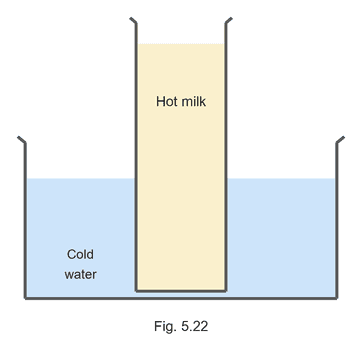
The Fig. 5.22 shows a glass tumbler containing hot milk which is placed in a tub of cold water. State the direction in which heat will flow.
 Solve with AI
Written solution
Solution:
Concept: Heat is a form of energy. It flows from a body at a higher temperature to a body at a lower temperature when they are in contact, and the flow stops when both reach the same temperature. Its S.I. unit is the joule (J).
Step 1 — Compare the temperatures.
The milk in the tumbler is hot, and the water in the tub around it is cold. So the milk is at the higher temperature.
Step 2 — Apply the rule for heat flow.
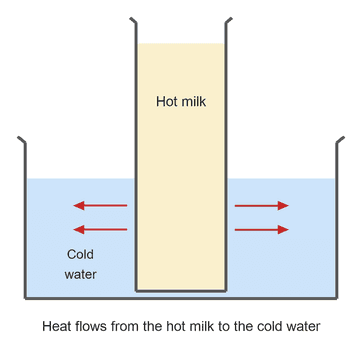
Heat flows from the hotter body to the colder one. So heat flows from the hot milk, out through the glass wall of the tumbler, into the cold water, as the arrows show.
Step 3 — Say when it stops.
The milk cools down and the water warms up. The flow stops when the milk and the water reach the same temperature.
Therefore, heat flows from the hot milk in the tumbler to the cold water in the tub.
- 582 marks
Question 58
Write down the body temperature of a healthy person.
Solve with AIWritten solution
Solution:
Concept: A temperature scale is fixed by two fixed points: the ice point (pure ice melting) and the steam point (pure water boiling at normal atmospheric pressure). On the Celsius scale they are 0 °C and 100 °C, on the Fahrenheit scale 32 °F and 212 °F, and on the Kelvin scale 273 K and 373 K.
Step 1 — Give the value on the Celsius scale.
The normal temperature of a healthy person is 37 °C.
Step 2 — Convert it to the other scales.
Using F = (9/5)C + 32 and T = C + 273, the same temperature is:
So it is 98.6 °F and 310 K.
Note: this is the standard value; a healthy person's temperature varies a little, roughly 36.5 °C to 37.5 °C.
Therefore, the body temperature of a healthy person is 37 °C (98.6 °F or 310 K).
- 592 marks
Question 59
Name two substances which expand on heating.
Solve with AIWritten solution
Solution:
Concept: Most substances expand (grow in size) when heated and contract when cooled. This is called thermal expansion. For the same rise in temperature, solids expand the least, liquids more, and gases the most.
Step 1 — Recall that all three states expand.
Solids, liquids and gases all expand when heated, so any common solid, liquid or gas will do.
Step 2 — Name two examples.
Two substances which expand on heating are:
- iron (a solid): iron rails and rims expand on hot days;
- mercury (a liquid): mercury rises in a thermometer on heating.
Air is another example: a balloon on the neck of a bottle of air fills up when the bottle is heated.
Therefore, iron and mercury are two substances which expand on heating.
- 602 marks
Question 60
Why do telephone wires sag in summer ?
Solve with AIWritten solution
Solution:
Concept: Most substances expand (grow in size) when heated and contract when cooled. This is called thermal expansion. For the same rise in temperature, solids expand the least, liquids more, and gases the most. When a solid is fixed in place, its expansion in summer and contraction in winter must be allowed for. Otherwise the pushing or pulling can bend, crack or break the structure.
Step 1 — See what summer heat does.
In summer the air temperature is high. The metal telephone wires get heated and expand, so each wire becomes longer.
Step 2 — Explain the sag.
The poles stay the same distance apart. A longer wire between the same two points cannot stay straight, so it hangs down and sags.
Step 3 — Link it to how wires are put up.
In winter the wires contract and become tight. So wires put up in summer are left a little loose, or they could snap when they contract in winter.
Therefore, telephone wires sag in summer because they expand on heating and become longer.
- 612 marks
Question 61
Why are gaps left between successive rails on a railway track ?
Solve with AIWritten solution
Solution:
Concept: Most substances expand (grow in size) when heated and contract when cooled. This is called thermal expansion. For the same rise in temperature, solids expand the least, liquids more, and gases the most. When a solid is fixed in place, its expansion in summer and contraction in winter must be allowed for. Otherwise the pushing or pulling can bend, crack or break the structure.
Step 1 — See what heat does to the rails.
Railway rails are made of steel. On hot days they get heated and expand, so each length of rail becomes a little longer.
Step 2 — Explain the gap.
A small gap is left between two successive rails so that each rail has room to expand freely.
Step 3 — Say what would happen without it.
With no gap, the expanding rails would push hard against each other and bend sideways. A bent track could derail a train.
Therefore, gaps are left between successive rails so that the rails can expand in summer without bending.
- 622 marks
Question 62
Why is a cement floor laid in small pieces with gaps in between ?
Solve with AIWritten solution
Solution:
Concept: Most substances expand (grow in size) when heated and contract when cooled. This is called thermal expansion. For the same rise in temperature, solids expand the least, liquids more, and gases the most. When a solid is fixed in place, its expansion in summer and contraction in winter must be allowed for. Otherwise the pushing or pulling can bend, crack or break the structure.
Step 1 — See what happens to the floor.
A cement floor expands on hot days and contracts on cold days.
Step 2 — Say what would happen to one big slab.
If the floor were laid as one large piece, the repeated expansion and contraction would make it crack.
Step 3 — Explain the small pieces.
So it is laid in small pieces with gaps between them. The gaps give each piece room to expand. Strips of glass or plastic are often set in the gaps.
Therefore, a cement floor is laid in small pieces with gaps so that it can expand and contract without cracking.
- 632 marks
Question 63
State one application of thermal expansion of liquids.
Solve with AIWritten solution
Solution:
Concept: A laboratory thermometer has a thin glass bulb filled with mercury, joined to a fine-bored capillary tube inside a thick glass stem. On heating, the mercury expands and rises in the capillary, and its level against the scale gives the temperature.
Step 1 — Name the application.
One application of the thermal expansion of liquids is the thermometer.
Step 2 — Explain how it uses the expansion.
When the bulb touches a hot body, the mercury in the bulb gets heated and expands, so it rises in the capillary tube. The level of mercury against the scale gives the temperature of the body.
Therefore, the mercury thermometer is an application of the thermal expansion of liquids.
- 642 marks
Question 64
State which expands more, when heated to the same temperature : solid, liquid or gas ?
Solve with AIWritten solution
Solution:
Concept: Most substances expand (grow in size) when heated and contract when cooled. This is called thermal expansion. For the same rise in temperature, solids expand the least, liquids more, and gases the most.
Step 1 — Compare the forces between particles.
Particles of a solid are held most firmly, those of a liquid less firmly, and those of a gas hardly at all.
Step 2 — Order the expansion.
The more loosely the particles are held, the more the substance expands for the same rise in temperature. So a solid expands least and a gas expands the most.
Therefore, a gas expands the most when heated to the same temperature.
- 652 marks
Question 65
Name the three modes of transfer of heat.
Solve with AIWritten solution
Solution:
Concept: Heat travels in three ways. In conduction heat passes from particle to particle while the particles stay in place (mainly in solids). In convection the heated particles themselves move and carry the heat (in liquids and gases). In radiation heat travels as heat rays and needs no medium.
Step 1 — Recall the three ways heat travels.
Heat can pass through a solid particle by particle, be carried by moving particles of a fluid, or travel as heat rays.
Step 2 — Name them.
The three modes are:
- conduction;
- convection;
- radiation.
Therefore, the three modes of transfer of heat are conduction, convection and radiation.
- 663 marks
Question 66
Name the mode of transfer of heat in the following :
(a) solid, (b) liquid, (c) gas, (d) vacuum
Solve with AIWritten solution
Solution:
Concept: Heat travels in three ways. In conduction heat passes from particle to particle while the particles stay in place (mainly in solids). In convection the heated particles themselves move and carry the heat (in liquids and gases). In radiation heat travels as heat rays and needs no medium.
Step 1 — Solid.
The particles of a solid cannot leave their places, so heat passes from particle to particle. The mode is conduction.
Step 2 — Liquid.
Heated liquid rises and cooler liquid sinks, carrying the heat. The mode is mainly convection (with only a little conduction).
Step 3 — Gas.
Heated gas rises in the same way, so the mode is mainly convection (with only a little conduction).
Step 4 — Vacuum.
A vacuum has no particles, so conduction and convection are impossible. The only mode is radiation.
Therefore, heat passes by (a) conduction in a solid, (b) convection in a liquid, (c) convection in a gas and (d) radiation in a vacuum.
- 672 marks
Question 67
Name a liquid which is a good conductor of heat.
Solve with AIWritten solution
Solution:
Concept: A good conductor of heat lets heat pass through it easily (all metals, including the liquid metal mercury). A bad conductor or insulator does not (wood, plastic, cork, wool, cotton, water and still air).
Step 1 — Note that most liquids conduct poorly.
Water, oil, kerosene and most other liquids are bad conductors of heat.
Step 2 — Name the exception.
Mercury is a liquid metal, and like other metals it is a good conductor of heat. This is one reason it is used in thermometers: it takes up the temperature of a body quickly.
Therefore, mercury is a liquid which is a good conductor of heat.
- 682 marks
Question 68
Name a solid which is a good conductor of heat.
Solve with AIWritten solution
Solution:
Concept: A good conductor of heat lets heat pass through it easily (all metals, including the liquid metal mercury). A bad conductor or insulator does not (wood, plastic, cork, wool, cotton, water and still air).
Step 1 — Recall which solids conduct well.
All metals are good conductors of heat.
Step 2 — Name one.
Copper is a solid which is a good conductor of heat. Silver, aluminium and iron are other examples.
Therefore, copper is a solid which is a good conductor of heat.
- 693 marks
Question 69
Select good and bad conductors of heat from the following :
copper, mercury, wood, iron, air, saw-dust, cardboard, silver, plastic, wool.
Solve with AIWritten solution
Solution:
Concept: A good conductor of heat lets heat pass through it easily (all metals, including the liquid metal mercury). A bad conductor or insulator does not (wood, plastic, cork, wool, cotton, water and still air).
Step 1 — Pick out the metals.
Copper, mercury, iron and silver are metals (mercury is the liquid metal). All metals are good conductors of heat.
Step 2 — Pick out the rest.
Wood, air, saw-dust, cardboard, plastic and wool are not metals, and most contain trapped air. They are bad conductors of heat.
Step 3 — Tabulate the answer.
The two groups are shown below.
Good conductors of heat Bad conductors of heat copper wood mercury air iron saw-dust silver cardboard plastic wool Therefore, copper, mercury, iron and silver are good conductors, and wood, air, saw-dust, cardboard, plastic and wool are bad conductors of heat.
- 702 marks
Question 70
Why is an oven made of double walls with the space in between filled with cork ?
Solve with AIWritten solution
Solution:
Concept: A good conductor of heat lets heat pass through it easily (all metals, including the liquid metal mercury). A bad conductor or insulator does not (wood, plastic, cork, wool, cotton, water and still air). Still (trapped) air is a very poor conductor of heat. Materials with many fine pores full of air, such as wool, fluffy cotton, gunny cloth, saw-dust and cork, are therefore good insulators.
Step 1 — Note what cork is.
Cork is full of tiny air pockets, so it is a very good insulator (bad conductor) of heat.
Step 2 — See what it does in the wall.
With cork between the two walls of the oven, the heat inside cannot pass easily through the walls to the outside.
Step 3 — State the result.
So the oven keeps its heat inside and stays hot, using less fuel, and its outer surface does not become dangerously hot.
Therefore, an oven has double walls filled with cork so that the insulating cork stops heat escaping from the oven.
- 712 marks
Question 71
Why do we use cooking utensils made up of copper ?
Solve with AIWritten solution
Solution:
Concept: A good conductor of heat lets heat pass through it easily (all metals, including the liquid metal mercury). A bad conductor or insulator does not (wood, plastic, cork, wool, cotton, water and still air).
Step 1 — Note what copper is.
Copper is a metal and a very good conductor of heat.
Step 2 — See what this does when cooking.
A copper pan passes the heat of the flame quickly and evenly to the food inside. So the food heats up rapidly, gets cooked quickly and fuel is saved.
Therefore, we use copper cooking utensils because copper is a good conductor of heat, so food is cooked quickly.
- 722 marks
Question 72
Why is a tea kettle provided with an ebonite handle ?
Solve with AIWritten solution
Solution:
Concept: A good conductor of heat lets heat pass through it easily (all metals, including the liquid metal mercury). A bad conductor or insulator does not (wood, plastic, cork, wool, cotton, water and still air).
Step 1 — Note what ebonite is.
Ebonite is a hard rubber, and it is an insulator (bad conductor) of heat.
Step 2 — See what it does on a kettle.
The body of the kettle becomes very hot, but very little of this heat passes through the ebonite handle. So we can hold the kettle by its handle without burning our hand.
Therefore, a tea kettle has an ebonite handle because ebonite is an insulator, so the handle stays cool enough to hold.
- 732 marks
Question 73
In summer, ice is kept wrapped in a gunny bag. Explain the reason.
Solve with AIWritten solution
Solution:
Concept: Still (trapped) air is a very poor conductor of heat. Materials with many fine pores full of air, such as wool, fluffy cotton, gunny cloth, saw-dust and cork, are therefore good insulators.
Step 1 — Look at the gunny bag.
A gunny bag is woven from jute and has many fine pores, which are filled with still air.
Step 2 — See what the trapped air does.
Still air is a very poor conductor of heat. So the bag stops heat from the warm surroundings reaching the ice quickly.
Step 3 — State the result.
The ice takes in heat only slowly, so it does not melt quickly. Saw-dust is used in the same way.
Watch out: The bag does not give out cold; it slows down the heat coming in from outside.
Therefore, ice is wrapped in a gunny bag because the air trapped in its pores is an insulator, which slows down melting.
- 742 marks
Question 74
State the direction of heat transfer by way of convection.
Solve with AIWritten solution
Solution:
Concept: In convection, the part of a liquid or gas near the heat source gets warmer, expands and becomes less dense, so it rises. Cooler, denser fluid sinks to take its place. This circulation is called a convection current, and it carries heat upwards.
Step 1 — Follow the heated fluid.
The part of the liquid or gas near the heat source becomes warmer and less dense, so it rises.
Step 2 — State the direction.
The rising fluid carries the heat with it, so in convection heat is carried upwards. Cooler, denser fluid sinks to take its place and is heated in turn.
Therefore, heat transfer by convection is upwards.
- 752 marks
Question 75
Why is a ventilator provided in a room ?
Solve with AIWritten solution
Solution:
Concept: In convection, the part of a liquid or gas near the heat source gets warmer, expands and becomes less dense, so it rises. Cooler, denser fluid sinks to take its place. This circulation is called a convection current, and it carries heat upwards.
Step 1 — See how the room air gets warm.
Air breathed out by people, and air near lamps and other warm things, is warm and stale.
Step 2 — Follow the warm air.
Warm air is less dense, so it rises and goes out through the ventilator near the ceiling.
Step 3 — Follow the fresh air.
Cooler fresh air comes in through the doors and windows to take its place. This convection current keeps the air of the room fresh.
Therefore, a ventilator lets the warm, stale air rise and go out near the ceiling so that fresh air can come in below.
- 762 marks
Question 76
Why are chimneys provided over furnaces in factories ?
Solve with AIWritten solution
Solution:
Concept: In convection, the part of a liquid or gas near the heat source gets warmer, expands and becomes less dense, so it rises. Cooler, denser fluid sinks to take its place. This circulation is called a convection current, and it carries heat upwards.
Step 1 — Look at the gases from a furnace.
The smoke and gases coming from a furnace are very hot, so they are much less dense than the air around.
Step 2 — See what the chimney does.
These light, hot gases rise up the chimney. Air and fumes around the furnace flow in to take their place, so the chimney keeps drawing the gases out.
Step 3 — State the use.
The chimney removes the smoke and fumes from the work place and lets them out high up in the air. The steady draught of air also keeps the furnace burning well.
Therefore, chimneys are provided over furnaces so that the hot gases rise and carry the smoke and fumes out high above the factory.
- 772 marks
Question 77
Give one example of heat transfer by radiation.
Solve with AIWritten solution
Solution:
Concept: Radiation is the transfer of heat by heat rays, which need no medium and travel in straight lines at the speed of light. When they fall on a body, part is absorbed (and warms the body) and part is reflected.
Step 1 — Think of heat crossing empty space.
Between the sun and the earth there is almost empty space, so neither conduction nor convection can carry heat across it.
Step 2 — Give the example.
We get heat from the sun by radiation. Another example is the warmth we feel on the face when we sit in front of a fire.
Therefore, the heat we receive from the sun is an example of heat transfer by radiation.
- 783 marks
Question 78
Why do we prefer to wear white or light coloured clothes in summer and black or dark coloured clothes in winter ?
Solve with AIWritten solution
Solution:
Concept: Black and dull surfaces are good absorbers of heat radiation and reflect little of it. White, smooth and shiny surfaces are poor absorbers and good reflectors.
Step 1 — Summer: white or light colours.
White and light-coloured clothes reflect most of the sun's heat and absorb only a little. Less heat reaches the body, so we feel cool.
Step 2 — Winter: black or dark colours.
Black and dark-coloured clothes absorb most of the sun's heat that falls on them. This heat warms the body, so we feel warm.
Therefore, we wear white clothes in summer because they reflect heat, and dark clothes in winter because they absorb heat.
- 793 marks
Question 79
Draw a neat labelled diagram of a laboratory thermometer.
Solve with AIWritten solution
Solution:
Concept: A laboratory thermometer has a thin glass bulb filled with mercury, joined to a fine-bored capillary tube inside a thick glass stem. On heating, the mercury expands and rises in the capillary, and its level against the scale gives the temperature.
Step 1 — Draw the thermometer.
The labelled diagram of a laboratory thermometer is shown below. It is marked from −10 °C to 110 °C.

Step 2 — Describe the bulb.
The bulb at one end is a thin-walled glass bulb filled with mercury. Its thin wall lets heat reach the mercury quickly.
Step 3 — Describe the capillary tube and stem.
The capillary tube is a glass tube with a very fine bore joined to the bulb; the mercury rises in it on heating. The thick glass stem around the bore acts like a lens, so the thin mercury thread is easy to see.
Step 4 — Describe the scale.
The stem is marked from −10 °C to 110 °C, with 120 equal divisions, each of 1 °C. The ice point (0 °C) is where the mercury stands when the bulb is in melting ice, and the steam point (100 °C) is where it stands in steam from boiling water.
Step 5 — Read the thermometer in the figure.
The mercury thread in the figure ends at the mark 30, so it reads 30 °C.
Therefore, a laboratory thermometer has a mercury bulb, a fine capillary tube inside a thick glass stem, and a scale from −10 °C to 110 °C (the one drawn reads 30 °C).
- 803 marks
Question 80
What do you understand by thermal expansion of a substance ?
Solve with AIWritten solution
Solution:
Concept: Most substances expand (grow in size) when heated and contract when cooled. This is called thermal expansion. For the same rise in temperature, solids expand the least, liquids more, and gases the most.
Step 1 — Define thermal expansion.
When a substance is heated, it usually expands, and when it is cooled, it contracts. The increase in the size of a body on heating is called thermal expansion.
Step 2 — Describe expansion of solids.
A solid expands in all directions. The increase in length is linear expansion, the increase in area is superficial expansion and the increase in volume is cubical expansion.
Step 3 — Describe expansion of liquids and gases.
Liquids and gases have no fixed shape, so only their volume matters; they show cubical expansion. For the same rise in temperature, solids expand least, liquids more and gases most.
Step 4 — Give examples.
Telephone wires sag in summer; mercury rises in a thermometer on heating; a balloon on the neck of a heated bottle of air fills up.
Therefore, thermal expansion is the increase in the size of a substance when it is heated.
- 813 marks
Question 81
Iron rims are heated before they are fixed on the wooden wheels. Explain the reason.
Solve with AIWritten solution
Solution:
Concept: Most substances expand (grow in size) when heated and contract when cooled. This is called thermal expansion. For the same rise in temperature, solids expand the least, liquids more, and gases the most.
Step 1 — See why the rim is made small.
An iron rim must grip the wooden wheel tightly. So the rim is made slightly smaller in diameter than the wheel, and it cannot be pushed on cold.
Step 2 — Heat the rim.
The rim is heated, so it expands and becomes slightly bigger than the wheel. It can then be slipped easily on to the wheel.
Step 3 — Let it cool.
As the rim cools, it contracts and grips the wheel very tightly, giving a firm fit. Water is often poured on it to cool it quickly.
Therefore, iron rims are heated so that they expand and slip on, and then contract on cooling to grip the wheel tightly.
- 823 marks
Question 82
A glass stopper stuck in the neck of a bottle can be removed by pouring hot water on the neck of the bottle. Explain why ?
Solve with AIWritten solution
Solution:
Concept: Most substances expand (grow in size) when heated and contract when cooled. This is called thermal expansion. For the same rise in temperature, solids expand the least, liquids more, and gases the most.
Step 1 — See what the hot water touches.
The hot water is poured on the neck of the bottle, so the neck is heated first.
Step 2 — See what the neck does.
The heated neck expands, so the mouth of the bottle becomes a little wider.
Step 3 — See why the stopper does not expand as much.
Glass is a bad conductor of heat, so the heat takes time to reach the stopper inside the neck. At that moment the stopper has hardly expanded.
Step 4 — State the result.
The stopper is now loose in the widened neck, so it can be pulled out easily.
Watch out: Act quickly: if the stopper also gets hot, it expands too and stays stuck.
Therefore, pouring hot water on the neck makes the neck expand before the stopper, so the stopper becomes loose.
- 834 marks
Question 83
Describe one experiment to show that liquids expand on heating.
Solve with AIWritten solution
Solution:
Concept: Most substances expand (grow in size) when heated and contract when cooled. This is called thermal expansion. For the same rise in temperature, solids expand the least, liquids more, and gases the most.
Step 1 — Collect the apparatus.
Take an empty glass bottle, a cork with a hole in its middle, a drinking straw, coloured water (water with a few drops of ink), two bricks, a wire gauze and a burner.
Step 2 — Set it up.
Fill the bottle completely with coloured water. Fit the cork in its mouth and push the straw through the hole, sealing round it with a little molten wax so no water leaks. Add a little water so that the level shows in the straw, and mark this initial level.
Step 3 — Heat the bottle.
Place the bottle on the wire gauze resting on the two bricks, and heat it gently with the burner. The set-up before and after heating is shown below.
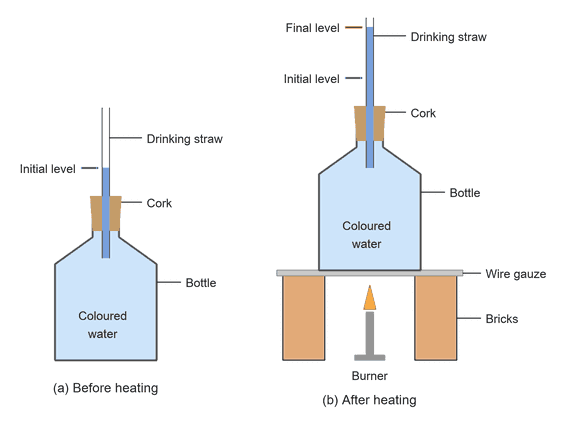
Step 4 — Observe.
As the water gets hotter, its level in the straw rises above the initial level.
Step 5 — Conclude.
The same water now fills more space, so its volume has increased. This shows that liquids expand on heating.
Watch out: Heat gently; the glass also expands a little at first, so the level may dip slightly before it rises.
Therefore, the rise of the coloured water in the straw on heating shows that liquids expand on heating.
- 844 marks
Question 84
Describe an experiment to show that air expands on heating.
Solve with AIWritten solution
Solution:
Concept: Most substances expand (grow in size) when heated and contract when cooled. This is called thermal expansion. For the same rise in temperature, solids expand the least, liquids more, and gases the most.
Step 1 — Collect the apparatus.
Take an empty glass bottle (it is full of air), a rubber balloon and a water bath of hot (boiling) water.
Step 2 — Set it up.
Stretch the mouth of the balloon over the neck of the bottle. At first the balloon is flat (deflated).
Step 3 — Heat the air.
Stand the bottle in the bath of boiling water and wait for a few minutes. The set-up before and after heating is shown below.
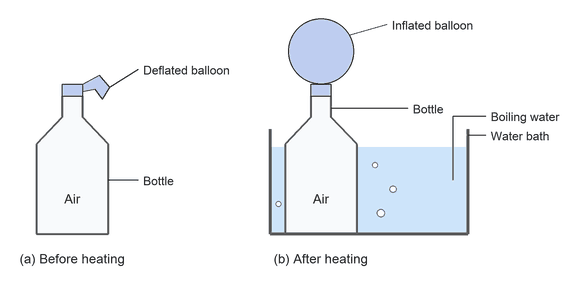
Step 4 — Observe.
The balloon slowly fills up (inflates). When the bottle is taken out and allowed to cool, the balloon goes flat again.
Step 5 — Explain and conclude.
The heated air in the bottle expands; it needs more space, so some of it goes into the balloon and fills it. On cooling the air contracts and goes back into the bottle. This shows that air expands on heating and contracts on cooling.
Therefore, the balloon fills up when the bottle of air is heated, which shows that air expands on heating.
- 853 marks
Question 85
An empty glass bottle is fitted with a narrow tube at its mouth. The open end of the tube is kept in a beaker containing water. When the bottle is heated, bubbles of air are seen escaping into the water. Explain the reason.
Solve with AIWritten solution
Solution:
Concept: Most substances expand (grow in size) when heated and contract when cooled. This is called thermal expansion. For the same rise in temperature, solids expand the least, liquids more, and gases the most.
Step 1 — Note what the empty bottle holds.
The “empty” bottle is really full of air.
Step 2 — Heat the air.
When the bottle is heated, the air inside it gets heated and expands, so it needs more space.
Step 3 — Follow the extra air.
The bottle cannot hold the larger volume, so the extra air is pushed out through the narrow tube. Since the open end of the tube is under water, this air comes out as bubbles.
Therefore, bubbles escape into the water because the air in the bottle expands on heating and is pushed out through the tube.
- 864 marks
Question 86
What are good and bad conductors of heat ? Give two examples of each.
Solve with AIWritten solution
Solution:
Concept: A good conductor of heat lets heat pass through it easily (all metals, including the liquid metal mercury). A bad conductor or insulator does not (wood, plastic, cork, wool, cotton, water and still air).
Step 1 — Define good conductors.
Substances which allow heat to pass through them easily are called good conductors of heat. Examples: silver and copper (all metals, including mercury).
Step 2 — Define bad conductors.
Substances which do not allow heat to pass through them easily are called bad conductors or insulators of heat. Examples: wood and plastic (also cork, wool, glass, water and still air).
Step 3 — Compare them.
The difference is summed up below.
Good conductors Bad conductors let heat pass easily do not let heat pass easily e.g. silver, copper e.g. wood, plastic Therefore, good conductors (e.g. silver, copper) let heat pass easily, while bad conductors (e.g. wood, plastic) do not.
- 874 marks
Question 87
Explain why
(a) we wear woolen clothes in winter ?
(b) the water pipes are covered with cotton during very cold weather ?
Solve with AIWritten solution
Solution:
Concept: Still (trapped) air is a very poor conductor of heat. Materials with many fine pores full of air, such as wool, fluffy cotton, gunny cloth, saw-dust and cork, are therefore good insulators.
Step 1 — Part (a): woollen clothes.
Wool has many fine pores filled with still air. Wool and the trapped air are insulators, so the heat of our body does not easily escape to the cold air outside. The clothes keep us warm.
Step 2 — Part (b): cotton round water pipes.
Cotton also traps air in its fine pores. Wrapped round a pipe, it slows the loss of heat from the water to the very cold air outside, so the water does not freeze.
Step 3 — Part (b): why freezing matters.
Water expands when it freezes. Ice forming inside a pipe could push on the pipe and burst it.
Therefore, (a) woollen clothes keep us warm because wool and its trapped air are insulators, and (b) cotton round water pipes stops the water freezing and bursting the pipes.
- 884 marks
Question 88
What are land and sea breezes ? Explain their formation.
Solve with AIWritten solution
Solution:
Concept: Land heats up and cools down much faster than sea water. In convection, the part of a liquid or gas near the heat source gets warmer, expands and becomes less dense, so it rises. Cooler, denser fluid sinks to take its place. This circulation is called a convection current, and it carries heat upwards.
Step 1 — Say what the breezes are.
Near the sea, a breeze blows from the sea to the land by day; this is the sea breeze. A breeze blows from the land to the sea by night; this is the land breeze. Both are local convection currents of air, shown below.

Step 2 — Explain the sea breeze (day).
By day the land heats up faster than the sea. The air above the land becomes warm and less dense, so it rises. Cooler air from over the sea blows in to take its place. This is the sea breeze.
Step 3 — Explain the land breeze (night).
At night the land cools faster than the sea, so the sea is now the warmer surface. The air above the sea is warmer and rises, and cooler air from over the land blows out to sea to take its place. This is the land breeze.
Step 4 — Complete the current.
In both cases the rising warm air moves high up towards the cooler side and sinks there, so the air goes round in a loop.
Therefore, the sea breeze (day, sea to land) and the land breeze (night, land to sea) are convection currents caused by land heating and cooling faster than the sea.
- 893 marks
Question 89
Explain briefly the process of heat transfer by radiation.
Solve with AIWritten solution
Solution:
Concept: Radiation is the transfer of heat by heat rays, which need no medium and travel in straight lines at the speed of light. When they fall on a body, part is absorbed (and warms the body) and part is reflected.
Step 1 — Define radiation.
Radiation is the transfer of heat from a hot body to a colder body by heat rays, without heating the space in between.
Step 2 — Note that no medium is needed.
Radiation needs no medium, so it is the only way heat can cross a vacuum. Heat from the sun reaches us by radiation.
Step 3 — Describe how the heat rays travel.
Heat rays travel in straight lines in all directions, at the speed of light ( m/s in vacuum). This makes radiation the fastest mode of heat transfer.
Step 4 — Say what happens when they fall on a body.
Part of the radiation is absorbed and warms the body, and the rest is reflected. Black and dull surfaces absorb more; white and shiny surfaces reflect more.
Step 5 — Give an example.
We feel warm when we sit in the sun or in front of a fire.
Therefore, radiation is the transfer of heat by heat rays that travel in straight lines at the speed of light and need no medium.
- 904 marks
Question 90
Draw a labelled diagram of a thermos flask. Explain how the transfer of heat by conduction, convection and radiation is reduced to a minimum in it.
Solve with AIWritten solution
Solution:
Concept: Conduction and convection both need a medium, but radiation does not. A thermos flask cuts down all three: a vacuum stops conduction and convection, silvered walls reflect radiation, and a stopper made of a bad conductor closes the mouth.
Step 1 — Draw the flask.
The labelled diagram of a thermos flask is shown below.
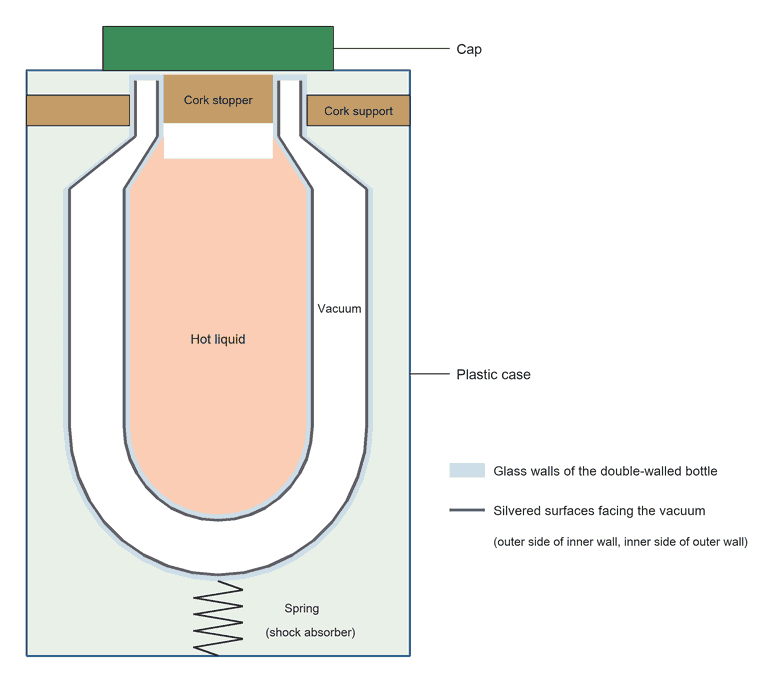
Step 2 — Describe its construction.
A thermos flask is a double-walled glass bottle with a vacuum between the walls. The walls are silvered on the sides facing the vacuum. The mouth is closed by a cork (or plastic) stopper. The bottle rests in a plastic case on cork supports and a spring that absorb shocks, and a cap covers the stopper.
Step 3 — Conduction and convection.
Both these modes need a medium. The vacuum between the walls has none, so it stops heat passing through the walls by conduction and convection.
Step 4 — Radiation.
The silvered surfaces reflect heat rays back, so very little heat crosses the vacuum by radiation.
Step 5 — The mouth and the supports.
The stopper is a bad conductor and seals the mouth, so heat cannot escape by conduction or convection there. The cork supports are also bad conductors.
Step 6 — State the result.
Very little heat passes in or out. So hot drinks stay hot and cold drinks stay cold for a long time.
Therefore, in a thermos flask the vacuum stops conduction and convection, the silvered walls cut down radiation and the stopper seals the mouth, so the contents keep their temperature for a long time.
- 914 marks
Question 91
The temperature of a body rises by 1°C. What is the corresponding rise on the (a) Fahrenheit scale (b) Kelvin scale?
Solve with AIWritten solution
Solution:
Concept: Between the ice point and the steam point there are 100 divisions on the Celsius scale, 180 on the Fahrenheit scale and 100 on the Kelvin scale. So a change of 1 °C equals a change of 1.8 °F, and equals a change of 1 K.
Given: Rise in temperature on the Celsius scale = 1 °C.
Step 1 — Note what is asked.
This is a rise (a difference) in temperature. A difference depends only on the size of the degree, so the 32 of the Fahrenheit scale and the 273 of the Kelvin scale do not enter.
Step 2 — Part (a): Fahrenheit scale.
100 Celsius divisions cover the same interval as 180 Fahrenheit divisions, so each Celsius degree equals 180/100 Fahrenheit degrees.
Step 3 — Part (b): Kelvin scale.
The Kelvin scale also has 100 divisions between the ice point and the steam point, so one kelvin is the same size as one Celsius degree.
Watch out: Do not add 32 or 273 to a rise; 1 °C is 33.8 °F as a temperature, but a rise of 1 °C is a rise of only 1.8 °F.
Therefore, a rise of 1 °C is (a) a rise of 1.8 °F and (b) a rise of 1 K.
- 923 marks
Question 92
The temperature rises by 18°F. What is the rise on the Celsius scale ?
Solve with AIWritten solution
Solution:
Concept: Between the ice point and the steam point there are 100 divisions on the Celsius scale, 180 on the Fahrenheit scale and 100 on the Kelvin scale. So a change of 1 °C equals a change of 1.8 °F, and equals a change of 1 K.
Given: Rise in temperature on the Fahrenheit scale = 18 °F.
Step 1 — Note what is asked.
This is a rise in temperature, so we compare only the sizes of the degrees; the 32 does not enter.
Step 2 — Convert the rise.
180 Fahrenheit divisions cover the same interval as 100 Celsius divisions, so each Fahrenheit degree equals 100/180 = 5/9 of a Celsius degree.
Watch out: Do not subtract 32 from a rise; that is done only when converting an actual temperature reading.
Therefore, a rise of 18 °F is a rise of 10 °C.
- 933 marks
Question 93
Convert 5°F to the Celsius scale.
Solve with AIWritten solution
Solution:
Concept: Between the ice point and the steam point there are 100 divisions on the Celsius scale, 180 on the Fahrenheit scale and 100 on the Kelvin scale. So a change of 1 °C equals a change of 1.8 °F, and equals a change of 1 K.
Given: Temperature on the Fahrenheit scale, F = 5 °F.
Step 1 — Write the formula.
To change a Fahrenheit reading into Celsius, first take away 32 (the Fahrenheit ice point), then scale by 5/9.
Step 2 — Substitute the reading.
Put F = 5 into the formula and work out the bracket first.
Step 3 — Check the answer.
Converting −15 °C back to Fahrenheit should give the reading we started with.
This is the given reading. Also, 5 °F is below the ice point (32 °F), so a temperature below 0 °C makes sense.
Therefore, 5 °F = −15 °C.
- 944 marks
Question 94
Convert 40°C to the (a) Fahrenheit scale (b) Kelvin Scale.
Solve with AIWritten solution
Solution:
Concept: A temperature scale is fixed by two fixed points: the ice point (pure ice melting) and the steam point (pure water boiling at normal atmospheric pressure). On the Celsius scale they are 0 °C and 100 °C, on the Fahrenheit scale 32 °F and 212 °F, and on the Kelvin scale 273 K and 373 K. Between the ice point and the steam point there are 100 divisions on the Celsius scale, 180 on the Fahrenheit scale and 100 on the Kelvin scale. So a change of 1 °C equals a change of 1.8 °F, and equals a change of 1 K.
Given: Temperature on the Celsius scale, C = 40 °C.
Step 1 — Part (a): write the formula.
To change a Celsius reading into Fahrenheit, scale it by 9/5 and then add 32 (the Fahrenheit ice point).
Step 2 — Part (a): substitute.
Put C = 40 into the formula.
Step 3 — Part (b): write the formula.
The Kelvin scale has the same size of degree as the Celsius scale, but its ice point is 273, so we add 273.
Step 4 — Part (b): substitute.
Put C = 40 into the formula.
Note: with the exact ice point 273.15 K, 40 °C is 313.15 K.
Therefore, 40 °C = (a) 104 °F and (b) 313 K.
- 953 marks
Question 95
Convert – 40°F to the Celsius scale.
Solve with AIWritten solution
Solution:
Concept: Between the ice point and the steam point there are 100 divisions on the Celsius scale, 180 on the Fahrenheit scale and 100 on the Kelvin scale. So a change of 1 °C equals a change of 1.8 °F, and equals a change of 1 K.
Given: Temperature on the Fahrenheit scale, F = −40 °F.
Step 1 — Write the formula.
To change a Fahrenheit reading into Celsius, take away 32 and then scale by 5/9.
Step 2 — Substitute the reading.
Put F = −40 into the formula and work out the bracket first.
Step 3 — Notice the special result.
The Celsius and Fahrenheit readings are the same at this temperature. −40 is the only temperature at which the two scales agree.
Watch out: (−40 − 32) is −72, not −8; keep the minus sign of −40.
Therefore, −40 °F = −40 °C.
- 962 marks
Question 96
One end of a steel girder in a bridge is not fixed, but is kept on rollers. Give the reason.
Solve with AIWritten solution
Solution:
Concept: Most substances expand (grow in size) when heated and contract when cooled. This is called thermal expansion. For the same rise in temperature, solids expand the least, liquids more, and gases the most. When a solid is fixed in place, its expansion in summer and contraction in winter must be allowed for. Otherwise the pushing or pulling can bend, crack or break the structure.
Step 1 — See what the girder does.
A steel girder becomes longer when the air gets warmer and shorter when it gets cooler.
Step 2 — Explain the rollers.
One end is fixed on a pillar, and the other end rests on rollers. As the girder expands or contracts, this end simply rolls back and forth, so the girder can change length freely.
Step 3 — Say what would happen otherwise.
If both ends were fixed, the expanding girder would push hard on the pillars and could bend, crack or damage the bridge.
Therefore, one end of a steel girder is kept on rollers so that the girder can expand and contract freely without damaging the bridge.
- 972 marks
Question 97
Why are quilts filled with fluffy cotton ?
Solve with AIWritten solution
Solution:
Concept: Still (trapped) air is a very poor conductor of heat. Materials with many fine pores full of air, such as wool, fluffy cotton, gunny cloth, saw-dust and cork, are therefore good insulators.
Step 1 — Look at fluffy cotton.
Fluffy cotton has a great deal of still air trapped between its fibres.
Step 2 — See what the trapped air does.
Cotton and still air are insulators, so the heat of our body cannot easily escape through the quilt to the cold air outside. The quilt keeps us warm.
Step 3 — Link it to old quilts.
In an old quilt the cotton is pressed flat and holds less air, so it is not as warm. Re-fluffing the cotton traps more air again.
Therefore, quilts are filled with fluffy cotton because the air trapped in it is an insulator, which keeps our body heat in.
- 982 marks
Question 98
Why is the freezing chest in a refrigerator fitted near its top ?
Solve with AIWritten solution
Solution:
Concept: In convection, the part of a liquid or gas near the heat source gets warmer, expands and becomes less dense, so it rises. Cooler, denser fluid sinks to take its place. This circulation is called a convection current, and it carries heat upwards.
Step 1 — Follow the air near the freezer.
The air touching the freezing chest at the top gets cooled, so it becomes denser and sinks to the lower part of the refrigerator.
Step 2 — Follow the warmer air.
The warmer air from the lower part rises to take its place, is cooled by the chest, and sinks in its turn.
Step 3 — State the result.
So convection currents go round the whole refrigerator and cool everything inside. If the chest were at the bottom, the cold air would stay at the bottom and the upper part would not be cooled.
Therefore, the freezing chest is fitted near the top so that the cooled, denser air sinks and sets up convection currents that cool the whole refrigerator.
- 992 marks
Question 99
The bottom of a cooking utensil is painted black. Give the reason.
Solve with AIWritten solution
Solution:
Concept: Black and dull surfaces are good absorbers of heat radiation and reflect little of it. White, smooth and shiny surfaces are poor absorbers and good reflectors.
Step 1 — Compare black and shiny surfaces.
A black surface absorbs most of the heat radiation falling on it, while a shiny surface reflects much of it.
Step 2 — Apply it to the utensil.
With a black bottom, the utensil takes in more of the heat radiated by the flame and the hot burner. So the food gets cooked faster and less fuel is used.
Therefore, the bottom of a cooking utensil is painted black because a black surface is a good absorber of heat.
What Class 7 Physics Ch 5 covers
The sections of the chapter, in the order the book takes them. Every question above comes from one of these.
- 01Heat is a Form of Energy
- 02Temperature
- 03Measurement of Temperature
- 04Effects of Heat
- 05Thermal Expansion
- 06Three Modes of Transfer of Heat
More ways to study this chapter
The same chapter asked three other ways. Practise it, revise it, and see what the board has set on Ch 5 before.
Class 7 Physics Ch 5 questions students ask
How many questions are there in Class 7 Physics Ch 5?
99 questions. Every one is solved step by step on this page.
Are these Class 7 Physics solutions free?
Yes. Every question and its full working is free to read, with no account needed.
Can I download the Class 7 Physics Ch 5 solutions as a PDF?
There is no PDF to download. Every solution is on this page instead, which means it is searchable, always the current syllabus, and readable on a phone. Use your browser's print option if you want it on paper.