
Question 904 marksMedium
Draw a labelled diagram of a thermos flask. Explain how the transfer of heat by conduction, convection and radiation is reduced to a minimum in it.
Confirming your payment
Sign up now and get 250 free tokens.
Heat · Question 90 of 99
Draw a labelled diagram of a thermos flask. Explain how the transfer of heat by conduction, convection and radiation is reduced to a minimum in it.
Solution:
Concept: Conduction and convection both need a medium, but radiation does not. A thermos flask cuts down all three: a vacuum stops conduction and convection, silvered walls reflect radiation, and a stopper made of a bad conductor closes the mouth.
Step 1 — Draw the flask.
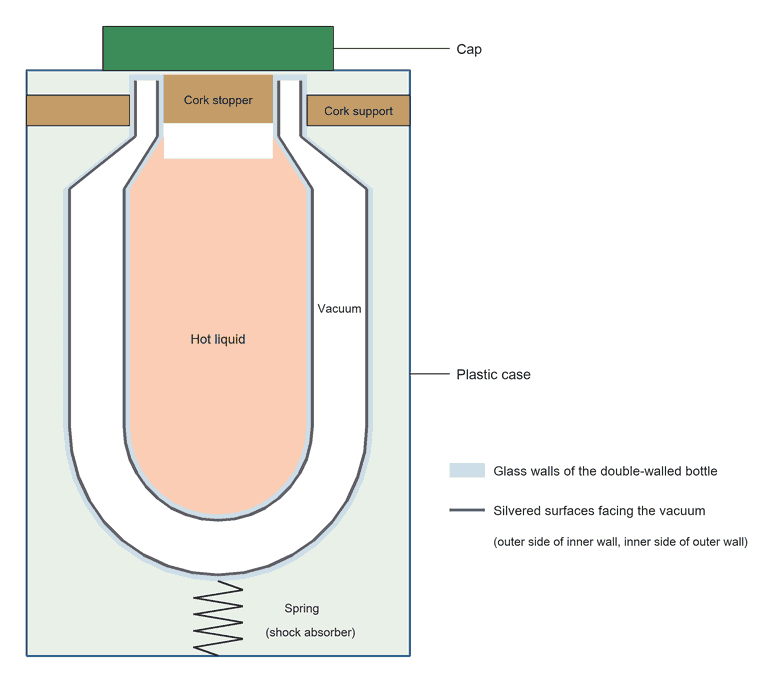
The labelled diagram of a thermos flask is shown below.
Step 2 — Describe its construction.
A thermos flask is a double-walled glass bottle with a vacuum between the walls. The walls are silvered on the sides facing the vacuum. The mouth is closed by a cork (or plastic) stopper. The bottle rests in a plastic case on cork supports and a spring that absorb shocks, and a cap covers the stopper.
Step 3 — Conduction and convection.
Both these modes need a medium. The vacuum between the walls has none, so it stops heat passing through the walls by conduction and convection.
Step 4 — Radiation.
The silvered surfaces reflect heat rays back, so very little heat crosses the vacuum by radiation.
Step 5 — The mouth and the supports.
The stopper is a bad conductor and seals the mouth, so heat cannot escape by conduction or convection there. The cork supports are also bad conductors.
Step 6 — State the result.
Very little heat passes in or out. So hot drinks stay hot and cold drinks stay cold for a long time.
Therefore, in a thermos flask the vacuum stops conduction and convection, the silvered walls cut down radiation and the stopper seals the mouth, so the contents keep their temperature for a long time.