
Opening your dashboard
Class 7 Physics Chapter 5 Heat: Competency-Based Questions (CBQ)
40 questions on Chapter 5, each worked through on its own page with the AI tutor. Class 7 Physics, ICSE 2026-27.
40 questions
1–5 marks · Mixed difficulty
- 11 mark
Question 1
Competency: Application
Meenal is following a cake recipe from a foreign magazine. It says, "Bake at 356°F." The dial of her oven is marked only in °C. To which temperature should she set the dial ?
- 21 mark
Question 2
Competency: Analysis
Two identical test tubes P and Q are nearly filled with cold water and heated with identical burners, as shown.
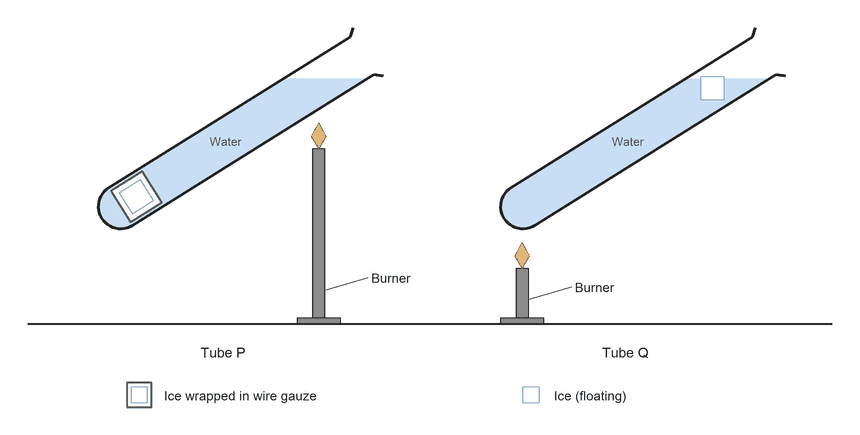
In tube P, a piece of ice wrapped in wire gauze lies at the bottom and the flame is near the mouth. In tube Q, a piece of ice floats at the top and the flame is at the bottom.
Observation: In P, the water near the mouth starts boiling while the ice is still there. In Q, the ice melts very quickly.
Which statement best explains the difference ?
- 31 mark
Question 3
Competency: Application
In a workshop, a steel ring has to be fixed tightly on a steel shaft (a solid rod). The hole of the ring is very slightly smaller than the shaft, so the ring cannot be pushed on. Which is the best way to fit it ?
- 41 mark
Question 4
Competency: Understanding & Application
A room heater has a shiny curved metal plate (reflector) fixed behind its heating coil. After some years the plate is covered with dust and soot and looks dull and dark. The coil still glows as brightly as before. What will a person sitting in front of the heater notice, and why ?
- 51 mark
Question 5
Competency: Understanding
Assertion (A): Wet clothes hung on a line become dry even on a cold winter day, although the water in them never gets anywhere near 100°C.
Reason (R): Evaporation, the change of a liquid into its vapour, takes place at all temperatures.
- 61 mark
Question 6
Competency: Analysis
Assertion (A): A room heater warms a whole room faster when it is fixed high up near the ceiling than when it is kept on the floor.
Reason (R): Air warmed by a heater expands, becomes less dense and rises.
- 72 marks
Question 7
Competency: Application
Sana heats 10 kg of water in a bucket with an immersion rod. The water is at 20°C to begin with. By the time she switches the rod off, it has given 1260000 J of heat to the water. (Take 1 cal = 4.2 J and assume that no heat is lost.)
(a) Express this heat in kilocalorie.
(b) Find the final temperature of the water. Is it warm enough for the 45°C bath that Sana wants ?
- 82 marks
Question 8
Competency: Evaluation
The water in a swimming pool is at 30°C. Kabir fills a cup with water from the pool and says, "The cup and the pool are at the same temperature, so the water in the cup has the same amount of heat energy as the water in the pool."
(a) Is Kabir's statement correct ? Give a reason.
(b) Kabir now floats the cup of water in the pool. Will heat flow from one to the other ? Explain.
- 92 marks
Question 9
Competency: Analysis
A steel plate and a wooden chopping board have been lying in the same kitchen for many hours. Asha touches both and finds that the steel plate feels colder. She then takes two identical ice cubes from the freezer and puts one on the plate and one on the board.
(a) Asha predicts, "The ice cube on the steel plate will melt more slowly, because steel is colder than wood." What is wrong with her reason ?
(b) Which ice cube will actually melt faster ? Explain.
- 102 marks
Question 10
Competency: Analysis
On a still winter night Ravi sits to one side of a campfire, a little away from it, and feels its warmth on his face. His friend then holds a sheet of cardboard between the fire and Ravi's face. The warmth on his face stops at once, although the air around him is the same as before.
(a) By which mode of transfer does the heat of the fire reach Ravi's face ?
(b) Use the observations to show that the other two modes cannot be bringing this heat.
- 114 marks
Question 11
Competency: Analysis & Evaluation
Case study: Zoya puts 200 g of crushed ice in a beaker and heats it with a small steady flame, stirring all the time. She notes the thermometer reading every minute and plots the graph below.

(a) What does the beaker contain at 5 minutes, and at 13 minutes ? Read the temperature at 13 minutes from the graph.
(b) The flame was steady, yet the reading did not change from A to B. Where did the heat go ? The flame gives the same heat every minute; use the graph to compare the heat used to melt the ice with the heat used to warm the water from 0°C to 100°C.
(c) Find the rise in temperature per minute from B to C. Zoya's friend says, "At this rate, 5 minutes after D the water will be at 150°C." Do you agree ? Give a reason.
- 124 marks
Question 12
Competency: Application & Analysis
Case study: Arnav has fever. His mother measures his temperature with a clinical thermometer marked in °F and notes the readings given below.
Time 8 a.m. 12 noon 4 p.m. 8 p.m. Temperature (in °F) 99.5 101.3 103.1 100.0 (a) The doctor asks for the highest reading in °C. Convert it.
(b) The doctor's note says, "Call me whenever the temperature is above 38°C." Express 38°C in °F and name the times at which she should have called.
(c) From 8 a.m. to 4 p.m. the reading rose by 3.6°F. By how many °C did the temperature rise ? Explain why 32 is not subtracted in this conversion.
- 134 marks
Question 13
Competency: Analysis & Evaluation
Case study: A railway engineer measures the gap between two successive steel rails of a track at different times of a day, along with the temperature of the rails.
Time 6 a.m. 10 a.m. 2 p.m. 6 p.m. Temperature of rails (in °C) 15 25 40 30 Gap between the rails (in mm) 12 10 7 9 (a) Why is the gap the smallest at 2 p.m. and the largest at 6 a.m. ?
(b) From the table, find by how much the gap changes for every 1°C change in the temperature of the rails. Use it to predict the gap when the rails are at 50°C.
(c) At this place the rails never get hotter than 65°C. Find the gap at 65°C. A contractor suggests, "To give a smoother ride, lay the rails touching each other, with no gap, on a morning when they are at 15°C." Use your results to judge this suggestion.
- 143 marks
Question 14
Competency: Analysis & Evaluation
Case study: For a science fair, Tara pours equal amounts of hot water at 90°C into three containers: an open steel tumbler, a steel tumbler covered with a lid, and a thermos flask closed with its stopper. She forgets to write which is which and calls them X, Y and Z. The room is at 30°C. Her readings are given below.
Time (in minute) 0 20 40 60 X (in °C) 90 70 56 47 Y (in °C) 90 88 86 84 Z (in °C) 90 62 47 39 (a) Find the fall in temperature of each container in 60 minutes and use it to identify X, Y and Z.
(b) The two tumblers are alike except for the lid. Which way of losing heat does the lid mainly cut down ? Why does the covered tumbler still cool much faster than the thermos flask ?
(c) The box of the flask says, "No heat can escape from this flask." Use Tara's readings to judge this claim.
- 154 marks
Question 15
Competency: Creation & Application
The markings on the stem of a laboratory mercury thermometer have been rubbed off. Riya decides to make a new Celsius scale for it on a strip of paper pasted along the stem. She has crushed ice, pure water, a beaker, a burner with a stand, a ruler and a fine pen.
(a) Plan how she should find and mark the two fixed points on the strip.
(b) How should she complete the scale between these two marks ? What property of mercury makes this method correct ?
(c) Her two marks turn out to be 18 cm apart. To test the scale, she dips the bulb in a cup of warm water and the mercury settles 6.3 cm above the lower mark. What is the temperature of the warm water ?
(d) State two precautions she must take so that her marks and readings are reliable.
- 161 mark
Question 16
Competency: Understanding
Rohan heats a solid iron ball on a gas burner for several minutes, from 30°C to 150°C. Which one of the following quantities of the ball does not change during the heating ?
- 171 mark
Question 17
Competency: Application
A clinical thermometer in Ria's home first-aid box is marked from 94°F to 108°F. Her mother says that the water in the bucket for the bath is "just about 50°C". Ria wants to check it. Why should she not dip the clinical thermometer in this water ?
- 181 mark
Question 18
Competency: Analysis
Three liquids X, Y and Z are tested one by one. Each time, 100 cm of the liquid is heated from 20°C to 60°C and the increase in its volume is noted. (Hypothetical data.)
Liquid X Y Z Increase in volume (in cm) 2.1 0.8 4.4 A maker has a glass bulb and a very narrow glass tube. He wants a thermometer in which the liquid thread rises as high as possible for the same rise in temperature. Which liquid should he fill in the bulb, and why ?
- 191 mark
Question 19
Competency: Application
Many houses in Shimla have windows with two glass panes and a thin layer of still air sealed between them. On a cold night, a room with such windows stays warmer than a room with ordinary single-pane windows. What is the best reason ?
- 201 mark
Question 20
Competency: Understanding
Assertion (A): On a sunny afternoon, the black tar of a road feels much hotter to bare feet than the white stripes of a zebra crossing painted on the same road.
Reason (R): White surfaces absorb more heat radiations than black surfaces.
- 211 mark
Question 21
Competency: Understanding
Assertion (A): A hot-air balloon rises when the air inside it is heated by a burner.
Reason (R): Air expands on heating, so the heated air becomes less dense (lighter) than the same volume of the cold air around it.
- 221 mark
Question 22
Competency: Analysis
The figure shows the tank of an electric water heater (geyser). The heating element lies near the bottom of the tank, the cold-water pipe enters near the bottom and the hot-water pipe leaves from the top.
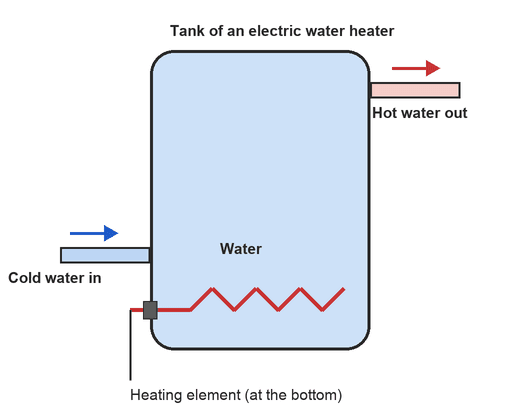
Why is the heating element fixed near the bottom and not near the top of the tank ?
- 231 mark
Question 23
Competency: Analysis
Three metal blocks P, Q and R are placed in a row so that Q touches P on one side and R on the other side. P and R do not touch. The temperatures at the start are P at 40°C, Q at 55°C and R at 25°C. Which statement describes the flow of heat at the start ?
- 241 mark
Question 24
Competency: Analysis
A thermos flask is kept for long at home. A tiny crack appears in the outer glass wall, and the air from outside slowly enters the space between its double walls. The tea kept in this flask now cools much faster than before. Which of the following explains this ?
- 251 mark
Question 25
Competency: Application
The figure shows a thermometer which has a Celsius scale on its left and a Fahrenheit scale on its right. The level of the mercury is as shown.

The temperature now falls by 27°F. What will the Celsius scale show after the fall ?
- 262 marks
Question 26
Competency: Analysis
A surveyor's steel tape is correctly marked at 20°C. She uses the same tape at noon in Nagpur, when the temperature is 44°C, to measure the length of a field.
(a) Does the length of the tape between its 0 m mark and its 100 m mark increase, decrease or stay the same at 44°C ?
(b) Will the length she reads be more than, less than or equal to the true length of the field ? Explain.
- 272 marks
Question 27
Competency: Analysis
Sonia holds her palm 10 cm above a burning candle flame for a few seconds, and then 10 cm to the side of the same flame. She feels much more heat above the flame than at its side.
(a) Name the mode of heat transfer that gives most of the heat to her hand above the flame.
(b) Name the mode by which her hand at the side gets heat. Why is it weaker ?
- 282 marks
Question 28
Competency: Application
Priya fits a balloon over the mouth of an empty glass bottle. She dips the bottle in hot water and the balloon swells. When she takes the bottle out and puts it in a bowl of ice-cold water, the balloon becomes smaller.
(a) Explain these two observations.
(b) Priya now fills the same bottle to the brim with water, closes it with a cork through which a narrow glass tube passes, and dips it in the same hot water. Will the change in volume she sees be more or less than with air ? Give a reason.
- 292 marks
Question 29
Competency: Analysis
The door of a heated room in a cold hill station is opened slightly. Rakesh holds a burning candle first near the bottom of the gap and then near the top of the gap. The flame leans into the room at the bottom and leans out of the room at the top.
(a) In which direction does air move at the bottom and at the top of the gap ?
(b) Explain why the air moves in this way.
- 302 marks
Question 30
Competency: Application
Anil heats 3 kg of water in a bucket from 25°C to 45°C. Bina heats 1.5 kg of water in another bucket from 25°C to 55°C. (Hypothetical data.) Take 1 cal = 4.2 J, and 1 kcal of heat raises the temperature of 1 kg of water by 1°C. Assume that no heat is lost.
(a) Find the heat taken by the water in each bucket, in kilocalorie.
(b) Which bucket took more heat, and by how many joule ?
- 312 marks
Question 31
Competency: Evaluation
Neha's friend says, "A woollen sweater produces heat and gives it to our body, that is why it keeps us warm." To test this, Neha wraps one ice cube in a piece of woollen cloth and puts another ice cube, unwrapped, on a plate in the same room. After one hour, the wrapped ice cube has melted much less than the unwrapped one.
(a) Does this result support her friend's statement ? Give a reason.
(b) What does the woollen cloth really do ?
- 323 marks
Question 32
Competency: Analysis
A few crystals of potassium permanganate are dropped to one side at the bottom of a large glass beaker filled with water, so that they rest there, and a small flame is placed under the crystals only. A purple streak is seen rising up from the crystals.
(a) Describe the path that the purple streak follows in the beaker.
(b) Why does the water above the flame rise ?
(c) Why cannot conduction explain this movement of the streak ?
- 333 marks
Question 33
Competency: Analysis
A cyclist rides down a long slope and presses the brakes for a long time. When he stops, he finds that the metal rims of the wheels are warm. A friend says, "The brake blocks have made the heat from nothing."
(a) Name the form of energy which the brakes change into heat, and say where this energy comes from on the slope.
(b) Why is the friend wrong ?
(c) The rims get warm but they do not keep on getting hotter and hotter while the brakes are pressed. Give a reason.
- 343 marks
Question 34
Competency: Application
Four spoons of the same size, made of copper, aluminium, steel and plastic, are dipped to the same depth in four cups of hot water, each at 80°C. After three minutes the temperature at the free end of each spoon is measured. The room is at 28°C. (Hypothetical data.)
Spoon Copper Aluminium Steel Plastic Temperature of the free end (in °C) 52 47 36 29 (a) Arrange the spoons from the best to the worst conductor of heat.
(b) By how many degrees did the free end of the copper spoon warm up above the room temperature ? How many times is this the rise of the steel spoon's free end ?
(c) What does the plastic spoon's reading of 29°C, only 1°C above the room temperature, show ?
- 353 marks
Question 35
Competency: Creation
Your school wants to build a simple solar water heater on its roof. You have a long thin metal pipe bent into a zig-zag and fixed on a flat board, black paint, white paint, a water tank, sheets of thermocol and aluminium foil.
(a) Which paint would you use on the pipe ? Give a reason.
(b) The lower end of the pipe is joined to the bottom of the tank and its upper end to the top of the tank. Should the tank be placed higher or lower than the pipe board ? Explain how the water will move round without a pump.
(c) Suggest two features that will keep the water in the tank hot until the next morning, with a reason for each.
- 363 marks
Question 36
Competency: Evaluation
A fire-fighter's suit is covered with a thin, shiny aluminium coat. A student says, "Shiny aluminium is a metal, so it is a good conductor, and it should heat up the fire-fighter more."
(a) Is the student's statement right about the job of the shiny coat ? Explain.
(b) Why would a thick dull black woollen coat be a poor choice near a fire ?
(c) After a long race, runners are wrapped in a thin shiny foil sheet. Why ?
- 375 marks
Question 37
Competency: Analysis
Case study: Two identical steel cans, P and Q, each hold 200 mL of water at 80°C. One can is wrapped tightly in a thick woollen cloth and the other is left bare. The temperature of the water in each can is noted every 10 minutes. The room is at 28°C. The readings are plotted in the graph.
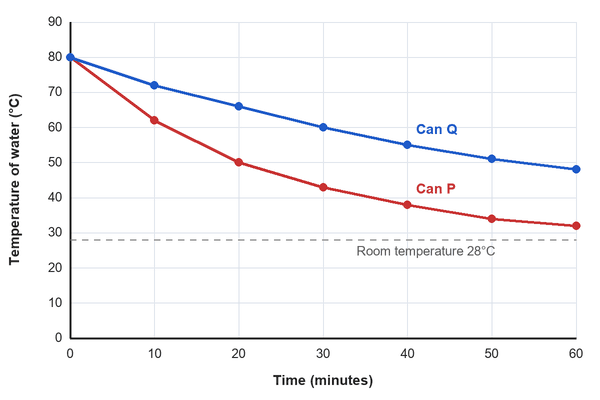
(a) Which can is wrapped in the woollen cloth ? Give a reason.
(b) Read from the graph the temperature of the water in can P after 30 minutes. How much did the water in each can cool in the first 20 minutes ?
(c) Both curves become flatter with time. Towards what temperature are they heading, and why can the water not cool below it ?
- 384 marks
Question 38
Competency: Evaluation
Case study: For a science fair, Imran makes a thermometer from a small glass bottle full of coloured spirit (alcohol). A thin transparent straw passes through a sealed cork in the neck of the bottle, and the spirit rises a little way into the straw. He dips the bottle in water baths at different temperatures and notes the level of the spirit in the straw. Spirit boils at about 78°C. (Hypothetical data.)
Temperature of the bath (in °C) 20 30 40 50 60 Level of spirit in the straw (in cm) 4.0 5.5 7.0 8.5 10.0 (a) Which property of the spirit does his thermometer use ?
(b) By how much does the level rise for every 10°C ? Find the level at 45°C and the temperature when the level is at 11.5 cm.
(c) Imran's thermometer cannot be used to measure the temperature of boiling water. Give a reason, and suggest one change that makes his thermometer show smaller changes of temperature more clearly.
- 395 marks
Question 39
Competency: Creation
Case study: A school canteen wants a new hot-milk mug that is comfortable to hold and keeps the milk warm for a long time. Students pour 200 mL of milk at 80°C into four open mugs of the same size and shape, made of different materials. They measure the temperature of the outer surface of each mug after 2 minutes, and the temperature of the milk after 30 minutes. The room is at 28°C. (Hypothetical data.)
Mug Steel Glass China (ceramic) Thick plastic Outer surface after 2 minutes (in °C) 74 58 50 36 Milk after 30 minutes (in °C) 44 47 49 52 (a) Which mug is the most comfortable to hold just after filling, and which is the least ? Explain using conduction.
(b) Find the fall in the temperature of the milk in 30 minutes in the steel mug and in the plastic mug. Why did the milk in the steel mug cool more ?
(c) Design the new mug. State the material of its outer wall, what you would keep between its two walls, and what kind of lid it should have. Give a reason for each choice.
- 404 marks
Question 40
Competency: Analysis
Case study: In a small village kitchen where food is cooked on a wood stove, Meena places a thermometer at different heights above the floor while the stove is burning. (Hypothetical data.)
Height above the floor (in m) 0.2 1.0 2.0 2.8 Temperature of the air (in °C) 31 35 39 44 The kitchen has one small window near the floor and no other opening. Smoke collects near the ceiling.
(a) At which height is the air hottest ? Find how much hotter it is than the air at the floor, and say why it is hottest there.
(b) Where should a ventilator be made to take out the hot air and smoke, and where a window to bring in fresh air ? Explain how air would move.
(c) Meena's neighbour says, "Put the ventilator near the floor, it is easier to reach." Evaluate the suggestion.