
Opening your dashboard
Class 7 Physics Chapter 5 Heat: Practice Questions
40 questions on Chapter 5, each worked through on its own page with the AI tutor. Class 7 Physics, ICSE 2026-27.
40 questions
1–5 marks · Mixed difficulty
- 11 mark
Question 1
Bloom's level: Remember
One kilocalorie (1 kcal) of heat is equal to :
- 21 mark
Question 2
Bloom's level: Remember
The lower fixed point (ice point) of a thermometer is the :
- 31 mark
Question 3
Bloom's level: Apply
A doctor's clinical thermometer is marked in °F. A child's temperature measured in the laboratory is 39°C. What will the clinical thermometer show ?
- 41 mark
Question 4
Bloom's level: Apply
The metal lid of a glass jar of pickle is stuck very tight. Which is the best way to open it easily ?
- 51 mark
Question 5
Bloom's level: Understand
Which one of these situations is an example of heating mainly by radiation ?
- 61 mark
Question 6
Bloom's level: Analyse
Four rods P, Q, R and S of the same length and thickness, but of different materials, are each coated with a small bead of wax at one end. The other ends are held in the same flame. The time taken for each bead to start melting is noted :
Rod P Q R S Time for wax to start melting 50 s 2 min 10 s not melted even after 10 min 30 s Which rod is the best conductor of heat, and which material would be the best for the handle of a cooking pan ?
- 71 mark
Question 7
Bloom's level: Apply
An air conditioner blows cold air into a room. To cool the whole room quickly, it should be fitted :
- 81 mark
Question 8
Bloom's level: Evaluate
Two identical cars, one black and one white, are parked side by side in the summer sun. Rohan says, "The black car will be cooler inside, because black colour hides the heat." Which is the best judgement of Rohan's statement ?
- 91 mark
Question 9
Bloom's level: Understand
In a thermos flask, the outer side of the inner wall and the inner side of the outer wall are silvered (made shiny). This is done mainly to :
- 101 mark
Question 10
Bloom's level: Understand
Read the Assertion (A) and the Reason (R) and choose the correct option.
Assertion (A): A liquid shows only cubical expansion on heating; it does not show linear or superficial expansion.
Reason (R): A liquid has no definite shape, but it has a definite volume.
- 111 mark
Question 11
Bloom's level: Understand
Read the Assertion (A) and the Reason (R) and choose the correct option.
Assertion (A): Heat from the sun reaches the earth by convection.
Reason (R): Most of the space between the sun and the earth is a vacuum.
- 121 mark
Question 12
Bloom's level: Analyse
Read the Assertion (A) and the Reason (R) and choose the correct option.
Assertion (A): On a cold day, a steel chair feels colder to touch than a wooden chair kept in the same room.
Reason (R): The steel chair is at a lower temperature than the wooden chair.
- 132 marks
Question 13
Bloom's level: Remember
(a) Name the three changes that can take place in an object when its heat energy increases.
(b) Name the three ways in which heat is transferred from a hot object to a cold object.
- 142 marks
Question 14
Bloom's level: Understand
Anu keeps her left hand in a bowl of cold water and her right hand in a bowl of warm water for a minute. Then she puts both hands together into a third bowl of lukewarm water. The left hand feels it is warm, while the right hand feels it is cold. Explain this, and state what it tells us about measuring temperature.
- 152 marks
Question 15
Bloom's level: Apply
A glass holds 250 g of water. How much heat is needed to raise its temperature by 8°C ? Give your answer (a) in calorie and (b) in joule. (Take 1 cal = 4.2 J.)
- 162 marks
Question 16
Bloom's level: Apply
(a) The temperature of a room is 300 K. Express it in °C.
(b) A weather report gives the temperature of a city as 77°F. Express it in °C.
- 172 marks
Question 17
Bloom's level: Understand
Crushed ice in a beaker is heated gently and its temperature is noted every 30 seconds. For the first few minutes the thermometer keeps showing 0°C, although heat is being supplied all the time. Explain why. What is the heat absorbed during this time called ?
- 181 mark
Question 18
Bloom's level: Remember
Name the process in each case : (a) camphor changing directly from solid into vapour on heating ; (b) vapour changing directly into solid on cooling.
- 192 marks
Question 19
Bloom's level: Apply
A bimetallic strip is made by riveting together a straight strip of brass and a straight strip of iron of the same length. For the same rise in temperature, brass expands about 1.5 times as much as iron. The strip is heated. Which way will it bend ? Explain.
- 202 marks
Question 20
Bloom's level: Apply
An ice-cream seller keeps his ice-cream in a box with thick walls made of thermocol. Explain why. Would a box with thin aluminium walls work as well ? Give a reason.
- 212 marks
Question 21
Bloom's level: Understand
During a fire in a building, people are advised to crawl close to the floor while getting out of a smoke-filled room. Explain why, using the idea of convection.
- 222 marks
Question 22
Bloom's level: Analyse
Two identical cans containing equal amounts of water are kept at the same distance from a room heater. One can is painted black and the other white. The thermometer readings are :
Time (in minute) 0 5 10 15 Black can (in °C) 25 29 33 37 White can (in °C) 25 26 27 28 (a) Find the rise in temperature of each can in 15 minutes.
(b) What do you conclude from these readings ?
- 233 marks
Question 23
Bloom's level: Apply
A travel website shows these temperatures on one day : Jaisalmer 45°C, London 50°F, and the inside of a deep freezer -18°C.
(a) Express the temperature of Jaisalmer in °F.
(b) Express the temperature of London in °C. Which city is hotter, and by how many degrees Celsius ?
(c) Express the temperature of the freezer in kelvin.
- 244 marks
Question 24
Bloom's level: Analyse
Case study: Meera puts a steel kettle full of cold water on a gas stove. The kettle has a plastic handle. After some time she feels warmth on her hands held near the side of the kettle. A few minutes later the water starts boiling, and the thermometer she has put in it stays at 100°C although the gas is still burning.
(a) Name the mode of heat transfer by which (i) heat passes through the steel bottom of the kettle, (ii) the whole water gets heated, (iii) her hands held near the side of the kettle feel warm.
(b) Why is the kettle made of steel but its handle made of plastic ?
(c) Name the effects of heat seen in this case. Explain why the temperature stays at 100°C while the water is boiling.
- 253 marks
Question 25
Bloom's level: Apply
A cup of hot tea at 80°C is placed in a large bucket of water at 35°C to cool it.
(a) In which direction will heat flow ? Give a reason.
(b) Will the bucket water become as hot as 80°C ? Explain.
(c) When will the flow of heat stop ? What will thermometers in the tea and in the bucket water then show ?
- 264 marks
Question 26
Bloom's level: Analyse
For each observation, name the mode of heat transfer (conduction, convection or radiation) and give the clue that tells you so.
(a) The far end of an iron poker kept in a fire becomes hot.
(b) The smoke of an agarbatti rises straight up in a still room.
(c) We feel the warmth of the sun on our face when we step out of the shade.
(d) Water in a pot heated from below becomes warm at the top first.
- 274 marks
Question 27
Bloom's level: Evaluate
Case study: Priya fills a thermos flask with hot soup at 7 a.m. for her lunch. At 1 p.m. the soup is still hot. One day she forgets to put the cork stopper in properly.
(a) Explain why the soup stays hot for so long when the flask is closed properly.
(b) What happens on the day the stopper is not put in properly ? Name the mode of heat transfer that is no longer prevented.
(c) Her brother says, "A thermos flask is useful only for hot drinks; it cannot keep cold juice cold in summer." Is he right ? Justify your answer.
- 285 marks
Question 28
Bloom's level: Create
Case study: Your class is going on a picnic on a hot summer day. You must keep a bottle of cold water cold for about four hours. You can use a cardboard box, sheets of thermocol, aluminium foil, old newspapers, a woollen cloth and some sticky tape.
(a) Design a 'cooling pack' using these materials. Describe its layers from the outside to the inside.
(b) For each layer, state which mode of heat transfer (conduction, convection or radiation) it reduces, and how.
(c) Suggest two more things you would do while using the pack (for example, where you keep it and how you close it), with a reason for each.
- 294 marks
Question 29
Bloom's level: Evaluate
A student wrote these revision notes for the chapter. Check each statement. Write Correct or Wrong, and correct each wrong statement.
(a) 1 cal = 4.2 J (nearly).
(b) 0 K = 273°C.
(c) Heat can be transferred by convection in solids.
(d) Black and dull surfaces are good absorbers of heat radiations.
(e) Water expands on heating from 0°C to 4°C.
(f) 100 Celsius degrees = 180 Fahrenheit degrees.
(g) Still (trapped) air is a good conductor of heat.
(h) Heat transfer by radiation is the slowest of the three modes.
- 304 marks
Question 30
Bloom's level: Create
Design an experiment to show that different liquids expand by different amounts for the same rise in temperature, using water and cooking oil. Include :
(a) the apparatus and how you will set it up,
(b) how you will make it a fair test,
(c) what you will observe and conclude,
(d) one safety precaution.
- 311 mark
Question 31
A steel spoon is left standing in a cup of hot soup. After a few minutes the handle of the spoon, which is outside the soup, also becomes hot. Heat has reached the handle mainly by :
- 321 mark
Question 32
The temperature of warm water in a beaker is 60°C. This temperature on the Kelvin scale is :
- 331 mark
Question 33
A thin square sheet of copper is heated. The increase in the area of the sheet is called its :
- 341 mark
Question 34
Fill in the blank :
Substances such as wood, cork and wool, which do not allow heat to pass through them easily, are called .............. of heat.
- 351 mark
Question 35
Write true or false :
The S.I. unit of heat is the calorie.
- 362 marks
Question 36
Name the effect of heat that is seen in each of the following cases :
(a) A lump of butter kept in a hot pan turns into a liquid.
(b) A tightly inflated bicycle tube left in the hot sun for many hours bursts.
- 372 marks
Question 37
(a) The temperature of the water of a hot spring is 122°F. Express it in °C.
(b) The temperature of a city on a summer afternoon is 35°C. Express it in °F.
- 384 marks
Question 38
(a) What is meant by the linear expansion of a solid ?
(b) You are given a piece of iron wire, a curtain ring, two vertical stands and a burner. Describe, with the help of a labelled diagram, an activity to show that a solid expands on heating and contracts on cooling.
(c) Name one substance which expands only negligibly on heating.
- 394 marks
Question 39
The figure shows a sea coast on a sunny day. P is a point in the air above the land and Q is a point in the air above the sea.
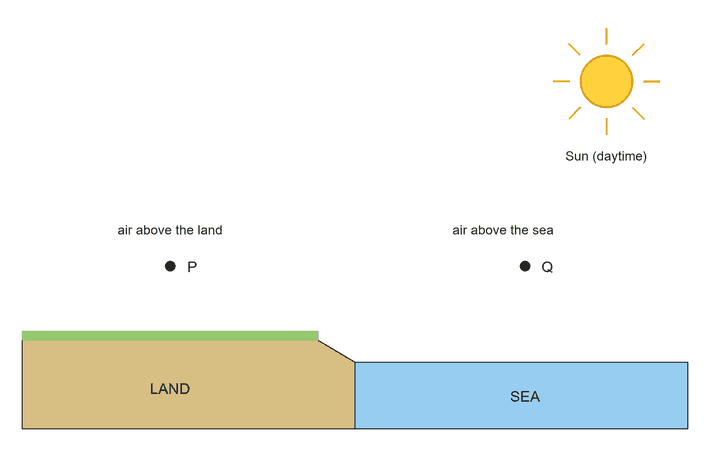
(a) Which becomes hotter during the day, the land or the sea water ? Hence state where the air is warmer and lighter, at P or at Q, and what happens to this warm air.
(b) In which direction does the breeze blow near the ground during the day ? Name this breeze, and name the mode of transfer of heat on which it is based.
(c) State how the direction of the breeze changes at night.
- 405 marks
Question 40
The figure shows the section of a thermos flask containing hot tea. Four of its parts are marked 1, 2, 3 and 4.
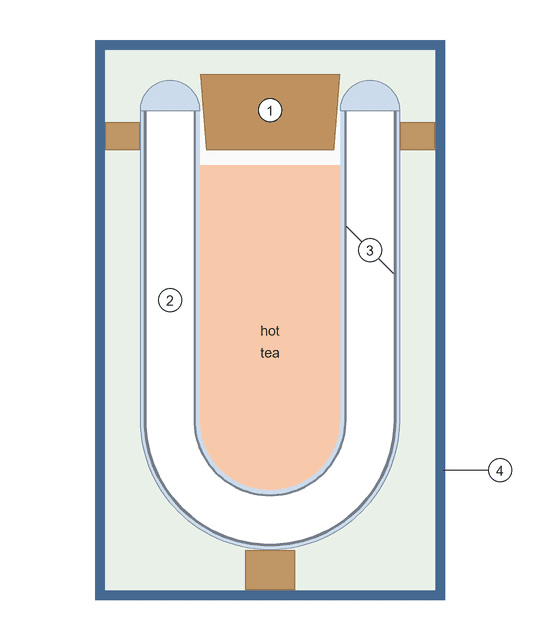
(a) Name the parts marked 1, 2, 3 and 4.
(b) State how part 2 and part 3 help in keeping the tea hot.
(c) Ice-cold lemonade is filled in the same flask in place of the hot tea. Will it stay cold for a long time ? Give a reason for your answer.