
Opening your dashboard
Class 7 Physics Chapter 4: Light Energy Solutions
70 textbook questions with step-by-step answers, free to read, for ICSE 2026-27.
Get talked through Ch 4, not just shown the answer
Reading a finished solution is not the same as being able to do it. The AI tutor takes one question at a time and works it with you, in your own words, until you can.
- Ask it out loud, in your own words
- It gives you the next step, not the answer
- Stuck on part (ii)? Start there
70 questions with solutions
1–4 marks · Mixed difficulty
- 11 mark
Question 1
A man standing in front of a plane mirror finds his image to be at a distance of 6 metre from himself. The distance of man from the mirror is :
Solve with AIAnswer
(A) 6 m
- Correct
(B) 3 m
(C) 2 m
(D) 12 m
Answer: (B) 3 m
Concept: The image formed by a plane mirror is virtual (it cannot be obtained on a screen), upright (erect), of the same size as the object and laterally inverted (its left and right sides are interchanged). It is formed as far behind the mirror as the object is in front of it.
Step 1 — Name the unknown.
Let the man stand at a distance in front of the mirror. His image is then the same distance behind the mirror.
Step 2 — Write the man-to-image distance.
The man and his image are on opposite sides of the mirror, so the distance between them is the sum of the two distances.
Step 3 — Use the given distance.
The man finds his image 6 m away from himself, so we set equal to 6 m and solve for .
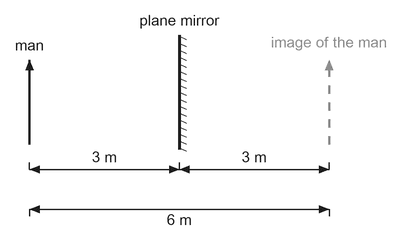
Watch out: The 6 m is measured from the man to his image, not from the man to the mirror; halve it.
Why the other options are wrong:
- (A) 6 m: 6 m is the distance between the man and his image, not between the man and the mirror.
- (C) 2 m: If the man were 2 m from the mirror, his image would be only 4 m from him, not 6 m.
- (D) 12 m: 12 m is double the given distance; that would be the man-to-image distance for a man 6 m from the mirror.
Therefore, the man is 3 m from the mirror, option (B).
- 21 mark
Question 2
The angle between the incident ray and the ray reflected from the plane mirror is 70°.
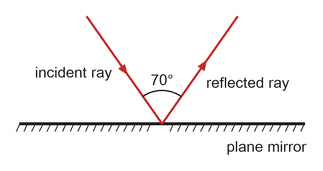
The angle of incidence will be :
Solve with AIAnswer
(A) 70°
(B) 30°
- Correct
(C) 35°
(D) 90°
Answer: (C) 35°
Concept: There are two laws of reflection. First, the angle of incidence is equal to the angle of reflection, . Second, the incident ray, the reflected ray and the normal at the point of incidence all lie in the same plane. Both angles are measured from the normal, the line drawn perpendicular to the mirror at the point of incidence, and never from the mirror surface.
Step 1 — Split the angle between the rays.
The normal lies between the incident ray and the reflected ray. So the angle between the two rays is made up of the angle of incidence and the angle of reflection.
Step 2 — Use the first law.
By the first law of reflection , so the two equal parts add up to 70°.
Watch out: The 70° is the angle between the two rays; the angle of incidence is only half of it.
Why the other options are wrong:
- (A) 70°: 70° is the whole angle between the incident ray and the reflected ray. It is the sum of the angles of incidence and reflection, not the angle of incidence alone.
- (B) 30°: An angle of incidence of 30° would make the angle between the rays 60°, not 70°.
- (D) 90°: An angle of incidence of 90° would mean the ray runs along the mirror surface; then there is no reflected ray at 70° to it.
Therefore, the angle of incidence is 35°, option (C).
- 31 mark
Question 3
Identify the correct statement for an image formed by a plane mirror.
Solve with AIAnswer
(A) Image is laterally inverted
(B) Image is of the same size as that of the object
(C) Image is upright
- Correct
(D) All of the above
Answer: (D) All of the above
Concept: The image formed by a plane mirror is virtual (it cannot be obtained on a screen), upright (erect), of the same size as the object and laterally inverted (its left and right sides are interchanged). It is formed as far behind the mirror as the object is in front of it.
Step 1 — Check each statement.
We compare statements (A), (B) and (C) with the characteristics of the image in a plane mirror. The image is laterally inverted, so (A) is true. It is of the same size as the object, so (B) is true. It is upright (erect), so (C) is true.
Step 2 — Choose the option.
All three statements are true, so the option that includes all of them is the correct one.
Why the other options are wrong:
- (A) Image is laterally inverted: This statement is true, but it gives only one of the true statements; (D) includes all three.
- (B) Image is of the same size as that of the object: This statement is true, but it gives only one of the true statements; (D) includes all three.
- (C) Image is upright: This statement is true, but it gives only one of the true statements; (D) includes all three.
Therefore, all three statements are correct, option (D).
- 41 mark
Question 4
The angle of incidence on a plane mirror is 30°. The angle of reflection will be :
Solve with AIAnswer
- Correct
(A) 30°
(B) 60°
(C) 15°
(D) 0°
Answer: (A) 30°
Concept: There are two laws of reflection. First, the angle of incidence is equal to the angle of reflection, . Second, the incident ray, the reflected ray and the normal at the point of incidence all lie in the same plane. Both angles are measured from the normal, the line drawn perpendicular to the mirror at the point of incidence, and never from the mirror surface.
Step 1 — Recall the first law.
The first law of reflection says that the angle of reflection is always equal to the angle of incidence.
Step 2 — Apply it.
The angle of incidence is 30°, so the angle of reflection is also 30°.
Why the other options are wrong:
- (B) 60°: 60° is the angle between the incident ray and the reflected ray (), not the angle of reflection.
- (C) 15°: 15° is half the angle of incidence; no law of reflection halves the angle.
- (D) 0°: The angle of reflection is 0° only when the ray falls along the normal, that is when .
Therefore, the angle of reflection is 30°, option (A).
- 51 mark
Question 5
The angle of incidence on a plane mirror is 30°.

The angle between the incident ray and the reflected ray is :
Solve with AIAnswer
(A) 30°
(B) 15°
- Correct
(C) 60°
(D) 90°
Answer: (C) 60°
Concept: There are two laws of reflection. First, the angle of incidence is equal to the angle of reflection, . Second, the incident ray, the reflected ray and the normal at the point of incidence all lie in the same plane. Both angles are measured from the normal, the line drawn perpendicular to the mirror at the point of incidence, and never from the mirror surface.
Step 1 — Find the angle of reflection.
By the first law of reflection, , so the angle of reflection is also 30°.
Step 2 — Add the two angles.
The incident ray and the reflected ray are on opposite sides of the normal, so the angle between them is the sum of the two angles.
Watch out: The angle of incidence is measured from the normal; the angle between the two rays is twice it.
Why the other options are wrong:
- (A) 30°: 30° is the angle of incidence (or of reflection) alone, measured from the normal.
- (B) 15°: 15° is half of 30°; it is not any angle in this reflection.
- (D) 90°: The angle between the rays would be 90° only if the angles of incidence and reflection were 45° each.
Therefore, the angle between the incident ray and the reflected ray is 60°, option (C).
- 61 mark
Question 6
The property due to which a light ray striking a surface is returned back into the same medium is called :
Solve with AIAnswer
(A) refraction
(B) reflex action
- Correct
(C) reflection
(D) regression
Answer: (C) reflection
Concept: Reflection of light is the returning of light into the same medium after it strikes a surface. A highly polished, smooth surface such as a plane mirror reflects most of the light falling on it.
Step 1 — See what the question describes.
The light strikes a surface and comes back into the same medium.
Step 2 — Name the process.
Returning of light into the same medium after striking a surface is called reflection of light.
Why the other options are wrong:
- (A) refraction: Refraction is the bending of light when it passes into a different medium, not its return.
- (B) reflex action: Reflex action is a quick, automatic response of the body; it is a term from biology.
- (D) regression: Regression means going back to an earlier state; it is not a property of light.
Therefore, the property is reflection, option (C).
- 71 mark
Question 7
A ray of light after reflection from a mirror is known as :
Solve with AIAnswer
- Correct
(A) reflected ray
(B) normal
(C) incident ray
(D) refracted ray
Answer: (A) reflected ray
Concept: The incident ray is the ray that falls on the surface, and the point of incidence is where it meets the surface. The normal is the line drawn perpendicular to the surface at that point. The reflected ray is the ray that comes back into the same medium. The angle of incidence is the angle between the incident ray and the normal, and the angle of reflection is the angle between the reflected ray and the normal.
Step 1 — Picture the ray.
The ray in the question has already struck the mirror and come back.
Step 2 — Name it.
The ray that is returned into the same medium after reflection is called the reflected ray.
Why the other options are wrong:
- (B) normal: The normal is the line drawn perpendicular to the mirror at the point of incidence; it is not a ray of light.
- (C) incident ray: The incident ray is the ray that falls on the mirror, before reflection.
- (D) refracted ray: A refracted ray is the ray that goes into a different medium; it is not formed by a mirror.
Therefore, a ray of light after reflection is the reflected ray, option (A).
- 81 mark
Question 8
The speed of light is maximum in :
Solve with AIAnswer
(A) glass
(B) water
- Correct
(C) air
(D) wood
Answer: (C) air
Concept: Light travels fastest in vacuum, at about , and its speed in air is almost the same. It is slower in transparent media: about in water and in glass.
Step 1 — Compare the media.
Light travels at about in air, in water and in glass. Wood does not let light through at all.
Step 2 — Choose the medium.
Of the four, light is fastest in air.
Watch out: The speed of light is greatest in vacuum; air is the fastest of these options because its speed is almost the same as in vacuum.
Why the other options are wrong:
- (A) glass: In glass light travels at only about , the slowest of the transparent media here.
- (B) water: In water light travels at about , which is less than in air.
- (D) wood: Wood is opaque, so light does not travel through it at all.
Therefore, the speed of light is maximum in air, option (C).
- 91 mark
Question 9
A red rose is seen in green light. It will appear:
Solve with AIAnswer
(A) red
(B) blue
(C) yellow
- Correct
(D) black
Answer: (D) black
Concept: An opaque object reflects the light of its own colour and absorbs the light of the other colours, so its colour is the colour of the light it reflects. A white object reflects light of all the colours. A black object absorbs light of all the colours and reflects none.
Step 1 — Recall what a red rose does.
A red rose reflects only red light and absorbs the light of all other colours.
Step 2 — Look at the light falling on it.
Only green light falls on the rose. The rose absorbs this green light, and there is no red light for it to reflect.
Step 3 — Decide what we see.
No light comes from the rose to our eyes, so it appears black.
Watch out: An object cannot reflect a colour that is not present in the light falling on it.
Why the other options are wrong:
- (A) red: The rose looks red only when red light falls on it, as in white or red light; green light has no red in it.
- (B) blue: No blue light falls on the rose, so it cannot send blue light to our eyes.
- (C) yellow: No yellow light falls on the rose, so it cannot send yellow light to our eyes.
Therefore, a red rose seen in green light appears black, option (D).
- 101 mark
Question 10
The primary colours are :
Solve with AIAnswer
(A) Red, Blue and Yellow
(B) Magenta, Yellow and Cyan
(C) Red, Blue and Cyan
- Correct
(D) Blue, Green and Red.
Answer: (D) Blue, Green and Red
Concept: The primary colours of light are red, green and blue. Mixed together they give white light, and none of them can be made by mixing other colours of light. Mixing two primary colours gives a secondary colour: red and green give yellow, green and blue give cyan, and blue and red give magenta.
Step 1 — Recall the definition.
A primary colour of light cannot be made by mixing other colours of light, and the three primary colours together give white light.
Step 2 — Name them.
These three colours are red, green and blue, which is option (D).
Watch out: Red, blue and yellow are the primary colours of paints (pigments), not of light.
Why the other options are wrong:
- (A) Red, Blue and Yellow: Yellow is a secondary colour of light (red and green); red, blue and yellow are the primary colours of paints, not of light.
- (B) Magenta, Yellow and Cyan: Magenta, yellow and cyan are the three secondary colours of light.
- (C) Red, Blue and Cyan: Cyan is a secondary colour (green and blue), and green is missing from this set.
Therefore, the primary colours are blue, green and red, option (D).
- 111 mark
Question 11
Assertion (A) : Mixing a red, green and blue light gives white light.
Reason (R) : Red, green and blue are secondary colours.
Solve with AIAnswer
(A) Both A and R are true and R is the correct explanation of A
(B) Both A and R are true and R is not the correct explanation of A
- Correct
(C) A is true but R is false
(D) A is false but R is true
Answer: (C) A is true but R is false
Concept: The primary colours of light are red, green and blue. Mixed together they give white light, and none of them can be made by mixing other colours of light. Mixing two primary colours gives a secondary colour: red and green give yellow, green and blue give cyan, and blue and red give magenta.
Step 1 — Judge the assertion.
When red, green and blue lights are thrown on the same part of a white screen, that part looks white. So the assertion is true.
Step 2 — Judge the reason.
Red, green and blue are the primary colours, not the secondary colours. The secondary colours are yellow, cyan and magenta. So the reason is false.
Step 3 — Choose the option.
The assertion is true and the reason is false.
Why the other options are wrong:
- (A): The reason is false, so it cannot be a true statement that explains the assertion.
- (B): The reason is false, so the option saying both are true is wrong.
- (D): The assertion is true, so the option calling it false is wrong.
Therefore, A is true but R is false, option (C).
- 121 mark
Question 12
Assertion (A) : A red rose appears red in white light.
Reason (R) : This is because it reflects all colours of light and absorbs red colour.
Solve with AIAnswer
(A) Both A and R are true and R is the correct explanation of A
(B) Both A and R are true and R is not the correct explanation of A
- Correct
(C) A is true but R is false
(D) A is false but R is true
Answer: (C) A is true but R is false
Concept: An opaque object reflects the light of its own colour and absorbs the light of the other colours, so its colour is the colour of the light it reflects. A white object reflects light of all the colours. A black object absorbs light of all the colours and reflects none.
Step 1 — Judge the assertion.
A red rose appears red in white light, because white light contains red light and the rose sends that red light to our eyes. So the assertion is true.
Step 2 — Judge the reason.
The reason says the rose reflects all colours and absorbs red. That is the wrong way round: the rose reflects red light and absorbs the light of the other colours. An object that reflected all colours would look white. So the reason is false.
Step 3 — Choose the option.
The assertion is true and the reason is false.
Why the other options are wrong:
- (A): The reason is false, so it cannot be a true statement that explains the assertion.
- (B): The reason is false, so the option saying both are true is wrong.
- (D): The assertion is true, so the option calling it false is wrong.
Therefore, A is true but R is false, option (C).
- 131 mark
Question 13
Fill in the blanks :
Angle of incidence = ........
Solve with AIWritten solution
Solution:
Concept: There are two laws of reflection. First, the angle of incidence is equal to the angle of reflection, . Second, the incident ray, the reflected ray and the normal at the point of incidence all lie in the same plane. Both angles are measured from the normal, the line drawn perpendicular to the mirror at the point of incidence, and never from the mirror surface.
Step 1 — Recall the first law.
The first law of reflection compares the angle of incidence with the angle of reflection.
Step 2 — Fill the blank.
The two angles are always equal, .
Therefore, angle of incidence = angle of reflection.
- 141 mark
Question 14
Fill in the blanks :
The incident ray, the reflected ray and the normal lie ........
Solve with AIWritten solution
Solution:
Concept: There are two laws of reflection. First, the angle of incidence is equal to the angle of reflection, . Second, the incident ray, the reflected ray and the normal at the point of incidence all lie in the same plane. Both angles are measured from the normal, the line drawn perpendicular to the mirror at the point of incidence, and never from the mirror surface.
Step 1 — Recall the second law.
The second law of reflection is about where the three lines lie.
Step 2 — Fill the blank.
The incident ray, the reflected ray and the normal at the point of incidence all lie in one plane (the same plane).
Therefore, the incident ray, the reflected ray and the normal lie in one plane.
- 151 mark
Question 15
Fill in the blanks :
The image formed by a plane mirror is at a distance behind the mirror as ........
Solve with AIWritten solution
Solution:
Concept: The image formed by a plane mirror is virtual (it cannot be obtained on a screen), upright (erect), of the same size as the object and laterally inverted (its left and right sides are interchanged). It is formed as far behind the mirror as the object is in front of it.
Step 1 — Recall where the image forms.
A plane mirror forms the image behind the mirror, at the same distance as the object is in front of it.
Step 2 — Check with an example.
An object 2 m in front of the mirror has its image 2 m behind the mirror.
Therefore, the image formed by a plane mirror is at a distance behind the mirror as the object is in front of it.
- 161 mark
Question 16
Fill in the blanks :
The image formed by a plane mirror is ........ and ........
Solve with AIWritten solution
Solution:
Concept: The image formed by a plane mirror is virtual (it cannot be obtained on a screen), upright (erect), of the same size as the object and laterally inverted (its left and right sides are interchanged). It is formed as far behind the mirror as the object is in front of it.
Step 1 — Pick two characteristics.
The blanks need two properties of the image. The image is erect (upright, not upside down), and it is virtual (it cannot be obtained on a screen).
Step 2 — Say why it is virtual.
The reflected rays only appear to come from a point behind the mirror; no light really reaches there.
Watch out: Other true pairs, such as 'virtual and of the same size', also fit, but 'erect and virtual' are the two properties usually written.
Therefore, the image formed by a plane mirror is erect and virtual.
- 171 mark
Question 17
Fill in the blanks :
We are able to see the objects around us due to ........ reflection.
Solve with AIWritten solution
Solution:
Concept: In regular reflection a smooth, polished surface such as a plane mirror reflects a parallel beam of light as a parallel beam. In irregular (diffused) reflection a rough surface reflects a parallel beam in many directions. Each ray still obeys the laws of reflection, but the tiny parts of a rough surface face in different directions.
Step 1 — Think about the surfaces around us.
Most objects (walls, paper, wood, clothes) have rough, uneven surfaces.
Step 2 — Fill the blank.
Such surfaces send the light falling on them in all directions. This is irregular (diffused) reflection, and some of this light reaches our eyes from wherever we stand.
Therefore, we are able to see the objects around us due to irregular reflection.
- 181 mark
Question 18
Fill in the blanks :
A ........ image cannot be obtained on a screen.
Solve with AIWritten solution
Solution:
Concept: The image formed by a plane mirror is virtual (it cannot be obtained on a screen), upright (erect), of the same size as the object and laterally inverted (its left and right sides are interchanged). It is formed as far behind the mirror as the object is in front of it.
Step 1 — Compare real and virtual images.
A real image is formed where light rays actually meet, so it can be caught on a screen. A virtual image is formed where the rays only appear to meet.
Step 2 — Fill the blank.
No light actually reaches the place of a virtual image, so a screen kept there shows nothing.
Therefore, a virtual image cannot be obtained on a screen.
- 191 mark
Question 19
Fill in the blanks :
One surface of mirror is made opaque by ........ it followed by a thin coating of paint of lead oxide.
Solve with AIWritten solution
Solution:
Concept: A plane mirror is a thin, flat glass plate silvered on one side. The silvering is covered with an opaque paint (such as red lead oxide) to protect it, and light is reflected from the silvered surface.
Step 1 — Recall how a mirror is made.
One side of a thin, flat glass plate is first coated with a shiny layer of silver (or aluminium). This is called silvering.
Step 2 — Say what the paint does.
The silvered side is then covered with a thin coat of opaque paint of lead oxide, which protects the silvering and stops light passing through.
Therefore, one surface of the mirror is made opaque by silvering it, followed by a thin coating of paint of lead oxide.
- 201 mark
Question 20
Fill in the blanks :
A plane mirror ........ reflect 100 percent light falling on it.
Solve with AIWritten solution
Solution:
Concept: Reflection of light is the returning of light into the same medium after it strikes a surface. A highly polished, smooth surface such as a plane mirror reflects most of the light falling on it.
Step 1 — Think about a real mirror.
Even a highly polished mirror absorbs a small part of the light falling on it in the glass and the silvering.
Step 2 — Fill the blank.
So a plane mirror reflects most of the light, but does not reflect all (100 percent) of it.
Therefore, a plane mirror does not reflect 100 percent light falling on it.
- 211 mark
Question 21
Fill in the blanks :
The colour of an opaque object is the colour of light which it ........
Solve with AIWritten solution
Solution:
Concept: An opaque object reflects the light of its own colour and absorbs the light of the other colours, so its colour is the colour of the light it reflects. A white object reflects light of all the colours. A black object absorbs light of all the colours and reflects none.
Step 1 — Follow the light.
White light falling on an opaque object is partly reflected and partly absorbed.
Step 2 — Fill the blank.
Only the reflected light reaches our eyes, so the colour we see is the colour of the light the object reflects.
Therefore, the colour of an opaque object is the colour of light which it reflects.
- 221 mark
Question 22
Fill in the blanks :
Magenta, cyan and yellow are the ........ colours.
Solve with AIWritten solution
Solution:
Concept: The primary colours of light are red, green and blue. Mixed together they give white light, and none of them can be made by mixing other colours of light. Mixing two primary colours gives a secondary colour: red and green give yellow, green and blue give cyan, and blue and red give magenta.
Step 1 — See how each colour is made.
Yellow is made from red and green, cyan from green and blue, and magenta from blue and red.
Step 2 — Fill the blank.
Each of them is made by mixing two primary colours, so they are the secondary colours.
Therefore, magenta, cyan and yellow are the secondary colours.
- 231 mark
Question 23
Write true or false for each statement :
The image formed by a plane mirror is real.
Solve with AIWritten solution
Solution:
Concept: The image formed by a plane mirror is virtual (it cannot be obtained on a screen), upright (erect), of the same size as the object and laterally inverted (its left and right sides are interchanged). It is formed as far behind the mirror as the object is in front of it.
Step 1 — Recall the nature of the image.
The image in a plane mirror is formed behind the mirror, where the reflected rays only appear to meet. It cannot be obtained on a screen, so it is virtual.
Step 2 — Judge the statement.
The statement calls the image real, so it is false. Correct statement: the image formed by a plane mirror is virtual.
Therefore, the statement is false.
- 241 mark
Question 24
Write true or false for each statement :
When a light ray is reflected from a wall, the angle of incidence is not equal to the angle of reflection.
Solve with AIWritten solution
Solution:
Concept: There are two laws of reflection. First, the angle of incidence is equal to the angle of reflection, . Second, the incident ray, the reflected ray and the normal at the point of incidence all lie in the same plane. Both angles are measured from the normal, the line drawn perpendicular to the mirror at the point of incidence, and never from the mirror surface.
Step 1 — Think about a rough surface.
A wall is rough, so its tiny parts face in different directions and the reflected rays go off in different directions.
Step 2 — Apply the law at each point.
Each ray still obeys at the small part of the wall it strikes. So the statement is false. Correct statement: when a light ray is reflected from a wall, the angle of incidence is equal to the angle of reflection.
Watch out: Irregular reflection does not break the laws of reflection; only the normals point in different directions.
Therefore, the statement is false.
- 251 mark
Question 25
Write true or false for each statement :
The image of the right hand in a plane mirror looks like that of a left hand.
Solve with AIWritten solution
Solution:
Concept: Lateral inversion is the interchange of the left and right sides of an object in its image formed by a plane mirror.
Step 1 — Use lateral inversion.
A plane mirror interchanges the left and right sides of the object in the image.
Step 2 — Judge the statement.
So the image of a right hand looks like a left hand, and the statement is true.
Therefore, the statement is true.
- 261 mark
Question 26
Write true or false for each statement :
The image formed by a plane mirror is upright.
Solve with AIWritten solution
Solution:
Concept: The image formed by a plane mirror is virtual (it cannot be obtained on a screen), upright (erect), of the same size as the object and laterally inverted (its left and right sides are interchanged). It is formed as far behind the mirror as the object is in front of it.
Step 1 — Recall the image.
The image formed by a plane mirror is not turned upside down; it is erect.
Step 2 — Judge the statement.
So the statement is true.
Therefore, the statement is true.
- 271 mark
Question 27
Write true or false for each statement :
The image formed by a plane mirror can be obtained on a screen.
Solve with AIWritten solution
Solution:
Concept: The image formed by a plane mirror is virtual (it cannot be obtained on a screen), upright (erect), of the same size as the object and laterally inverted (its left and right sides are interchanged). It is formed as far behind the mirror as the object is in front of it.
Step 1 — Recall the nature of the image.
The image in a plane mirror is virtual: no light actually reaches the place behind the mirror where it appears.
Step 2 — Judge the statement.
So a screen kept there shows nothing, and the statement is false. Correct statement: the image formed by a plane mirror cannot be obtained on a screen.
Therefore, the statement is false.
- 281 mark
Question 28
Write true or false for each statement :
The objects around us are seen due to irregular reflection of light.
Solve with AIWritten solution
Solution:
Concept: In regular reflection a smooth, polished surface such as a plane mirror reflects a parallel beam of light as a parallel beam. In irregular (diffused) reflection a rough surface reflects a parallel beam in many directions. Each ray still obeys the laws of reflection, but the tiny parts of a rough surface face in different directions.
Step 1 — Think about ordinary objects.
Most objects around us have rough surfaces, which reflect light in all directions (irregular reflection).
Step 2 — Judge the statement.
Some of this scattered light reaches our eyes from wherever we stand, so we can see the objects. The statement is true.
Therefore, the statement is true.
- 291 mark
Question 29
Write true or false for each statement :
The speed of light in vacuum is m s.
Solve with AIWritten solution
Solution:
Concept: Light travels fastest in vacuum, at about , and its speed in air is almost the same. It is slower in transparent media: about in water and in glass.
Step 1 — Recall the speed.
In one second light covers 299,792,458 m in vacuum, which is nearly m.
Step 2 — Judge the statement.
So the speed of light in vacuum is about , and the statement is true.
Therefore, the statement is true.
- 301 mark
Question 30
Write true or false for each statement :
A rose appears red in light of all the colours.
Solve with AIWritten solution
Solution:
Concept: An opaque object reflects the light of its own colour and absorbs the light of the other colours, so its colour is the colour of the light it reflects. A white object reflects light of all the colours. A black object absorbs light of all the colours and reflects none.
Step 1 — Read the statement as each colour of light.
The statement says the rose appears red whatever the colour of the light falling on it. A red rose reflects only red light. In red light it looks red, but in green or blue light there is no red light for it to reflect, so it looks black.
Step 2 — Judge the statement.
Since the rose does not look red in every colour of light, the statement is false. Correct statement: a rose appears red only in light that contains red, such as white light or red light.
Note: if “light of all the colours” is read as all the colours mixed together, that mixture is white light, and a red rose does look red in it. Read that way the statement would be true; the usual reading, used here, is light of each colour in turn.
Therefore, the statement is false.
- 311 mark
Question 31
Write true or false for each statement :
A black paper absorbs light of all the colours and reflects none.
Solve with AIWritten solution
Solution:
Concept: An opaque object reflects the light of its own colour and absorbs the light of the other colours, so its colour is the colour of the light it reflects. A white object reflects light of all the colours. A black object absorbs light of all the colours and reflects none.
Step 1 — Recall why a body looks black.
A body looks black when no light comes from it to our eyes.
Step 2 — Judge the statement.
Black paper absorbs the light of all the colours falling on it and reflects none. The statement is true.
Therefore, the statement is true.
- 321 mark
Question 32
Write true or false for each statement :
The primary colours are red, blue and green.
Solve with AIWritten solution
Solution:
Concept: The primary colours of light are red, green and blue. Mixed together they give white light, and none of them can be made by mixing other colours of light. Mixing two primary colours gives a secondary colour: red and green give yellow, green and blue give cyan, and blue and red give magenta.
Step 1 — Recall the primary colours.
The three colours of light that give white light and cannot be made from other colours are red, green and blue.
Step 2 — Judge the statement.
The statement lists red, blue and green, the same three colours, so it is true.
Therefore, the statement is true.
- 331 mark
Question 33
Match the following :
Column A : A light ray passes from air to glass
Column B : (i) speeds up, (ii) reflects red light, (iii) secondary colours, (iv) plane mirror, (v) slows down
Solve with AIWritten solution
Solution:
Concept: Light travels fastest in vacuum, at about , and its speed in air is almost the same. It is slower in transparent media: about in water and in glass.
Step 1 — Compare the speeds.
Light travels at about in air but only in glass.
Step 2 — Match.
The speed falls on entering glass, so the light slows down. This is item v.
Therefore, a light ray passing from air to glass matches (v) slows down.
- 341 mark
Question 34
Match the following :
Column A : A light ray passes from glass to water
Column B : (i) speeds up, (ii) reflects red light, (iii) secondary colours, (iv) plane mirror, (v) slows down
Solve with AIWritten solution
Solution:
Concept: Light travels fastest in vacuum, at about , and its speed in air is almost the same. It is slower in transparent media: about in water and in glass.
Step 1 — Compare the speeds.
Light travels at about in glass and in water.
Step 2 — Match.
The speed rises on going from glass into water, so the light speeds up. This is item i.
Therefore, a light ray passing from glass to water matches (i) speeds up.
- 351 mark
Question 35
Match the following :
Column A : Virtual image
Column B : (i) speeds up, (ii) reflects red light, (iii) secondary colours, (iv) plane mirror, (v) slows down
Solve with AIWritten solution
Solution:
Concept: The image formed by a plane mirror is virtual (it cannot be obtained on a screen), upright (erect), of the same size as the object and laterally inverted (its left and right sides are interchanged). It is formed as far behind the mirror as the object is in front of it.
Step 1 — Recall which device gives a virtual image.
The image formed by a plane mirror is behind the mirror and cannot be obtained on a screen, so it is virtual.
Step 2 — Match.
So a virtual image goes with the plane mirror, item iv.
Therefore, virtual image matches (iv) plane mirror.
- 361 mark
Question 36
Match the following :
Column A : Red rose
Column B : (i) speeds up, (ii) reflects red light, (iii) secondary colours, (iv) plane mirror, (v) slows down
Solve with AIWritten solution
Solution:
Concept: An opaque object reflects the light of its own colour and absorbs the light of the other colours, so its colour is the colour of the light it reflects. A white object reflects light of all the colours. A black object absorbs light of all the colours and reflects none.
Step 1 — Recall why a rose looks red.
A red rose reflects red light and absorbs the light of the other colours.
Step 2 — Match.
So the red rose goes with reflects red light, item ii.
Therefore, red rose matches (ii) reflects red light.
- 371 mark
Question 37
Match the following :
Column A : Yellow, cyan, magenta
Column B : (i) speeds up, (ii) reflects red light, (iii) secondary colours, (iv) plane mirror, (v) slows down
Solve with AIWritten solution
Solution:
Concept: The primary colours of light are red, green and blue. Mixed together they give white light, and none of them can be made by mixing other colours of light. Mixing two primary colours gives a secondary colour: red and green give yellow, green and blue give cyan, and blue and red give magenta.
Step 1 — See how each colour is made.
Yellow is made from red and green, cyan from green and blue, and magenta from blue and red, each from two primary colours.
Step 2 — Match.
So yellow, cyan and magenta are the secondary colours, item iii.
Therefore, yellow, cyan, magenta matches (iii) secondary colours.
- 382 marks
Question 38
What do you mean by the term reflection of light?
Solve with AIWritten solution
Solution:
Concept: Reflection of light is the returning of light into the same medium after it strikes a surface. A highly polished, smooth surface such as a plane mirror reflects most of the light falling on it.
Step 1 — Define the term.
Reflection of light is the returning of light into the same medium after it strikes a surface.
Step 2 — Explain with a picture in mind.
A ball thrown at the ground bounces back. In the same way, light falling on a shiny surface such as a mirror comes back into the air it came from, instead of going on into the surface.
Step 3 — Give an example.
We see our face in a mirror because light from our face is reflected by the mirror into our eyes.
Therefore, reflection of light is the returning of light into the same medium after striking a surface.
- 392 marks
Question 39
How is a plane mirror made ?
Solve with AIWritten solution
Solution:
Concept: A plane mirror is a thin, flat glass plate silvered on one side. The silvering is covered with an opaque paint (such as red lead oxide) to protect it, and light is reflected from the silvered surface.
Step 1 — Start with a glass plate.
A plane mirror is made from a thin, flat (plane) sheet of glass with polished, smooth surfaces.
Step 2 — Silver one side.
One side of the glass plate is coated with a thin, shiny layer of silver. This is called silvering, and that side is the silvered surface.
Step 3 — Protect the silvering.
The silvered surface is covered with an opaque paint (such as red lead oxide). The paint protects the thin silver layer from scratches and makes the back opaque, so no light passes through the mirror.
Step 4 — See where the light reflects.
Light enters through the front glass surface and is reflected from the silvered surface behind it.
Therefore, a plane mirror is made by silvering one side of a thin plane glass plate and covering the silvering with an opaque paint.
- 402 marks
Question 40
State the two laws of reflection of light.
Solve with AIWritten solution
Solution:
Concept: The incident ray is the ray that falls on the surface, and the point of incidence is where it meets the surface. The normal is the line drawn perpendicular to the surface at that point. The reflected ray is the ray that comes back into the same medium. The angle of incidence is the angle between the incident ray and the normal, and the angle of reflection is the angle between the reflected ray and the normal.
Step 1 — State the first law.
The angle of incidence is always equal to the angle of reflection: . Both angles are measured from the normal.
Step 2 — State the second law.
The incident ray, the reflected ray and the normal at the point of incidence all lie in the same plane.
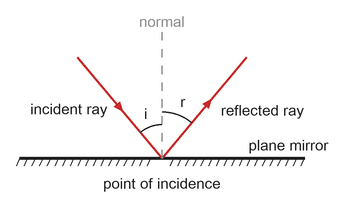
Therefore, the two laws are: (1) the angle of incidence equals the angle of reflection; (2) the incident ray, the reflected ray and the normal at the point of incidence lie in the same plane.
- 412 marks
Question 41
A ray of light falls normally on a plane mirror. What is the angle of incidence ?
Solve with AIWritten solution
Solution:
Concept: There are two laws of reflection. First, the angle of incidence is equal to the angle of reflection, . Second, the incident ray, the reflected ray and the normal at the point of incidence all lie in the same plane. Both angles are measured from the normal, the line drawn perpendicular to the mirror at the point of incidence, and never from the mirror surface.
Step 1 — See where the ray travels.
A ray that falls normally on a mirror travels along the normal itself, at 90° to the mirror surface.
Step 2 — Measure the angle from the normal.
The angle of incidence is the angle between the incident ray and the normal. Here the ray and the normal are the same line, so the angle between them is zero.
Step 3 — Find what happens next.
Since , the angle of reflection is also 0°. The ray is reflected straight back along its own path, as the figure shows.

Watch out: The ray makes 90° with the mirror surface, but the angle of incidence is measured from the normal, so it is 0°, not 90°.
Therefore, the angle of incidence is 0°.
- 422 marks
Question 42
How is the position of image formed by a plane mirror related to the position of the object ?
Solve with AIWritten solution
Solution:
Concept: The image formed by a plane mirror is virtual (it cannot be obtained on a screen), upright (erect), of the same size as the object and laterally inverted (its left and right sides are interchanged). It is formed as far behind the mirror as the object is in front of it.
Step 1 — Compare the distances.
The image is formed as far behind the mirror as the object is in front of it. The perpendicular distance of the image from the mirror equals the perpendicular distance of the object from the mirror.
Step 2 — Compare the directions.
The image lies on the perpendicular drawn from the object to the mirror, produced behind the mirror.
Step 3 — Give an example.
An object kept 1 m in front of a plane mirror has its image 1 m behind the mirror, so object and image are 2 m apart.

Therefore, the image is as far behind the mirror as the object is in front of it, on the perpendicular from the object to the mirror.
- 433 marks
Question 43
You are standing at a distance 2 metre from a plane mirror.
(a) What is the distance of your image from the mirror ?
(b) What is the distance between you and your image ?
Solve with AIWritten solution
Solution:
Concept: The image formed by a plane mirror is virtual (it cannot be obtained on a screen), upright (erect), of the same size as the object and laterally inverted (its left and right sides are interchanged). It is formed as far behind the mirror as the object is in front of it.
Given: You stand 2 m in front of a plane mirror.
Step 1 — (a) Find the distance of the image from the mirror.
The image is as far behind the mirror as you are in front of it. You are 2 m in front, so your image is 2 m behind the mirror.
Step 2 — (b) Find the distance between you and your image.
You and your image are on opposite sides of the mirror, so we add the two distances.
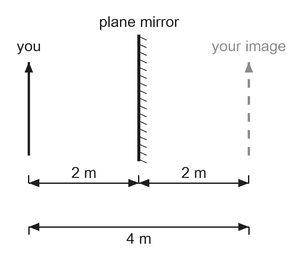
Therefore, (a) your image is 2 m from the mirror (behind it); (b) you and your image are 4 m apart.
- 442 marks
Question 44
Write down the letter C and I as seen in a plane mirror.
Solve with AIWritten solution
Solution:
Concept: Lateral inversion is the interchange of the left and right sides of an object in its image formed by a plane mirror.
Step 1 — Turn the letter C.
In the mirror the left and right sides of C are interchanged, so its opening, which faces right, now faces left. The letter looks like Ɔ.
Step 2 — Turn the letter I.
The letter I is the same on its left and right sides (it is symmetrical about a vertical line through its middle). Interchanging the sides makes no visible change, so it still looks like I.
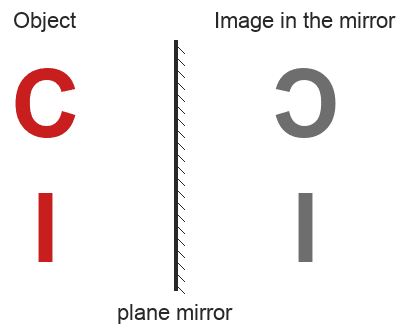
Therefore, C is seen as Ɔ (reversed left to right) and I is seen as I (unchanged).
- 452 marks
Question 45
What is irregular reflection ? Give an example.
Solve with AIWritten solution
Solution:
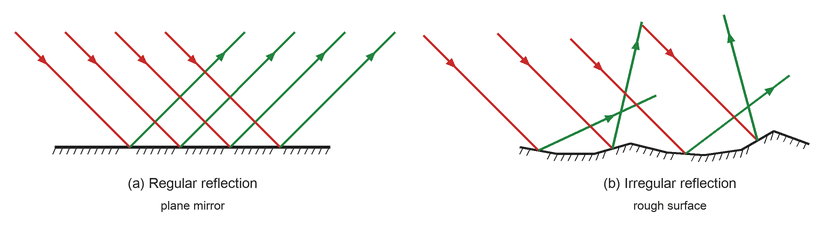
Concept: In regular reflection a smooth, polished surface such as a plane mirror reflects a parallel beam of light as a parallel beam. In irregular (diffused) reflection a rough surface reflects a parallel beam in many directions. Each ray still obeys the laws of reflection, but the tiny parts of a rough surface face in different directions.
Step 1 — Define the term.
Irregular (diffused) reflection is the reflection of light from a rough, uneven surface in which different parts of the surface reflect light in different directions.
Step 2 — Explain why the rays spread.
When a parallel beam falls on a rough surface, the reflected rays are not parallel. Each ray still obeys the laws of reflection, but the tiny parts of the surface face in different directions, so their normals point different ways. Figure (b) shows this; figure (a) shows regular reflection at a plane mirror for comparison.
Step 3 — Give an example.
Reflection of light from a wall, a sheet of paper or a wooden table is irregular reflection.
Therefore, irregular reflection is reflection from a rough surface that sends a parallel beam off in different directions; for example, reflection from a wall.
- 462 marks
Question 46
How do we see objects around us ?
Solve with AIWritten solution
Solution:
Concept: In regular reflection a smooth, polished surface such as a plane mirror reflects a parallel beam of light as a parallel beam. In irregular (diffused) reflection a rough surface reflects a parallel beam in many directions. Each ray still obeys the laws of reflection, but the tiny parts of a rough surface face in different directions.
Step 1 — Follow the light from an object.
When light falls on an object, its uneven surface reflects the light in all directions. This is irregular (diffused) reflection.
Step 2 — See how it reaches us.
Some of this reflected light enters our eyes, and so we see the object. As the light goes out in all directions, we can see the object from any position.
Step 3 — Check with darkness.
In the dark no light falls on the object, so nothing is reflected and we cannot see it.
Therefore, we see objects because light reflected irregularly from them reaches our eyes.
- 472 marks
Question 47
State two uses of a plane mirror.
Solve with AIWritten solution
Solution:
Concept: The image formed by a plane mirror is virtual (it cannot be obtained on a screen), upright (erect), of the same size as the object and laterally inverted (its left and right sides are interchanged). It is formed as far behind the mirror as the object is in front of it.
Step 1 — First use.
A plane mirror is used as a looking glass (dressing mirror) to see ourselves, because it gives an upright image of the same size.
Step 2 — Second use.
Plane mirrors are used as reflectors in periscopes, kaleidoscopes and solar cookers.
Step 3 — More uses.
They are also used in a barber's shop to see the back of the head, in an optician's room to double the effective length of the room, and as the rear view mirror inside a car.
Therefore, two uses of a plane mirror are as a looking glass and in periscopes.
- 482 marks
Question 48
Can light travel in vacuum ?
Solve with AIWritten solution
Solution:
Concept: Light travels fastest in vacuum, at about , and its speed in air is almost the same. It is slower in transparent media: about in water and in glass.
Step 1 — Answer the question.
Yes, light can travel in vacuum. It does not need any medium.
Step 2 — Give the evidence.
Light from the sun and the stars reaches us through empty space, where there is no air. In vacuum light travels fastest, at about .
Therefore, yes, light can travel in vacuum.
- 492 marks
Question 49
State the speed of light in (a) air, (b) glass.
Solve with AIWritten solution
Solution:
Concept: Light travels fastest in vacuum, at about , and its speed in air is almost the same. It is slower in transparent media: about in water and in glass.
Step 1 — (a) Speed in air.
Light travels at about in air, almost the same as in vacuum.
Step 2 — (b) Speed in glass.
Light travels more slowly in glass, at about .
Medium Speed of light (m s⁻¹) Air (or vacuum) Water Glass Therefore, the speed of light is about 3 × 10⁸ m s⁻¹ in air and 2 × 10⁸ m s⁻¹ in glass.
- 503 marks
Question 50
State whether light slows down or speeds up in the following cases :
(a) Light going from air to glass.
(b) Light going from glass to water.
(c) Light going from water to air.
Solve with AIWritten solution
Solution:
Concept: Light travels fastest in vacuum, at about , and its speed in air is almost the same. It is slower in transparent media: about in water and in glass.
Step 1 — Collect the speeds.
We compare the speed of light in the two media in each case, using the table below.
Medium Speed of light (m s⁻¹) Air (or vacuum) Water Glass Step 2 — (a) Air to glass.
The speed changes from to . It falls, so light slows down.
Step 3 — (b) Glass to water.
The speed changes from to . It rises, so light speeds up.
Step 4 — (c) Water to air.
The speed changes from to . It rises, so light speeds up.
Therefore, (a) slows down, (b) speeds up, (c) speeds up.
- 512 marks
Question 51
What are primary colours ? Name the three primary colours.
Solve with AIWritten solution
Solution:
Concept: The primary colours of light are red, green and blue. Mixed together they give white light, and none of them can be made by mixing other colours of light. Mixing two primary colours gives a secondary colour: red and green give yellow, green and blue give cyan, and blue and red give magenta.
Step 1 — Define primary colours.
Primary colours are the colours of light which, mixed together, give white light, but which cannot themselves be made by mixing light of any other colours.
Step 2 — Name them.
The three primary colours are red, green and blue. Red, green and blue lights falling on the same part of a white screen make it look white.
Therefore, primary colours cannot be made from other colours and together give white; they are red, green and blue.
- 522 marks
Question 52
What are secondary colours ? Name the three secondary colours.
Solve with AIWritten solution
Solution:
Concept: The primary colours of light are red, green and blue. Mixed together they give white light, and none of them can be made by mixing other colours of light. Mixing two primary colours gives a secondary colour: red and green give yellow, green and blue give cyan, and blue and red give magenta.
Step 1 — Define secondary colours.
Secondary colours are the colours of light obtained by mixing any two primary colours.
Step 2 — Name them.
The table shows the three secondary colours and how each is made.
Secondary colour Made by mixing Yellow red and green Cyan (peacock blue) green and blue Magenta (purple) blue and red Therefore, secondary colours are made by mixing two primary colours; they are yellow, cyan and magenta.
- 533 marks
Question 53
Fill in the blanks with the appropriate colour :
(a) Blue + ........ = Cyan
(b) Red + Blue + ........ = White
(c) Red + Blue = ........
(d) Green + Red = ........
Solve with AIWritten solution
Solution:
Concept: The primary colours of light are red, green and blue. Mixed together they give white light, and none of them can be made by mixing other colours of light. Mixing two primary colours gives a secondary colour: red and green give yellow, green and blue give cyan, and blue and red give magenta.
Step 1 — (a) Blue + …… = Cyan.
Cyan is made from green and blue, so the missing colour is green.
Step 2 — (b) Red + Blue + …… = White.
White needs all three primary colours. Red and blue are given, so the missing colour is green.
Step 3 — (c) Red + Blue = …….
Blue and red together give magenta.
Step 4 — (d) Green + Red = …….
Red and green together give yellow.
Therefore, (a) green, (b) green, (c) magenta, (d) yellow.
- 544 marks
Question 54
Explain the following terms :
Incident ray, Reflected ray, Angle of incidence, Angle of reflection, Normal.
Solve with AIWritten solution
Solution:
Concept: There are two laws of reflection. First, the angle of incidence is equal to the angle of reflection, . Second, the incident ray, the reflected ray and the normal at the point of incidence all lie in the same plane. Both angles are measured from the normal, the line drawn perpendicular to the mirror at the point of incidence, and never from the mirror surface.
Step 1 — Set up the figure.
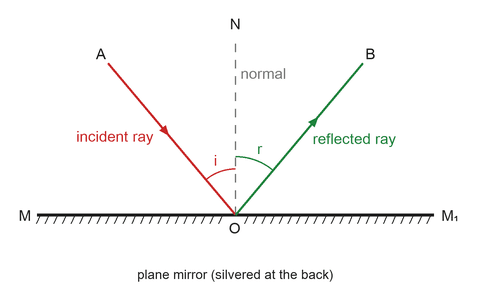
In the figure, MM₁ is a plane mirror, AO is a ray falling on it at the point O, ON is the normal at O and OB is the ray coming back.
Step 2 — Incident ray.
The ray of light that strikes the reflecting surface is called the incident ray (AO).
Step 3 — Reflected ray.
The ray of light that is returned into the same medium after striking the surface is called the reflected ray (OB).
Step 4 — Normal.
The line drawn perpendicular to the surface at the point of incidence is called the normal (ON). It makes 90° with the mirror.
Step 5 — Angle of incidence.
The angle between the incident ray and the normal is the angle of incidence, written . Here .
Step 6 — Angle of reflection.
The angle between the reflected ray and the normal is the angle of reflection, written . Here .
Watch out: Both angles are measured from the normal, not from the mirror surface.
Therefore, the incident ray strikes the surface, the reflected ray comes back, the normal is perpendicular to the surface at the point of incidence, and i and r are the angles the two rays make with the normal.
- 553 marks
Question 55
Draw a diagram showing the reflection of a light ray from a plane mirror. Label on it the incident ray, the reflected ray, the normal, the angle of incidence i and the angle of reflection r.
Solve with AIWritten solution
Solution:
Concept: There are two laws of reflection. First, the angle of incidence is equal to the angle of reflection, . Second, the incident ray, the reflected ray and the normal at the point of incidence all lie in the same plane. Both angles are measured from the normal, the line drawn perpendicular to the mirror at the point of incidence, and never from the mirror surface.
Step 1 — Draw the mirror and the normal.
Draw a straight line MM₁ for the mirror and shade its back (silvered) side. Mark the point of incidence O and draw the normal ON perpendicular to MM₁ as a dotted line.
Step 2 — Draw the incident ray.
Draw the incident ray AO with an arrow pointing towards O. Measure with a protractor; this is the angle of incidence .
Step 3 — Draw the reflected ray.
On the other side of ON, draw OB so that , with an arrow pointing away from O. This is the reflected ray, and is the angle of reflection .
Step 4 — Label the diagram.
Label the incident ray, the reflected ray, the normal, and , as in the figure. Each angle has its own arc between its ray and the normal.
Therefore, the diagram shows the incident ray AO, the normal ON, the reflected ray OB, and the equal angles i and r.
- 564 marks
Question 56
Describe an experiment to verify the laws of reflection of light.
Solve with AIWritten solution
Solution:
Concept: There are two laws of reflection. First, the angle of incidence is equal to the angle of reflection, . Second, the incident ray, the reflected ray and the normal at the point of incidence all lie in the same plane. Both angles are measured from the normal, the line drawn perpendicular to the mirror at the point of incidence, and never from the mirror surface.
Step 1 — Collect the apparatus.
A drawing board, a white sheet of paper, drawing pins, a small plane mirror, plasticine, four pins, a protractor and a ruler.
Step 2 — Draw the lines.
Fix the paper on the board and draw a straight line MM₁ on it. Mark a point O near the middle of MM₁. Draw the normal ON at O, and a line AO that makes an angle with ON (this will be the incident ray).
Step 3 — Place the mirror.
Stand the mirror upright on the paper with plasticine, its reflecting surface along MM₁.
Step 4 — Fix the pins on the incident ray.
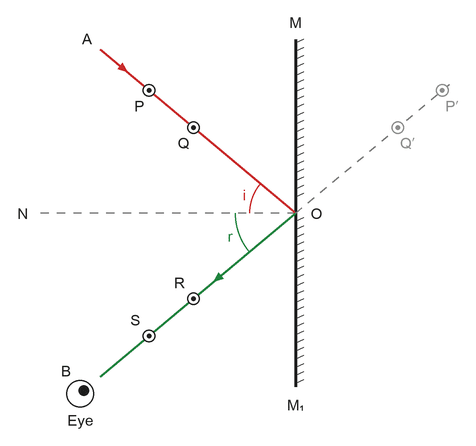
Fix two pins P and Q upright on the line AO, a few centimetres apart.
Step 5 — Fix the pins on the reflected ray.
Look into the mirror from the other side of ON and find the images P′ and Q′ of the pins. Fix two more pins R and S so that R, S, Q′ and P′ all appear in one straight line.
Step 6 — Draw the reflected ray.
Remove the mirror and the pins, and ring the pin marks. Join R and S and extend the line to meet MM₁ at O. Then AO is the incident ray, OB (through R and S) is the reflected ray and ON is the normal.
Step 7 — Measure and conclude.
Measure and with the protractor. They are found to be equal, , which verifies the first law. AO, ON and OB all lie on the paper, that is in one plane, which verifies the second law.
Step 8 — Repeat.
Repeat the experiment for other angles of incidence; each time the two angles come out equal.
Watch out: The pins must stand upright, and R and S must line up with the images P′ and Q′, not with the pins P and Q themselves.
Therefore, the experiment shows that i = r and that the incident ray, the normal and the reflected ray lie in one plane, verifying both laws of reflection.
- 573 marks
Question 57
Draw a diagram to show the reflection of a light ray incident normally on a plane mirror.
Solve with AIWritten solution
Solution:
Concept: There are two laws of reflection. First, the angle of incidence is equal to the angle of reflection, . Second, the incident ray, the reflected ray and the normal at the point of incidence all lie in the same plane. Both angles are measured from the normal, the line drawn perpendicular to the mirror at the point of incidence, and never from the mirror surface.
Step 1 — Draw the ray along the normal.
Draw the mirror MM₁ and the ray AO falling on it at O at 90° to the mirror. This ray lies along the normal.
Step 2 — Find the angles.
The angle of incidence is measured from the normal, so . By the first law, too.
Step 3 — Draw the reflected ray.
The reflected ray goes back along OA, the same line, with its arrow pointing away from the mirror.
Therefore, a ray incident normally on a plane mirror is reflected back along its own path, with both angles 0°.
- 584 marks
Question 58
The diagram in Fig 4.18 shows an incident ray AO and the reflected ray OB from a plane mirror. The angle AOB is 30°. Draw normal on the plane mirror at the point O and find :
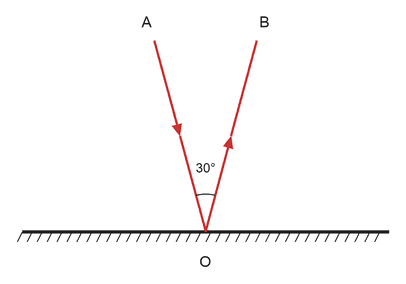
(a) the angle of incidence
(b) the angle of reflection
Solve with AIWritten solution
Solution:
Concept: There are two laws of reflection. First, the angle of incidence is equal to the angle of reflection, . Second, the incident ray, the reflected ray and the normal at the point of incidence all lie in the same plane. Both angles are measured from the normal, the line drawn perpendicular to the mirror at the point of incidence, and never from the mirror surface.
Step 1 — Draw the normal.
Draw the normal ON at O, perpendicular to the mirror. It lies between AO and OB and splits into and .
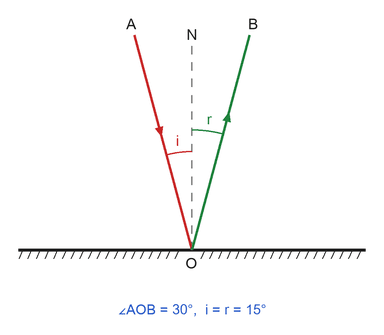
Step 2 — Write the sum of the angles.
The two parts together make up the given angle.
Step 3 — Use the first law.
By the first law of reflection , so the angle is shared equally.
Step 4 — Find the angle of reflection.
The angle of reflection equals the angle of incidence.
Watch out: 30° is the angle between the two rays; each of i and r is half of it.
Therefore, (a) the angle of incidence is 15° and (b) the angle of reflection is 15°.
- 594 marks
Question 59
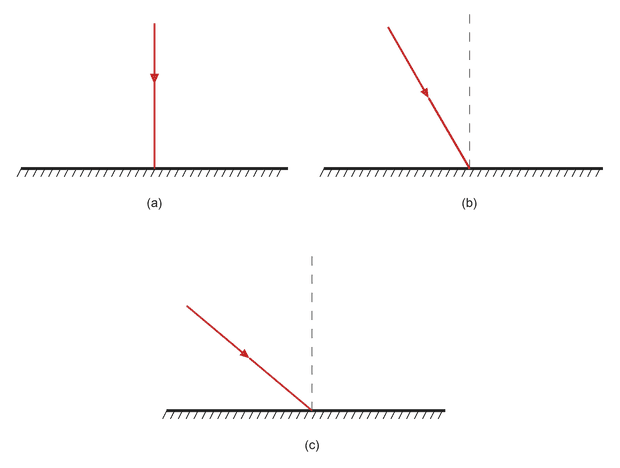
In the following diagrams (Fig 4.19), measure and write the angle of incidence and draw the reflected ray in each case.
 Solve with AI
Written solution
Solution:
Concept: There are two laws of reflection. First, the angle of incidence is equal to the angle of reflection, . Second, the incident ray, the reflected ray and the normal at the point of incidence all lie in the same plane. Both angles are measured from the normal, the line drawn perpendicular to the mirror at the point of incidence, and never from the mirror surface.
Step 1 — Measure each angle from the normal.
In each part, place the protractor at the point of incidence and measure the angle between the incident ray and the normal (the dotted line).
Step 2 — (a).
The ray falls along the normal (at 90° to the mirror), so .
The angle of reflection is then 0° as well, and the reflected ray goes back up along the same path.
Step 3 — (b).
The incident ray makes 30° with the normal, so the angle of incidence is 30°. Draw the reflected ray on the other side of the normal, making 30° with it.
Step 4 — (c).
The incident ray makes 50° with the normal, so the angle of incidence is 50°. Draw the reflected ray on the other side of the normal, making 50° with it.
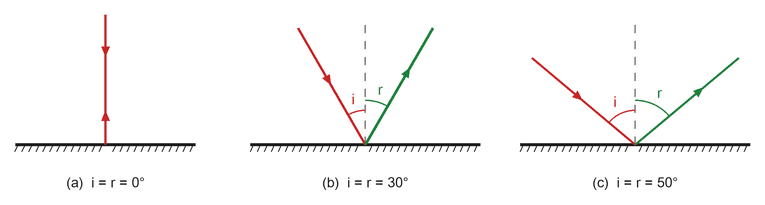
Note: the angles in (b) and (c) are read with a protractor from the figure (30.0° and 50.1° when measured); a reading within a degree or two is acceptable.
Therefore, (a) i = 0°, (b) i = 30°, (c) i = 50°, with each reflected ray drawn at r = i on the other side of the normal.
- 604 marks
Question 60
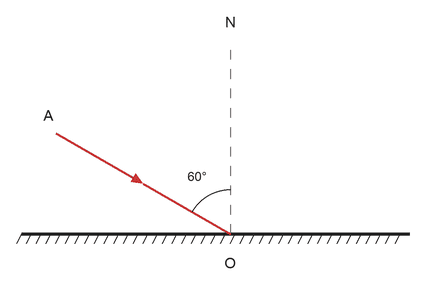
The diagram in Fig 4.20 shows an incident ray AO and the normal ON on a plane mirror. Draw the reflected ray. State the law you use to draw the direction of the reflected ray.
 Solve with AI
Written solution
Solution:
Concept: There are two laws of reflection. First, the angle of incidence is equal to the angle of reflection, . Second, the incident ray, the reflected ray and the normal at the point of incidence all lie in the same plane. Both angles are measured from the normal, the line drawn perpendicular to the mirror at the point of incidence, and never from the mirror surface.
Step 1 — Read the angle of incidence.
The figure shows the incident ray AO making 60° with the normal ON, so the angle of incidence is 60°.
Step 2 — Find the angle of reflection.
By the first law of reflection the angle of reflection equals the angle of incidence.
Step 3 — Draw the reflected ray.
Draw OB on the other side of ON so that , in the plane of the paper (the plane of AO and ON), as the second law requires.
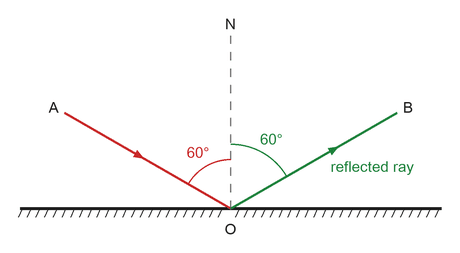
Therefore, the reflected ray OB makes 60° with the normal, drawn using the law that the angle of incidence equals the angle of reflection.
- 613 marks
Question 61
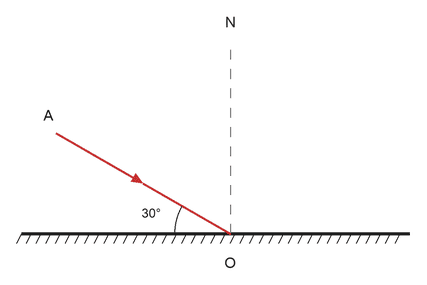
The following diagram (Fig 4.21) shows an incident ray AO and the normal ON on a plane mirror. Find the angle of incidence and angle of reflection.
 Solve with AI
Written solution
Solution:
Concept: There are two laws of reflection. First, the angle of incidence is equal to the angle of reflection, . Second, the incident ray, the reflected ray and the normal at the point of incidence all lie in the same plane. Both angles are measured from the normal, the line drawn perpendicular to the mirror at the point of incidence, and never from the mirror surface.
Step 1 — Notice which angle is given.
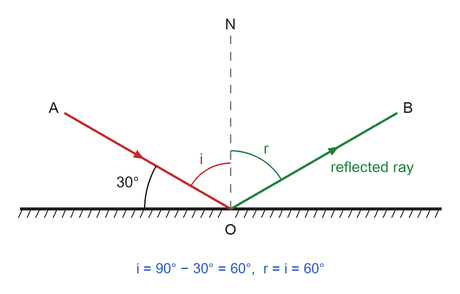
The 30° in the figure is between the incident ray AO and the mirror surface, not between AO and the normal.
Step 2 — Find the angle of incidence.
The normal ON makes 90° with the mirror, so the angle of incidence is what is left of 90°.
Step 3 — Find the angle of reflection.
By the first law of reflection the angle of reflection equals the angle of incidence.
Watch out: Do not take 30° as the angle of incidence; angles are always measured from the normal.
Therefore, the angle of incidence is 60° and the angle of reflection is 60°.
- 623 marks
Question 62
State in words, how do you find the location of image of an object formed by a plane mirror.
Solve with AIWritten solution
Solution:
Concept: Every ray from a point object is reflected with . The reflected rays spread out, but when they are produced backwards behind the mirror they all meet at one point, the image. The eye sees the object at that point. The rays only appear to come from it, so the image is virtual.
Step 1 — Take two rays.
From the point object O, draw at least two rays falling on the mirror at two different points. (The ray falling normally on the mirror can be one of them.)
Step 2 — Reflect each ray.
At each point of incidence draw the normal, and draw the reflected ray so that the angle of reflection equals the angle of incidence.
Step 3 — Produce the reflected rays backwards.
The reflected rays spread out in front of the mirror, so extend them backwards behind the mirror as dotted lines.
Step 4 — Mark the image.
The point where these dotted lines meet is the image I. The reflected rays entering the eye appear to come from this point. On measuring, I is found to be as far behind the mirror as O is in front of it, on the perpendicular from O to the mirror.
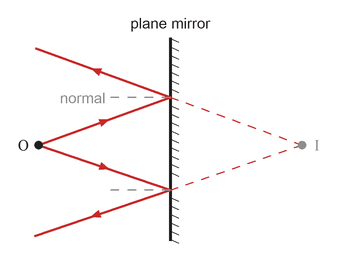
Therefore, the image is located where the reflected rays, produced backwards, meet behind the mirror; it is a virtual image as far behind the mirror as the object is in front.
- 633 marks
Question 63
Draw a ray diagram showing the formation of image of a point object by a plane mirror.
Solve with AIWritten solution
Solution:
Concept: Every ray from a point object is reflected with . The reflected rays spread out, but when they are produced backwards behind the mirror they all meet at one point, the image. The eye sees the object at that point. The rays only appear to come from it, so the image is virtual.
Step 1 — Draw two rays from the object.
O is a point object in front of the plane mirror MM₁. Draw two rays OA and OB from O to the mirror.
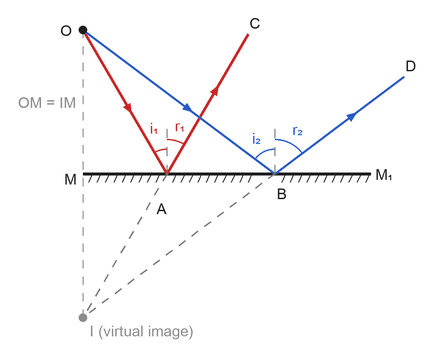
Step 2 — Reflect them.
At A and at B draw the normals, and draw the reflected rays AC and BD so that and .
Step 3 — Find the image.
Produce AC and BD backwards behind the mirror (dotted lines). They meet at the point I. The reflected rays appear to come from I, so I is the virtual image of O.
Step 4 — Check its position.
I lies on the perpendicular OM drawn from O to the mirror and produced, with OM = IM: the image is as far behind the mirror as the object is in front of it.
Therefore, the reflected rays AC and BD, produced backwards, meet at I, the virtual image of O, with OM = IM.
- 644 marks
Question 64
The following diagram (Fig. 4.22) shows a point object O placed in front of a plane mirror. Take two rays from the point O and show how the image of O is formed and seen by the eye.
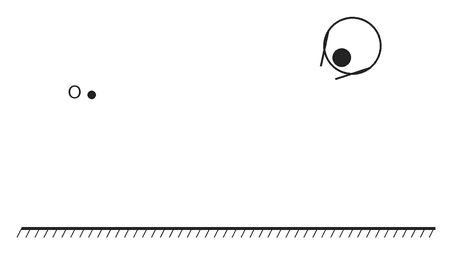 Solve with AI
Written solution
Solution:
Concept: Every ray from a point object is reflected with . The reflected rays spread out, but when they are produced backwards behind the mirror they all meet at one point, the image. The eye sees the object at that point. The rays only appear to come from it, so the image is virtual.
Step 1 — Draw two rays towards the eye.
From O draw two rays OA and OB to the mirror, choosing A and B so that the reflected rays will go towards the eye.
Step 2 — Reflect them.
At A and at B draw the normal and the reflected ray, with the angle of reflection equal to the angle of incidence. Both reflected rays enter the eye. (The normals are left out of the figure to keep it clear.)
Step 3 — Produce the reflected rays backwards.
Extend the two reflected rays behind the mirror as dotted lines. They meet at the point I.
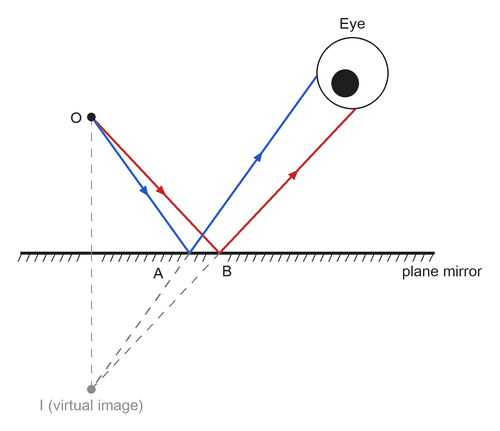
Step 4 — Explain what the eye sees.
The eye receives the reflected rays as if they came from I, so it sees the image of O at I. No light really reaches I, so the image is virtual. It lies on the perpendicular from O to the mirror, as far behind the mirror as O is in front of it.
Therefore, the eye sees the image of O at I, the point behind the mirror from which the reflected rays appear to come.
- 653 marks
Question 65
State four characteristics of the image formed by a plane mirror.
Solve with AIWritten solution
Solution:
Concept: The image formed by a plane mirror is virtual (it cannot be obtained on a screen), upright (erect), of the same size as the object and laterally inverted (its left and right sides are interchanged). It is formed as far behind the mirror as the object is in front of it.
Step 1 — Characteristic 1.
The image is upright (erect); it is not turned upside down.
Step 2 — Characteristic 2.
The image is virtual: it cannot be obtained on a screen.
Step 3 — Characteristic 3.
The image is of the same size as the object.
Step 4 — Characteristic 4.
The image is as far behind the mirror as the object is in front of it.
Step 5 — One more (for extra marks).
The image is laterally inverted: its left and right sides are interchanged.
Therefore, the image is upright, virtual, of the same size as the object, and as far behind the mirror as the object is in front (it is also laterally inverted).
- 664 marks
Question 66
What is meant by lateral inversion of an image in a plane mirror ? Explain it with the help of a diagram.
Solve with AIWritten solution
Solution:
Concept: Lateral inversion is the interchange of the left and right sides of an object in its image formed by a plane mirror.
Step 1 — Define the term.
Lateral inversion is the interchange of the left and right sides of an object in its image formed by a plane mirror.
Step 2 — Explain with an everyday example.
If you stand in front of a plane mirror holding a pen in your right hand, your image seems to hold the pen in its left hand.
Step 3 — Explain with the diagram.
In the figure the letter P stands in front of a plane mirror. R is a point on the bowl of the P (nearer the mirror) and L is a point on its stem. Rays from R and L are reflected into the eye, and produced backwards they meet at R′ and L′, each as far behind the mirror as R and L are in front. So in the image the bowl is on the other side of the stem: the P is reversed left to right.
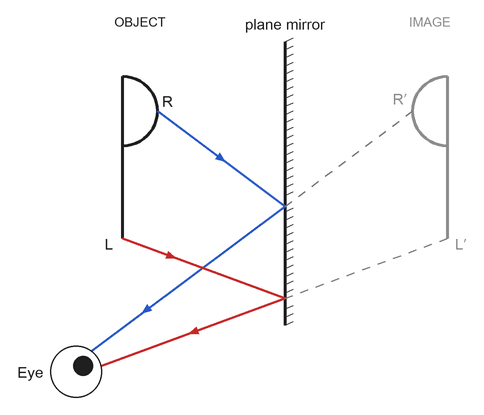
Step 4 — Give more examples.
The letter F looks reversed in a mirror. The word AMBULANCE is painted laterally inverted on the front of an ambulance, so that a driver ahead reads it correctly in the rear view mirror. Letters such as A, H, I, M, O, T, U, V, W, X and Y look the same, because they are symmetrical about a vertical line through their middle.
Therefore, lateral inversion is the interchange of left and right in the image formed by a plane mirror, as the reversed letter P in the figure shows.
- 672 marks
Question 67
The leaves appear green when seen in white light. Give a reason.
Solve with AIWritten solution
Solution:
Concept: An opaque object reflects the light of its own colour and absorbs the light of the other colours, so its colour is the colour of the light it reflects. A white object reflects light of all the colours. A black object absorbs light of all the colours and reflects none.
Step 1 — Look at the light falling on the leaves.
White light contains light of all the colours.
Step 2 — Say what the leaves do.
The leaves reflect only the green light and absorb the light of all the other colours.
Step 3 — Say what we see.
Only the reflected green light reaches our eyes, so the leaves appear green.
Therefore, leaves appear green in white light because they reflect only green light and absorb the rest.
- 683 marks
Question 68
A rose appears red in white light. How will it appear in (i) green light, (ii) red light ? Give a reason for each of your answers.
Solve with AIWritten solution
Solution:
Concept: An opaque object reflects the light of its own colour and absorbs the light of the other colours, so its colour is the colour of the light it reflects. A white object reflects light of all the colours. A black object absorbs light of all the colours and reflects none.
Step 1 — Recall why the rose is red.
A red rose reflects only the red part of white light and absorbs the rest.
Step 2 — (i) In green light.
Green light has no red in it. The rose absorbs the green light and reflects nothing, so no light comes from it to our eyes and it appears black.
Step 3 — (ii) In red light.
The rose reflects the red light falling on it, so red light reaches our eyes and it appears red.
Watch out: An object can only reflect a colour that is present in the light falling on it.
Therefore, the rose appears (i) black in green light and (ii) red in red light.
- 693 marks
Question 69
Why does a piece of paper appear white in sunlight ? How would you expect it to appear when viewed in red light ?
Solve with AIWritten solution
Solution:
Concept: An opaque object reflects the light of its own colour and absorbs the light of the other colours, so its colour is the colour of the light it reflects. A white object reflects light of all the colours. A black object absorbs light of all the colours and reflects none.
Step 1 — In sunlight.
Sunlight is white light, a mixture of all the colours. White paper reflects the light of all the colours falling on it. All these colours reach our eyes together, so the paper appears white.
Step 2 — In red light.
Only red light falls on the paper, and the paper reflects it. So only red light reaches our eyes, and the paper appears red.
Therefore, white paper appears white in sunlight because it reflects all colours, and it appears red in red light.
- 702 marks
Question 70
A piece of paper appears black in sunlight. What will be its colour when seen in red light?
Solve with AIWritten solution
Solution:
Concept: An opaque object reflects the light of its own colour and absorbs the light of the other colours, so its colour is the colour of the light it reflects. A white object reflects light of all the colours. A black object absorbs light of all the colours and reflects none.
Step 1 — Explain the black colour in sunlight.
The paper appears black in sunlight because it absorbs the light of all the colours and reflects none.
Step 2 — Apply this to red light.
In red light the paper absorbs the red light too and reflects nothing. No light comes from it to our eyes, so it still appears black.
Therefore, the paper will still appear black in red light.
What Class 7 Physics Ch 4 covers
The sections of the chapter, in the order the book takes them. Every question above comes from one of these.
- 01Reflection of Light
- 02Some Terms Related to Reflection of Light
- 03Laws of Reflection of Light
- 04Formation of Image by a Plane Mirror
- 05Characteristics of the Image Formed by a Plane Mirror
- 06Regular and Irregular (or Diffused) Reflection
More ways to study this chapter
The same chapter asked three other ways. Practise it, revise it, and see what the board has set on Ch 4 before.
Class 7 Physics Ch 4 questions students ask
How many questions are there in Class 7 Physics Ch 4?
70 questions. Every one is solved step by step on this page.
Are these Class 7 Physics solutions free?
Yes. Every question and its full working is free to read, with no account needed.
Can I download the Class 7 Physics Ch 4 solutions as a PDF?
There is no PDF to download. Every solution is on this page instead, which means it is searchable, always the current syllabus, and readable on a phone. Use your browser's print option if you want it on paper.