
Question 644 marksEasy
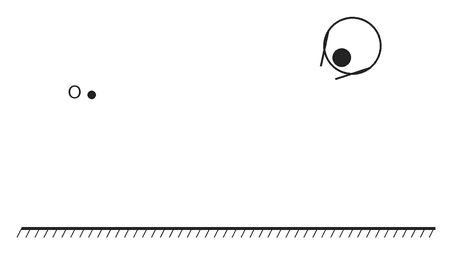
The following diagram (Fig. 4.22) shows a point object O placed in front of a plane mirror. Take two rays from the point O and show how the image of O is formed and seen by the eye.
Confirming your payment
Sign up now and get 250 free tokens.
Light Energy · Question 64 of 70
The following diagram (Fig. 4.22) shows a point object O placed in front of a plane mirror. Take two rays from the point O and show how the image of O is formed and seen by the eye.
Solution:
Concept: Every ray from a point object is reflected with . The reflected rays spread out, but when they are produced backwards behind the mirror they all meet at one point, the image. The eye sees the object at that point. The rays only appear to come from it, so the image is virtual.
Step 1 — Draw two rays towards the eye.
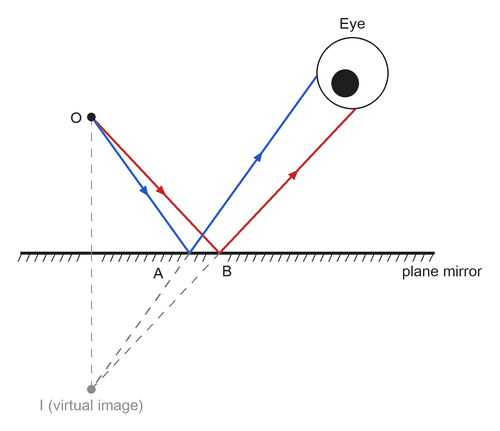
From O draw two rays OA and OB to the mirror, choosing A and B so that the reflected rays will go towards the eye.
Step 2 — Reflect them.
At A and at B draw the normal and the reflected ray, with the angle of reflection equal to the angle of incidence. Both reflected rays enter the eye. (The normals are left out of the figure to keep it clear.)
Step 3 — Produce the reflected rays backwards.
Extend the two reflected rays behind the mirror as dotted lines. They meet at the point I.
Step 4 — Explain what the eye sees.
The eye receives the reflected rays as if they came from I, so it sees the image of O at I. No light really reaches I, so the image is virtual. It lies on the perpendicular from O to the mirror, as far behind the mirror as O is in front of it.
Therefore, the eye sees the image of O at I, the point behind the mirror from which the reflected rays appear to come.