
Opening your dashboard
Class 7 Physics Chapter 4 Light Energy: Competency-Based Questions (CBQ)
40 questions on Chapter 4, each worked through on its own page with the AI tutor. Class 7 Physics, ICSE 2026-27.
40 questions
1–5 marks · Mixed difficulty
- 11 mark
Question 1
Competency: Application
Arjun is getting his hair cut. A wall clock hangs on the wall behind him, and he sees its image in the plane mirror in front of him. The dial of the clock has marks but no numbers. The image that Arjun sees is shown.

What is the actual time shown by the clock ?
- 21 mark
Question 2
Competency: Application
An underwater lamp in a swimming pool gives out a flash of light. In the time this flash travels 9 m through the water, how far would a flash of light travel through air ?
(Speed of light in air = m s, speed of light in water = m s.)
- 31 mark
Question 3
Competency: Application
Riya stands 2 m in front of a large plane mirror fixed on a wall. On a high shelf behind her, 3 m from the mirror, there is a flower vase. Looking into the mirror, Riya sees the image of the vase above the image of her own head.
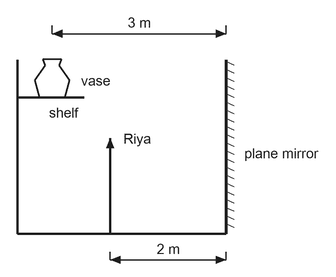
How far from Riya is this image of the vase ? (All distances are measured along the line at right angles to the mirror.)
- 41 mark
Question 4
Competency: Analysis
In a dark room, Zoya looks at three cards X, Y and Z, first in red light, then in green light and then in blue light. The colour that each card appears to have is given in the table below.
Card In red light In green light In blue light X red green blue Y black green black Z black black black What are the colours of the three cards when they are seen in sunlight ?
- 51 mark
Question 5
Competency: Analysis
Assertion (A): Light takes less time to pass through 1 m of water than through 1 m of glass.
Reason (R): Light travels slower in water than in air.
- 61 mark
Question 6
Competency: Understanding
Assertion (A): We can see our face in a polished steel plate, but not in a sheet of white paper.
Reason (R): White paper absorbs most of the light that falls on it.
- 72 marks
Question 7
Competency: Analysis & Evaluation
A ray of light AO falls on a plane mirror MM₁ at the point O, as shown. The angle between the ray and the mirror is 30°.
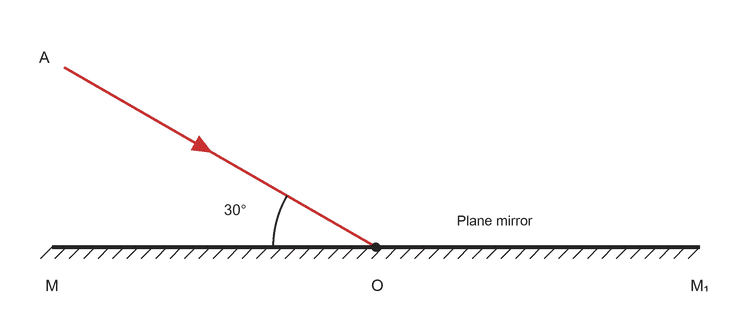
Kabir says, "The angle of incidence is 30°, so the reflected ray will also make an angle of 30° with the normal."
(a) Is Kabir right ? Give the correct angle of incidence and angle of reflection.
(b) Find the angle between the incident ray and the reflected ray.
- 82 marks
Question 8
Competency: Understanding & Application
A small jewellery shop is 4 m wide. The owner covers the whole of one side wall with a plane mirror.
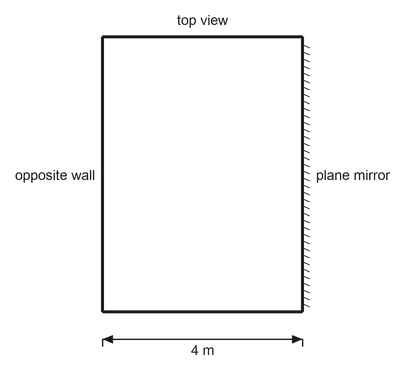
A customer who walks in feels that the shop is twice as wide as it really is.
(a) Explain why the shop looks wider.
(b) How far behind the mirror does the image of the opposite wall appear ? How wide does the shop appear to be ?
- 92 marks
Question 9
Competency: Application
For a science exhibition, Aman covers three torches with red, green and blue transparent sheets, one colour on each. In a dark room he shines them on a white wall so that the three round patches of light partly overlap.
(a) What colour is seen where all three patches overlap ? Why ?
(b) The cells of the green torch run down and it goes off. What colour is now seen where the other two patches overlap ? Is it a primary colour or a secondary colour ?
- 102 marks
Question 10
Competency: Analysis
Meher finds an old plane mirror. At its back, the paint and the silvering have come off in a small patch. She holds the mirror up and looks at this patch from the front. She can see the wall behind the mirror through the patch, and her face is seen in the patch only very faintly. Everywhere else, the mirror shows her face clearly.
(a) Why can Meher see the wall through the patch ?
(b) What does this observation show about the part of a mirror that reflects most of the light ?
- 114 marks
Question 11
Competency: Application & Analysis
Case study: Tara places a small lamp O in front of a plane mirror and looks at the mirror from the position E. She draws a top view of the arrangement on squared paper, as shown. Each square has a side of 10 cm. P, Q, R and S are four marks on the mirror.
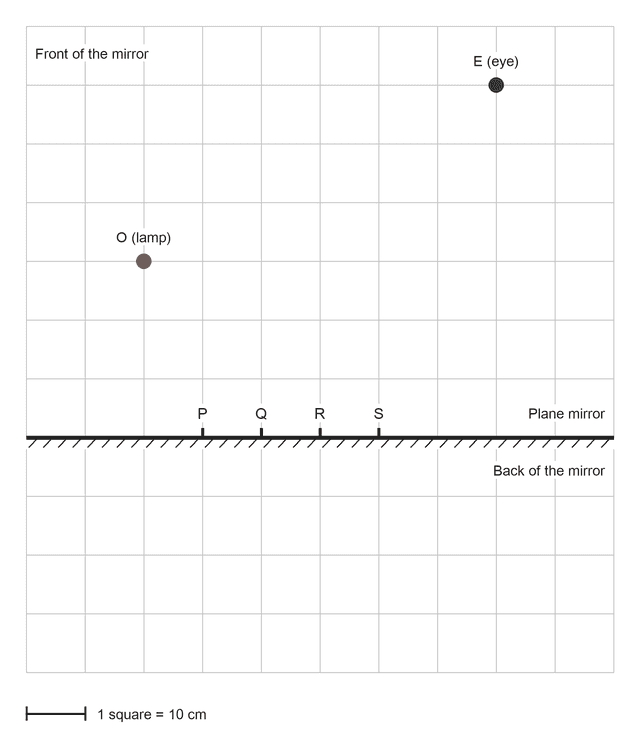
(a) How far behind the mirror is the image of the lamp formed ? Describe the position of the image on the squared paper.
(b) What is the distance between the lamp and its image ?
(c) Tara's eye at E sees the image of the lamp in the mirror. At which of the marks P, Q, R or S is the light that reaches E reflected ? Show, by counting squares, that the law of reflection holds at that mark.
- 124 marks
Question 12
Competency: Analysis & Evaluation
Case study: Neil and Sana verify the laws of reflection using a strip of plane mirror, pins and a protractor on a sheet of paper. For each incident ray they draw the normal, trace the reflected ray and measure the two angles. Their readings are given in the table below.
Reading 1 2 3 4 Angle of incidence 20° 35° 50° 65° Angle of reflection 20° 36° 50° 25° (a) Which law of reflection do readings 1 and 3 support ?
(b) In reading 2 the two angles differ by 1°. Sana says, "This shows that the law is not exact." Do you agree ? Give a reason.
(c) Reading 4 is clearly wrong. What should the angle of reflection have been ? Suggest the mistake that most probably gave 25°, and support your suggestion with a calculation.
- 133 marks
Question 13
Competency: Application & Evaluation
Case study: A telephone company sends messages as flashes of light through a thin fibre of glass. One such cable, 600 km long, joins two cities. The speed of light in three media is given in the table below.
Medium Speed of light (in m s) Air Water Glass (a) A flash of light passes from air into the glass fibre. Does it speed up or slow down ? What fraction of its speed in air does it have in glass ?
(b) Take the path of the light inside the fibre to be 600 km long. Find the time a flash takes to go from one city to the other.
(c) An engineer says, "If the same flash could travel 600 km straight through air, it would arrive 0.001 s earlier." Check this claim by calculation.
- 144 marks
Question 14
Competency: Analysis
Case study: For a science fair, Dev makes a "colour box". Inside it, a red lamp, a green lamp and a blue lamp, each with its own switch, shine on the same spot of a white screen. He notes the colour of the spot for different positions of the switches in the table below.
Trial Red lamp Green lamp Blue lamp Colour of the spot 1 ON ON OFF yellow 2 OFF ON ON ........ 3 ON OFF ON ........ 4 ON ON ON ........ (a) Write the colour of the spot in trials 2, 3 and 4.
(b) Which of the colours seen in the four trials are secondary colours ? In trial 4, which one lamp should Dev switch off to change the spot to cyan ?
(c) Dev now pastes a small red paper star on the screen at the spot and repeats the four trials. In which trials does the star look red, and in which does it look black ? Give a reason.
- 154 marks
Question 15
Competency: Creation
Sara wants to find out which of these surfaces give regular reflection and which give irregular (diffused) reflection : a plane mirror, a polished steel plate, a smooth sheet of aluminium foil, the same foil after it has been crumpled and opened out, and a sheet of white chart paper.
She has a torch, a piece of black card with a narrow slit cut in it, and a dark room with a white wall. Design the investigation for her.
(a) Describe the set-up and what she should do with each surface.
(b) State two things that she must keep the same for every surface, so that the test is fair.
(c) Draw the observation table she should use, and fill in the result you expect for each surface.
(d) What conclusion should she expect about the kind of surface that gives regular reflection ?
- 161 mark
Question 16
Competency: Analysis
The figure shows a simple periscope: a bent tube with two plane mirrors and that are parallel to each other. A ray of light AB travels along the upper arm of the tube and strikes at B. The angle between the ray AB and the mirror is .
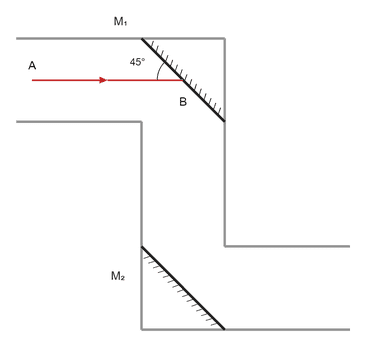
Which statement about the light inside the periscope is correct ?
- 171 mark
Question 17
Competency: Application
A laser beam is shone straight through an aquarium. It passes through the front glass wall, which is cm thick, then through cm of water, and then through the back glass wall, which is also cm thick. The speed of light is m s in glass and m s in water.
How long does the light take to go from the outer face of the front wall to the outer face of the back wall ?
- 181 mark
Question 18
Competency: Application
In sunlight, Lata looks at a red rose through a sheet of blue cellophane paper held in front of her eyes. (Take the rose to reflect only red light, and the blue cellophane to let only blue light pass through it.)
How does the rose look to her ?
- 191 mark
Question 19
Competency: Understanding
Assertion (A): When we look at a star at night, we see light that left the star a long time ago.
Reason (R): Light travels at a very high but limited speed, and the stars are extremely far away from us.
- 201 mark
Question 20
Competency: Evaluation
The principal of a school wants to paint the wall of a hall that faces a large window. A notice board is fixed on this wall. Sunlight from the window falls on the wall, and the principal wants the notice board to be easy to read from every seat in the hall.
Which finish should be chosen, and for what reason ?
- 211 mark
Question 21
Competency: Analysis
A narrow beam of parallel rays of light falls on a surface. The figure shows the rays that fall on the surface and the rays that leave it.
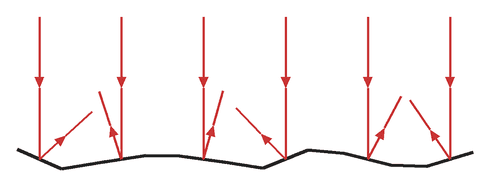
Which statement about this surface is correct ?
- 221 mark
Question 22
Competency: Analysis
In a dark room, a narrow beam of sunlight passes through a glass prism and forms a band of seven colours on a white screen. Meera moves a strip of red paper slowly across the band, from the violet end to the red end. (Take the paper to reflect only red light.)
How does the strip look as it moves ?
- 231 mark
Question 23
Competency: Analysis
A long plane mirror is fixed on one wall of a room. A toy car moves on the floor along a straight line that is parallel to the mirror and cm in front of it. The car moves cm towards the door at one end of the room.
How does the image of the car move ?
- 241 mark
Question 24
Competency: Understanding
Assertion (A): A kaleidoscope, which has plane mirror strips inside a tube, shows the pattern of a few coloured glass pieces repeated many times.
Reason (R): Each plane mirror strip by itself forms many images of every glass piece.
- 251 mark
Question 25
Competency: Understanding
We see some objects because they give out their own light and others because they reflect light that falls on them.
Which of the following lists has only objects that we see because they reflect light ?
- 262 marks
Question 26
Competency: Analysis
On a still morning, Ishaan sees a clear upside-down reflection of the trees on the bank in a pond. In the afternoon a breeze blows, and the reflection in the water breaks up into wavy pieces.
(a) Why does the still water give a clear reflection ?
(b) Why does the reflection break up when the breeze blows ?
- 272 marks
Question 27
Competency: Application
A railway signal lamp is km from the driver of a train. (Speed of light in air m s.)
(a) How long does the light from the lamp take to reach the driver's eyes ?
(b) The driver takes s to react after seeing the signal. How many times longer than the travel time of light is the reaction time ?
- 282 marks
Question 28
Competency: Evaluation
A sheet of black chart paper is stuck on a white wall in a well-lit room. Rohit says, "We see the black chart because it sends light of black colour to our eyes."
(a) Is Rohit right ?
(b) Explain why we can see the black chart on the white wall.
- 292 marks
Question 29
Competency: Understanding
It is late afternoon after a shower of rain. The Sun is low in the western sky, and there are still raindrops in the air. Kabir wants to see a rainbow.
(a) In which direction should Kabir look: towards the Sun or away from it ?
(b) How do the raindrops produce the colours of the rainbow ?
- 302 marks
Question 30
Competency: Application
A dentist cannot look straight at the back surface of a tooth in a patient's mouth. She holds a small plane mirror at the end of a long handle in the mouth and looks into it.
(a) Explain how the mirror lets her see the back of the tooth.
(b) State two features of the image of the tooth that she sees in the plane mirror.
- 312 marks
Question 31
Competency: Creation
Reema wants to make a toy disc to show that white light is made of several colours. She has a circular piece of cardboard, a pencil and seven colours of paint.
(a) Describe how she should paint the disc and what she should do with it.
(b) The disc looks dull whitish and not pure white when it is turned fast. Give one reason.
- 323 marks
Question 32
Competency: Analysis
Sana stands at different distances from a large plane mirror. Each time, she measures the distance between herself and her image. She plots her readings in the graph below. (Hypothetical data.)
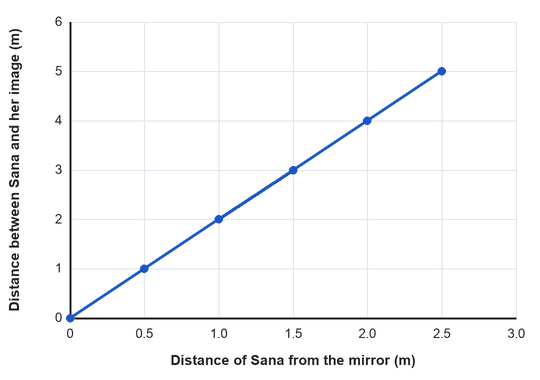
(a) What is the distance between Sana and her image when she stands m from the mirror ?
(b) The graph is a straight line through the origin. What does this show about the distance of the image behind the mirror ?
(c) Sana wants the distance between herself and her image to be m. How far from the mirror should she stand ?
- 333 marks
Question 33
Competency: Analysis
Arnav looks at the screen of a colour television through a strong magnifying glass. He sees that the screen is made of tiny spots, and each spot has three very small dots: one gives red light, one gives green light and one gives blue light.
(a) Which dots give out light in a part of the screen that looks yellow ?
(b) Which dots give out light in a part of the screen that looks white, and which in a part that looks black ?
(c) The screen shows a magenta flower. Which dots give out light in the petals ? If the blue dots in that part stopped working, what colour would the petals look ?
- 343 marks
Question 34
Competency: Evaluation
Ritu says, "Light needs air to travel, just as sound does." Her teacher fixes an electric bulb and an electric bell inside a glass bell jar and pumps the air out of the jar. When the air has been pumped out, the bulb is still seen to glow through the glass, but the sound of the bell can hardly be heard.
(a) What do these observations show about light and sound ?
(b) Is Ritu right ? Give a reason.
(c) There is no air on the Moon. Two astronauts standing a few metres apart on the Moon can see each other, but they cannot hear each other speak without their radio sets. Explain why.
- 353 marks
Question 35
Competency: Evaluation
Dhruv wrote three statements in his notes. Each of them has one mistake.
(i) Light travels faster in glass than in air.
(ii) A candle is placed cm in front of a plane mirror. Its image is formed cm behind the mirror, since the image is half as far as the object.
(iii) Magenta light is obtained by mixing red and green lights.
Find the mistake in each statement and write the correct statement.
- 363 marks
Question 36
Competency: Analysis
Prisha switches on a torch in a dark room whose air is clean. She sees a bright spot on the wall where the beam ends, but she cannot see the beam itself when she looks at it from the side. Her brother then claps a duster and fills the air with chalk dust, and the whole beam is now seen as a bright streak.
(a) Why is the beam not seen from the side in clean air ?
(b) Why does the beam become visible when the air has dust in it ?
(c) Is the reflection from the dust regular or irregular ? Give a reason.
- 375 marks
Question 37
Competency: Analysis
Case study: For Diwali, Reena has a string of three bulbs P, Q and R. Each bulb gives light of a different primary colour (red, green or blue), but the colours are not marked. She switches the bulbs on in different ways and notes the colour of the light on a white wall.
Bulbs switched on Colour on the white wall P and Q yellow Q and R cyan P and R magenta P, Q and R white (a) Find the colour of each of the bulbs P, Q and R. Give a reason.
(b) One evening only one of the three bulbs is switched on. In its light, a green leaf and a red apple both look black. Which bulb is on ? Give a reason.
(c) Reena adds a fourth bulb S. When only S and R are switched on, the wall looks white. What is the colour of the light from S ? Explain.
- 384 marks
Question 38
Competency: Evaluation
Case study: Kavya checks the laws of reflection with a plane mirror, pins and a protractor. For each ray she measures the angle of incidence i and also the angle between the incident ray and the reflected ray, which she calls . She plots against i in the graph below. (Hypothetical data.)
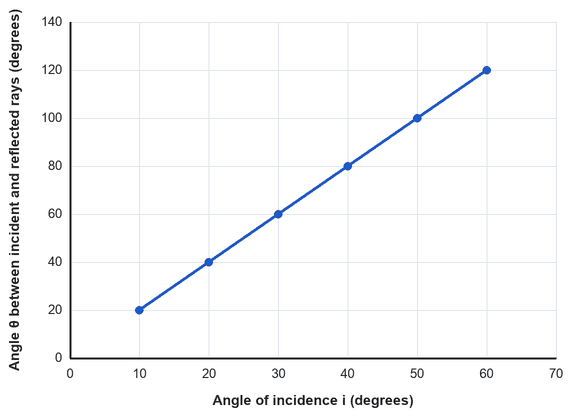
(a) Read from the graph the value of when i . Find the angle of reflection for this ray.
(b) Kavya's friend says, "The graph shows that is always twice i, so the angle of reflection is twice the angle of incidence." Do you agree ? Give a reason.
(c) Use the pattern of the graph to find the angle of incidence of a ray for which . What would be for a ray that falls along the normal ?
- 394 marks
Question 39
Competency: Application
Case study: Aarav stands on a small pier at the edge of a still lake. His eye E is m above the water. A tree stands on the bank, m from the pier, and its top T is m above the water, as shown. Take the still water as a plane mirror. (Hypothetical data.)
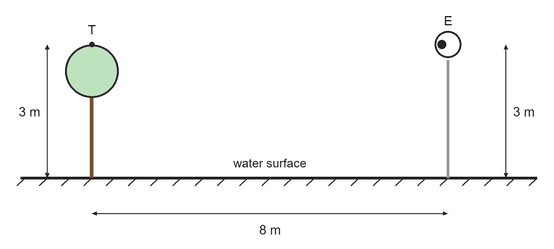
(a) How far below the water surface is the image T of the top of the tree ?
(b) Find the straight distance from E to T.
(c) The ray from T that Aarav sees is reflected at a point P of the water surface. The reflected ray seems to come from T. How far is P from the foot of the tree ?
- 405 marks
Question 40
Competency: Analysis
Case study: In a school project, Pooja's team measures the speed of light in air. They send a short pulse of laser light over different distances and read the time taken on a very fast timer. The readings are given below. ( ns s.) (Hypothetical data.)
Trial Distance travelled (m) Time taken (ns) 1 2 3 4 (a) Find the speed of light from trial 1 and from trial 2.
(b) One of the four timer readings is faulty. Find which one, and say what it should have been.
(c) The team then sends a pulse through a long tank that holds m of water, in which the speed of light is m s. Find the time the pulse takes in the water, and how much longer this is than the time for m of air.