
Question 594 marksEasy
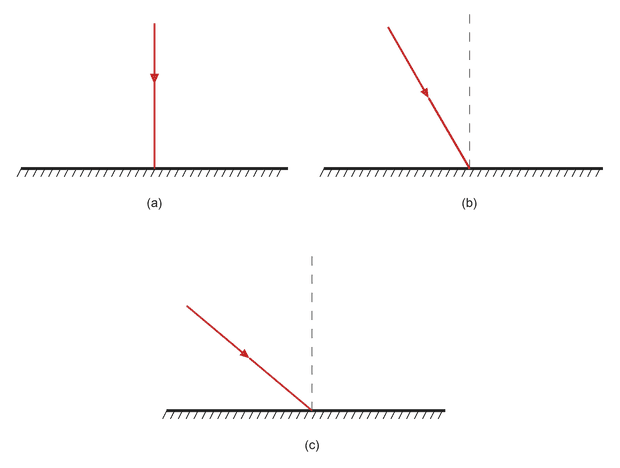
In the following diagrams (Fig 4.19), measure and write the angle of incidence and draw the reflected ray in each case.
Confirming your payment
Sign up now and get 250 free tokens.
Light Energy · Question 59 of 70
In the following diagrams (Fig 4.19), measure and write the angle of incidence and draw the reflected ray in each case.
Solution:
Concept: There are two laws of reflection. First, the angle of incidence is equal to the angle of reflection, . Second, the incident ray, the reflected ray and the normal at the point of incidence all lie in the same plane. Both angles are measured from the normal, the line drawn perpendicular to the mirror at the point of incidence, and never from the mirror surface.
Step 1 — Measure each angle from the normal.
In each part, place the protractor at the point of incidence and measure the angle between the incident ray and the normal (the dotted line).
Step 2 — (a).
The ray falls along the normal (at 90° to the mirror), so .
The angle of reflection is then 0° as well, and the reflected ray goes back up along the same path.
Step 3 — (b).
The incident ray makes 30° with the normal, so the angle of incidence is 30°. Draw the reflected ray on the other side of the normal, making 30° with it.
Step 4 — (c).
The incident ray makes 50° with the normal, so the angle of incidence is 50°. Draw the reflected ray on the other side of the normal, making 50° with it.
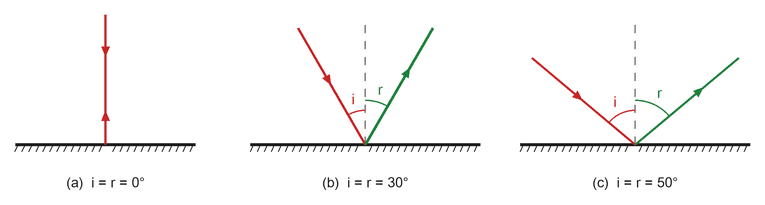
Note: the angles in (b) and (c) are read with a protractor from the figure (30.0° and 50.1° when measured); a reading within a degree or two is acceptable.
Therefore, (a) i = 0°, (b) i = 30°, (c) i = 50°, with each reflected ray drawn at r = i on the other side of the normal.