
Opening your dashboard
Class 7 Physics Chapter 3: Energy Solutions
55 textbook questions with step-by-step answers, free to read, for ICSE 2026-27.
Get talked through Ch 3, not just shown the answer
Reading a finished solution is not the same as being able to do it. The AI tutor takes one question at a time and works it with you, in your own words, until you can.
- Ask it out loud, in your own words
- It gives you the next step, not the answer
- Stuck on part (ii)? Start there
55 questions with solutions
1–4 marks · Mixed difficulty
- 11 mark
Question 1
When we rub our hands :
Solve with AIAnswer
(A) kinetic energy changes into potential energy.
- Correct
(B) mechanical energy changes into heat energy.
(C) potential energy changes into kinetic energy.
(D) heat energy changes into mechanical energy.
Answer: (B) mechanical energy changes into heat energy
Concept: In every device or process, one form of energy goes in and another form (or forms) comes out. We find the change by asking what energy the body starts with and what energy it gives out.
Step 1 — See what we do.
When we rub our hands, we move them against each other. Moving hands have mechanical energy, and we spend it against the friction between the palms.
Step 2 — See what comes out.
The work done against friction appears as heat energy, which is why our hands become warm. So mechanical energy changes into heat energy.
Why the other options are wrong:
- (A) kinetic energy changes into potential energy: Nothing is lifted, stretched or compressed, so no energy is being stored as potential energy.
- (C) potential energy changes into kinetic energy: The hands are not falling or being released from a stored state, so potential energy is not changing into kinetic energy.
- (D) heat energy changes into mechanical energy: This is the reverse change, as in a steam engine. In rubbing, heat is produced, not used up to make motion.
Therefore, when we rub our hands, mechanical energy changes into heat energy, option (B).
- 21 mark
Question 2
A ball rolling on the ground possesses :
Solve with AIAnswer
- Correct
(A) kinetic energy
(B) potential energy
(C) no energy
(D) heat energy.
Answer: (A) kinetic energy
Concept: Mechanical energy has two kinds. Potential energy (P.E.) is the energy of a body due to its position (height) or its state (compressed, stretched or wound up). Kinetic energy (K.E.) is the energy of a body due to its motion.
Step 1 — See the state of the ball.
A ball rolling on the ground is moving.
Step 2 — Name its energy.
The energy a body has because of its motion is kinetic energy. So the rolling ball has kinetic energy; it can, for example, knock over another ball in its way.
Why the other options are wrong:
- (B) potential energy: The ball is on the ground, not raised to a height or stretched or compressed, so its energy here is not potential energy.
- (C) no energy: A moving ball can do work, such as pushing another ball, so it does have energy.
- (D) heat energy: Heat energy is given out by burning fuels or by friction; the energy the question asks about is due to the ball's motion.
Therefore, a ball rolling on the ground possesses kinetic energy, option (A).
- 31 mark
Question 3
The energy stored in an electric cell is
Solve with AIAnswer
- Correct
(A) chemical energy
(B) electrical energy
(C) heat energy
(D) mechanical energy.
Answer: (A) chemical energy
Concept: Energy exists in many forms: mechanical, heat, light, sound, chemical, electrical, magnetic and nuclear energy. One form of energy can change into another form.
Step 1 — Look inside the cell.
An electric cell (a dry cell or a battery) contains chemicals. Energy is stored in these chemicals as chemical energy.
Step 2 — See what happens in use.
When the cell is connected in a circuit, a chemical reaction takes place and the chemical energy changes into electrical energy.
Watch out: A cell gives out electrical energy, but what it stores is chemical energy.
Why the other options are wrong:
- (B) electrical energy: Electrical energy is what the cell gives out while it is in use; it is not stored in that form.
- (C) heat energy: A cell does not store heat energy.
- (D) mechanical energy: Nothing in a cell is moving or raised, so it does not store mechanical energy.
Therefore, the energy stored in an electric cell is chemical energy, option (A).
- 41 mark
Question 4
When a bulb lights up on passing current, the change of energy is :
Solve with AIAnswer
(A) from electrical energy to heat energy
(B) from electrical energy to light energy
- Correct
(C) from electrical energy to heat and light energy
(D) from electrical energy to mechanical energy.
Answer: (C) from electrical energy to heat and light energy
Concept: In every device or process, one form of energy goes in and another form (or forms) comes out. We find the change by asking what energy the body starts with and what energy it gives out.
Step 1 — See what goes in.
Electric current is passed through the bulb, so electrical energy goes in.
Step 2 — See what comes out.
The bulb gives out light, and it also becomes hot to touch. So the electrical energy changes into both heat energy and light energy.
Watch out: A filament bulb gives out more heat than light, so heat must not be left out.
Why the other options are wrong:
- (A) from electrical energy to heat energy: Heat alone is not the whole change; the bulb also gives light.
- (B) from electrical energy to light energy: Light alone is not the whole change; a part of the electrical energy becomes heat that warms the bulb.
- (D) from electrical energy to mechanical energy: Nothing moves in a bulb, so no mechanical energy is produced.
Therefore, the change of energy in a glowing bulb is from electrical energy to heat and light energy, option (C).
- 51 mark
Question 5
The correct statement is :
Solve with AIAnswer
- Correct
(A) Both work and energy have the same units
(B) Potential energy of a body is due to its motion
(C) Kinetic energy of a body is due to its position or state
(D) Kinetic energy can change into potential energy, but potential energy cannot change into kinetic energy
Answer: (A) Both work and energy have the same units
Concept: Energy is measured in the same unit as work. Its S.I. unit is the joule (J): 1 J is the work done when a force of 1 newton moves a body through 1 metre in the direction of the force. Mechanical energy has two kinds. Potential energy (P.E.) is the energy of a body due to its position (height) or its state (compressed, stretched or wound up). Kinetic energy (K.E.) is the energy of a body due to its motion.
Step 1 — Check statement (A).
Energy is the capacity to do work, and it is measured by the work a body can do. So work and energy have the same S.I. unit, the joule (J). Statement (A) is correct.
Step 2 — Check the other statements.
Potential energy is due to position or state, and kinetic energy is due to motion. Each of statements (B) and (C) swaps these two meanings, and statement (D) is false, as shown below.
Why the other options are wrong:
- (B) Potential energy of a body is due to its motion: Potential energy is due to the position or state of a body, not its motion.
- (C) Kinetic energy of a body is due to its position or state: Kinetic energy is due to the motion of a body, not its position or state.
- (D) Kinetic energy can change into potential energy, but potential energy cannot change into kinetic energy: Potential energy does change into kinetic energy when it is put to use; for example, a raised hammer falls and a stretched bow sends off an arrow.
Therefore, the correct statement is that both work and energy have the same units, option (A).
- 61 mark
Question 6
According to law of conservation of energy, energy changes from one form to another form, but the total energy of that system :
Solve with AIAnswer
(A) increases
(B) decreases
(C) alternates
- Correct
(D) remains the same
Answer: (D) remains the same
Concept: The law of conservation of energy says that energy can neither be created nor destroyed; it only changes from one form to another, so the total energy stays the same. A part may change into a non-useful form such as heat, but it is still counted in the total.
Step 1 — Recall the law.
By the law of conservation of energy, energy is neither created nor destroyed in any change of form.
Step 2 — Apply it to the total.
Since no energy is made and none is lost, the total energy of the system remains the same while its forms change.
Watch out: Some energy may change into a form we cannot use, such as heat, but it is still part of the total.
Why the other options are wrong:
- (A) increases: Energy cannot be created, so the total cannot increase.
- (B) decreases: Energy cannot be destroyed, so the total cannot decrease.
- (C) alternates: The total does not go up and down; it stays constant all the time.
Therefore, the total energy of the system remains the same, option (D).
- 71 mark
Question 7
Water is lifted from ground floor to overhead tank at the second floor. The work done is stored in the form of :
Solve with AIAnswer
(A) kinetic energy
(B) chemical energy
- Correct
(C) potential energy
(D) both (A) and (B)
Answer: (C) potential energy
Concept: Mechanical energy has two kinds. Potential energy (P.E.) is the energy of a body due to its position (height) or its state (compressed, stretched or wound up). Kinetic energy (K.E.) is the energy of a body due to its motion. The potential energy of a raised body is the work done against gravity in lifting it. So it is greater when the mass is greater and when the height is greater.
Step 1 — See what work is done.
Lifting water from the ground floor to an overhead tank is work done against the force of gravity.
Step 2 — Find where the work goes.
The water is now at rest at a greater height. The work done in lifting it is stored in it as potential energy, because of its raised position. It comes out again as kinetic energy when the water flows down through the taps.
Why the other options are wrong:
- (A) kinetic energy: The water in the tank is at rest, so the stored energy is not kinetic energy.
- (B) chemical energy: Lifting water does not store energy in chemicals, so it is not chemical energy.
- (D) both (A) and (B): Neither of the first two options is correct, so “both” is also wrong.
Therefore, the work done is stored in the form of potential energy, option (C).
- 81 mark
Question 8
Assertion-Reason based question. Choose the answer based on the codes given below.
Assertion (A) : Mechanical energy of a freely falling body increases as it falls.
Reason (R) : Potential energy is converted into kinetic energy during free fall.
Solve with AIAnswer
(A) Both A and R are true and R is the correct explanation of A
(B) Both A and R are true and R is not the correct explanation of A
(C) A is true but R is false
- Correct
(D) A is false but R is true
Answer: (D) A is false but R is true
Concept: When potential energy changes into kinetic energy (or back), the loss in one equals the gain in the other. So, if friction and air resistance are neglected, P.E. + K.E. stays the same at every point.
Step 1 — Judge the assertion.
The assertion is false. As a body falls freely, its potential energy decreases and its kinetic energy increases by the same amount. So the total mechanical energy, P.E. + K.E., stays the same (air resistance neglected); it does not increase.
Step 2 — Judge the reason.
The reason is true. During the fall the height decreases and the speed increases, so potential energy changes into kinetic energy.
Step 3 — Choose the code.
The assertion is false and the reason is true, which is the last code.
Watch out: It is the kinetic energy that increases during the fall, not the total mechanical energy.
Why the other options are wrong:
- (A): This code needs both statements to be true, but the assertion is false.
- (B): This code also needs both statements to be true, but the assertion is false.
- (C): It is the assertion that is false, not the reason.
Therefore, A is false but R is true, option (D).
- 91 mark
Question 9
Assertion-Reason based question. Choose the answer based on the codes given below.
Assertion (A) : A stretched bow has kinetic energy.
Reason (R) : Stretching stores potential energy.
Solve with AIAnswer
(A) Both A and R are true and R is the correct explanation of A
(B) Both A and R are true and R is not the correct explanation of A
(C) A is true but R is false
- Correct
(D) A is false but R is true
Answer: (D) A is false but R is true
Concept: Mechanical energy has two kinds. Potential energy (P.E.) is the energy of a body due to its position (height) or its state (compressed, stretched or wound up). Kinetic energy (K.E.) is the energy of a body due to its motion.
Step 1 — Judge the assertion.
The assertion is false. A stretched bow is held at rest, so it has no kinetic energy. It has potential energy because of its stretched state, and it gives kinetic energy to the arrow only when it is released.
Step 2 — Judge the reason.
The reason is true. When a bow or a rubber band is stretched, work is done on it, and this work is stored in it as potential energy.
Step 3 — Choose the code.
The assertion is false and the reason is true, which is the last code.
Why the other options are wrong:
- (A): This code needs both statements to be true, but the assertion is false.
- (B): This code also needs both statements to be true, but the assertion is false.
- (C): The reason is true; it is the assertion that is false.
Therefore, A is false but R is true, option (D).
- 101 mark
Question 10
Fill in the blanks :
An electric fan converts electrical energy into .................. energy.
Solve with AIWritten solution
Solution:
Concept: In every device or process, one form of energy goes in and another form (or forms) comes out. We find the change by asking what energy the body starts with and what energy it gives out.
Step 1 — See what goes in.
An electric fan runs on electricity, so electrical energy goes in.
Step 2 — See what comes out.
The motor of the fan turns its blades, so the energy comes out as mechanical energy (the kinetic energy of the turning blades).
Therefore, an electric fan converts electrical energy into mechanical energy.
- 111 mark
Question 11
Fill in the blanks :
Cooking gas converts .................. energy into heat energy.
Solve with AIWritten solution
Solution:
Concept: In every device or process, one form of energy goes in and another form (or forms) comes out. We find the change by asking what energy the body starts with and what energy it gives out.
Step 1 — See what cooking gas is.
Cooking gas (LPG) is a fuel, and fuels store energy in their chemicals as chemical energy.
Step 2 — See what burning does.
When the gas burns, this chemical energy is set free as heat energy, which cooks the food.
Therefore, cooking gas converts chemical energy into heat energy.
- 121 mark
Question 12
Fill in the blanks :
Energy possessed by a compressed spring is .................. energy.
Solve with AIWritten solution
Solution:
Concept: Mechanical energy has two kinds. Potential energy (P.E.) is the energy of a body due to its position (height) or its state (compressed, stretched or wound up). Kinetic energy (K.E.) is the energy of a body due to its motion.
Step 1 — See what was done to the spring.
Work is done on a spring to compress it.
Step 2 — Name the stored energy.
This work is stored in the spring because of its compressed state. Energy due to the state of a body is potential energy; it shows itself when the spring is released and pushes something away.
Therefore, the energy possessed by a compressed spring is potential energy.
- 131 mark
Question 13
Fill in the blanks :
The ability to do work is called ..................
Solve with AIWritten solution
Solution:
Concept: Energy is the capacity (ability) to do work. A body that can do work has energy; the more work it can do, the more energy it has.
Step 1 — Recall the definition.
The capacity, or ability, of a body to do work is called its energy.
Step 2 — Link it to work.
A body that does work spends some of its energy, and a body on which work is done gains energy.
Therefore, the ability to do work is called energy.
- 141 mark
Question 14
Fill in the blanks :
The energy possessed by a body due to its position is called .................. energy.
Solve with AIWritten solution
Solution:
Concept: Mechanical energy has two kinds. Potential energy (P.E.) is the energy of a body due to its position (height) or its state (compressed, stretched or wound up). Kinetic energy (K.E.) is the energy of a body due to its motion.
Step 1 — Look at the cause.
The energy here comes from the position of the body, for example its height above the ground.
Step 2 — Name the energy.
Energy due to the position or state of a body is called potential energy. A hammer held at a height is an example.
Therefore, the energy possessed by a body due to its position is called potential energy.
- 151 mark
Question 15
Fill in the blanks :
The energy possessed by a body due to its motion is called .................. energy.
Solve with AIWritten solution
Solution:
Concept: Mechanical energy has two kinds. Potential energy (P.E.) is the energy of a body due to its position (height) or its state (compressed, stretched or wound up). Kinetic energy (K.E.) is the energy of a body due to its motion.
Step 1 — Look at the cause.
The energy here comes from the motion of the body.
Step 2 — Name the energy.
Energy due to the motion of a body is called kinetic energy. A moving cricket ball is an example.
Therefore, the energy possessed by a body due to its motion is called kinetic energy.
- 161 mark
Question 16
Fill in the blanks :
Green plants convert .................. energy into chemical energy.
Solve with AIWritten solution
Solution:
Concept: In every device or process, one form of energy goes in and another form (or forms) comes out. We find the change by asking what energy the body starts with and what energy it gives out.
Step 1 — Recall photosynthesis.
Green plants make their food by photosynthesis, using sunlight.
Step 2 — Find the energy change.
During photosynthesis the light energy of the sun is changed into chemical energy, which is stored in the food.
Therefore, green plants convert light energy into chemical energy.
- 171 mark
Question 17
Fill in the blanks :
The S.I.unit of energy is ..................
Solve with AIWritten solution
Solution:
Concept: Energy is measured in the same unit as work. Its S.I. unit is the joule (J): 1 J is the work done when a force of 1 newton moves a body through 1 metre in the direction of the force.
Step 1 — Link energy to work.
Energy is measured by the work a body can do, so it has the same unit as work.
Step 2 — Name the unit.
The S.I. unit of work is the joule, so the S.I. unit of energy is the joule (symbol J).
Therefore, the S.I. unit of energy is the joule (J).
- 181 mark
Question 18
Fill in the blanks :
An object falling freely from the roof of a multistorey building has .................. and .................. energy when halfway down the building.
Solve with AIWritten solution
Solution:
Concept: When potential energy changes into kinetic energy (or back), the loss in one equals the gain in the other. So, if friction and air resistance are neglected, P.E. + K.E. stays the same at every point.
Step 1 — Look at the height.
Halfway down, the object is still above the ground, so it has potential energy.
Step 2 — Look at the motion.
It has been falling and is moving, so it also has kinetic energy.
Step 3 — Compare the two.
Measuring height from the ground and neglecting air resistance, the object has lost half its height, so half of its potential energy has changed into kinetic energy. At that point P.E. and K.E. are equal.
Therefore, halfway down the building the object has potential and kinetic energy.
- 191 mark
Question 19
Write true or false for each statement :
A man going up has potential energy and kinetic energy both.
Solve with AIWritten solution
Solution:
Concept: Mechanical energy has two kinds. Potential energy (P.E.) is the energy of a body due to its position (height) or its state (compressed, stretched or wound up). Kinetic energy (K.E.) is the energy of a body due to its motion.
Step 1 — Check for kinetic energy.
The man is going up, so he is moving and has kinetic energy.
Step 2 — Check for potential energy.
He is at some height above the ground, so he also has potential energy, and it increases as he goes higher.
Step 3 — Decide.
He has both forms at once, so the statement is true.
Therefore, the statement is true: a man going up has both potential energy and kinetic energy.
- 201 mark
Question 20
Write true or false for each statement :
A gum bottle lying on a table has no energy.
Solve with AIWritten solution
Solution:
Concept: Mechanical energy has two kinds. Potential energy (P.E.) is the energy of a body due to its position (height) or its state (compressed, stretched or wound up). Kinetic energy (K.E.) is the energy of a body due to its motion.
Step 1 — Look at its position.
The gum bottle is at rest on a table, above the ground.
Step 2 — Decide.
A body at a height has potential energy due to its position. If the bottle falls off the table, this potential energy changes into kinetic energy. So the bottle does have energy, and the statement is false.
Watch out: A body at rest has no kinetic energy, but it can still have potential energy.
Therefore, the statement is false: a gum bottle lying on a table has potential energy.
- 211 mark
Question 21
Write true or false for each statement :
In an automobile engine, chemical energy changes into mechanical energy.
Solve with AIWritten solution
Solution:
Concept: In every device or process, one form of energy goes in and another form (or forms) comes out. We find the change by asking what energy the body starts with and what energy it gives out.
Step 1 — See what goes in.
Petrol or diesel burns in the engine. The fuel stores chemical energy.
Step 2 — See what comes out.
The burning fuel pushes the pistons, which turn the wheels, so the chemical energy becomes mechanical energy that moves the vehicle. Some of it also becomes heat. So the statement is true.
Therefore, the statement is true: in an automobile engine, chemical energy changes into mechanical energy.
- 221 mark
Question 22
Write true or false for each statement :
Potential energy changes into kinetic energy when it is put to use.
Solve with AIWritten solution
Solution:
Concept: Mechanical energy has two kinds. Potential energy (P.E.) is the energy of a body due to its position (height) or its state (compressed, stretched or wound up). Kinetic energy (K.E.) is the energy of a body due to its motion.
Step 1 — Recall what potential energy is.
Potential energy is stored energy, due to the position or state of a body.
Step 2 — See what happens when it is used.
When the body is released, the stored energy shows itself as motion. A raised hammer falls and drives a nail, and a wound up watch spring unwinds and moves the hands of the watch. So the statement is true.
Therefore, the statement is true: potential energy changes into kinetic energy when it is put to use.
- 231 mark
Question 23
Write true or false for each statement :
One form of energy cannot be converted into another form.
Solve with AIWritten solution
Solution:
Concept: Energy exists in many forms: mechanical, heat, light, sound, chemical, electrical, magnetic and nuclear energy. One form of energy can change into another form.
Step 1 — Look at everyday devices.
An electric fan changes electrical energy into mechanical energy, and a bulb changes electrical energy into heat and light energy.
Step 2 — Decide.
These examples show that one form of energy can be converted into another form, so the statement is false.
Therefore, the statement is false: one form of energy can be converted into another form.
- 241 mark
Question 24
Write true or false for each statement :
There is always some loss of energy in conversion from one form of energy to another form, so the total energy is not conserved.
Solve with AIWritten solution
Solution:
Concept: The law of conservation of energy says that energy can neither be created nor destroyed; it only changes from one form to another, so the total energy stays the same. A part may change into a non-useful form such as heat, but it is still counted in the total.
Step 1 — See what the “loss” is.
In a conversion, a part of the energy changes into a form we cannot use, such as heat. This part is not useful, but it is not destroyed.
Step 2 — Add up all the energy.
The useful energy and the non-useful energy together are equal to the energy that was converted. So the total energy is always conserved, and the statement is false.
Watch out: Energy said to be lost has only changed into a form we cannot use; it still exists.
Therefore, the statement is false: the total energy is always conserved in a conversion.
- 251 mark
Question 25
Write true or false for each statement :
The energy of flowing water can be converted into electric energy (electricity).
Solve with AIWritten solution
Solution:
Concept: In every device or process, one form of energy goes in and another form (or forms) comes out. We find the change by asking what energy the body starts with and what energy it gives out.
Step 1 — Follow the water.
In a hydroelectric power station, falling or flowing water strikes the blades of a turbine and turns it.
Step 2 — Follow the energy.
The turbine turns a generator (dynamo), which changes the mechanical energy into electrical energy. So the statement is true.
Therefore, the statement is true: the energy of flowing water can be converted into electrical energy.
- 261 mark
Question 26
Match the following columns :
Column A : (a) Running water
Column B :
Column B (i) heat energy (ii) vibrations (iii) atom bomb (iv) kinetic energy (v) joule Solve with AIWritten solution
Solution:
Concept: Mechanical energy has two kinds. Potential energy (P.E.) is the energy of a body due to its position (height) or its state (compressed, stretched or wound up). Kinetic energy (K.E.) is the energy of a body due to its motion.
Step 1 — Look at running water.
Running water is in motion, and it can move a boat or a log of wood.
Step 2 — Pick the matching item.
Column B lists heat energy, vibrations, atom bomb, kinetic energy and joule. Energy due to motion is kinetic energy, so running water matches item (iv).
Therefore, running water matches (iv), kinetic energy.
- 271 mark
Question 27
Match the following columns :
Column A : (b) Burning
Column B :
Column B (i) heat energy (ii) vibrations (iii) atom bomb (iv) kinetic energy (v) joule Solve with AIWritten solution
Solution:
Concept: Energy exists in many forms: mechanical, heat, light, sound, chemical, electrical, magnetic and nuclear energy. One form of energy can change into another form.
Step 1 — Look at burning.
When we burn coal, wood, oil or gas, the chemical energy of the fuel is set free.
Step 2 — Pick the matching item.
Column B lists heat energy, vibrations, atom bomb, kinetic energy and joule. The energy given out on burning is mainly heat energy (with some light), so burning matches item (i).
Therefore, burning matches (i), heat energy.
- 281 mark
Question 28
Match the following columns :
Column A : (c) Energy
Column B :
Column B (i) heat energy (ii) vibrations (iii) atom bomb (iv) kinetic energy (v) joule Solve with AIWritten solution
Solution:
Concept: Energy is measured in the same unit as work. Its S.I. unit is the joule (J): 1 J is the work done when a force of 1 newton moves a body through 1 metre in the direction of the force.
Step 1 — Look at the word energy.
Of the items in Column B, only one is a unit; the others are forms or sources of energy.
Step 2 — Pick the matching item.
Column B lists heat energy, vibrations, atom bomb, kinetic energy and joule. The S.I. unit of energy is the joule, so energy matches item (v).
Therefore, energy matches (v), joule.
- 291 mark
Question 29
Match the following columns :
Column A : (d) Sound energy
Column B :
Column B (i) heat energy (ii) vibrations (iii) atom bomb (iv) kinetic energy (v) joule Solve with AIWritten solution
Solution:
Concept: Energy exists in many forms: mechanical, heat, light, sound, chemical, electrical, magnetic and nuclear energy. One form of energy can change into another form.
Step 1 — Recall how sound is made.
Sound is produced by a vibrating body, such as a plucked string or a struck bell.
Step 2 — Pick the matching item.
Column B lists heat energy, vibrations, atom bomb, kinetic energy and joule. The vibrations carry sound energy to our ears, so sound energy matches item (ii).
Therefore, sound energy matches (ii), vibrations.
- 301 mark
Question 30
Match the following columns :
Column A : (e) Nuclear energy
Column B :
Column B (i) heat energy (ii) vibrations (iii) atom bomb (iv) kinetic energy (v) joule Solve with AIWritten solution
Solution:
Concept: Energy exists in many forms: mechanical, heat, light, sound, chemical, electrical, magnetic and nuclear energy. One form of energy can change into another form.
Step 1 — Recall nuclear energy.
Nuclear (atomic) energy is the energy stored in the nucleus of atoms. It is set free in nuclear reactions.
Step 2 — Pick the matching item.
Column B lists heat energy, vibrations, atom bomb, kinetic energy and joule. An atom bomb releases nuclear energy in a destructive way, so nuclear energy matches item (iii). The same energy is used peacefully in nuclear power stations to make electricity.
Therefore, nuclear energy matches (iii), atom bomb.
- 312 marks
Question 31
Define the term energy.
Solve with AIWritten solution
Solution:
Concept: Energy is the capacity (ability) to do work. A body that can do work has energy; the more work it can do, the more energy it has.
Step 1 — Define energy.
Energy is the capacity to do work. A body that can do work is said to possess energy.
Step 2 — Link energy and work.
The more energy a body has, the more work it can do. When work is done on a body, its energy increases; when a body does work, it spends some of its energy.
Step 3 — Give an example.
A girl riding a bicycle spends energy in doing work. She can go on riding only as long as she has energy.
Therefore, energy is the capacity to do work.
- 322 marks
Question 32
State the unit of energy and define it.
Solve with AIWritten solution
Solution:
Concept: Energy is measured in the same unit as work. Its S.I. unit is the joule (J): 1 J is the work done when a force of 1 newton moves a body through 1 metre in the direction of the force.
Step 1 — Name the unit.
Energy is measured by the work a body can do, so it has the same unit as work. The S.I. unit of energy is the joule (symbol J).
Step 2 — Define one joule.
One joule is the work done when a force of 1 newton moves a body through 1 metre in the direction of the force. A body has 1 J of energy when it can do 1 J of work.
Step 3 — Mention another unit.
Heat energy is also measured in calories (cal): 1 cal is about 4.2 J, and 1 kcal is 1000 cal.
Therefore, the S.I. unit of energy is the joule; 1 J is the work done when a force of 1 N moves a body through 1 m in its own direction.
- 332 marks
Question 33
Name five different forms of energy.
Solve with AIWritten solution
Solution:
Concept: Energy exists in many forms: mechanical, heat, light, sound, chemical, electrical, magnetic and nuclear energy. One form of energy can change into another form.
Step 1 — List five forms.
Five different forms of energy are:
- mechanical energy;
- heat energy;
- light energy;
- chemical energy;
- electrical energy.
Step 2 — Note other forms.
Sound energy, magnetic energy and nuclear (atomic) energy are other forms that may also be named.
Therefore, five forms of energy are mechanical, heat, light, chemical and electrical energy.
- 342 marks
Question 34
What are the two kinds of mechanical energy.
Solve with AIWritten solution
Solution:
Concept: Mechanical energy has two kinds. Potential energy (P.E.) is the energy of a body due to its position (height) or its state (compressed, stretched or wound up). Kinetic energy (K.E.) is the energy of a body due to its motion.
Step 1 — Name the first kind.
Potential energy is the energy of a body due to its position or state, for example a stone held at a height.
Step 2 — Name the second kind.
Kinetic energy is the energy of a body due to its motion, for example a moving car.
Step 3 — Put them together.
The total mechanical energy of a body is the sum of its potential energy and its kinetic energy.
Therefore, the two kinds of mechanical energy are potential energy and kinetic energy.
- 352 marks
Question 35
What is potential energy ? State its unit.
Solve with AIWritten solution
Solution:
Concept: Mechanical energy has two kinds. Potential energy (P.E.) is the energy of a body due to its position (height) or its state (compressed, stretched or wound up). Kinetic energy (K.E.) is the energy of a body due to its motion.
Step 1 — Define potential energy.
The potential energy of a body is the energy it has due to its position or state. It is equal to the work done in bringing the body to that position or state. It is written P.E. or U.
Step 2 — Give examples.
A hammer held at a height has potential energy due to its raised position, and a compressed spring has potential energy due to its compressed state.
Step 3 — State the unit.
Like every form of energy, potential energy is measured in joules (J).
Therefore, potential energy is the energy of a body due to its position or state, and its S.I. unit is the joule (J).
- 362 marks
Question 36
Give one example of a body that has potential energy, in each of the following : (i) due to its position, (ii) due to its state.
Solve with AIWritten solution
Solution:
Concept: Potential energy can be due to a raised position or due to a changed state (compressed, stretched or wound up).
Step 1 — Part (i): due to position.
Water stored in a dam is at a height, so it has potential energy because of its position. A stone on the top of a building is another example.
Step 2 — Part (ii): due to state.
A compressed spring has potential energy because of its compressed state. A stretched rubber band or a wound up watch spring is another example.
Therefore, (i) water stored in a dam has potential energy due to its position, and (ii) a compressed spring has potential energy due to its state.
- 372 marks
Question 37
Two bodies A and B of masses 10 kg and 20 kg respectively are at the same height above the ground. Which of the two has greater potential energy ?
Solve with AIWritten solution
Solution:
Concept: The potential energy of a raised body is the work done against gravity in lifting it. So it is greater when the mass is greater and when the height is greater.
Step 1 — See what is the same.
Both bodies are at the same height above the ground, so only their masses decide which has more potential energy.
Step 2 — Compare the masses.
Body B has mass 20 kg and body A has mass 10 kg. More work is needed to lift the heavier body B to the same height, so more energy is stored in it.
Step 3 — Compare how much.
At the same height, potential energy is in proportion to mass. B has twice the mass of A, so it has twice the potential energy of A.
Therefore, body B (20 kg) has the greater potential energy, twice that of A.
- 382 marks
Question 38
A bucket full of water is on the first floor of your house and another identical bucket with same quantity of water is kept on the second floor. Which of the two has greater potential energy ?
Solve with AIWritten solution
Solution:
Concept: The potential energy of a raised body is the work done against gravity in lifting it. So it is greater when the mass is greater and when the height is greater.
Step 1 — See what is the same.
The buckets are identical and hold the same quantity of water, so they have the same mass. Only their heights decide.
Step 2 — Compare the heights.
The bucket on the second floor is higher above the ground. More work is done against gravity in lifting it there, and this work is stored in it as potential energy.
Therefore, the bucket on the second floor has the greater potential energy.
- 392 marks
Question 39
Define the term kinetic energy. Give one example of a body which possesses kinetic energy.
Solve with AIWritten solution
Solution:
Concept: Mechanical energy has two kinds. Potential energy (P.E.) is the energy of a body due to its position (height) or its state (compressed, stretched or wound up). Kinetic energy (K.E.) is the energy of a body due to its motion.
Step 1 — Define kinetic energy.
The kinetic energy of a body is the energy it has due to its motion. It is equal to the work done on the body in bringing it to that state of motion. It is written K.E. or K.
Step 2 — Give an example.
A fast moving stone has kinetic energy; it can break a window pane when it strikes it. A bullet fired from a gun and water flowing in a river also have kinetic energy.
Therefore, kinetic energy is the energy of a body due to its motion; for example, a fast moving stone.
- 402 marks
Question 40
State two factors on which the kinetic energy of a moving body depends.
Solve with AIWritten solution
Solution:
Concept: The kinetic energy of a moving body is greater when its mass is greater and when its speed is greater.
Step 1 — First factor: mass.
If two bodies move with the same speed, the one with greater mass has more kinetic energy. A moving truck can do more damage than a bicycle at the same speed.
Step 2 — Second factor: speed.
For the same body, the greater its speed, the more its kinetic energy. A ball thrown fast hurts more than the same ball thrown slowly.
Therefore, the kinetic energy of a moving body depends on (a) its mass and (b) its speed.
- 412 marks
Question 41
Two toy-cars A and B of masses 500 g and 200 g respectively are moving with the same speed. Which of the two has greater kinetic energy ?
Solve with AIWritten solution
Solution:
Concept: The kinetic energy of a moving body is greater when its mass is greater and when its speed is greater.
Step 1 — See what is the same.
Both toy-cars move with the same speed, so only their masses decide which has more kinetic energy.
Step 2 — Compare the masses.
Toy-car A has mass 500 g and toy-car B has mass 200 g, so A has the greater mass. At the same speed, kinetic energy is in proportion to mass, so A has 500/200 = 2.5 times the kinetic energy of B.
Therefore, toy-car A has the greater kinetic energy.
- 422 marks
Question 42
A cyclist doubles his speed. How will his kinetic energy change : increases, decreases or remains the same ?
Solve with AIWritten solution
Solution:
Concept: The kinetic energy of a moving body is greater when its mass is greater and when its speed is greater.
Step 1 — See what changes.
The mass of the cyclist with his cycle stays the same, but his speed becomes double.
Step 2 — Decide the effect.
Kinetic energy increases when speed increases, so his kinetic energy increases.
Step 3 — See by how much.
In higher classes you will learn that kinetic energy depends on the square of the speed. So doubling the speed makes the kinetic energy four times as much, not just twice.
Therefore, his kinetic energy increases (it becomes four times as much).
- 432 marks
Question 43
Name the form of energy which a wound up watch spring possesses.
Solve with AIWritten solution
Solution:
Concept: Mechanical energy has two kinds. Potential energy (P.E.) is the energy of a body due to its position (height) or its state (compressed, stretched or wound up). Kinetic energy (K.E.) is the energy of a body due to its motion.
Step 1 — Look at the state of the spring.
Work is done in winding up a watch spring, and the spring stays in its wound up (tightly coiled) state.
Step 2 — Name the energy.
Energy stored due to the state of a body is potential energy. As the spring unwinds, this potential energy changes into kinetic energy, which moves the hands of the watch.
Therefore, a wound up watch spring possesses potential energy.
- 443 marks
Question 44
Name the type of energy (kinetic or potential ) possessed by the following :
(i) A moving cricket ball.
(ii) A stone at rest on the top of a building.
(iii) A compressed spring.
(iv) A moving bus.
(v) A bullet fired from a gun.
(vi) Water flowing in a river.
(vii) A stretched rubber band.
Solve with AIWritten solution
Solution:
Concept: Mechanical energy has two kinds. Potential energy (P.E.) is the energy of a body due to its position (height) or its state (compressed, stretched or wound up). Kinetic energy (K.E.) is the energy of a body due to its motion.
Step 1 — Use one test for each body.
We ask whether the body is moving (kinetic energy), or at rest at a height or in a compressed or stretched state (potential energy). The table applies this test to each body.
Body Type of energy Reason (i) A moving cricket ball Kinetic it is in motion (ii) A stone at rest on the top of a building Potential due to its position at a height (iii) A compressed spring Potential due to its compressed state (iv) A moving bus Kinetic it is in motion (v) A bullet fired from a gun Kinetic it is in motion (vi) Water flowing in a river Kinetic it is in motion (vii) A stretched rubber band Potential due to its stretched state Therefore, (i), (iv), (v) and (vi) possess kinetic energy, and (ii), (iii) and (vii) possess potential energy.
- 453 marks
Question 45
State the energy changes that occur in the following :
(i) The unwinding of a watch spring.
(ii) Burning coal while operating a steam engine.
(iii) Lighting of a torch bulb.
(iv) An electric generator (or dynamo).
Solve with AIWritten solution
Solution:
Concept: In every device or process, one form of energy goes in and another form (or forms) comes out. We find the change by asking what energy the body starts with and what energy it gives out.
Step 1 — Part (i): unwinding of a watch spring.
The wound up spring has potential energy. As it unwinds, this changes into kinetic energy, which moves the hands of the watch: potential energy to kinetic energy.
Step 2 — Part (ii): burning coal in a steam engine.
The chemical energy of the coal becomes heat energy in the steam, and the heat energy of the steam becomes mechanical energy that moves the engine: chemical energy to heat energy to mechanical energy.
Step 3 — Part (iii): lighting of a torch bulb.
The chemical energy of the cells becomes electrical energy, and in the bulb the electrical energy becomes light and heat energy: chemical energy to electrical energy to light and heat energy.
Step 4 — Part (iv): an electric generator (dynamo).
The coil of a generator is turned by an engine or a turbine, and the generator changes this mechanical energy into electrical energy.
Therefore, (i) potential to kinetic, (ii) chemical to heat to mechanical, (iii) chemical to electrical to light and heat, and (iv) mechanical to electrical energy.
- 463 marks
Question 46
A ball is made to fall freely from a height. State the kind / kinds of energy possessed by the ball when it is
(a) at the highest point
(b) just in the middle
(c) at the ground.
Solve with AIWritten solution
Solution:
Concept: When potential energy changes into kinetic energy (or back), the loss in one equals the gain in the other. So, if friction and air resistance are neglected, P.E. + K.E. stays the same at every point.
Step 1 — Name the total energy.
Let the total energy of the ball be E. The figure shows the ball at the three points, with heights measured from the ground and air resistance neglected.

Step 2 — Part (a): at the highest point.
The ball is at rest at its greatest height. So it has only potential energy, which is maximum and equal to E; its kinetic energy is zero.
Step 3 — Part (b): just in the middle.
The ball is at half the height and is moving. So it has both potential and kinetic energy. Half of its potential energy has changed into kinetic energy, so P.E. and K.E. are each E/2.
Step 4 — Part (c): at the ground.
Its height is zero, so its potential energy is zero. All of its potential energy has changed into kinetic energy, so just as it reaches the ground it has only kinetic energy, maximum and equal to E.
Therefore, the ball has (a) only potential energy at the highest point, (b) both potential and kinetic energy in the middle, and (c) only kinetic energy at the ground.
- 473 marks
Question 47
State two factors on which the potential energy of a body at a certain height above the ground depends.
Solve with AIWritten solution
Solution:
Concept: The potential energy of a raised body is the work done against gravity in lifting it. So it is greater when the mass is greater and when the height is greater.
Step 1 — First factor: mass.
The greater the mass of the body, the greater its potential energy. A 20 kg stone on a roof has more potential energy than a 10 kg stone on the same roof.
Step 2 — Second factor: height.
The greater the height of the body above the ground, the greater its potential energy. A bucket of water on the second floor has more potential energy than an identical bucket on the first floor.
Step 3 — See why.
Both factors decide how much work is done against gravity in lifting the body, and this work is stored in it as potential energy.
Therefore, the potential energy of a raised body depends on (a) its mass and (b) its height above the ground.
- 483 marks
Question 48
Can a body possess energy even when it is not in motion ? Explain your answer with an example.
Solve with AIWritten solution
Solution:
Concept: Mechanical energy has two kinds. Potential energy (P.E.) is the energy of a body due to its position (height) or its state (compressed, stretched or wound up). Kinetic energy (K.E.) is the energy of a body due to its motion.
Step 1 — Give the answer.
Yes. A body can possess energy even when it is not moving. Such energy is potential energy, the energy due to position or state.
Step 2 — Explain with an example.
A hammer held at a height is not moving, but work was done against gravity in lifting it, and this work is stored in it. When it is dropped on a nail fixed in wood, it drives the nail in, that is, it does work. This shows it had energy even while it was at rest.
Step 3 — Note other examples.
A compressed spring and a stretched rubber band are at rest, but they have potential energy due to their state.
Therefore, yes, a body at rest can possess energy, as potential energy; for example, a hammer held at a height.
- 493 marks
Question 49
Give one example to show the conversion of potential energy to kinetic energy when put in use.
Solve with AIWritten solution
Solution:
Concept: Mechanical energy has two kinds. Potential energy (P.E.) is the energy of a body due to its position (height) or its state (compressed, stretched or wound up). Kinetic energy (K.E.) is the energy of a body due to its motion.
Step 1 — Choose an example.
Take a stretched bow with an arrow in it.
Step 2 — Find the stored energy.
The bow has potential energy because of its stretched state.
Step 3 — Follow the energy when it is used.
When the bow is released, its potential energy changes into kinetic energy. The bow does work on the arrow and makes the arrow fly off.
Step 4 — Note other examples.
A raised hammer falls and drives a nail into wood, and a wound up watch spring unwinds and moves the hands of the watch.
Therefore, a stretched bow shows potential energy changing into kinetic energy when it is released and shoots the arrow.
- 503 marks
Question 50
Energy can exist in several forms and may change from one form to another. Give two examples to show the conversion of energy from one form to another.
Solve with AIWritten solution
Solution:
Concept: In every device or process, one form of energy goes in and another form (or forms) comes out. We find the change by asking what energy the body starts with and what energy it gives out.
Step 1 — Example 1: an electric fan.
In an electric fan (or electric motor), electrical energy changes into mechanical energy, which turns the blades.
Step 2 — Example 2: a steam engine.
The chemical energy of coal first changes into heat energy of the steam. Then the heat energy of the steam changes into mechanical energy, which moves the engine.
Step 3 — Other examples.
A glowing bulb changes electrical energy into heat and light energy, and green plants change light energy into chemical energy of food during photosynthesis.
Therefore, an electric fan (electrical to mechanical energy) and a steam engine (chemical to heat to mechanical energy) show energy changing from one form to another.
- 514 marks
Question 51
Give one relevant example for each of the following transformations of energy :
(i) Electrical energy to heat energy.
(ii) Electrical energy to mechanical energy.
(iii) Electrical energy to light energy.
(iv) Chemical energy to heat energy.
(v) Chemical energy to light energy.
Solve with AIWritten solution
Solution:
Concept: In every device or process, one form of energy goes in and another form (or forms) comes out. We find the change by asking what energy the body starts with and what energy it gives out.
Step 1 — Pick a device or process for each change.
For each change we pick something that takes in the first form of energy and gives out the second.
Transformation Example (i) Electrical energy to heat energy Electric iron (or heater, toaster) (ii) Electrical energy to mechanical energy Electric fan (or electric motor, mixer) (iii) Electrical energy to light energy Tube light or electric bulb (iv) Chemical energy to heat energy Burning of cooking gas (LPG) (or wood, coal) (v) Chemical energy to light energy A burning candle (or fire crackers) Step 2 — Explain the chemical examples.
In (iv) and (v) the fuel stores chemical energy, which is set free when it burns.
Therefore, (i) an electric iron, (ii) an electric fan, (iii) a tube light, (iv) burning cooking gas and (v) a burning candle.
- 523 marks
Question 52
What do you mean by conservation of mechanical energy ? State the condition when it holds.
Solve with AIWritten solution
Solution:
Concept: When potential energy changes into kinetic energy (or back), the loss in one equals the gain in the other. So, if friction and air resistance are neglected, P.E. + K.E. stays the same at every point.
Step 1 — Explain the conservation.
When potential energy changes into kinetic energy, or kinetic energy into potential energy, the loss in one is equal to the gain in the other. So the sum of the potential energy and the kinetic energy of the body stays constant at every point of its motion.
Step 2 — State the condition.
It holds only when there is no friction, for example when air resistance is neglected. If there is friction, a part of the mechanical energy changes into heat, so the mechanical energy does not stay constant, although the total energy, including the heat, is still conserved.
Step 3 — Give an example.
For a ball falling freely from a height, the P.E. decreases and the K.E. increases, but their sum is the same at every point of its path.
Therefore, conservation of mechanical energy means that P.E. + K.E. stays constant, and it holds when friction (air resistance) is absent.
- 534 marks
Question 53
Give one example to show that the sum of potential energy and kinetic energy remains constant if friction is ignored.
Solve with AIWritten solution
Solution:
Concept: When potential energy changes into kinetic energy (or back), the loss in one equals the gain in the other. So, if friction and air resistance are neglected, P.E. + K.E. stays the same at every point.
Step 1 — Choose the example.
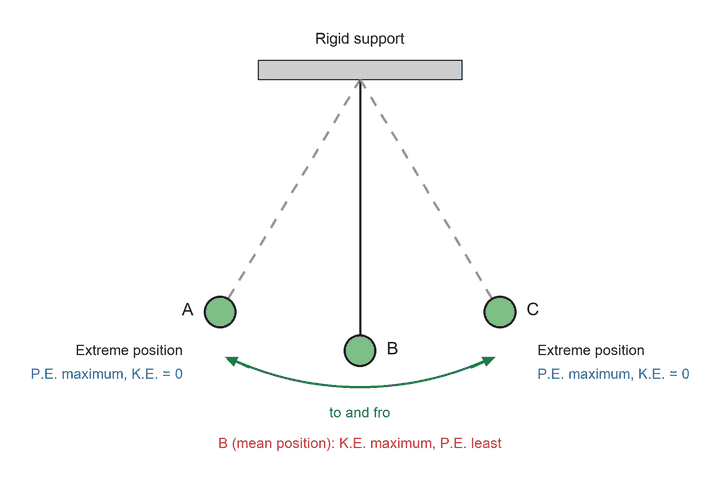
Take a simple pendulum swinging between the extreme positions A and C through the mean position B. We measure heights from the level of B.
Step 2 — At the extreme positions A and C.
The bob stops for a moment at its highest position. So its kinetic energy is zero and its potential energy is maximum; all its energy is potential energy.
Step 3 — From A to B.
As the bob moves down towards B, its height decreases and its speed increases, so potential energy changes into kinetic energy.
Step 4 — At the mean position B.
The bob is at its lowest point and moves fastest. Its kinetic energy is maximum and its potential energy is zero, because B is our zero level; all its energy is kinetic energy.
Step 5 — From B to C.
The bob rises again, so its kinetic energy changes back into potential energy until it stops for a moment at C.
Step 6 — Compare the totals.
At every point the loss in one form equals the gain in the other, so P.E. + K.E. stays the same throughout the swing, if friction and air resistance are ignored.
Watch out: In a real pendulum air resistance slowly turns some energy into heat, so the swings slowly die away.
Therefore, a swinging pendulum shows that P.E. + K.E. remains constant when friction is ignored.
- 543 marks
Question 54
State the changes in form of energy while producing hydro electricity.
Solve with AIWritten solution
Solution:
Concept: In a hydroelectric power station, the potential energy of stored water finally becomes electrical energy.
Step 1 — Water stored in the dam.
The water of a river is collected in a dam at a height. The stored water has potential energy.

Step 2 — Water falling down.
When the water flows down through pipes onto a water turbine, its potential energy changes into kinetic energy.
Step 3 — Turbine turning.
The moving water gives its kinetic energy to the blades of the turbine, which rotate. The turbine now has mechanical energy.
Step 4 — Generator working.
The turbine turns the coil (armature) of a generator (dynamo), which changes the mechanical energy into electrical energy.
Therefore, the changes are potential energy to kinetic energy to mechanical energy to electrical energy.
- 553 marks
Question 55
A truck starts from rest on a plane road. What are the possible energy changes taking place while the truck is in motion ?
Solve with AIWritten solution
Solution:
Concept: In every device or process, one form of energy goes in and another form (or forms) comes out. We find the change by asking what energy the body starts with and what energy it gives out. The law of conservation of energy says that energy can neither be created nor destroyed; it only changes from one form to another, so the total energy stays the same. A part may change into a non-useful form such as heat, but it is still counted in the total.
Step 1 — Chemical energy to kinetic energy.
In the engine, the fuel (diesel or petrol) burns, and its chemical energy changes into mechanical energy that moves the truck. As the truck picks up speed from rest, it gains kinetic energy.
Step 2 — Chemical energy to heat energy.
A part of the energy of the fuel becomes heat, so the engine gets hot.
Step 3 — Kinetic energy to heat energy.
Friction between the tyres and the road and in the moving parts turns some energy into heat, so the tyres become warm.
Step 4 — Energy to sound.
The engine and the moving truck produce sound energy. If the truck uses its headlights or horn, electrical energy from its battery changes into light and sound energy.
Step 5 — Potential energy.
The road is plane (level), so the height of the truck does not change and its potential energy stays the same.
Therefore, while the truck moves, chemical energy of the fuel changes into kinetic energy, heat energy and sound energy, while its potential energy stays the same.
What Class 7 Physics Ch 3 covers
The sections of the chapter, in the order the book takes them. Every question above comes from one of these.
- 01Units of Energy
- 02Different Forms of Energy
- 03Two Forms of Mechanical Energy
- 04Conversion of Potential Energy into Kinetic Energy
- 05Conversion of One Form of Energy into Another Form
- 06Conservation of Energy
More ways to study this chapter
The same chapter asked three other ways. Practise it, revise it, and see what the board has set on Ch 3 before.
Class 7 Physics Ch 3 questions students ask
How many questions are there in Class 7 Physics Ch 3?
55 questions. Every one is solved step by step on this page.
Are these Class 7 Physics solutions free?
Yes. Every question and its full working is free to read, with no account needed.
Can I download the Class 7 Physics Ch 3 solutions as a PDF?
There is no PDF to download. Every solution is on this page instead, which means it is searchable, always the current syllabus, and readable on a phone. Use your browser's print option if you want it on paper.