
Question 534 marksEasy
Give one example to show that the sum of potential energy and kinetic energy remains constant if friction is ignored.
Confirming your payment
Sign up now and get 250 free tokens.
Energy · Question 53 of 55
Give one example to show that the sum of potential energy and kinetic energy remains constant if friction is ignored.
Solution:
Concept: When potential energy changes into kinetic energy (or back), the loss in one equals the gain in the other. So, if friction and air resistance are neglected, P.E. + K.E. stays the same at every point.
Step 1 — Choose the example.
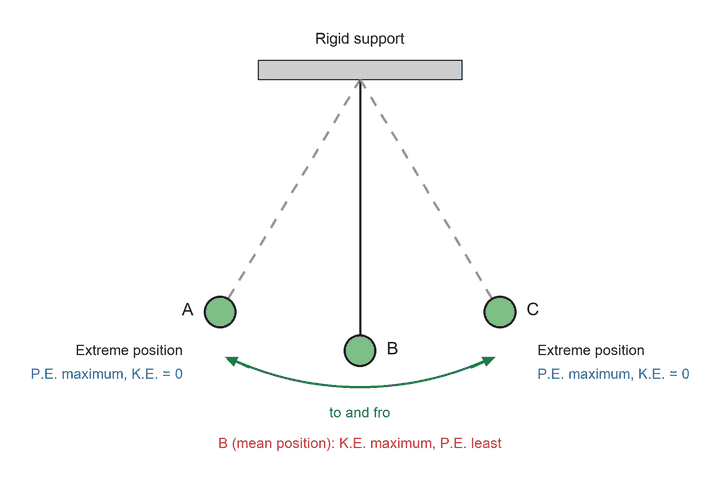
Take a simple pendulum swinging between the extreme positions A and C through the mean position B. We measure heights from the level of B.
Step 2 — At the extreme positions A and C.
The bob stops for a moment at its highest position. So its kinetic energy is zero and its potential energy is maximum; all its energy is potential energy.
Step 3 — From A to B.
As the bob moves down towards B, its height decreases and its speed increases, so potential energy changes into kinetic energy.
Step 4 — At the mean position B.
The bob is at its lowest point and moves fastest. Its kinetic energy is maximum and its potential energy is zero, because B is our zero level; all its energy is kinetic energy.
Step 5 — From B to C.
The bob rises again, so its kinetic energy changes back into potential energy until it stops for a moment at C.
Step 6 — Compare the totals.
At every point the loss in one form equals the gain in the other, so P.E. + K.E. stays the same throughout the swing, if friction and air resistance are ignored.
Watch out: In a real pendulum air resistance slowly turns some energy into heat, so the swings slowly die away.
Therefore, a swinging pendulum shows that P.E. + K.E. remains constant when friction is ignored.