
Opening your dashboard
Class 7 Physics Chapter 3 Energy: Competency-Based Questions (CBQ)
40 questions on Chapter 3, each worked through on its own page with the AI tutor. Class 7 Physics, ICSE 2026-27.
40 questions
1–5 marks · Mixed difficulty
- 11 mark
Question 1
Competency: Application
At a railway station, a porter pushes a loaded trolley along the platform with a steady force of 150 N and moves it through 20 m. He then stands still for 2 minutes, holding a suitcase of weight 200 N on his head. How much work has he done on the trolley and the suitcase altogether ?
- 21 mark
Question 2
Competency: Understanding & Application
In a scrap yard, a crane has a large electromagnet hanging from its arm. When the operator switches on the current, pieces of iron jump up from a heap of mixed scrap and stick to the electromagnet. Which chain shows the energy changes that make the iron pieces move up ?
- 31 mark
Question 3
Competency: Analysis
A traffic survey notes five vehicles on a level road at one moment.
Vehicle Mass (in kg) Speed (in km h) P : bicycle with rider 80 20 Q : scooter with rider 180 20 R : car 1000 20 S : car exactly like R 1000 60 T : loaded truck, parked 9000 0 Which vehicle has the greatest kinetic energy and which has the least ?
- 41 mark
Question 4
Competency: Application
Farid has a "squeeze torch" that has no cell in it. When he presses its handle again and again, a small generator inside it spins and the lamp glows. Starting from Farid, which chain shows the energy changes in the correct order ?
- 51 mark
Question 5
Competency: Understanding
Assertion (A): A rubber ball dropped on a hard floor rises to a smaller height after every bounce.
Reason (R): A part of the energy of the ball is destroyed every time it strikes the floor.
- 61 mark
Question 6
Competency: Understanding & Application
Assertion (A): In a hydroelectric power plant, the water turbine is placed far below the level of the water stored in the dam.
Reason (R): The greater the height through which the water falls, the more potential energy changes into kinetic energy to turn the turbine.
- 72 marks
Question 7
Competency: Application
Mitali compares the labels of two snack bars of the same price. The label of bar X says "Energy : 840 kJ". The label of bar Y says "Energy : 190 kcal". (Take 1 cal = 4.2 J, and 1 kJ = 1000 J.)
(a) Express the energy of bar Y in joule.
(b) Which bar gives more energy, and by how many joule ?
- 82 marks
Question 8
Competency: Evaluation
Dev shines a torch on a small paper ball lying on a table. The ball does not move. He says, "Energy is the capacity to do work. Light could not move even a paper ball, so light is not a form of energy."
(a) Is Dev's conclusion correct ?
(b) Give two observations from daily life that support your answer.
- 92 marks
Question 9
Competency: Analysis
Kavya tests a catapult in an open field. Each time she uses the same pebble and aims in the same direction, but pulls the rubber band back by a different length.
Length by which the rubber band is pulled back (in cm) 4 8 12 Distance at which the pebble lands (in m) 3 8 15 (a) Which form of energy does the stretched rubber band have, and where does this energy come from ?
(b) What does the table tell about this energy ? Why did Kavya keep the pebble and the direction the same in every trial ?
- 102 marks
Question 10
Competency: Application & Analysis
A toy gun has a spring inside its barrel. Imran pushes a light plastic dart fully into the barrel, so that the spring is compressed. He points the gun straight up and presses the trigger. The dart shoots up, stops for a moment at its highest point and then falls back.
(a) Write, in order, the energy changes from the compressed spring to the dart at its highest point.
(b) Next time Imran pushes the dart only half-way in. The dart now rises to a smaller height. Explain why.
- 114 marks
Question 11
Competency: Analysis & Evaluation
Case study: Kiran is at rest at point A, the top of the left side of a curved skating ramp. The figure shows the ramp and Kiran's potential energy (P.E.) at four points of it, measured from the lowest point B. Kiran is shown as a ball. She rolls down without pushing. Neglect friction.
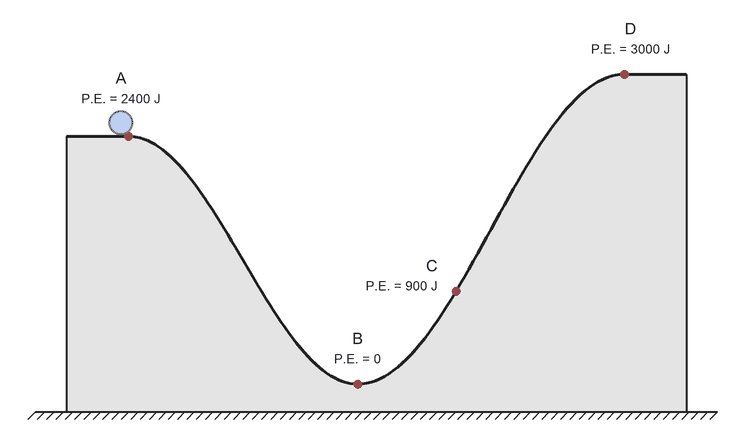
(a) What is Kiran's total mechanical energy at A ? Find her kinetic energy at B and at C.
(b) At which of the points A, B and C is she moving the fastest ? Give a reason.
(c) Kiran says, "Since there is no friction, I will go over the top at D." Use the values in the figure to judge her statement, and say what she must do to get past D.
- 124 marks
Question 12
Competency: Application & Analysis
Case study: A coconut hangs on a palm tree, 8 m above the ground. The graph shows how the potential energy of this coconut, measured from the ground, depends on its height.
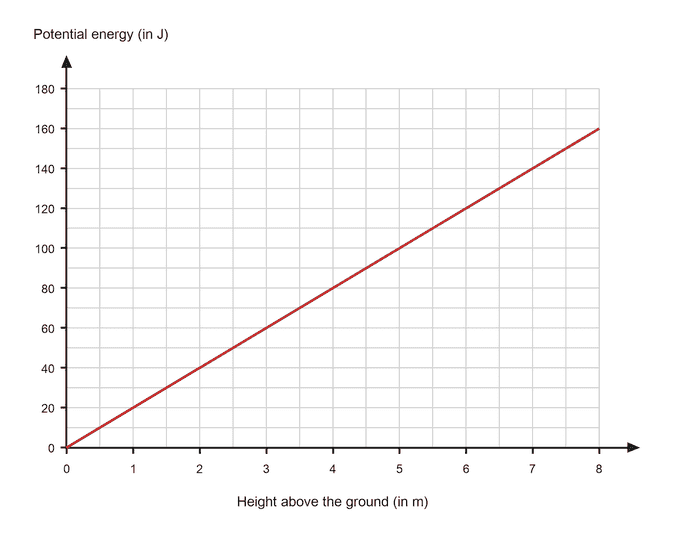
(a) Read from the graph the potential energy of the coconut at a height of 8 m and at a height of 2 m. What does the shape of the graph tell about potential energy and height ?
(b) The coconut breaks off and falls. Neglecting the friction of air, find its kinetic energy when it is 2 m above the ground. At what height are its kinetic energy and potential energy equal ?
(c) The coconut hits the soft ground and comes to rest in a small pit. Now its potential energy and kinetic energy are both zero. Has its energy been destroyed ? Explain.
- 133 marks
Question 13
Competency: Analysis & Evaluation
Case study: The engineer of a small hydroelectric power plant notes how much energy passes on at each stage in one second.
Stage Energy in one second (in J) Potential energy lost by the water in falling from the dam to the turbine 50000 Kinetic energy given to the blades of the turbine 45000 Electrical energy produced by the generator 40500 (a) Write the energy changes, in order, from the water stored in the dam to the electricity produced.
(b) How much of the 50000 J does not become electrical energy in one second ? In which forms does this part appear ?
(c) A visitor says, "The plant gives out less energy than the water loses. So energy is destroyed here, and the law of conservation of energy fails." Judge the visitor's statement.
- 144 marks
Question 14
Competency: Creation
Ananya wants to show her class that the kinetic energy of a moving body depends on its speed and on its mass. She has a smooth wooden plank, a few books, a steel ball and a wooden ball of the same size (the steel ball is much heavier), an empty matchbox and a metre scale.
(a) Describe how she should set up these things, and how she can compare kinetic energies with this set-up.
(b) Plan the trials that test the effect of speed.
(c) Plan the trials that test the effect of mass.
(d) State what she should observe in (b) and (c), and the conclusion.
- 154 marks
Question 15
Competency: Application & Analysis
Case study: A farmer uses a solar panel to run an electric motor. The motor works a pump, which lifts water from a well into a tank on a tower. On a bright afternoon, the energies in one second are as follows.
Energy In one second (in J) Light energy falling on the solar panel 5000 Electrical energy given by the panel to the motor 900 Mechanical energy given by the motor to the pump 720 Potential energy gained by the water lifted into the tank 600 (a) Name the energy change that takes place in the solar panel and in the motor.
(b) Find the energy that is not passed on to the next stage in the panel, in the motor and in the pump. The farmer has money to improve only one of the three. Which one should he choose, and why ?
(c) On a cloudy afternoon only 2000 J of light energy falls on the panel in one second. If every stage passes on the same fraction of the energy as before, how much potential energy does the water gain in one second ?
- 161 mark
Question 16
Competency: Application
A rickshaw puller pulls a rickshaw carrying two passengers along a straight road with a steady force of 125 N in the direction of motion. He pulls it through a distance of 3.2 km. How much work does he do ?
- 171 mark
Question 17
Competency: Application
Rakesh, a school attendant, pushes a loaded book trolley along a corridor with a steady force of 20 N in the direction of motion. He does 160 J of work on the trolley. Through what distance does the trolley move ?
- 181 mark
Question 18
Competency: Understanding
Which of the following is paired with the correct energy change ?
- 191 mark
Question 19
Competency: Analysis
A stone is dropped from the top of a tall tower and falls freely. Air resistance is negligible. A student finds its potential energy (P.E.) and kinetic energy (K.E.) at four moments of the fall and draws the bar graph shown. One of the four moments must have a wrong reading.

At which moment is a reading wrong ?
- 201 mark
Question 20
Competency: Application
Four overhead water tanks in a housing colony are full. The table gives the mass of water in each tank and the height of the water above the ground. The potential energy of a body is proportional to its mass and also to its height, so it is proportional to (mass × height). (Hypothetical data.)
Tank Mass of water (in kg) Height above the ground (in m) P 1000 6 Q 1500 5 R 2500 2.5 S 800 9 The water in which tank has the greatest potential energy ?
- 211 mark
Question 21
Competency: Evaluation
A simple pendulum bob is pulled aside to the extreme position A and released. It swings through the lowest point B to the extreme position C on the other side. Four students describe the motion. Friction and air resistance may be neglected. Whose description is correct ?
- 221 mark
Question 22
Competency: Understanding
Assertion (A): A stone thrown vertically upwards has no kinetic energy at its highest point, yet it still has mechanical energy there.
Reason (R): At the highest point, all the mechanical energy of the stone is in the form of potential energy.
- 231 mark
Question 23
Competency: Understanding
Assertion (A): The calorie is the S.I. unit of energy.
Reason (R): One calorie is equal to about 4.2 joule.
- 241 mark
Question 24
Competency: Analysis
Sunil rides his bicycle down a long slope without pedalling. He keeps pressing the brakes so that the speed of the cycle stays the same all the way down. At the bottom, he finds that the metal rims of the wheels feel warm. Which statement explains this correctly ?
- 251 mark
Question 25
Competency: Understanding
Which of the following pairs consists of two things that both store energy in the form of chemical energy ?
- 262 marks
Question 26
Competency: Analysis
A trainer notes the work done by three students on exercise machines. Asha did 2.5 kJ, Bharat did 2400 J and Chandni did 0.5 kcal. (Take 1 cal = 4.2 J.)
(a) Express the work done by each student in joule.
(b) Arrange the students in order, from the least to the greatest work done.
- 272 marks
Question 27
Competency: Understanding
On Diwali night, Tara's father lights the fuse of a rocket firework. The rocket rises with a hiss and a trail of sparks, and bursts high in the sky with a loud bang and coloured light.
(a) Name the form of energy stored in the rocket before it is lit.
(b) Name three other forms of energy that appear when the rocket burns and bursts.
- 282 marks
Question 28
Competency: Application
Raju and Mohan have the same body mass. Both climb the same staircase of 20 steps to the terrace. Raju carries two filled water cans, while Mohan climbs with empty hands.
(a) Who gains more potential energy ? Give a reason.
(b) From which form of energy of their bodies does this gain come ?
- 292 marks
Question 29
Competency: Analysis
A ball is released from rest at A, at the top of a smooth slope. It rolls down to B and then onto a rough carpet, and comes to rest at C. B and C are on the same level ground.
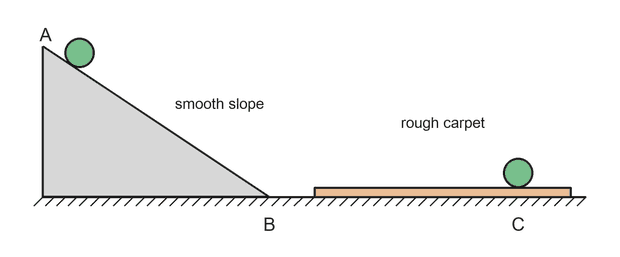
(a) Write the energy changes of the ball as it goes from A to B.
(b) At C the ball has neither potential energy nor kinetic energy, measured from the ground. Where has the energy it had at A gone ? Name two forms.
- 302 marks
Question 30
Competency: Application & Analysis
Some hydroelectric plants have a second, lower lake. At night, when electricity is spare, electric pumps lift water from the lower lake back up into the upper reservoir. In the daytime, when more electricity is needed, this water flows down through the turbines again.
(a) Name the energy change that takes place when the water is pumped up at night, and the form in which the energy is then stored.
(b) The plant gets back less electrical energy in the day than its pumps used at night. Where does the difference go, and why is pumping still useful ?
- 312 marks
Question 31
Competency: Application
A carpenter drives a nail into a wooden plank with a hammer. The nail sinks into the wood, the head of the nail becomes slightly warm and a "tock" sound is heard.
(a) Write the energy changes, in order, starting with the energy in the carpenter's body.
(b) Name three forms in which the kinetic energy of the hammer appears after it strikes the nail.
- 323 marks
Question 32
Competency: Application
A farmer's bullock pulls a wooden plough with a steady force of 800 N through 150 m, from one end of the field to the other. A small tractor, pulling a bigger plough with a steady force of 2400 N, ploughs a strip of the same field through 100 m. In each case the force acts along the motion.
(a) Find the work done by the bullock in one run, in kJ.
(b) Find the work done by the tractor in one run, in kJ.
(c) How many runs of 150 m must the bullock make to do as much work as the tractor does in one run ?
- 333 marks
Question 33
Competency: Creativity
The electricity bill of your school has become very high. The principal asks the science club to suggest three different practical ways to use less electrical energy. For each suggestion, name the useless form into which the electrical energy would otherwise have been changed.
- 343 marks
Question 34
Competency: Analysis
A toy car is released from rest from different heights on a smooth ramp, and then runs on a level floor until it stops. The same car and the same floor are used each time. (Hypothetical data.)
Height of release on the ramp (in cm) 10 20 30 Distance travelled by the car on the floor (in cm) 40 80 120 (a) Name the energy of the car at the moment of release and the energy it has at the foot of the ramp.
(b) What does the table show about the energy of the car at the foot of the ramp and the height of release ?
(c) Predict the distance on the floor for a release height of 40 cm, and say what change of energy makes the car stop.
- 353 marks
Question 35
Competency: Evaluation
Reena says, "Energy can never be destroyed. So the electrical energy we use is still there, and it makes no difference whether we leave the lights and fans on in an empty room or not."
(a) Is the first sentence of Reena's statement correct ?
(b) Is her conclusion correct ? Give a reason.
(c) Give one example of energy changing into a form that cannot easily be used again.
- 363 marks
Question 36
Competency: Application & Analysis
Neha holds a small plastic paddle wheel under a tap which is connected to the water tank on the terrace. The falling water turns the paddle wheel. The axle of the wheel winds up a thread and lifts a small stone from the table.
(a) Write the energy changes from the water in the tank to the lifted stone.
(b) The potential energy gained by the stone is less than the potential energy lost by the water. Explain where the rest of the energy has gone.
(c) Neha moves the wheel to a tap lower down, so that the water falls through a greater height. What change will she see in the wheel ? Give a reason.
- 375 marks
Question 37
Competency: Analysis & Evaluation
Case study: A cyclist rides on a level road. The graph shows the kinetic energy of the cyclist with his bicycle at different speeds. (Hypothetical data.) To stop the cycle, the brakes must do work equal to its kinetic energy, and the work done = force × distance.
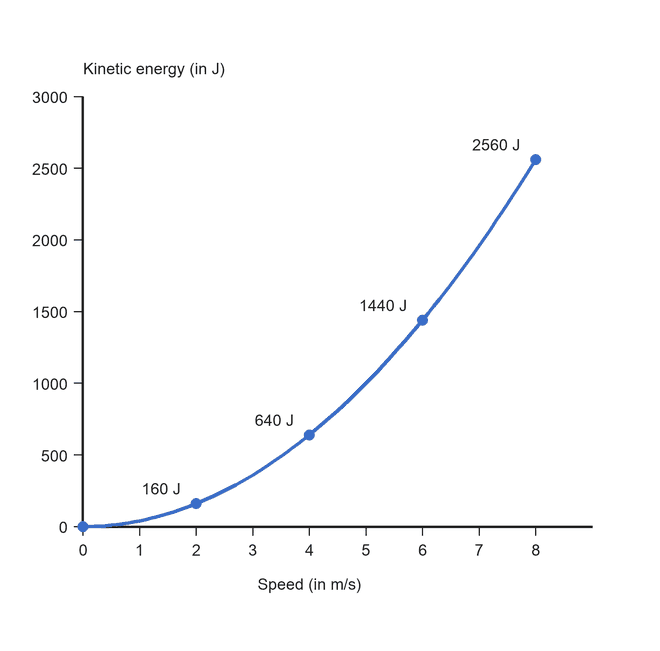
(a) From the graph, find the kinetic energy at a speed of 4 m/s. At what speed is the kinetic energy 1440 J ?
(b) Find how many times the kinetic energy becomes when the speed is doubled from 2 m/s to 4 m/s, and from 4 m/s to 8 m/s. What do you conclude ?
(c) The cyclist says, "If I ride twice as fast, my brakes will need only twice the distance to stop me." His brakes stop the cycle with a steady force of 160 N. Find the stopping distance at 4 m/s and at 8 m/s, and judge his statement.
- 384 marks
Question 38
Competency: Application & Analysis
Case study: A school wants to choose a kind of lamp for its classrooms. Three lamps are tested for 1 hour each, adjusted to give the same amount of light. (Hypothetical data.) The energy that is not given out as light may be taken as heat.
Lamp Electrical energy taken in 1 hour (in kJ) Light energy given out in 1 hour (in kJ) P : filament lamp 216 10.8 Q : CFL 54 10.8 R : LED lamp 32.4 10.8 (a) Find the heat energy given out by each lamp in 1 hour.
(b) Find the percentage of the electrical energy taken in that each lamp changes into light.
(c) The school has 20 lamps of type P, each used for 6 hours a day. By how much would the electrical energy used in one day fall if all of them were replaced by type R lamps ? Give the answer in kJ.
- 394 marks
Question 39
Competency: Analysis & Evaluation
Case study: Arun sets up a simple pendulum and releases the bob from rest at the right-hand end position. He notes the height of the bob above its lowest point at the moment of release, and again each time the bob comes back and stops for a moment at the right-hand end. The potential energy of the bob at an end position is proportional to this height. (Hypothetical data.)
Number of complete swings 0 (release) 1 2 3 Height of the bob at the right-hand end (in cm) 20.0 18.0 16.2 14.6 (a) What does the table tell about the mechanical energy of the pendulum as it keeps swinging ?
(b) What percentage of the mechanical energy at release is left after 3 complete swings ? What percentage is lost ?
(c) Arun says, "The energy of the pendulum has been destroyed, so the law of conservation of energy is wrong." Judge his statement and say what must be done to keep the pendulum swinging to the same height.
- 404 marks
Question 40
Competency: Creativity
Case study: For the science exhibition, the Class 7 students build a "chain-reaction model" on a table, using a ramp, a marble, a row of standing dominoes, a toy car, a thread and a small bell. The marble starts the chain, and each stage sets off the next. The last stage must ring the bell. Nobody touches anything after the marble is released.
(a) Describe a chain of at least four stages that uses these things, from the release of the marble to the ringing of the bell.
(b) For each stage, name the energy change that takes place.
(c) The bell rings only softly. Name the two stores of potential energy in the model at the start, and explain why only a small part of the energy reaches the bell.