
Opening your dashboard
Class 7 Physics Chapter 3 Energy: Practice Questions
40 questions on Chapter 3, each worked through on its own page with the AI tutor. Class 7 Physics, ICSE 2026-27.
40 questions
1–5 marks · Mixed difficulty
- 11 mark
Question 1
Bloom's level: Remember
One joule of work is said to be done when :
- 21 mark
Question 2
Bloom's level: Remember
One kilo-calorie (1 kcal) is equal to :
- 31 mark
Question 3
Bloom's level: Understand
When water boils in a kettle with a lid on it, the lid starts moving up and down. This shows that :
- 41 mark
Question 4
Bloom's level: Understand
Which of the following has potential energy because of its state (and not because of its position) ?
- 51 mark
Question 5
Bloom's level: Apply
A girl pushes a box along the floor with a force of 40 N and moves it through 3 m in the direction of the force. The work done by her is :
- 61 mark
Question 6
Bloom's level: Apply
A packet of biscuits gives 500 kcal of energy. Taking 1 cal = 4.2 J, this energy in joule is :
- 71 mark
Question 7
Bloom's level: Analyse
A roller coaster car starts from rest at the top point P. Neglecting friction, its potential energy at four points is :
Point P Q R S Potential energy (in kJ) 60 15 0 35 At which point is the car moving the fastest ?
- 81 mark
Question 8
Bloom's level: Evaluate
Rahul writes in his notebook: "A solar cell changes heat energy into electrical energy." Which is the best judgement of his statement ?
- 91 mark
Question 9
Bloom's level: Understand
In a hydroelectric power plant, the water stored in the dam at a height mainly possesses :
- 101 mark
Question 10
Bloom's level: Understand
Read the Assertion (A) and the Reason (R) and choose the correct option.
Assertion (A): A hammer raised above a nail can drive the nail into a block of wood when it is dropped.
Reason (R): The potential energy of the raised hammer changes into kinetic energy as it falls, and this kinetic energy does work on the nail.
- 111 mark
Question 11
Bloom's level: Understand
Read the Assertion (A) and the Reason (R) and choose the correct option.
Assertion (A): When an electric motor is given 100 J of electrical energy and produces only 60 J of mechanical energy, 40 J of energy is destroyed.
Reason (R): In every transformation of energy, a part of the energy changes into non-useful forms such as heat and sound.
- 121 mark
Question 12
Bloom's level: Remember
Read the Assertion (A) and the Reason (R) and choose the correct option.
Assertion (A): The kinetic energy of a moving body depends on its speed.
Reason (R): A body at rest can never have any energy.
- 132 marks
Question 13
Bloom's level: Understand
Aman pushes hard against a classroom wall for five minutes and feels very tired. Has he done any work on the wall ? Explain, and say what happened to the energy he spent.
- 142 marks
Question 14
Bloom's level: Apply
A room heater gives out 8400 J of heat in a short time. Express this energy in (a) calorie, (b) kilo-calorie. (Take 1 cal = 4.2 J.)
- 152 marks
Question 15
Bloom's level: Apply
Name the form of energy that each of the following possesses or gives out :
(a) a bar magnet pulling a pin towards it
(b) petrol in the tank of a car
(c) the school bell while it is ringing
(d) uranium in the reactor of an atomic power station
- 162 marks
Question 16
Bloom's level: Understand
The spring of a toy car is wound up with a key and the car is placed on the floor and released. (a) What energy is stored in the wound-up spring ? (b) What happens to this energy as the car moves ? (c) Why does the car finally stop ?
- 172 marks
Question 17
Bloom's level: Apply
State the energy change that takes place in each of the following :
(a) a solar calculator working in sunlight
(b) a mixer grinder while running
(c) a matchstick being struck
(d) a windmill turning a generator
- 182 marks
Question 18
Bloom's level: Apply
State whether each of the following has potential energy, kinetic energy or both :
(a) an aeroplane flying high in the sky
(b) water in an overhead tank
(c) a catapult stretched just before release
(d) a marble rolling on the floor
- 192 marks
Question 19
Bloom's level: Apply
An electric motor is supplied 500 J of electrical energy. It gives 350 J of useful mechanical energy. (a) How much energy changes into heat and sound ? (b) What is the total energy after the change ? Which law does this show ?
- 202 marks
Question 20
Bloom's level: Evaluate
Meena says, "A car parked with its brakes on at the top of a hill has no energy at all, because it is not moving." Do you agree ? Justify your answer.
- 212 marks
Question 21
Bloom's level: Analyse
Engineers prefer to build a hydroelectric dam on a river high up in the hills and to store a large amount of water behind it. Explain both choices using what you know about potential energy.
- 222 marks
Question 22
Bloom's level: Remember
(a) Write the relation for the work done by a force.
(b) State the law of conservation of energy.
- 234 marks
Question 23
Bloom's level: Apply
A crane lifts a load by applying an upward force of 5000 N and raises it through a height of 12 m.
(a) Find the work done by the crane.
(b) In what form is this work stored in the load at the top ? Give a reason.
(c) Express this energy in kilojoule and in kilo-calorie. (1 cal = 4.2 J)
- 244 marks
Question 24
Bloom's level: Analyse
A ball is held at rest at point A, at a height above the ground, where its potential energy is 120 J. It is dropped and falls through B (half the height of A) to C on the ground. Neglect air friction.
Point Potential energy (J) Kinetic energy (J) A (top) 120 ? B (half-way) ? ? C (ground, just before striking) ? ? (a) Copy and complete the table.
(b) What do you notice about the sum of potential and kinetic energy at A, B and C ? Name the law it shows.
(c) After striking a hard floor, the ball bounces up, but each bounce is lower than the one before. Is energy being destroyed ? Explain.
- 254 marks
Question 25
Bloom's level: Analyse
Case study: A small hydroelectric plant supplies electricity to villages in a hilly area. The same amount of water is let out on to the turbine every second, but the height of the water in the dam above the turbine changes with the season. The plant records :
Season Height of water above the turbine (m) Number of homes supplied After the monsoon 40 400 Winter 30 300 Summer 20 200 (a) Write the chain of energy changes from the water stored in the dam to the bulbs glowing in the homes.
(b) What relation do you find between the height of the water and the number of homes supplied ? Explain it using potential energy.
(c) Predict the number of homes that could be supplied if the height of the water fell to 10 m, and suggest why the plant supplies the fewest homes in summer.
- 264 marks
Question 26
Bloom's level: Analyse
Case study: In Priya's kitchen in the morning, her mother lights the LPG stove to make tea, boils water in an electric kettle, grinds chutney in a mixer grinder and listens to the news on a radio.
(a) Name the energy change in each of the four appliances.
(b) In which two appliances is the useful energy obtained in the form of heat ?
(c) The kettle takes 1000 J of electrical energy, and 850 J of it heats the water. How much energy is lost, and in what form ? Does this mean the law of conservation of energy is broken ?
- 273 marks
Question 27
Bloom's level: Apply
A swimmer stands on the end of a springboard above a pool, bounces so that the board bends down, is thrown up into the air, and then falls into the water. State the form of mechanical energy in each case below and give a reason :
(a) the swimmer standing still on the board
(b) the board when it is bent down to the lowest point
(c) the swimmer at the highest point in the air, and then just before touching the water
- 283 marks
Question 28
Bloom's level: Evaluate
Two inventors make claims about their new machines :
Inventor X: "My machine takes in 200 J of electrical energy and gives out 250 J of mechanical energy."
Inventor Y: "My machine takes in 200 J of electrical energy and gives out exactly 200 J of mechanical energy - none of it becomes heat or sound."
Judge each claim using what you have learnt about energy. Which claim is impossible and which is only very unlikely ? Give reasons.
- 295 marks
Question 29
Bloom's level: Create
Design an experiment to show that the potential energy of a raised body depends on (i) its height and (ii) its mass. Use a tray of smooth, damp sand and some balls. Include :
(a) the apparatus and how you will measure the effect of the potential energy,
(b) the steps for each of the two tests, and what you will keep the same in each,
(c) an observation table with your own sample readings,
(d) your conclusions.
- 304 marks
Question 30
Bloom's level: Create
Construct an energy-flow chart that traces the energy used by a girl running a race back to the sun. Show at least four steps, name the form of energy at each step, and name the process or device at each arrow. Then add one branch to your chart showing where some of the energy goes that is not useful for running.
- 311 mark
Question 31
Which of the following is not a unit of energy ?
- 321 mark
Question 32
Coal, petrol and cooking gas (LPG) are fuels. The energy stored in these fuels is in the form of :
- 331 mark
Question 33
Which of the following has both potential energy and kinetic energy ?
- 341 mark
Question 34
Fill in the blank :
The device used on a stage which changes the sound energy of a speaker's voice into electrical energy is called a .............. .
- 351 mark
Question 35
Write true or false :
When a stone falls freely from a height, the sum of its potential energy and kinetic energy remains the same at every point of its path, if friction due to air is neglected.
- 362 marks
Question 36
Differentiate between potential energy and kinetic energy. Give one example of each.
- 372 marks
Question 37
A gardener pulls a lawn roller with a force of 60 N and moves it through a distance of 35 m in the direction of the force. Calculate the energy spent by the gardener in (a) joule, (b) calorie. (Take 1 cal = 4.2 J.)
- 384 marks
Question 38
The figure shows the track of a roller coaster. The car is at rest at the highest point A, where its potential energy is 30 000 J. It then runs down to the lowest point B on the ground level and rises to the point C, where its potential energy is 12 000 J. Neglect friction.
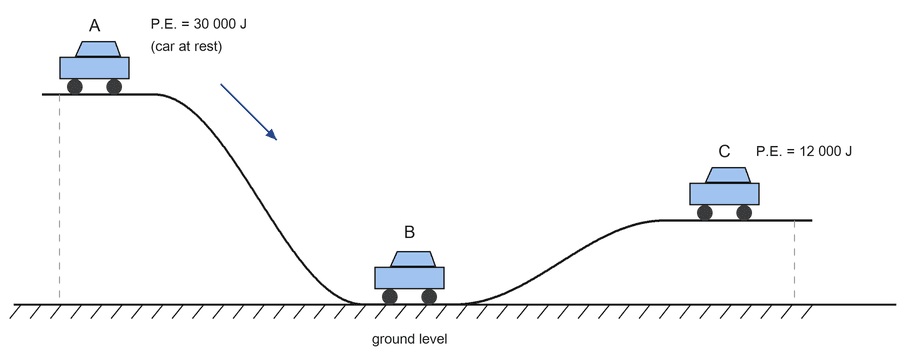
(a) What is the kinetic energy of the car at A ? Give a reason.
(b) State the energy change that takes place as the car moves (i) from A to B, (ii) from B to C.
(c) Find the kinetic energy of the car (i) at B, (ii) at C.
- 394 marks
Question 39
In a hydroelectric power plant, the water of a river is collected in a dam built at a high altitude.
(a) Which form of energy does the water stored in the dam possess ? Why is the dam built at a high altitude ?
(b) State the function of (i) the water turbine, (ii) the generator (dynamo) in the power plant.
(c) Complete the table to show the energy change at each stage.
Stage Energy change Water falls from the dam on the turbine .............. energy of water → .............. energy of water Falling water turns the blades of the turbine kinetic energy of water → .............. energy of the turbine The turbine rotates the armature of the generator .............. energy → .............. energy - 405 marks
Question 40
(a) State the law of conservation of energy.
(b) State the energy change that takes place in each of the following : (i) a windmill, (ii) a steam engine, (iii) a television.
(c) A mixer grinder is supplied with 800 J of electrical energy. Out of this, 520 J changes into mechanical energy of its blades and 40 J into sound energy. The rest changes into heat energy. Calculate the heat energy produced. Which of these forms of energy is the useful one here ?