
Opening your dashboard
Class 7 Maths Chapter 21: Congruency: Congruent Triangles Solutions
38 textbook questions with step-by-step answers, free to read, for ICSE 2026-27.
Get talked through Ch 21, not just shown the answer
Reading a finished solution is not the same as being able to do it. The AI tutor takes one question at a time and works it with you, in your own words, until you can.
- Ask it out loud, in your own words
- It gives you the next step, not the answer
- Stuck on part (ii)? Start there
38 questions with solutions
1–3 marks · Mixed difficulty
- 13 marks
Question 1
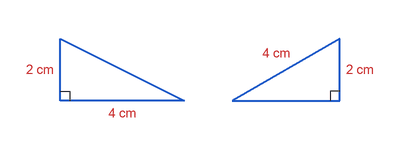
State, whether the pairs of triangles given in the following figures are congruent or not :
(i)
 Solve with AI
Written solution
Solution:
Concept: Two triangles are congruent when one fits exactly on the other. Each of these tests is enough: S.S.S. (three pairs of equal sides); S.A.S. (two pairs of equal sides and the angle between them); A.S.A. or A.A.S. (two pairs of equal angles and one pair of corresponding sides); R.H.S. (a right angle, the hypotenuse and one more side). Three angles alone, or two sides with an angle that is not between them, are not enough.
Step 1 — Read the first triangle.
The first triangle has a right angle between its 2 cm and 4 cm sides. So these two sides are the arms of the right angle, and its hypotenuse is longer than 4 cm.
This is about 4·47 cm.
Step 2 — Read the second triangle.
In the second triangle the 2 cm side is an arm of the right angle, but the 4 cm side is the hypotenuse (it is opposite the right angle).
Step 3 — Compare.
The hypotenuses are √20 cm and 4 cm, which are not equal, so the sides do not match. No test of congruence can be applied.
Watch out: Check where each length is: a 4 cm arm of the right angle is not the same as a 4 cm hypotenuse.
Therefore, the triangles are not congruent.
- 23 marks
Question 2
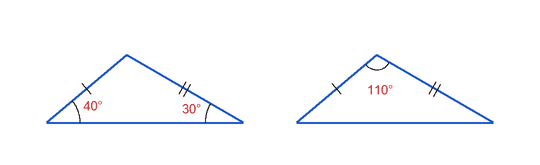
State, whether the pairs of triangles given in the following figures are congruent or not :
(ii)
 Solve with AI
Written solution
Solution:
Concept: Two triangles are congruent when one fits exactly on the other. Each of these tests is enough: S.S.S. (three pairs of equal sides); S.A.S. (two pairs of equal sides and the angle between them); A.S.A. or A.A.S. (two pairs of equal angles and one pair of corresponding sides); R.H.S. (a right angle, the hypotenuse and one more side). Three angles alone, or two sides with an angle that is not between them, are not enough.
Step 1 — Find the third angle of the first triangle.
The angles of a triangle add up to 180°.
Step 2 — Locate the 110° angles.
In the first triangle the 110° angle is at the top vertex, between the side with one tick and the side with two ticks. In the second triangle the 110° angle is also between the side with one tick and the side with two ticks.
Step 3 — Apply S.A.S.
The one-tick sides are equal, the two-tick sides are equal, and the angles between them are both 110°. So two sides and the included angle are equal.
Watch out: Find the missing angle first; it is the angle between the two marked sides that S.A.S. needs.
Therefore, yes, the triangles are congruent (by S.A.S.).
- 33 marks
Question 3
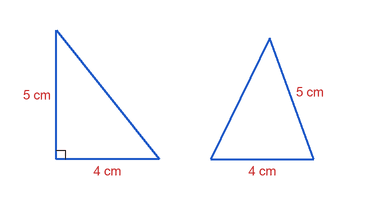
State, whether the pairs of triangles given in the following figures are congruent or not :
(iii)
 Solve with AI
Written solution
Solution:
Concept: Two triangles are congruent when one fits exactly on the other. Each of these tests is enough: S.S.S. (three pairs of equal sides); S.A.S. (two pairs of equal sides and the angle between them); A.S.A. or A.A.S. (two pairs of equal angles and one pair of corresponding sides); R.H.S. (a right angle, the hypotenuse and one more side). Three angles alone, or two sides with an angle that is not between them, are not enough.
Step 1 — Read the first triangle.
The first triangle has sides 5 cm and 4 cm, and the angle between them is marked as a right angle.
Step 2 — Read the second triangle.
The second triangle also has sides 5 cm and 4 cm, but the angle between them is not marked, and no other angle is marked either.
Step 3 — Compare.
We know only two pairs of equal sides. The angle between them is 90° in the first triangle but is not given (and is drawn acute) in the second, so S.A.S. cannot be used and no other test fits.
Watch out: Two equal pairs of sides are not enough; the included angles must be equal too.
Therefore, the triangles are not congruent.
- 43 marks
Question 4
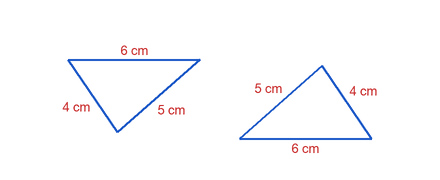
State, whether the pairs of triangles given in the following figures are congruent or not :
(iv)
 Solve with AI
Written solution
Solution:
Concept: Two triangles are congruent when one fits exactly on the other. Each of these tests is enough: S.S.S. (three pairs of equal sides); S.A.S. (two pairs of equal sides and the angle between them); A.S.A. or A.A.S. (two pairs of equal angles and one pair of corresponding sides); R.H.S. (a right angle, the hypotenuse and one more side). Three angles alone, or two sides with an angle that is not between them, are not enough.
Step 1 — List the sides.
The first triangle has sides 6 cm, 4 cm and 5 cm. The second triangle has sides 6 cm, 5 cm and 4 cm.
Step 2 — Apply S.S.S.
Each side of one triangle equals a side of the other: 6 cm with 6 cm, 5 cm with 5 cm and 4 cm with 4 cm. Three pairs of equal sides give S.S.S.
Watch out: The triangles may be turned over or drawn the other way up; only the lengths matter for S.S.S.
Therefore, yes, the triangles are congruent (by S.S.S.).
- 53 marks
Question 5
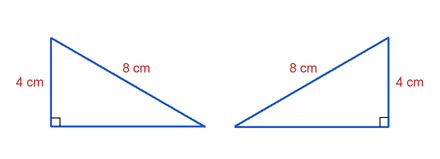
State, whether the pairs of triangles given in the following figures are congruent or not :
(v)
 Solve with AI
Written solution
Solution:
Concept: Two triangles are congruent when one fits exactly on the other. Each of these tests is enough: S.S.S. (three pairs of equal sides); S.A.S. (two pairs of equal sides and the angle between them); A.S.A. or A.A.S. (two pairs of equal angles and one pair of corresponding sides); R.H.S. (a right angle, the hypotenuse and one more side). Three angles alone, or two sides with an angle that is not between them, are not enough.
Step 1 — Read both triangles.
Both triangles have a right angle. In each, the side opposite the right angle (the hypotenuse) is 8 cm, and one arm of the right angle is 4 cm.
Step 2 — Apply R.H.S.
A right angle, equal hypotenuses and one more pair of equal sides is exactly the R.H.S. test.
Watch out: R.H.S. needs the hypotenuse to be one of the equal sides; check that the 8 cm side is opposite the right angle in both triangles.
Therefore, yes, the triangles are congruent (by R.H.S.).
- 63 marks
Question 6
State, whether the pairs of triangles given in the following figures are congruent or not :
(vi)
 Solve with AI
Written solution
Solution:
Concept: Two triangles are congruent when one fits exactly on the other. Each of these tests is enough: S.S.S. (three pairs of equal sides); S.A.S. (two pairs of equal sides and the angle between them); A.S.A. or A.A.S. (two pairs of equal angles and one pair of corresponding sides); R.H.S. (a right angle, the hypotenuse and one more side). Three angles alone, or two sides with an angle that is not between them, are not enough.
Step 1 — Read the marks.
Each triangle has a 6 cm side. At one end of it is the angle marked with one arc, and at the other end is the angle marked with two arcs, in both triangles.
Step 2 — Apply A.S.A.
Two pairs of equal angles with the equal side between them is the A.S.A. test. (Once two angles are equal, the third angles are equal too, so A.A.S. also applies.)
Watch out: The second triangle is a mirror image of the first; turning a triangle over does not stop it being congruent.
Therefore, yes, the triangles are congruent (by A.S.A.; A.A.S. also holds).
- 73 marks
Question 7
State, whether the pairs of triangles given in the following figures are congruent or not :
(vii) Δ ABC in which AB = 2 cm, BC = 3·5 cm and ∠A = 80°.

and, ΔDEF in which DE = 2 cm, DF = 3·5 cm and ∠D = 80°.
Solve with AIWritten solution
Solution:
Concept: Two triangles are congruent when one fits exactly on the other. Each of these tests is enough: S.S.S. (three pairs of equal sides); S.A.S. (two pairs of equal sides and the angle between them); A.S.A. or A.A.S. (two pairs of equal angles and one pair of corresponding sides); R.H.S. (a right angle, the hypotenuse and one more side). Three angles alone, or two sides with an angle that is not between them, are not enough.
Step 1 — Locate the 80° angle in ΔABC.
In ΔABC the equal sides are AB and BC, which meet at B. The 80° angle is at A, so it is not the angle between AB and BC.
Step 2 — Locate the 80° angle in ΔDEF.
In ΔDEF the sides DE and DF meet at D, and the 80° angle is at D, so it is the angle between them.
Step 3 — Compare.
The equal angles are in different positions with respect to the equal sides, so S.A.S. cannot be used. Two sides with an angle that is not between them do not fix a triangle.
Watch out: For S.A.S. the angle must be the one formed by the two given sides in both triangles.
Note: The book prints ∠C = 80° for ΔABC, but no triangle has AB = 2 cm, BC = 3·5 cm and ∠C = 80°: from B, 3·5 cm away from C, an arc of radius 2 cm never reaches the other arm of an 80° angle at C. The angle is corrected here to ∠A = 80°, which gives a real triangle. Drawn to scale, the third side AC is about 3·2 cm while EF is about 3·7 cm, which confirms that the triangles are different.
Therefore, the triangles are not congruent.
- 83 marks
Question 8
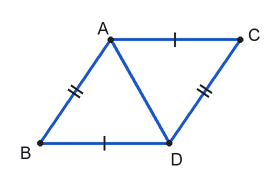
In the given figure, prove that :
Δ ABD ≅ Δ ACD
 Solve with AI
Written solution
Solution:
Concept: Two triangles are congruent when one fits exactly on the other. Each of these tests is enough: S.S.S. (three pairs of equal sides); S.A.S. (two pairs of equal sides and the angle between them); A.S.A. or A.A.S. (two pairs of equal angles and one pair of corresponding sides); R.H.S. (a right angle, the hypotenuse and one more side). Three angles alone, or two sides with an angle that is not between them, are not enough. When two triangles are congruent, every part of one equals the matching (corresponding) part of the other. We write the vertices in matching order, so ΔABC ≅ ΔPQR means A ↔ P, B ↔ Q and C ↔ R.
Step 1 — Choose the triangles and match the vertices.
We compare ΔABD and ΔDCA. The figure marks AB = DC (two ticks) and BD = CA (one tick), and AD is a side of both triangles.
Step 2 — Apply S.S.S.
We list the three pairs of equal sides.
AB = DC (given, marked equal)
BD = CA (given, marked equal)
AD = DA (common side)
So ΔABD ≅ ΔDCA by S.S.S.
Watch out: Write the vertices in matching order; the order tells which sides and angles are equal.
Note: Since AB = DC and BD = AC, vertex A of ΔABD matches D, and B matches C. In matching order the congruence is ΔABD ≅ ΔDCA; the question's ΔACD names the same triangle.
Therefore, ΔABD ≅ ΔDCA (S.S.S.), so triangles ABD and ACD are congruent. Hence proved.
- 93 marks
Question 9
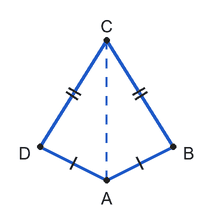
Prove that :
(i) Δ ABC ≅ Δ ADC
(ii) ∠B = ∠D
(iii) AC bisects angle DCB
 Solve with AI
Written solution
Solution:
Concept: Two triangles are congruent when one fits exactly on the other. Each of these tests is enough: S.S.S. (three pairs of equal sides); S.A.S. (two pairs of equal sides and the angle between them); A.S.A. or A.A.S. (two pairs of equal angles and one pair of corresponding sides); R.H.S. (a right angle, the hypotenuse and one more side). Three angles alone, or two sides with an angle that is not between them, are not enough. When two triangles are congruent, every part of one equals the matching (corresponding) part of the other. We write the vertices in matching order, so ΔABC ≅ ΔPQR means A ↔ P, B ↔ Q and C ↔ R.
Step 1 — Part (i): prove the triangles congruent.
The figure marks AB = AD and CB = CD, and AC is a side of both triangles.
AB = AD (given)
CB = CD (given)
AC = AC (common side)
So ΔABC ≅ ΔADC by S.S.S.
Step 2 — Part (ii): ∠B = ∠D.
In the congruence ΔABC ≅ ΔADC, vertex B matches vertex D. So ∠B = ∠D, as corresponding angles of congruent triangles.
Step 3 — Part (iii): AC bisects ∠DCB.
Vertex C matches C, so ∠BCA = ∠DCA (corresponding angles). AC therefore divides ∠DCB into two equal angles, which means it bisects ∠DCB.
Watch out: Prove the congruence first; only then may matching angles be called equal.
Therefore, ΔABC ≅ ΔADC (S.S.S.), so ∠B = ∠D and AC bisects ∠DCB. Hence proved.
- 103 marks
Question 10
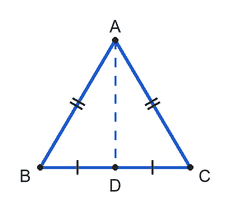
Prove that :
(i) Δ ABD ≅ Δ ACD
(ii) ∠B = ∠C
(iii) ∠ADB = ∠ADC
(iv) ∠ADB = 90°
 Solve with AI
Written solution
Solution:
Concept: Two triangles are congruent when one fits exactly on the other. Each of these tests is enough: S.S.S. (three pairs of equal sides); S.A.S. (two pairs of equal sides and the angle between them); A.S.A. or A.A.S. (two pairs of equal angles and one pair of corresponding sides); R.H.S. (a right angle, the hypotenuse and one more side). Three angles alone, or two sides with an angle that is not between them, are not enough. When two triangles are congruent, every part of one equals the matching (corresponding) part of the other. We write the vertices in matching order, so ΔABC ≅ ΔPQR means A ↔ P, B ↔ Q and C ↔ R. Angles on a straight line add up to 180°.
Step 1 — Part (i): prove the triangles congruent.
The figure marks AB = AC and BD = DC, and AD is a side of both triangles.
AB = AC (given)
BD = CD (given)
AD = AD (common side)
So ΔABD ≅ ΔACD by S.S.S.
Step 2 — Part (ii): ∠B = ∠C.
In ΔABD ≅ ΔACD, vertex B matches C, so ∠B = ∠C (corresponding angles).
Step 3 — Part (iii): ∠ADB = ∠ADC.
Vertex D matches D, so ∠ADB = ∠ADC (corresponding angles).
Step 4 — Part (iv): ∠ADB = 90°.
B, D and C lie on a straight line, so the two angles at D add up to 180°. Since they are equal, each of them is half of 180°.
Watch out: ∠ADB = 90° needs both facts: the two angles are equal and they lie on a straight line.
Therefore, ΔABD ≅ ΔACD (S.S.S.), so ∠B = ∠C, ∠ADB = ∠ADC and ∠ADB = 90°. Hence proved.
- 113 marks
Question 11
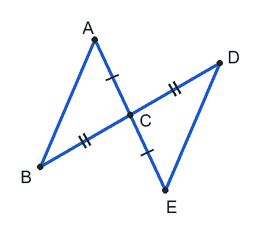
In the given figure, prove that :
(i) Δ ACB ≅ Δ ECD
(ii) AB = ED
 Solve with AI
Written solution
Solution:
Concept: Two triangles are congruent when one fits exactly on the other. Each of these tests is enough: S.S.S. (three pairs of equal sides); S.A.S. (two pairs of equal sides and the angle between them); A.S.A. or A.A.S. (two pairs of equal angles and one pair of corresponding sides); R.H.S. (a right angle, the hypotenuse and one more side). Three angles alone, or two sides with an angle that is not between them, are not enough. When two triangles are congruent, every part of one equals the matching (corresponding) part of the other. We write the vertices in matching order, so ΔABC ≅ ΔPQR means A ↔ P, B ↔ Q and C ↔ R. Vertically opposite angles are equal.
Step 1 — Part (i): prove the triangles congruent.
The figure marks AC = EC and BC = DC. Lines AE and BD cross at C, so the angles ACB and ECD are vertically opposite angles, which are always equal.
AC = EC (given)
∠ACB = ∠ECD (vertically opposite angles)
BC = DC (given)
The equal angles lie between the equal sides, so ΔACB ≅ ΔECD by S.A.S.
Step 2 — Part (ii): AB = ED.
In ΔACB ≅ ΔECD, A matches E and B matches D, so AB = ED (corresponding sides).
Watch out: The angle used in S.A.S. must be the one between the two equal sides; here it is the angle at C.
Therefore, ΔACB ≅ ΔECD (S.A.S.), so AB = ED. Hence proved.
- 123 marks
Question 12
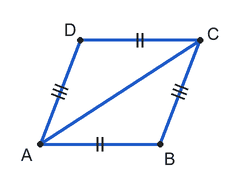
Prove that :
(i) Δ ABC ≅ Δ ADC
(ii) ∠B = ∠D
 Solve with AI
Written solution
Solution:
Concept: Two triangles are congruent when one fits exactly on the other. Each of these tests is enough: S.S.S. (three pairs of equal sides); S.A.S. (two pairs of equal sides and the angle between them); A.S.A. or A.A.S. (two pairs of equal angles and one pair of corresponding sides); R.H.S. (a right angle, the hypotenuse and one more side). Three angles alone, or two sides with an angle that is not between them, are not enough. When two triangles are congruent, every part of one equals the matching (corresponding) part of the other. We write the vertices in matching order, so ΔABC ≅ ΔPQR means A ↔ P, B ↔ Q and C ↔ R.
Step 1 — Part (i): prove the triangles congruent.
The figure marks AB = DC (two ticks) and BC = DA (three ticks), and AC is a side of both triangles.
AB = CD (given)
BC = DA (given)
AC = CA (common side)
So ΔABC ≅ ΔCDA by S.S.S., which says that triangles ABC and ADC are congruent.
Step 2 — Part (ii): ∠B = ∠D.
In ΔABC ≅ ΔCDA, vertex B matches D, so ∠B = ∠D (corresponding angles).
Watch out: Write the vertices in matching order; the order tells which sides and angles are equal.
Note: Since AB = CD and BC = DA, vertex A of ΔABC matches C and C matches A. In matching order the congruence is ΔABC ≅ ΔCDA; the question's ΔADC names the same triangle.
Therefore, ΔABC ≅ ΔCDA (S.S.S.), so ∠B = ∠D. Hence proved.
- 133 marks
Question 13
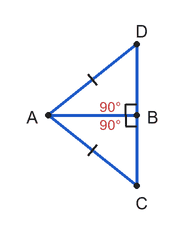
In the given figure, prove that :
BD = BC.
 Solve with AI
Written solution
Solution:
Concept: Two triangles are congruent when one fits exactly on the other. Each of these tests is enough: S.S.S. (three pairs of equal sides); S.A.S. (two pairs of equal sides and the angle between them); A.S.A. or A.A.S. (two pairs of equal angles and one pair of corresponding sides); R.H.S. (a right angle, the hypotenuse and one more side). Three angles alone, or two sides with an angle that is not between them, are not enough. When two triangles are congruent, every part of one equals the matching (corresponding) part of the other. We write the vertices in matching order, so ΔABC ≅ ΔPQR means A ↔ P, B ↔ Q and C ↔ R.
Step 1 — Choose the triangles.
We compare ΔABD and ΔABC. The figure marks right angles at B and AD = AC, and AB is a side of both triangles.
∠ABD = 90° (given)
∠ABC = 90° (given)
AD = AC (given; each is the hypotenuse)
AB = AB (common side)
So ΔABD ≅ ΔABC by R.H.S.
Step 2 — Conclude.
In ΔABD ≅ ΔABC, D matches C, so BD = BC (corresponding sides).
Watch out: In R.H.S. the equal hypotenuses are the sides opposite the right angles, here AD and AC.
Therefore, BD = BC. Hence proved.
- 143 marks
Question 14
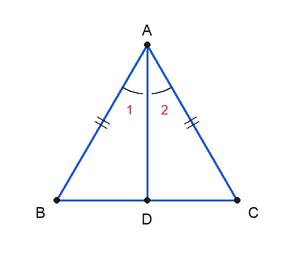
In the given figure,
∠1 = ∠2 and AB = AC.
Prove that
(i) ∠B = ∠C
(ii) BD = DC
(iii) AD is perpendicular to BC.
 Solve with AI
Written solution
Solution:
Concept: Two triangles are congruent when one fits exactly on the other. Each of these tests is enough: S.S.S. (three pairs of equal sides); S.A.S. (two pairs of equal sides and the angle between them); A.S.A. or A.A.S. (two pairs of equal angles and one pair of corresponding sides); R.H.S. (a right angle, the hypotenuse and one more side). Three angles alone, or two sides with an angle that is not between them, are not enough. When two triangles are congruent, every part of one equals the matching (corresponding) part of the other. We write the vertices in matching order, so ΔABC ≅ ΔPQR means A ↔ P, B ↔ Q and C ↔ R. Angles on a straight line add up to 180°.
Step 1 — Prove the triangles congruent.
We compare ΔABD and ΔACD. The figure gives AB = AC and ∠1 = ∠2, and AD is a side of both triangles.
AB = AC (given)
∠1 = ∠2 (given)
AD = AD (common side)
The equal angles are between the equal sides, so ΔABD ≅ ΔACD by S.A.S.
Step 2 — Part (i): ∠B = ∠C.
B matches C, so ∠B = ∠C (corresponding angles).
Step 3 — Part (ii): BD = DC.
D matches D and B matches C, so BD = CD (corresponding sides).
Step 4 — Part (iii): AD ⊥ BC.
D matches D, so ∠ADB = ∠ADC (corresponding angles), and the two angles lie on the straight line BC, so they add up to 180°.
So AD is perpendicular to BC.
Watch out: ∠1 and ∠2 are the angles at A between the equal sides and AD, which is why S.A.S. applies.
Therefore, ΔABD ≅ ΔACD (S.A.S.), so ∠B = ∠C, BD = DC and AD ⊥ BC. Hence proved.
- 153 marks
Question 15
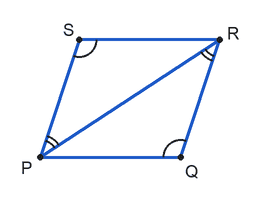
In the given figure, prove that :
(i) PQ = RS
(ii) PS = QR
 Solve with AI
Written solution
Solution:
Concept: Two triangles are congruent when one fits exactly on the other. Each of these tests is enough: S.S.S. (three pairs of equal sides); S.A.S. (two pairs of equal sides and the angle between them); A.S.A. or A.A.S. (two pairs of equal angles and one pair of corresponding sides); R.H.S. (a right angle, the hypotenuse and one more side). Three angles alone, or two sides with an angle that is not between them, are not enough. When two triangles are congruent, every part of one equals the matching (corresponding) part of the other. We write the vertices in matching order, so ΔABC ≅ ΔPQR means A ↔ P, B ↔ Q and C ↔ R.
Step 1 — Read the marks.
The figure marks ∠S = ∠Q (one arc each) and ∠SPR = ∠QRP (two arcs each). PR is a side of both triangles PSR and RQP.
Step 2 — Prove the triangles congruent.
We match S with Q, P with R and R with P.
∠S = ∠Q (given)
∠SPR = ∠QRP (given)
PR = RP (common side)
Two angles and a side give ΔPSR ≅ ΔRQP by A.A.S.
Step 3 — Part (i): PQ = RS.
S matches Q and R matches P, so SR = QP (corresponding sides), that is PQ = RS.
Step 4 — Part (ii): PS = QR.
P matches R and S matches Q, so PS = RQ (corresponding sides), that is PS = QR.
Watch out: PR is not between the two marked angles of one triangle (∠S is opposite it), so the test is A.A.S.
Therefore, ΔPSR ≅ ΔRQP (A.A.S.), so PQ = RS and PS = QR. Hence proved.
- 163 marks
Question 16
In the given figure, prove that :
(i) Δ XYZ ≅ Δ XPZ
(ii) YZ = PZ
(iii) ∠ YXZ = ∠ PXZ
 Solve with AI
Written solution
Solution:
Concept: Two triangles are congruent when one fits exactly on the other. Each of these tests is enough: S.S.S. (three pairs of equal sides); S.A.S. (two pairs of equal sides and the angle between them); A.S.A. or A.A.S. (two pairs of equal angles and one pair of corresponding sides); R.H.S. (a right angle, the hypotenuse and one more side). Three angles alone, or two sides with an angle that is not between them, are not enough. When two triangles are congruent, every part of one equals the matching (corresponding) part of the other. We write the vertices in matching order, so ΔABC ≅ ΔPQR means A ↔ P, B ↔ Q and C ↔ R.
Step 1 — Part (i): prove the triangles congruent.
We compare ΔXYZ and ΔXPZ. The figure marks right angles at Y and P and XY = XP, and XZ is the hypotenuse of both triangles.
∠XYZ = 90° (given)
∠XPZ = 90° (given)
XZ = XZ (common hypotenuse)
XY = XP (given)
So ΔXYZ ≅ ΔXPZ by R.H.S.
Step 2 — Part (ii): YZ = PZ.
Y matches P and Z matches Z, so YZ = PZ (corresponding sides).
Step 3 — Part (iii): ∠YXZ = ∠PXZ.
X matches X, Y matches P and Z matches Z, so ∠YXZ = ∠PXZ (corresponding angles).
Watch out: XZ is opposite the right angle in both triangles, so it is the common hypotenuse.
Therefore, ΔXYZ ≅ ΔXPZ (R.H.S.), so YZ = PZ and ∠YXZ = ∠PXZ. Hence proved.
- 173 marks
Question 17
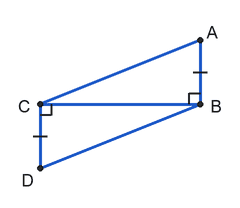
In the given figure, prove that :
(i) Δ ABC ≅ Δ DCB
(ii) AC = DB
 Solve with AI
Written solution
Solution:
Concept: Two triangles are congruent when one fits exactly on the other. Each of these tests is enough: S.S.S. (three pairs of equal sides); S.A.S. (two pairs of equal sides and the angle between them); A.S.A. or A.A.S. (two pairs of equal angles and one pair of corresponding sides); R.H.S. (a right angle, the hypotenuse and one more side). Three angles alone, or two sides with an angle that is not between them, are not enough. When two triangles are congruent, every part of one equals the matching (corresponding) part of the other. We write the vertices in matching order, so ΔABC ≅ ΔPQR means A ↔ P, B ↔ Q and C ↔ R.
Step 1 — Part (i): prove the triangles congruent.
We compare ΔABC and ΔDCB. The figure marks AB = DC and right angles at B and C, and BC is a side of both triangles.
AB = DC (given)
∠ABC = 90° (given)
∠DCB = 90° (given)
BC = CB (common side)
The right angles are between the equal sides, so ΔABC ≅ ΔDCB by S.A.S.
Step 2 — Part (ii): AC = DB.
A matches D and C matches B, so AC = DB (corresponding sides).
Watch out: R.H.S. would need the hypotenuses AC and DB to be known equal, but that is what we must prove.
Therefore, ΔABC ≅ ΔDCB (S.A.S.), so AC = DB. Hence proved.
- 183 marks
Question 18
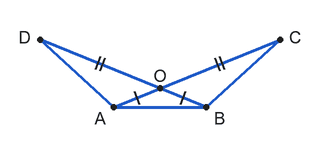
In the given figure, prove that :
(i) Δ AOD ≅ Δ BOC
(ii) AD = BC
(iii) ∠ ADB = ∠ ACB
(iv) Δ ADB ≅ Δ BCA
 Solve with AI
Written solution
Solution:
Concept: Two triangles are congruent when one fits exactly on the other. Each of these tests is enough: S.S.S. (three pairs of equal sides); S.A.S. (two pairs of equal sides and the angle between them); A.S.A. or A.A.S. (two pairs of equal angles and one pair of corresponding sides); R.H.S. (a right angle, the hypotenuse and one more side). Three angles alone, or two sides with an angle that is not between them, are not enough. When two triangles are congruent, every part of one equals the matching (corresponding) part of the other. We write the vertices in matching order, so ΔABC ≅ ΔPQR means A ↔ P, B ↔ Q and C ↔ R. Vertically opposite angles are equal.
Step 1 — Part (i): prove ΔAOD ≅ ΔBOC.
The figure marks OA = OB and OD = OC. Lines AC and BD cross at O, so ∠AOD and ∠BOC are vertically opposite angles.
OA = OB (given)
∠AOD = ∠BOC (vertically opposite angles)
OD = OC (given)
So ΔAOD ≅ ΔBOC by S.A.S.
Step 2 — Part (ii): AD = BC.
A matches B and D matches C, so AD = BC (corresponding sides).
Step 3 — Part (iii): ∠ADB = ∠ACB.
D matches C, so ∠ODA = ∠OCB (corresponding angles). Since D, O, B lie on one line and A, O, C lie on one line, ∠ODA is the same angle as ∠ADB, and ∠OCB is the same angle as ∠ACB. So ∠ADB = ∠ACB.
Step 4 — Part (iv): prove ΔADB ≅ ΔBCA.
First we find DB and CA. Each is made of two pieces that are given equal.
DB = DO + OB
CA = CO + OA
Since DO = CO and OB = OA, the two sums are equal, so DB = CA. Now we compare the large triangles.
AD = BC (proved in part (ii))
DB = CA (shown above)
AB = BA (common side)
So ΔADB ≅ ΔBCA by S.S.S.
Watch out: ∠ODA and ∠ADB are one angle with two names, because O lies on DB; say so before using it.
Therefore, ΔAOD ≅ ΔBOC (S.A.S.), AD = BC, ∠ADB = ∠ACB, and ΔADB ≅ ΔBCA (S.S.S.). Hence proved.
- 193 marks
Question 19
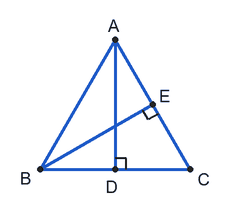
ABC is an equilateral triangle, AD and BE are perpendiculars to BC and AC respectively. Prove that :
(i) AD = BE
(ii) BD = CE
 Solve with AI
Written solution
Solution:
Concept: Two triangles are congruent when one fits exactly on the other. Each of these tests is enough: S.S.S. (three pairs of equal sides); S.A.S. (two pairs of equal sides and the angle between them); A.S.A. or A.A.S. (two pairs of equal angles and one pair of corresponding sides); R.H.S. (a right angle, the hypotenuse and one more side). Three angles alone, or two sides with an angle that is not between them, are not enough. When two triangles are congruent, every part of one equals the matching (corresponding) part of the other. We write the vertices in matching order, so ΔABC ≅ ΔPQR means A ↔ P, B ↔ Q and C ↔ R. In an equilateral triangle all sides are equal and every angle is 60°.
Step 1 — Choose the triangles.
We compare ΔADB and ΔBEC, matching A with B, D with E and B with C.
∠ADB = 90° (AD ⊥ BC)
∠BEC = 90° (BE ⊥ AC)
∠ABD = ∠BCE (each is 60°, an angle of the equilateral triangle)
AB = BC (sides of the equilateral triangle)
Two angles and a side opposite one of them give ΔADB ≅ ΔBEC by A.A.S.
Step 2 — Part (i): AD = BE.
A matches B and D matches E, so AD = BE (corresponding sides).
Step 3 — Part (ii): BD = CE.
D matches E and B matches C, so DB = EC (corresponding sides), that is BD = CE.
Watch out: Match the vertices with care: the right angles are at D and E, so D matches E.
Therefore, ΔADB ≅ ΔBEC (A.A.S.), so AD = BE and BD = CE. Hence proved.
- 203 marks
Question 20
Use the information given in the following figure to prove that triangles ABD and CBD are congruent.
Also, find the values of x and y.
 Solve with AI
Written solution
Solution:
Concept: Two triangles are congruent when one fits exactly on the other. Each of these tests is enough: S.S.S. (three pairs of equal sides); S.A.S. (two pairs of equal sides and the angle between them); A.S.A. or A.A.S. (two pairs of equal angles and one pair of corresponding sides); R.H.S. (a right angle, the hypotenuse and one more side). Three angles alone, or two sides with an angle that is not between them, are not enough. When two triangles are congruent, every part of one equals the matching (corresponding) part of the other. We write the vertices in matching order, so ΔABC ≅ ΔPQR means A ↔ P, B ↔ Q and C ↔ R.
Step 1 — Prove the triangles congruent.
The figure marks AB = CB (one tick) and AD = CD (two ticks), and BD is a side of both triangles.
AB = CB (given)
AD = CD (given)
BD = BD (common side)
So ΔABD ≅ ΔCBD by S.S.S.
Step 2 — Find x.
B matches B and D matches D, so ∠ABD = ∠CBD (corresponding angles).
Step 3 — Find y.
In the same way ∠ADB = ∠CDB (corresponding angles).
Watch out: Pair each angle with the angle at the same vertex on the other side of BD: 50° with x + 5° at B, and y − 7° with 38° at D.
Therefore, ΔABD ≅ ΔCBD (S.S.S.), x = 45 and y = 45.
- 213 marks
Question 21
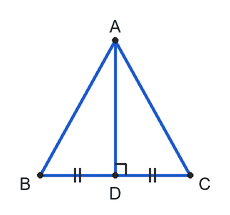
The given figure shows a triangle ABC in which AD is perpendicular to side BC and BD = CD. Prove that :
(i) Δ ABD ≅ Δ ACD
(ii) AB = AC
(iii) ∠B = ∠C.
 Solve with AI
Written solution
Solution:
Concept: Two triangles are congruent when one fits exactly on the other. Each of these tests is enough: S.S.S. (three pairs of equal sides); S.A.S. (two pairs of equal sides and the angle between them); A.S.A. or A.A.S. (two pairs of equal angles and one pair of corresponding sides); R.H.S. (a right angle, the hypotenuse and one more side). Three angles alone, or two sides with an angle that is not between them, are not enough. When two triangles are congruent, every part of one equals the matching (corresponding) part of the other. We write the vertices in matching order, so ΔABC ≅ ΔPQR means A ↔ P, B ↔ Q and C ↔ R.
Step 1 — Part (i): prove the triangles congruent.
The figure gives BD = CD and AD ⊥ BC, and AD is a side of both triangles.
BD = CD (given)
∠ADB = 90° (AD ⊥ BC)
∠ADC = 90° (AD ⊥ BC)
AD = AD (common side)
The right angles are between the equal sides, so ΔABD ≅ ΔACD by S.A.S.
Step 2 — Part (ii): AB = AC.
B matches C, so AB = AC (corresponding sides).
Step 3 — Part (iii): ∠B = ∠C.
B matches C, so ∠B = ∠C (corresponding angles).
Watch out: R.H.S. cannot be used here: the hypotenuses AB and AC are what we are asked to prove equal.
Therefore, ΔABD ≅ ΔACD (S.A.S.), so AB = AC and ∠B = ∠C. Hence proved.
- 221 mark
Question 22
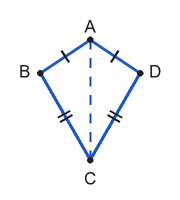
In the given figure :
 Solve with AI
Answer
(A) AB = AD
(B) BC = DC
(C) AC = AC
- Correct
(D) all of these are true
Answer: (D) all of these are true
Concept: Equal marks (ticks) on two sides of a figure mean those sides are equal, and a side shared by two triangles is equal to itself (a common side).
Step 1 — Read the marks.
AB and AD carry the same mark, so AB = AD. BC and DC carry the same mark, so BC = DC.
Step 2 — Check the common side.
AC is a side of both triangles ABC and ADC, and every segment equals itself, so AC = AC.
Why the other options are wrong:
- (A): AB = AD is true, but it is only one of the three true statements.
- (B): BC = DC is true, but it is only one of the three true statements.
- (C): AC = AC is true, but it is only one of the three true statements.
Therefore, all of these are true, option (D).
- 231 mark
Question 23
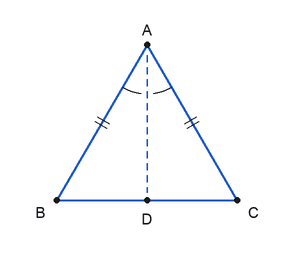
Triangles ABD and ACD are congruent by :
 Solve with AI
Answer
(A) SSS
(B) RHS
- Correct
(C) SAS
(D) ASA
Answer: (C) SAS
Concept: Two triangles are congruent when one fits exactly on the other. Each of these tests is enough: S.S.S. (three pairs of equal sides); S.A.S. (two pairs of equal sides and the angle between them); A.S.A. or A.A.S. (two pairs of equal angles and one pair of corresponding sides); R.H.S. (a right angle, the hypotenuse and one more side). Three angles alone, or two sides with an angle that is not between them, are not enough.
Step 1 — Read the figure.
AB = AC (marked), the angle at A is split into two equal parts, ∠BAD = ∠CAD (marked), and AD is a side of both triangles.
Step 2 — Name the test.
The equal angles at A are between the equal sides AB, AD and AC, AD. Two sides and the included angle give S.A.S.
Why the other options are wrong:
- (A): S.S.S. needs BD = CD, which is not marked.
- (B): R.H.S. needs a right angle, and none is marked.
- (D): A.S.A. needs two pairs of equal angles, and only the pair at A is marked.
Therefore, the triangles are congruent by SAS, option (C).
- 241 mark
Question 24
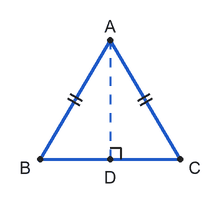
Triangles ABD and ACD are congruent by :
 Solve with AI
Answer
(A) SSS
- Correct
(B) RHS
(C) SAS
(D) ASA
Answer: (B) RHS
Concept: Two triangles are congruent when one fits exactly on the other. Each of these tests is enough: S.S.S. (three pairs of equal sides); S.A.S. (two pairs of equal sides and the angle between them); A.S.A. or A.A.S. (two pairs of equal angles and one pair of corresponding sides); R.H.S. (a right angle, the hypotenuse and one more side). Three angles alone, or two sides with an angle that is not between them, are not enough.
Step 1 — Read the figure.
The figure marks these facts.
∠ADB = 90° and ∠ADC = 90° (marked at D)
AB = AC (marked)
AD = AD (common side)
Step 2 — Name the test.
AB and AC are opposite the right angles, so they are the hypotenuses. A right angle, equal hypotenuses and a common side give R.H.S.
Why the other options are wrong:
- (A): S.S.S. needs BD = CD, which is not marked.
- (C): S.A.S. would need the angle between AB and AD, but the right angle lies between AD and BD.
- (D): A.S.A. needs two pairs of equal angles, and only the right angles are known.
Therefore, the triangles are congruent by RHS, option (B).
- 251 mark
Question 25
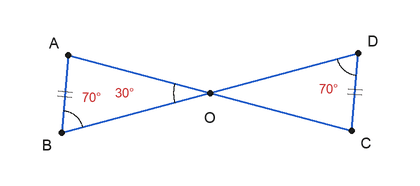
ΔAOB is congruent to ΔCOD by :
 Solve with AI
Answer
(A) SAS
- Correct
(B) ASA
(C) SSS
(D) none of these
Answer: (B) ASA
Concept: Two triangles are congruent when one fits exactly on the other. Each of these tests is enough: S.S.S. (three pairs of equal sides); S.A.S. (two pairs of equal sides and the angle between them); A.S.A. or A.A.S. (two pairs of equal angles and one pair of corresponding sides); R.H.S. (a right angle, the hypotenuse and one more side). Three angles alone, or two sides with an angle that is not between them, are not enough. Vertically opposite angles are equal, and the angles of a triangle add up to 180°.
Step 1 — Find all the angles.
The angles at O are vertically opposite, and the angles at B and D are marked.
∠AOB = 30° (given)
∠COD = 30° (vertically opposite to ∠AOB)
∠B = 70° and ∠D = 70° (marked)
The third angle of each triangle follows from the angle sum.
In the same way ∠C = 80°.
Step 2 — Name the test.
AB = CD (marked) and in each triangle this side lies between the 80° angle and the 70° angle. Two angles and the side between them give A.S.A.
Why the other options are wrong:
- (A): S.A.S. needs two pairs of equal sides, and only AB = CD is known.
- (C): S.S.S. needs three pairs of equal sides, and only one pair is known.
- (D): the triangles are congruent by A.S.A., so 'none of these' is wrong.
Therefore, ΔAOB ≅ ΔCOD by ASA, option (B).
- 261 mark
Question 26
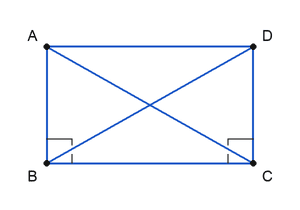
In the given figure, if AC = DB, triangles ABC and DCB are congruent to each by :
 Solve with AI
Answer
(A) SSS
(B) SAS
- Correct
(C) RHS
(D) ASA
Answer: (C) RHS
Concept: Two triangles are congruent when one fits exactly on the other. Each of these tests is enough: S.S.S. (three pairs of equal sides); S.A.S. (two pairs of equal sides and the angle between them); A.S.A. or A.A.S. (two pairs of equal angles and one pair of corresponding sides); R.H.S. (a right angle, the hypotenuse and one more side). Three angles alone, or two sides with an angle that is not between them, are not enough.
Step 1 — Read the figure.
The figure and the stem give these facts.
∠ABC = 90° and ∠DCB = 90° (marked)
AC = DB (given)
BC = CB (common side)
Step 2 — Name the test.
AC and DB are opposite the right angles, so they are the hypotenuses. A right angle, equal hypotenuses and the common side BC give R.H.S.
Why the other options are wrong:
- (A): S.S.S. needs AB = DC as well, which is not given.
- (B): S.A.S. would need AB = DC to go with BC and the right angles, and that is not given.
- (D): A.S.A. needs two pairs of equal angles, and only the right angles are known.
Therefore, the triangles are congruent by RHS, option (C).
- 271 mark
Question 27
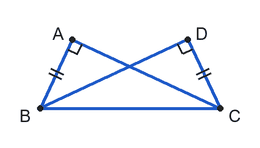
Triangles BAC and CDB are congruent by :
 Solve with AI
Answer
(A) SSS
(B) SAS
(C) ASA
- Correct
(D) RHS
Answer: (D) RHS
Concept: Two triangles are congruent when one fits exactly on the other. Each of these tests is enough: S.S.S. (three pairs of equal sides); S.A.S. (two pairs of equal sides and the angle between them); A.S.A. or A.A.S. (two pairs of equal angles and one pair of corresponding sides); R.H.S. (a right angle, the hypotenuse and one more side). Three angles alone, or two sides with an angle that is not between them, are not enough.
Step 1 — Read the figure.
The figure marks these facts.
∠BAC = 90° and ∠CDB = 90° (marked)
AB = DC (marked)
BC = CB (common side)
Step 2 — Name the test.
BC is opposite the right angle in both triangles, so it is the common hypotenuse. A right angle, the hypotenuse and one more side give R.H.S.
Why the other options are wrong:
- (A): S.S.S. needs AC = DB as well, which is not marked.
- (B): S.A.S. would need AC = DB, the other side round the right angle, and that is not marked.
- (C): A.S.A. needs two pairs of equal angles, and only the right angles are known.
Therefore, the triangles are congruent by RHS, option (D).
- 281 mark
Question 28
Two circles are congruent to each other, if their :
Solve with AIAnswer
(A) radii are equal
(B) circumferences are equal
(C) areas are equal
- Correct
(D) all of the above are true
Answer: (D) all of the above are true
Concept: Two figures are congruent when they have the same shape and the same size. All circles have the same shape, so two circles are congruent when they are the same size.
Step 1 — Equal radii.
A circle is fixed by its radius: two circles with equal radii fit exactly on each other.
Step 2 — Equal circumferences or areas.
The circumference is and the area is , and each grows when grows. So equal circumferences, or equal areas, can only happen when the radii are equal.
Why the other options are wrong:
- (A): equal radii is a correct condition, but it is only one of the three correct conditions.
- (B): equal circumferences is a correct condition, but it is only one of the three correct conditions.
- (C): equal areas is a correct condition, but it is only one of the three correct conditions.
Therefore, all of the above are true, option (D).
- 291 mark
Question 29
Two quadrilaterals are congruent to each other, if their :
Solve with AIAnswer
(A) each angle is 90°
(B) perimeters are equal
(C) areas are equal
- Correct
(D) none of these
Answer: (D) none of these
Concept: Two figures are congruent only when they have the same shape and the same size. One counter-example is enough to show that a condition is not sufficient.
Step 1 — Test equal angles and perimeters.
A 6 cm × 2 cm rectangle and a 4 cm × 4 cm square both have every angle 90° and the same perimeter.
Yet they are not congruent, because their shapes differ.
Step 2 — Test equal areas.
An 8 cm × 2 cm rectangle and a 4 cm × 4 cm square have equal areas.
The square's area is also 16 cm², but again the two figures are not congruent.
Why the other options are wrong:
- (A) each angle is 90°: a 6 cm × 2 cm rectangle and a 4 cm × 4 cm square both have every angle 90° but are not congruent.
- (B) perimeters are equal: the same two figures both have a perimeter of 16 cm but are not congruent.
- (C) areas are equal: an 8 cm × 2 cm rectangle and a 4 cm × 4 cm square both have an area of 16 cm² but are not congruent.
Therefore, none of these conditions is enough, option (D).
- 301 mark
Question 30
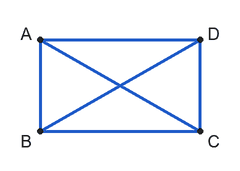
In the given figure, AB = CD and AC = DB, then ΔABC is congruent to ΔDCB by :
 Solve with AI
Answer
- Correct
(A) SSS
(B) SAS
(C) ASA
(D) RHS
Answer: (A) SSS
Concept: Two triangles are congruent when one fits exactly on the other. Each of these tests is enough: S.S.S. (three pairs of equal sides); S.A.S. (two pairs of equal sides and the angle between them); A.S.A. or A.A.S. (two pairs of equal angles and one pair of corresponding sides); R.H.S. (a right angle, the hypotenuse and one more side). Three angles alone, or two sides with an angle that is not between them, are not enough.
Step 1 — Read the data.
AB = CD and AC = DB are given, and BC is a side of both ΔABC and ΔDCB.
Step 2 — Name the test.
Three pairs of equal sides give S.S.S.
Why the other options are wrong:
- (B): S.A.S. needs a pair of equal angles, and no angle is given equal.
- (C): A.S.A. needs two pairs of equal angles, and none is given.
- (D): R.H.S. needs a right angle, and none is given.
Therefore, ΔABC ≅ ΔDCB by SSS, option (A).
- 311 mark
Question 31
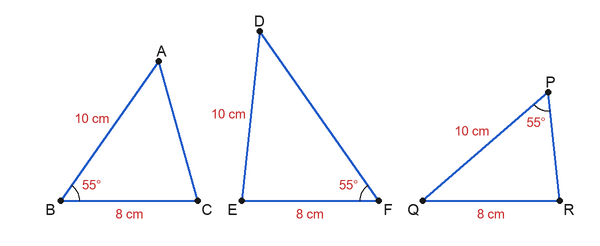
In the given figure :
 Solve with AI
Answer
(A) ΔABC ≅ ΔDEF
(B) ΔABC ≅ ΔPQR
(C) ΔDEF ≅ ΔPQR
- Correct
(D) none of these
Answer: (D) none of these
Concept: Two triangles are congruent when one fits exactly on the other. Each of these tests is enough: S.S.S. (three pairs of equal sides); S.A.S. (two pairs of equal sides and the angle between them); A.S.A. or A.A.S. (two pairs of equal angles and one pair of corresponding sides); R.H.S. (a right angle, the hypotenuse and one more side). Three angles alone, or two sides with an angle that is not between them, are not enough.
Step 1 — Locate the 55° angle in each triangle.
Each triangle has a 10 cm side, an 8 cm side and a 55° angle. In ΔABC the 55° angle at B is between the 10 cm and 8 cm sides. In ΔDEF the 55° angle at F is opposite the 10 cm side. In ΔPQR the 55° angle at P is opposite the 8 cm side.
Step 2 — Compare.
No two triangles have the 55° angle in the same position with respect to the equal sides, so no test of congruence matches any pair.
Watch out: The same three measurements in different positions do not make congruent triangles; check where the angle is.
Note: ΔPQR is not drawn to scale, because no triangle has these three measurements. If we draw an angle of 55° at P and mark Q on one arm 10 cm from P, then Q is about 8·2 cm from the other arm, so an 8 cm arc from Q cannot reach it.
Why the other options are wrong:
- (A): in ΔABC the 55° angle is between the 10 cm and 8 cm sides, but in ΔDEF it is opposite the 10 cm side; drawn accurately, their third sides are about 8·5 cm and 12·1 cm.
- (B): in ΔPQR the 55° angle is opposite the 8 cm side, not between the two given sides as in ΔABC.
- (C): in ΔDEF the 55° angle is opposite the 10 cm side, but in ΔPQR it is opposite the 8 cm side.
Therefore, none of these pairs is congruent, option (D).
- 321 mark
Question 32
In the given figure, triangles ABD and ACD are congruent to each other, then :
 Solve with AI
Answer
(A) AB = AC
(B) ∠B = ∠C
(C) BD = CD
- Correct
(D) all of the above are true
Answer: (D) all of the above are true
Concept: When two triangles are congruent, every part of one equals the matching (corresponding) part of the other. We write the vertices in matching order, so ΔABC ≅ ΔPQR means A ↔ P, B ↔ Q and C ↔ R.
Step 1 — Match the vertices.
The congruence ΔABD ≅ ΔACD matches A with A, B with C and D with D.
Step 2 — List the corresponding parts.
So AB = AC, BD = CD and ∠B = ∠C, as corresponding parts of congruent triangles.
Why the other options are wrong:
- (A): AB = AC is true, but it is only one of the three true statements.
- (B): ∠B = ∠C is true, but it is only one of the three true statements.
- (C): BD = CD is true, but it is only one of the three true statements.
Therefore, all of the above are true, option (D).
- 331 mark
Question 33
The two triangles shown in the given figures are :
 Solve with AI
Answer
(A) congruent by AAA
- Correct
(B) congruent by AAS
(C) congruent by SAS
(D) not congruent
Answer: (B) congruent by AAS
Concept: Two triangles are congruent when one fits exactly on the other. Each of these tests is enough: S.S.S. (three pairs of equal sides); S.A.S. (two pairs of equal sides and the angle between them); A.S.A. or A.A.S. (two pairs of equal angles and one pair of corresponding sides); R.H.S. (a right angle, the hypotenuse and one more side). Three angles alone, or two sides with an angle that is not between them, are not enough.
Step 1 — Read the marks.
The figure marks these equal parts.
∠A = ∠P (two arcs)
∠B = ∠Q (one arc)
BC = QR (marked equal)
Step 2 — Name the test.
BC is not between ∠A and ∠B (it is opposite ∠A), so the data are two angles and a non-included side: A.A.S. So ΔABC ≅ ΔPQR.
Why the other options are wrong:
- (A): AAA is not a test of congruence: equal angles fix only the shape, not the size.
- (C): SAS needs two pairs of equal sides, and only BC = QR is marked.
- (D): two angles and a corresponding side are enough, so the triangles are congruent.
Therefore, the triangles are congruent by AAS, option (B).
- 341 mark
Question 34
Statement 1 : AAA(angle-angle-angle) axiom does not prove congruence.
Statement 2 : SSA (side-side-angle) axiom does prove congruence.
Which of the following options is correct?
Solve with AIAnswer
(A) Both the statements are true.
(B) Both the statements are false.
- Correct
(C) Statement 1 is true, and statement 2 is false.
(D) Statement 1 is false, and statement 2 is true.
Answer: (C) Statement 1 is true, and statement 2 is false.
Concept: A test of congruence must fix both the shape and the size of a triangle. We judge each statement separately and choose the option that matches both verdicts.
Step 1 — Judge Statement 1.
Equal angles fix only the shape of a triangle, not its size: a small and a large equilateral triangle have equal angles but are not congruent. So Statement 1 is true.
Step 2 — Judge Statement 2.
Two sides and an angle that is not between them can give two different triangles. So SSA does not prove congruence, and Statement 2 is false.
Why the other options are wrong:
- (A): Statement 2 is false, so 'both true' is wrong.
- (B): Statement 1 is true, so 'both false' is wrong.
- (D): this reverses the verdicts: Statement 1 is true and Statement 2 is false.
Therefore, Statement 1 is true and Statement 2 is false, option (C).
- 351 mark
Question 35
The following questions are Assertion-Reason based questions. Choose your answer based on the codes given below :
(1) A is true, R is false.
(2) A is false, R is true.
(3) Both A and R are true.
(4) Both A and R are false.
Assertion (A) : In the given figure ΔABC ≅ ΔPQR ( RHS congruence axiom)

Reason (R) : RHS axiom of congruence : One angle of both the triangles is a right angle, also the hypotenuse and one side of one triangle are equal to the hypotenuse and the corresponding side of the other triangle.
Solve with AIAnswer
(A) (1)
- Correct
(B) (2)
(C) (3)
(D) (4)
Answer: (B) (2)
Concept: In an Assertion–Reason item we judge the Assertion (A) and the Reason (R) separately, true or false, and then choose the code that matches both verdicts. Two triangles are congruent when one fits exactly on the other. Each of these tests is enough: S.S.S. (three pairs of equal sides); S.A.S. (two pairs of equal sides and the angle between them); A.S.A. or A.A.S. (two pairs of equal angles and one pair of corresponding sides); R.H.S. (a right angle, the hypotenuse and one more side). Three angles alone, or two sides with an angle that is not between them, are not enough.
Step 1 — Read the figure.
The figure marks AC = PR and ∠C = ∠R. ∠B is marked as a right angle; ∠Q is drawn as a right angle too, so we take both right angles as given.
AC = PR (marked)
∠C = ∠R (marked)
∠ABC = 90° and ∠PQR = 90°
Step 2 — Judge the Assertion.
R.H.S. needs equal hypotenuses and a second pair of equal sides. Only the hypotenuses AC and PR are known equal. With the right angles and ∠C = ∠R the triangles are congruent by A.A.S., not by R.H.S. So A, which names R.H.S., is false.
Step 3 — Judge the Reason.
R states the R.H.S. axiom correctly, so R is true. Code (2).
Watch out: An Assertion that names the wrong test is false, even when the triangles really are congruent.
Why the other options are wrong:
- (A): code (1) calls A true and R false, but A names the wrong test and R is correct.
- (C): code (3) calls A true, but R.H.S. cannot be used without a second pair of equal sides.
- (D): code (4) calls R false, but R is the correct statement of R.H.S.
Therefore, A is false and R is true, code (2), option (B).
- 361 mark
Question 36
The following questions are Assertion-Reason based questions. Choose your answer based on the codes given below :
(1) A is true, R is false.
(2) A is false, R is true.
(3) Both A and R are true.
(4) Both A and R are false.
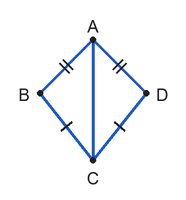
Assertion (A) : In the given figure AC is the bisector of ∠BAD and ∠BCD.
Reason (R) : SSS (Side-side -side) axiom of congruence : Two triangles are congruent if the sides of one triangle are correspondingly equal to sides of other triangle.
Solve with AIAnswer
(A) (1)
(B) (2)
- Correct
(C) (3)
(D) (4)
Answer: (C) (3)
Concept: In an Assertion–Reason item we judge the Assertion (A) and the Reason (R) separately, true or false, and then choose the code that matches both verdicts. Two triangles are congruent when one fits exactly on the other. Each of these tests is enough: S.S.S. (three pairs of equal sides); S.A.S. (two pairs of equal sides and the angle between them); A.S.A. or A.A.S. (two pairs of equal angles and one pair of corresponding sides); R.H.S. (a right angle, the hypotenuse and one more side). Three angles alone, or two sides with an angle that is not between them, are not enough.
Step 1 — Judge the Assertion.
AB = AD and CB = CD are marked, and AC is common, so ΔABC ≅ ΔADC by S.S.S. Then ∠BAC = ∠DAC and ∠BCA = ∠DCA (corresponding angles), so AC bisects ∠BAD and ∠BCD. A is true.
Step 2 — Judge the Reason.
R states the S.S.S. axiom correctly, so R is true. Code (3).
Why the other options are wrong:
- (A): code (1) calls R false, but R is the correct S.S.S. axiom.
- (B): code (2) calls A false, but the S.S.S. congruence shows AC bisects both angles.
- (D): code (4) calls both false, but both are true.
Therefore, both A and R are true, code (3), option (C).
- 371 mark
Question 37
The following questions are Assertion-Reason based questions. Choose your answer based on the codes given below :
(1) A is true, R is false.
(2) A is false, R is true.
(3) Both A and R are true.
(4) Both A and R are false.
Assertion (A) : In the given figure ΔABD ≅ ΔADC ( RHS congruence axiom)

⇒ AB = AC (c.p.c.t.)
⇒ ΔABC is an isosceles triangle.
Reason (R) : SAS (side-angle-side) axiom of congruence : Two triangles are congruent if two sides and included angle of one triangle are correspondingly equal to two sides and included angle of the other triangle.
Solve with AIAnswer
(A) (1)
- Correct
(B) (2)
(C) (3)
(D) (4)
Answer: (B) (2)
Concept: In an Assertion–Reason item we judge the Assertion (A) and the Reason (R) separately, true or false, and then choose the code that matches both verdicts. Two triangles are congruent when one fits exactly on the other. Each of these tests is enough: S.S.S. (three pairs of equal sides); S.A.S. (two pairs of equal sides and the angle between them); A.S.A. or A.A.S. (two pairs of equal angles and one pair of corresponding sides); R.H.S. (a right angle, the hypotenuse and one more side). Three angles alone, or two sides with an angle that is not between them, are not enough.
Step 1 — Read the figure.
The figure marks these facts.
BD = DC (marked)
∠ADB = 90° and ∠ADC = 90° (marked)
AD = AD (common side)
These are two sides and the angle between them, so the triangles are congruent by S.A.S.
Step 2 — Judge the Assertion.
R.H.S. would need the hypotenuses AB and AC to be known equal, but that is the result we want. So the Assertion, which claims R.H.S., is false. (Its vertex order ΔADC is also a slip for ΔACD.)
Step 3 — Judge the Reason.
R states the S.A.S. axiom correctly, so R is true. Code (2).
Watch out: AB = AC is true here, but it follows from S.A.S.; the Assertion is false because it names R.H.S.
Why the other options are wrong:
- (A): code (1) calls A true and R false, but A uses the wrong test and R is correct.
- (C): code (3) calls A true, but R.H.S. cannot be used before AB = AC is known.
- (D): code (4) calls R false, but R is the correct S.A.S. axiom.
Therefore, A is false and R is true, code (2), option (B).
- 381 mark
Question 38
The following questions are Assertion-Reason based questions. Choose your answer based on the codes given below :
(1) A is true, R is false.
(2) A is false, R is true.
(3) Both A and R are true.
(4) Both A and R are false.
Assertion (A) : In the given figure ΔACO ≅ ΔBOD ( ASA congruence axiom).

Reason (R) : If any two angles and a side (not the included side) of one triangle are equal to two angles and the corresponding side of the other triangle then the two triangles are congruent.
Solve with AIAnswer
(A) (1)
(B) (2)
- Correct
(C) (3)
(D) (4)
Answer: (C) (3)
Concept: In an Assertion–Reason item we judge the Assertion (A) and the Reason (R) separately, true or false, and then choose the code that matches both verdicts. Two triangles are congruent when one fits exactly on the other. Each of these tests is enough: S.S.S. (three pairs of equal sides); S.A.S. (two pairs of equal sides and the angle between them); A.S.A. or A.A.S. (two pairs of equal angles and one pair of corresponding sides); R.H.S. (a right angle, the hypotenuse and one more side). Three angles alone, or two sides with an angle that is not between them, are not enough.
Step 1 — Read the figure.
The figure gives these measurements for ΔACO and ΔBDO.
∠A = 50° and ∠B = 50°
AC = 4 cm and BD = 4 cm
∠C = 70° and ∠D = 70°
Step 2 — Judge the Assertion.
The 4 cm sides lie between the 50° and 70° angles in both triangles, so the triangles are congruent by A.S.A. In matching order this is ΔACO ≅ ΔBDO. A is true.
Step 3 — Judge the Reason.
R states the A.A.S. axiom correctly, so R is true. Code (3).
Watch out: Write the vertices in matching order; the order tells which sides and angles are equal.
Note: The Assertion writes the second triangle as ΔBOD; with A ↔ B, C ↔ D and O ↔ O the matching order is ΔBDO. Read strictly, that vertex order would make A false; the congruence itself is true by A.S.A.
Why the other options are wrong:
- (A): code (1) calls R false, but R is the correct A.A.S. axiom.
- (B): code (2) calls A false, but A.S.A. does prove the two triangles congruent.
- (D): code (4) calls both false, but both are true.
Therefore, both A and R are true, code (3), option (C).
What Class 7 Maths Ch 21 covers
The sections of the chapter, in the order the book takes them. Every question above comes from one of these.
- 01Meaning of Congruency
- 02Congruency in Triangles
- 03Corresponding Sides and Corresponding Angles
- 04Conditions of Congruency
More ways to study this chapter
The same chapter asked three other ways. Practise it, revise it, and see what the board has set on Ch 21 before.
Class 7 Maths Ch 21 questions students ask
How many questions are there in Class 7 Maths Ch 21?
38 questions. Every one is solved step by step on this page.
Are these Class 7 Maths solutions free?
Yes. Every question and its full working is free to read, with no account needed.
Can I download the Class 7 Maths Ch 21 solutions as a PDF?
There is no PDF to download. Every solution is on this page instead, which means it is searchable, always the current syllabus, and readable on a phone. Use your browser's print option if you want it on paper.