
Opening your dashboard
Class 7 Maths Chapter 21 Congruency: Congruent Triangles: Competency-Based Questions (CBQ)
40 questions on Chapter 21, each worked through on its own page with the AI tutor. Class 7 Maths, ICSE 2026-27.
40 questions
1–5 marks · Mixed difficulty
- 11 mark
Question 1
Competency: Understanding
A shop sells rectangular photo frames. Asha says, “Two frames that need the same length of border strip (the same perimeter) are always congruent.”
Each pair of frames below has a perimeter of 60 cm. Which pair shows that Asha is wrong?
- 21 mark
Question 2
Competency: Application
Two triangular road signs are cut from one mould, so ΔSTP ≅ ΔGOL.
A worker measures the first sign: ST = 45 cm, TP = 60 cm and ∠T = 60°.
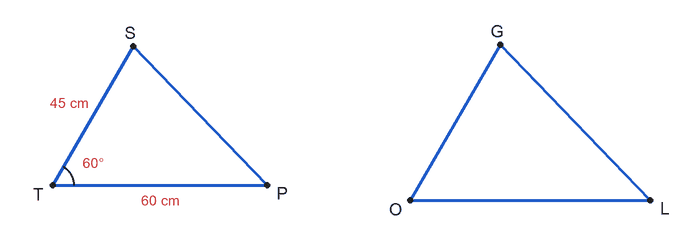
Which fact about the second sign can he write down without measuring it?
- 31 mark
Question 3
Competency: Analysis
A carpenter makes triangular shelf brackets. For every bracket he joins a 20 cm strip and a 30 cm strip of wood, and then cuts a third strip to close the triangle.
Which one extra instruction makes sure that all the brackets are congruent?
- 41 mark
Question 4
Competency: Understanding
A surveyor compares two triangular plots. She has found that two angles of the first plot are equal to two angles of the second plot.
What is the least extra information she needs to be sure that the plots are congruent?
- 51 mark
Question 5
Competency: Evaluation
Assertion (A): If two triangular fields are congruent, the same length of fencing wire goes around each of them.
Reason (R): If two triangles have equal perimeters, then the triangles are congruent.
- 61 mark
Question 6
Competency: Application
The figure shows a folding table from the side. Its legs AD and BC are joined by a pin at O, which is the mid-point of both legs. The feet C and D are 70 cm apart on the floor.

How far apart are the top ends A and B?
- 72 marks
Question 7
Competency: Application
A tent pole PM stands vertically on level ground. Two ropes of equal length, PA and PB, are tied from the top P to pegs A and B on the ground, on opposite sides of the pole. A, M and B lie in a straight line.
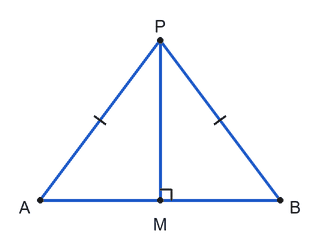
Show that the two pegs are at the same distance from the foot M of the pole.
- 82 marks
Question 8
Competency: Evaluation
A triangular glass pane of a window is broken. The owner sends two messages to the glass-cutter.
Message 1: “Two sides of the pane are 40 cm and 50 cm, and the angle between them is 70°.”
Message 2: “The three angles of the pane are 50°, 60° and 70°.”
Which message is enough for the glass-cutter to cut a pane that fits exactly? Give a reason for each message.
- 92 marks
Question 9
Competency: Application
Two triangular vegetable patches are congruent: ΔKLM ≅ ΔXYZ.
Exactly 90 m of wire was used to fence once around ΔKLM. In ΔXYZ, XY = 25 m and YZ = 36 m.
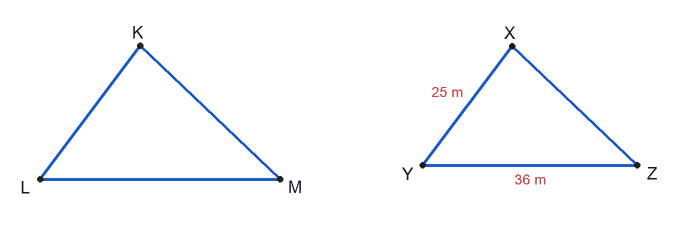
Find the length of the side KM. Give a reason for each step.
- 102 marks
Question 10
Competency: Analysis
Two paper pennants are isosceles triangles. In each pennant the two equal sides are 6 cm long, and one of the angles is 40°.
Are the two pennants always, sometimes or never congruent? Explain with the angles of the triangles.
- 113 marks
Question 11
Competency: Analysis & Evaluation
In the figure, AB ∥ DC and AB = DC. Rohan writes this proof.
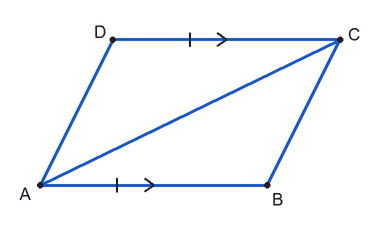
“In ΔABC and ΔADC : AB = DC (given), AC = AC (common), ∠BAC = ∠DAC (alternate angles). ∴ ΔABC ≅ ΔADC by S.A.S.”
(a) Find the mistake in Rohan's proof.
(b) Write the correct proof and the correct congruence statement.
(c) Which side is equal to BC? Give the reason.
- 123 marks
Question 12
Competency: Creativity
For a craft project you have a rectangular sheet of paper 12 cm long and 8 cm wide.
Design a way to cut the whole sheet into four congruent triangles using straight cuts only.
(a) Describe your cuts (a rough sketch may be used).
(b) Prove that your four triangles are congruent, naming the condition of congruency.
- 133 marks
Question 13
Competency: Analysis
Meera bisects ∠XOY with ruler and compasses, as shown.
- With centre O she draws an arc that cuts the arms at A and B.
- With centres A and B, and the same radius, she draws two arcs that cut each other at P.
- She joins OP.

(a) Which lengths in the figure are equal because of the way the arcs were drawn?
(b) Use congruent triangles to explain why OP bisects ∠XOY.
(c) In step 2, Meera's friend uses a radius of 4 cm for the arc from A and 5 cm for the arc from B. Will OP still bisect the angle? Give a reason.
- 144 marks
Question 14
Competency: Application & Evaluation
Case study — Checking a door frame
A carpenter makes a door frame ABCD, 90 cm wide and 210 cm high. It should be a rectangle, so AD = BC and every corner should be 90°. To check the corners, he measures the two diagonals AC and BD with a tape.
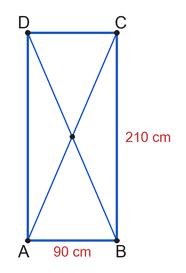
(a) If the frame is a true rectangle, prove that ΔABC ≅ ΔBAD. What does this tell you about the diagonals?
(b) The carpenter finds AC = 227 cm and BD = 230 cm. What should he conclude about the frame? Give a reason.
(c) He corrects the frame so that it is a true rectangle, and nails a strip along AC to keep it firm. Prove that ΔABC ≅ ΔCDA. Which angle of ΔCDA is equal to ∠BAC?
- 155 marks
Question 15
Competency: Application & Analysis
Case study — Aarav's kite
Aarav makes a kite ABCD from four thin sticks and paper. The two upper sticks are equal (AB = AD) and the two lower sticks are equal (CB = CD). The spine AC and the cross stick BD meet at O. He measures ∠BAD = 110° and ∠BCD = 50°.
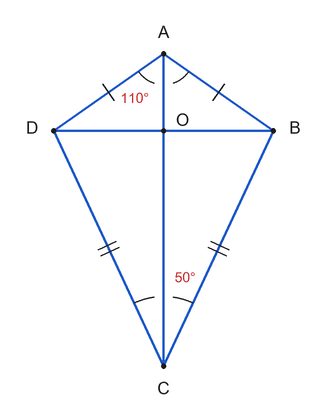
(a) Prove that ΔABC ≅ ΔADC.
(b) Find ∠BAC, ∠BCA and ∠ABC.
(c) Aarav says, “The spine AC cuts the cross stick BD into two equal parts.” Is he right? Prove your answer using ΔABO and ΔADO.
- 161 mark
Question 16
Competency: Understanding
ΔLMN ≅ ΔQRP. In ΔLMN, ∠M = 72° and MN = 9 cm.
Which pair of statements about ΔQRP must be true?
- 171 mark
Question 17
Competency: Analysis
On squared paper (1 square = 1 cm), Meena draws ΔABC with its right angle at A. The side AB goes 3 squares to the right of A, and the side AC goes 4 squares up from A.
She then draws four triangles PQR, each with its right angle at P, as described below. Which one is congruent to ΔABC?
- 181 mark
Question 18
Competency: Analysis
Assertion (A): ΔABC ≅ ΔBCA is possible only when ΔABC is an equilateral triangle.
Reason (R): In ΔABC ≅ ΔBCA the vertices match as A with B, B with C and C with A, so AB = BC, BC = CA and CA = AB.
- 191 mark
Question 19
Competency: Evaluation
Assertion (A): Two right-angled triangles, each with a hypotenuse of 10 cm, are always congruent.
Reason (R): Two right-angled triangles are congruent if the hypotenuse and one other side of the first are equal to the hypotenuse and one other side of the second.
- 201 mark
Question 20
Competency: Application
ΔABC ≅ ΔFED. In ΔABC, ∠A : ∠B : ∠C = 2 : 3 : 4.
Find ∠D.
- 211 mark
Question 21
Competency: Understanding
ΔABC ≅ ΔXYZ and ΔXYZ ≅ ΔQRP. In ΔABC, BC = 9 cm.
Which side of ΔQRP is certainly 9 cm?
- 221 mark
Question 22
Competency: Application
Temple T is 8 km from village A and 6 km from village B, and ∠ATB = 70°. Temple U is 6 km from village C and 8 km from village D, and ∠CUD = 70°.
How does the straight-line distance AB compare with CD?
- 231 mark
Question 23
Competency: Analysis
In ΔABC, M is the mid-point of BC. The line AM divides ΔABC into ΔABM and ΔACM.
Which statement is correct?
- 241 mark
Question 24
Competency: Analysis
ΔABC ≅ ΔDEF. The bisector of ∠B meets AC at X, and the bisector of ∠E meets DF at Y.
Which statement must be true?
- 251 mark
Question 25
Competency: Application
In ΔABC, the bisector of ∠A meets BC at D, and AD ⊥ BC.
To show that AB = AC, which condition should be used for ΔABD and ΔACD?
- 262 marks
Question 26
Competency: Analysis
The hour marks on a clock face are 30° apart. A clock has a minute hand 8 cm long and an hour hand 5 cm long, both fixed at the centre O.
At 4 o'clock, the tips of the two hands and O make a triangle. At 8 o'clock, they make another triangle.
Are the two triangles congruent? Give the condition and the reason.
- 272 marks
Question 27
Competency: Creativity
Kavya has to write a question for her class. She wants two triangles ΔABC and ΔPQR that are congruent by A.S.A., where the correct statement is ΔABC ≅ ΔRPQ and not ΔABC ≅ ΔPQR.
Write measurements of three parts of each triangle that suit her question, and show how your data give ΔABC ≅ ΔRPQ.
- 282 marks
Question 28
Competency: Application
A giant wheel at a mela has 6 equal spokes OA₁, OA₂, …, OA₆, each 9 m long. The angle between any two neighbouring spokes is 60°. A rope joins the end of every spoke to the end of the next spoke: A₁A₂, A₂A₃, and so on.
Show that the ropes A₁A₂ and A₃A₄ are equal in length, and name the condition.
- 292 marks
Question 29
Competency: Analysis
A square cake ABCD is cut into two pieces by one straight cut. M is the mid-point of side CD.
In which of these cuts are the two pieces congruent? Give a reason for each.
(i) The cut is along the diagonal AC.
(ii) The cut joins the mid-point of AB to the mid-point of CD.
(iii) The cut joins the corner A to M.
- 302 marks
Question 30
Competency: Evaluation
Ritu says: “To be sure that two triangles are congruent, I must check that all three pairs of sides and all three pairs of angles are equal.”
Is she right? Explain your answer, and say how many pairs of equal parts the tests S.S.S., S.A.S. and A.S.A. use.
- 312 marks
Question 31
Competency: Application
ABCD is a rectangular stage. AB is the front edge and DC is the back edge. A spotlight is fixed at E, the mid-point of DC. One wire is stretched from A to E and another from B to E.
Show that the two wires are of equal length.
- 323 marks
Question 32
Competency: Application & Analysis
Two identical set squares have angles 30°, 60° and 90°. They are placed side by side so that their shorter sides coincide along BC, and A, B and D are in one straight line, as shown. The angles at A and D are 30°.

(a) Show that ΔABC ≅ ΔDBC.
(b) Find ∠ACD.
(c) What kind of triangle is ΔACD? Give a reason.
- 333 marks
Question 33
Competency: Analysis
A teacher gives each group 12 identical matchsticks. Each group must use all 12 to make a triangle, with a whole number of sticks along each side (no sticks may be broken). Remember that the two shorter sides together must be longer than the third side.
How many triangles that are not congruent to each other can be made? Write the number of sticks along the three sides of each, and explain why two groups that use the same three numbers get congruent triangles.
- 343 marks
Question 34
Competency: Analysis & Evaluation
Rahul makes a frame from straws joined at the corners with pins. A frame made of three straws keeps its shape however he pushes it. A frame made of four straws forming a rectangle can be pushed into a slanting shape.
(a) Use a test of congruency to explain why the three-straw frame cannot change its shape.
(b) Explain why the four-straw frame can.
(c) Rahul fixes one more straw along a diagonal of the four-straw frame. Will it stay rigid? Give a reason.
- 353 marks
Question 35
Competency: Creativity
Aman has drawn an angle ∠XOY on paper. He wants to draw an angle of the same size at a point P on a line PQ, using only a pair of compasses and a ruler (no protractor).
(a) Describe a method he can follow.
(b) Use congruent triangles to show that the angle he draws is equal to ∠XOY.
- 363 marks
Question 36
Competency: Application & Analysis
A footbridge girder is made of 7 triangles of steel bars. Each triangle is equilateral with each bar 3 m long, and neighbouring triangles share a bar, as shown.
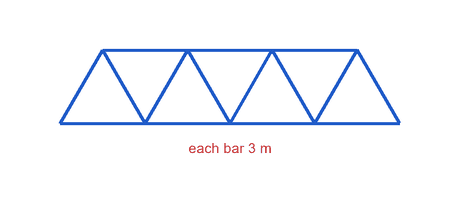
(a) Show that all 7 triangles are congruent.
(b) Count the bars in the girder and find the total length of steel used.
- 374 marks
Question 37
Competency: Application & Analysis
Case study: folding a paper triangle
Sana cuts a paper triangle ABC with AB = 6 cm, BC = 9 cm and AC = 10 cm. She measures ∠ABC and finds it is 81° (to the nearest degree). She folds the paper along a crease AD, with D on BC, so that the corner B falls exactly on a point E of AC. Then she unfolds the paper and draws the line DE.

(a) Explain why AE = AB and DE = DB. Hence prove that ΔABD ≅ ΔAED and name the condition.
(b) Find EC, ∠AED and ∠DEC.
(c) Without measuring DE or DC, find the perimeter of ΔDEC.
- 385 marks
Question 38
Competency: Application & Analysis
Case study: the square lawn
ABCD is a square lawn of side 10 m. Points P, Q, R and S are on AB, BC, CD and DA, with AP = BQ = CR = DS = 3 m. Paths are laid along PQ, QR, RS and SP.
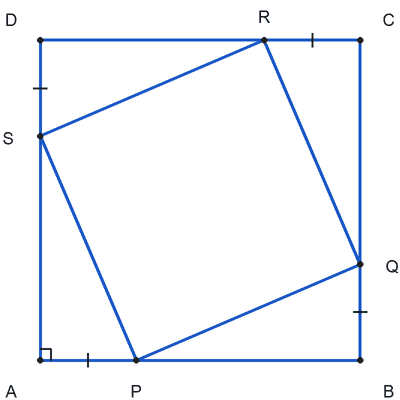
(a) Find AS and BP.
(b) Prove that ΔAPS ≅ ΔBQP.
(c) Hence prove that ∠SPQ = 90°, and say what this tells you about the paths.
- 395 marks
Question 39
Competency: Analysis
Case study: the wall hanging
A triangular cloth ABC has AB = AC. Points D and E are on AB and AC with AD = AE. Two strings BE and CD cross at O.

(a) Prove that ΔABE ≅ ΔACD.
(b) Hence prove that BE = CD. If BE = 1.4 m, find CD.
(c) Prove that OB = OC.
- 404 marks
Question 40
Competency: Analysis & Evaluation
Case study: checking signboards
The master triangular signboard ΔABC has ∠A = 55°, ∠B = 65° and AB = 10 cm. A factory measures four other boards, and the readings are in the table.
Board Readings 1 PQ = 10 cm, ∠P = 55°, ∠Q = 65° 2 ∠P = 55°, ∠R = 60°, PQ = 10 cm 3 ∠P = 55°, ∠Q = 65°, ∠R = 60° 4 ∠P = 55°, ∠Q = 65°, QR = 10 cm (a) Find ∠C of the master. Which boards are certainly congruent to the master? Name the condition for each.
(b) Explain why the readings of board 4 do not prove that it is congruent to the master.
(c) Which one extra measurement of board 3 would settle the matter?