
Question 93 marksEasy
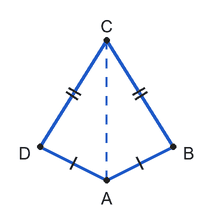
Prove that :
(i) Δ ABC ≅ Δ ADC
(ii) ∠B = ∠D
(iii) AC bisects angle DCB
Confirming your payment
Sign up now and get 250 free tokens.
Congruency: Congruent Triangles · Question 9 of 38
Prove that :
(i) Δ ABC ≅ Δ ADC
(ii) ∠B = ∠D
(iii) AC bisects angle DCB
Solution:
Concept: Two triangles are congruent when one fits exactly on the other. Each of these tests is enough: S.S.S. (three pairs of equal sides); S.A.S. (two pairs of equal sides and the angle between them); A.S.A. or A.A.S. (two pairs of equal angles and one pair of corresponding sides); R.H.S. (a right angle, the hypotenuse and one more side). Three angles alone, or two sides with an angle that is not between them, are not enough. When two triangles are congruent, every part of one equals the matching (corresponding) part of the other. We write the vertices in matching order, so ΔABC ≅ ΔPQR means A ↔ P, B ↔ Q and C ↔ R.
Step 1 — Part (i): prove the triangles congruent.
The figure marks AB = AD and CB = CD, and AC is a side of both triangles.
AB = AD (given)
CB = CD (given)
AC = AC (common side)
So ΔABC ≅ ΔADC by S.S.S.
Step 2 — Part (ii): ∠B = ∠D.
In the congruence ΔABC ≅ ΔADC, vertex B matches vertex D. So ∠B = ∠D, as corresponding angles of congruent triangles.
Step 3 — Part (iii): AC bisects ∠DCB.
Vertex C matches C, so ∠BCA = ∠DCA (corresponding angles). AC therefore divides ∠DCB into two equal angles, which means it bisects ∠DCB.
Watch out: Prove the congruence first; only then may matching angles be called equal.
Therefore, ΔABC ≅ ΔADC (S.S.S.), so ∠B = ∠D and AC bisects ∠DCB. Hence proved.