
Question 193 marksMedium
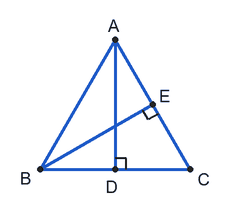
ABC is an equilateral triangle, AD and BE are perpendiculars to BC and AC respectively. Prove that :
(i) AD = BE
(ii) BD = CE
Confirming your payment
Sign up now and get 250 free tokens.
Congruency: Congruent Triangles · Question 19 of 38
ABC is an equilateral triangle, AD and BE are perpendiculars to BC and AC respectively. Prove that :
(i) AD = BE
(ii) BD = CE
Solution:
Concept: Two triangles are congruent when one fits exactly on the other. Each of these tests is enough: S.S.S. (three pairs of equal sides); S.A.S. (two pairs of equal sides and the angle between them); A.S.A. or A.A.S. (two pairs of equal angles and one pair of corresponding sides); R.H.S. (a right angle, the hypotenuse and one more side). Three angles alone, or two sides with an angle that is not between them, are not enough. When two triangles are congruent, every part of one equals the matching (corresponding) part of the other. We write the vertices in matching order, so ΔABC ≅ ΔPQR means A ↔ P, B ↔ Q and C ↔ R. In an equilateral triangle all sides are equal and every angle is 60°.
Step 1 — Choose the triangles.
We compare ΔADB and ΔBEC, matching A with B, D with E and B with C.
∠ADB = 90° (AD ⊥ BC)
∠BEC = 90° (BE ⊥ AC)
∠ABD = ∠BCE (each is 60°, an angle of the equilateral triangle)
AB = BC (sides of the equilateral triangle)
Two angles and a side opposite one of them give ΔADB ≅ ΔBEC by A.A.S.
Step 2 — Part (i): AD = BE.
A matches B and D matches E, so AD = BE (corresponding sides).
Step 3 — Part (ii): BD = CE.
D matches E and B matches C, so DB = EC (corresponding sides), that is BD = CE.
Watch out: Match the vertices with care: the right angles are at D and E, so D matches E.
Therefore, ΔADB ≅ ΔBEC (A.A.S.), so AD = BE and BD = CE. Hence proved.