
Opening your dashboard
Class 7 Biology Chapter 6: Nervous System Solutions
29 textbook questions with step-by-step answers, free to read, for ICSE 2026-27.
Get talked through Ch 6, not just shown the answer
Reading a finished solution is not the same as being able to do it. The AI tutor takes one question at a time and works it with you, in your own words, until you can.
- Ask it out loud, in your own words
- It gives you the next step, not the answer
- Stuck on part (ii)? Start there
29 questions with solutions
1–12 marks · Mixed difficulty
- 11 mark
Question 1
Medulla oblongata controls
Solve with AIAnswer
(A) Smelling
- Correct
(B) Beating of heart and respiratory movement
(C) Intelligence and will power
(D) Balancing of the body
Answer: (B) Beating of heart and respiratory movement
Concept: The human brain has three main parts. The cerebrum (the largest part) is the seat of intelligence, memory and will power and controls voluntary actions; the cerebellum keeps the balance of the body and coordinates muscular activities; the medulla oblongata controls involuntary actions of the internal organs, such as the heart beat and breathing.
Step 1 — Recall the role of the medulla oblongata.
The medulla oblongata is the lowest part of the brain. It controls the involuntary activities of the internal organs: the beating of the heart, breathing, swallowing, coughing, sneezing and vomiting.
Step 2 — Pick the option.
Beating of the heart and breathing (respiratory) movements are both controlled by the medulla oblongata, so the answer is option (B).
Watch out: Do not mix up the medulla (heart beat, breathing) with the cerebellum (balance).
Why the other options are wrong:
- (A) Smelling: smells are picked up by the nose, but the sense of smell is felt and understood in the cerebrum.
- (C) Intelligence and will power: intelligence and will power are functions of the cerebrum.
- (D) Balancing of the body: balancing of the body is the work of the cerebellum.
Therefore, the medulla oblongata controls the beating of the heart and respiratory movements, option (B).
- 21 mark
Question 2
Spinal cord is an extention of :
Solve with AIAnswer
(A) Cerebellum
(B) Cerebrum
(C) Vertebral column
- Correct
(D) Medulla oblongata
Answer: (D) Medulla oblongata
Concept: The spinal cord is the part of the central nervous system that runs down from the brain inside the backbone (vertebral column).
Step 1 — Find where the spinal cord begins.
The medulla oblongata is the lowest part of the brain. As it leaves the skull through a large opening at its base, it simply carries on downwards as the spinal cord.
Step 2 — Pick the option.
So the spinal cord is an extension of the medulla oblongata, option (D).
Watch out: The vertebral column surrounds and protects the spinal cord; the cord itself is nervous tissue, not bone.
Why the other options are wrong:
- (A) Cerebellum: the cerebellum lies at the back of the head, below the cerebrum; it does not continue as the spinal cord.
- (B) Cerebrum: the cerebrum is the large upper part of the brain, far from the spinal cord.
- (C) Vertebral column: the vertebral column (backbone) is made of bones that protect the spinal cord; it is not part of the nervous system.
Therefore, the spinal cord is an extension of the medulla oblongata, option (D).
- 31 mark
Question 3
Body posture is mantained by :
Solve with AIAnswer
(A) Cerebrum
- Correct
(B) Cerebellum
(C) Medulla oblongata
(D) Spinal cord
Answer: (B) Cerebellum
Concept: The human brain has three main parts. The cerebrum (the largest part) is the seat of intelligence, memory and will power and controls voluntary actions; the cerebellum keeps the balance of the body and coordinates muscular activities; the medulla oblongata controls involuntary actions of the internal organs, such as the heart beat and breathing.
Step 1 — Recall what keeps the posture.
To stand or sit upright, many muscles must pull by just the right amount at the same time. The cerebellum keeps the body balanced and coordinates these muscles, so it maintains the body posture.
Step 2 — Pick the option.
So body posture is maintained by the cerebellum, option (B).
Watch out: The cerebrum starts a movement, but the cerebellum keeps the body balanced while it happens.
Why the other options are wrong:
- (A) Cerebrum: the cerebrum decides and starts voluntary movements, but it does not keep the balance and posture.
- (C) Medulla oblongata: the medulla oblongata controls the internal organs, such as the heart and the lungs.
- (D) Spinal cord: the spinal cord controls reflexes below the neck and carries messages, but the fine adjustment of the muscles that keeps the posture is done by the cerebellum.
Therefore, body posture is maintained by the cerebellum, option (B).
- 41 mark
Question 4
Which of these is the largest part of the human brain ?
Solve with AIAnswer
(A) Cerebellum
(B) Pons
- Correct
(C) Cerebrum
(D) Medulla oblongata
Answer: (C) Cerebrum
Concept: The brain has a large cerebrum on top, a smaller cerebellum at the back below it, and a brain stem (midbrain, pons and medulla oblongata) joining it to the spinal cord.
Step 1 — Compare the sizes.
The cerebrum fills most of the skull and makes up more than three-quarters of the mass of the brain. The other parts are much smaller.
Step 2 — Pick the option.
So the largest part of the human brain is the cerebrum, option (C).
Watch out: Do not confuse cerebrum (largest) with cerebellum (the "little brain").
Why the other options are wrong:
- (A) Cerebellum: the cerebellum is much smaller and lies below the back of the cerebrum.
- (B) Pons: the pons is a small part of the brain stem.
- (D) Medulla oblongata: the medulla oblongata is a small part at the lowest end of the brain.
Therefore, the cerebrum is the largest part of the human brain, option (C).
- 51 mark
Question 5
Memory and intelligence are controlled by :
Solve with AIAnswer
- Correct
(A) Cerebrum
(B) Hypothalamus
(C) Cerebellum
(D) Midbrain
Answer: (A) Cerebrum
Concept: The human brain has three main parts. The cerebrum (the largest part) is the seat of intelligence, memory and will power and controls voluntary actions; the cerebellum keeps the balance of the body and coordinates muscular activities; the medulla oblongata controls involuntary actions of the internal organs, such as the heart beat and breathing.
Step 1 — Recall the seat of thinking.
The cerebrum is the seat of intelligence, memory, consciousness and will power. It lets us think, reason, learn and remember.
Step 2 — Pick the option.
So memory and intelligence are controlled by the cerebrum, option (A).
Why the other options are wrong:
- (B) Hypothalamus: the hypothalamus controls body temperature, hunger and thirst, and it also controls the pituitary gland.
- (C) Cerebellum: the cerebellum controls balance and coordinates muscular activities.
- (D) Midbrain: the midbrain is a small part of the brain stem; it handles reflexes to light and sound, such as turning the eyes or head towards a sudden noise.
Therefore, memory and intelligence are controlled by the cerebrum, option (A).
- 61 mark
Question 6
Basic structural and functional unit of the nervous system is :
Solve with AIAnswer
(A) Nerve
- Correct
(B) Neuron
(C) Axon
(D) Nephron
Answer: (B) Neuron
Concept: A structural and functional unit is the smallest part that is built like the whole system and can also do its work. The nervous system is made of nerve cells, called neurons.
Step 1 — Find the unit of the nervous system.
Each neuron can receive a message, carry it along and pass it on to the next cell. So the neuron is both the building block and the working unit of the nervous system.
Step 2 — Pick the option.
The answer is the neuron, option (B).
Watch out: A nerve is made of many neurons' fibres; it is not the basic unit.
Why the other options are wrong:
- (A) Nerve: a nerve is a bundle of many nerve fibres (axons), so it is made of parts of many neurons.
- (C) Axon: the axon is only one part (the long fibre) of a neuron.
- (D) Nephron: the nephron is the structural and functional unit of the kidney, not of the nervous system.
Therefore, the basic structural and functional unit of the nervous system is the neuron, option (B).
- 71 mark
Question 7
The bony protective covering of the brain is :
Solve with AIAnswer
(A) Meninges
(B) Pericardium
(C) Pleura
- Correct
(D) Cranium
Answer: (D) Cranium
Concept: The brain is soft and delicate, so it is protected by a hard, bony box called the cranium (the part of the skull around the brain), and inside it by three membranes, the meninges.
Step 1 — Separate the bony cover from the membranes.
The question asks for the bony covering. Of the options, only the cranium is made of bone.
Step 2 — Pick the option.
So the bony protective covering of the brain is the cranium, option (D).
Watch out: The meninges also protect the brain, but they are membranes, not bone.
Why the other options are wrong:
- (A) Meninges: the meninges are three protective membranes around the brain and spinal cord, not bone.
- (B) Pericardium: the pericardium is the membrane around the heart.
- (C) Pleura: the pleura is the double membrane around each lung.
Therefore, the bony protective covering of the brain is the cranium, option (D).
- 81 mark
Question 8
Which of the following structures is responsible in controlling the reflexes below the neck?
Solve with AIAnswer
(A) Vertebral column
(B) Sensory neuron
- Correct
(C) Spinal cord
(D) Motor neuron
Answer: (C) Spinal cord
Concept: A reflex is a quick, automatic response to a stimulus, such as pulling the hand away from a hot object. Reflexes of the parts below the neck are controlled by the spinal cord.
Step 1 — Follow a reflex below the neck.
A sensory neuron brings the message from the skin to the spinal cord. The spinal cord at once sends an order back through a motor neuron to the muscle, before the brain is even aware of it.
Step 2 — Pick the controlling structure.
The sensory and motor neurons only carry the messages; the decision is made in the spinal cord. So the answer is option (C).
Watch out: A neuron that only carries a message does not control the reflex.
Why the other options are wrong:
- (A) Vertebral column: the vertebral column only protects the spinal cord; it is bone and does not control anything.
- (B) Sensory neuron: a sensory neuron only carries the message from the sense organ to the spinal cord.
- (D) Motor neuron: a motor neuron only carries the order from the spinal cord to the muscle.
Therefore, reflexes below the neck are controlled by the spinal cord, option (C).
- 91 mark
Question 9
Which part of the brain coordinates our muscular activity ?
Solve with AIAnswer
(A) Cerebrum
(B) Medulla oblongata
- Correct
(C) Cerebellum
(D) None of the above
Answer: (C) Cerebellum
Concept: The human brain has three main parts. The cerebrum (the largest part) is the seat of intelligence, memory and will power and controls voluntary actions; the cerebellum keeps the balance of the body and coordinates muscular activities; the medulla oblongata controls involuntary actions of the internal organs, such as the heart beat and breathing.
Step 1 — Separate deciding from coordinating.
The cerebrum decides to make a voluntary movement. The cerebellum then makes the different muscles work together smoothly and in the right order, so the movement is steady and balanced.
Step 2 — Pick the option.
So the part of the brain that coordinates muscular activity is the cerebellum, option (C).
Why the other options are wrong:
- (A) Cerebrum: the cerebrum starts voluntary actions, but the smooth coordination of the muscles is done by the cerebellum.
- (B) Medulla oblongata: the medulla oblongata controls the internal organs, such as the heart beat and breathing.
- (D) None of the above: the cerebellum is listed as option (C), so "None of the above" is wrong.
Therefore, the cerebellum coordinates our muscular activity, option (C).
- 101 mark
Question 10
The point of contact between two nerve cells is termed as :
Solve with AIAnswer
(A) Synaptic cleft
(B) Association neuron
- Correct
(C) Synapse
(D) Mixed nerve
Answer: (C) Synapse
Concept: The end branches of the axon of one neuron lie very close to the dendrites of the next neuron. This point of contact is called a synapse; the message crosses the tiny gap there with the help of chemical messengers.
Step 1 — Name the point of contact.
The place where two nerve cells meet and pass on a message is the synapse.
Step 2 — Pick the option.
So the point of contact between two nerve cells is the synapse, option (C).
Watch out: The synaptic cleft is only the narrow gap inside a synapse, not the whole point of contact.
Why the other options are wrong:
- (A) Synaptic cleft: the synaptic cleft is just the tiny gap between the two neurons, which is one part of the synapse.
- (B) Association neuron: an association neuron is a type of neuron that links sensory and motor neurons; it is a cell, not a junction.
- (D) Mixed nerve: a mixed nerve is a bundle containing both sensory and motor fibres; it is not a point of contact.
Therefore, the point of contact between two nerve cells is termed a synapse, option (C).
- 111 mark
Question 11
Assertion (A): The life of living beings is dependent on a number of processes going on in their bodies like digestion, respiration, etc. All these processes are inter-related to fulfil the general needs of the body.
Reason (R): Living beings obtain the simplest forms of food after digestion and this digested food is burnt during respiration which provides energy. So, only two processes — digestion and respiration are enough for the survival of living beings.
Solve with AIAnswer
(A) (1) Both A and R are true and R is the correct explanation of A.
(B) (2) Both A and R are true but R is not the correct explanation of A.
- Correct
(C) (3) A is true but R is false.
(D) (4) A is false but R is true.
Answer: (C) (3) A is true but R is false.
Concept: In an assertion-reason item, first judge the Assertion (A) and the Reason (R) separately as true or false; only when both are true do we ask whether R correctly explains A.
Step 1 — Judge the Assertion.
A is true. Digestion, respiration, circulation, excretion and the other life processes depend on one another. For example, digestion gives the food that respiration burns, and circulation carries it. Together they meet the needs of the body.
Step 2 — Judge the Reason.
R is false. It is true that digested food is burnt in respiration to give energy, but R ends by saying that only digestion and respiration are enough for survival. We also need circulation, excretion, movement, coordination and other processes.
Step 3 — Pick the option.
A is true and R is false, so the answer is option (C).
Watch out: One false part ("only two processes are enough") makes the whole Reason false.
Why the other options are wrong:
- (A): R is false, so it cannot be the correct explanation of A.
- (B): R is false, so "both A and R are true" is wrong.
- (D): A is true, not false; the life processes really are inter-related.
Therefore, A is true but R is false, option (C).
- 121 mark
Question 12
Assertion (A): Nervous system and chemical coordination in human beings are functionally related to each other.
Reason (R): Nervous coordination is mainly regulated by brain, spinal cord, nerves and sense organs whereas chemical coordination is controlled by the chemical messengers called hormones. They both work in proper coordination.
Solve with AIAnswer
- Correct
(A) (1) Both A and R are true and R is the correct explanation of A.
(B) (2) Both A and R are true but R is not the correct explanation of A.
(C) (3) A is true but R is false.
(D) (4) A is false but R is true.
Answer: (A) (1) Both A and R are true and R is the correct explanation of A.
Concept: In an assertion-reason item, first judge the Assertion (A) and the Reason (R) separately as true or false; only when both are true do we ask whether R correctly explains A.
Step 1 — Judge the Assertion.
A is true. The nervous system and the hormones work together. For example, in danger, nerves signal the adrenal glands to release the hormone adrenaline, and the hypothalamus (part of the brain) controls the pituitary gland.
Step 2 — Judge the Reason.
R is true. Nervous coordination is done by the brain, spinal cord, nerves and sense organs, and chemical coordination by hormones. R also says that the two work in proper coordination.
Step 3 — Decide whether R explains A.
A says the two systems are functionally related. The last part of R, that they work in proper coordination with each other, gives the reason for this. So R explains A, and the answer is option (A).
Note: One could argue that R only describes the two systems; but its last sentence (they work in proper coordination) is what makes them functionally related, so R is taken as the explanation of A.
Why the other options are wrong:
- (B): R ends by saying that the two systems work together, and that is exactly why they are functionally related, so R does explain A.
- (C): R is true: it describes the two kinds of coordination correctly.
- (D): A is true: the nervous system and the hormones are linked in their work.
Therefore, both A and R are true and R is the correct explanation of A, option (A).
- 131 mark
Question 13
Assertion (A): The terminal branches of the axon of one neuron lie very close to the dendrites of another neuron.
Reason (R): If there were a big gap between the axon and dendrites of two connecting neurons, impulses or messages would not be transmitted from one part of the body to another.
Solve with AIAnswer
- Correct
(A) (1) Both A and R are true and R is the correct explanation of A.
(B) (2) Both A and R are true but R is not the correct explanation of A.
(C) (3) A is true but R is false.
(D) (4) A is false but R is true.
Answer: (A) (1) Both A and R are true and R is the correct explanation of A.
Concept: In an assertion-reason item, first judge the Assertion (A) and the Reason (R) separately as true or false; only when both are true do we ask whether R correctly explains A.
Step 1 — Judge the Assertion.
A is true. At a synapse, the end branches of the axon of one neuron lie very close to the dendrites of the next neuron, with only a tiny gap between them.
Step 2 — Judge the Reason.
R is true. The message crosses this tiny gap with the help of chemical messengers. If the gap were large, the message could not reach the next neuron.
Step 3 — Decide whether R explains A.
The neurons lie close together precisely so that the message can be passed on. So R explains A, and the answer is option (A).
Why the other options are wrong:
- (B): R gives the very reason why the neurons lie close, so it does explain A.
- (C): R is true: a large gap would stop the message.
- (D): A is true: the axon endings do lie very close to the next neuron's dendrites.
Therefore, both A and R are true and R is the correct explanation of A, option (A).
- 141 mark
Question 14
Assertion (A): The cerebrum is the seat of intelligence, consciousness and will power. It controls all voluntary activities of the body.
Reason (R): Cerebrum is the largest portion of the brain which accomodates a large number of neurons. Hence, it controls all the internal and external activities of the body, whether voluntary or involuntary.
Solve with AIAnswer
(A) (1) Both A and R are true and R is the correct explanation of A.
(B) (2) Both A and R are true but R is not the correct explanation of A.
- Correct
(C) (3) A is true but R is false.
(D) (4) A is false but R is true.
Answer: (C) (3) A is true but R is false.
Concept: In an assertion-reason item, first judge the Assertion (A) and the Reason (R) separately as true or false; only when both are true do we ask whether R correctly explains A.
Step 1 — Judge the Assertion.
A is true. The cerebrum is the seat of intelligence, consciousness and will power, and it controls the voluntary activities of the body, such as walking and writing.
Step 2 — Judge the Reason.
R is false. The cerebrum is indeed the largest part of the brain with a very large number of neurons, but it does not control all the involuntary activities. The heart beat and breathing are controlled by the medulla oblongata, and reflexes below the neck by the spinal cord.
Step 3 — Pick the option.
A is true and R is false, so the answer is option (C).
Watch out: The word "all" (voluntary or involuntary) makes R false.
Why the other options are wrong:
- (A): R is false, so it cannot be the correct explanation of A.
- (B): R is false, so "both A and R are true" is wrong.
- (D): A is true, not false.
Therefore, A is true but R is false, option (C).
- 151 mark
Question 15
Assertion (A): Sympathetic and parasympathetic systems are the two parts of autonomic nervous system which are independent in their functioning and are not related to each other at all.
Reason (R): Both of these nervous systems are opposite in their actions. Sympathetic nervous system accelerates the actions while parsympathetic system relaxes them.
Solve with AIAnswer
(A) (1) Both A and R are true and R is the correct explanation of A.
(B) (2) Both A and R are true but R is not the correct explanation of A.
(C) (3) A is true but R is false.
- Correct
(D) (4) A is false but R is true.
Answer: (D) (4) A is false but R is true.
Concept: In an assertion-reason item, first judge the Assertion (A) and the Reason (R) separately as true or false; only when both are true do we ask whether R correctly explains A.
Step 1 — Judge the Assertion.
A is false. The sympathetic and parasympathetic systems are the two parts of the autonomic nervous system, but they are closely related: they act on the same organs in opposite ways and together keep the body balanced.
Step 2 — Judge the Reason.
R is true. The two systems are opposite in their actions. For example, the sympathetic system speeds up the heart beat and breathing in an emergency, and the parasympathetic system slows them down again.
Step 3 — Pick the option.
A is false and R is true, so the answer is option (D).
Watch out: "Opposite in action" does not mean "unrelated": the two work as a pair on the same organs.
Note: R is a simplified statement. For the heart and breathing it is exactly right, but for digestion the roles are reversed: the parasympathetic system speeds digestion up and the sympathetic system slows it down.
Why the other options are wrong:
- (A): A is false, so this option cannot be right.
- (B): A is false, so "both A and R are true" is wrong.
- (C): it is the other way round: A is false and R is true.
Therefore, A is false but R is true, option (D).
- 165 marks
Question 16
Match the terms given in column A with those of column B :
Column A Column B (i) Sensory neuron (a) Brain and spinal cord (ii) Motor neuron (b) Somatic and autonomic (iii) Central nervous system (c) Sympathetic and parasympathetic (iv) Peripheral nervous system (d) Sense organs (v) Autonomic nervous system (e) Effectors Solve with AIWritten solution
Solution:
Concept: The nervous system has a central part (brain and spinal cord) and a peripheral part (nerves). The peripheral part is divided into the somatic and autonomic systems, and the autonomic system into the sympathetic and parasympathetic systems.
Step 1 — Match the neurons.
A sensory neuron carries messages from the sense organs, so (i) matches (d). A motor neuron carries orders to the effectors (muscles and glands), so (ii) matches (e).
Step 2 — Match the divisions.
The central nervous system is made of the brain and spinal cord, so (iii) matches (a). The peripheral nervous system has a somatic and an autonomic part, so (iv) matches (b). The autonomic nervous system has a sympathetic and a parasympathetic part, so (v) matches (c).
Step 3 — Write the matched pairs.
The completed matching is shown in the table.
Column A Column B (i) Sensory neuron (d) Sense organs (ii) Motor neuron (e) Effectors (iii) Central nervous system (a) Brain and spinal cord (iv) Peripheral nervous system (b) Somatic and autonomic (v) Autonomic nervous system (c) Sympathetic and parasympathetic Watch out: Sensory neurons start at the sense organs; motor neurons end at the effectors.
Therefore, (i) matches (d), (ii) matches (e), (iii) matches (a), (iv) matches (b) and (v) matches (c).
- 175 marks
Question 17
Correct the following statements by changing the first and the last word only :
(i) Cerebrum maintains the balance of the body.
(ii) The long process which extends from the cell body of a neuron is termed as a dendron.
(iii) Enzymes regulate chemical coordination of the body.
(iv) Motor neurons carry impulses from the sense organs to the central nervous system.
(v) Spinal cord regulates the heart beat and breathing movements.
Solve with AIWritten solution
Solution:
Concept: Each statement has one wrong word, either the first or the last. We find the wrong word, put in the correct term and keep the rest of the sentence.
Step 1 — Statement (i).
Balance of the body is kept by the cerebellum, not the cerebrum. So the first word changes:
Cerebellum maintains the balance of the body.
Step 2 — Statement (ii).
The long process from the cell body that carries the impulse away is the axon; the dendron is a short, branched process. So the last word changes (and "a" becomes "an"):
The long process which extends from the cell body of a neuron is termed as an axon.
Step 3 — Statement (iii).
Chemical coordination is done by hormones; enzymes only speed up chemical reactions such as digestion. So the first word changes:
Hormones regulate chemical coordination of the body.
Step 4 — Statement (iv).
Neurons that carry impulses from the sense organs to the brain or spinal cord are sensory neurons; motor neurons carry orders away to the muscles. So the first word changes:
Sensory neurons carry impulses from the sense organs to the central nervous system.
Step 5 — Statement (v).
The heart beat and breathing are controlled by the medulla oblongata, not the spinal cord. So the first words change:
Medulla oblongata regulates the heart beat and breathing movements.
Watch out: Change only the wrong word; the other end of the sentence is already correct.
Therefore, the corrected first or last words are (i) Cerebellum, (ii) axon, (iii) Hormones, (iv) Sensory and (v) Medulla oblongata.
- 182 marks
Question 18
Write one word in the space provided to complete the second pair of the related words pertaining to nervous system :
Memory : cerebrum : : breathing : ..........
Balance : cerebellum : : reasoning : ..........
Solve with AIWritten solution
Solution:
Concept: The human brain has three main parts. The cerebrum (the largest part) is the seat of intelligence, memory and will power and controls voluntary actions; the cerebellum keeps the balance of the body and coordinates muscular activities; the medulla oblongata controls involuntary actions of the internal organs, such as the heart beat and breathing.
Step 1 — Understand the first pair.
In "Memory : cerebrum", a function is paired with the part of the brain that controls it. The second pair must follow the same rule.
Step 2 — Complete the breathing pair.
Breathing is an involuntary action controlled by the medulla oblongata.
Memory : cerebrum : : breathing : medulla oblongata
Step 3 — Complete the reasoning pair.
Reasoning (thinking) is done by the cerebrum.
Balance : cerebellum : : reasoning : cerebrum
Therefore, the missing words are medulla oblongata and cerebrum.
- 194 marks
Question 19
Name :
(i) Three main parts of the brain.
(ii) Three kinds of nerves.
(iii) Three kinds of neurons
(iv) Two divisions of the peripheral nervous system.
Solve with AIWritten solution
Solution:
Concept: The nervous system is made of neurons; bundles of their fibres form nerves; and it has a central part (brain and spinal cord) and a peripheral part (the nerves).
Step 1 — (i) Main parts of the brain.
The three main parts of the brain are the cerebrum, the cerebellum and the medulla oblongata. (By how it develops, the brain is also grouped into the forebrain, midbrain and hindbrain.)
Step 2 — (ii) Kinds of nerves.
Nerves are named by the fibres they carry: sensory nerves, motor nerves and mixed nerves.
Step 3 — (iii) Kinds of neurons.
Neurons are named by their work: sensory neurons, motor neurons and association (relay) neurons, which link the other two.
Step 4 — (iv) Divisions of the peripheral nervous system.
The peripheral nervous system has two divisions: the somatic nervous system and the autonomic nervous system.
Watch out: Kinds of nerves and kinds of neurons have similar names, but association neurons are found only inside the brain and spinal cord.
Therefore, (i) cerebrum, cerebellum, medulla oblongata; (ii) sensory, motor, mixed nerves; (iii) sensory, motor, association neurons; (iv) somatic and autonomic nervous systems.
- 2010 marks
Question 20
Define the following terms :
(i) Coordination
(ii) Neuron
(iii) Synapse
(iv) Brain
(v) Spinal cord
Solve with AIWritten solution
Solution:
Concept: A definition says exactly what a term means, in one or two clear sentences, using the key words of the chapter.
Step 1 — (i) Coordination.
Coordination is the working together of the different organs and activities of a living being in a proper order, according to the needs of the body, inside or outside.
Step 2 — (ii) Neuron.
A neuron is a nerve cell. It is the structural and functional unit of the nervous system, made of a cell body (cyton) with short branched dendrites and one long axon.
Step 3 — (iii) Synapse.
A synapse is the point of contact between the end branches of the axon of one neuron and the dendrites of the next neuron, where the message passes from one neuron to the next.
Step 4 — (iv) Brain.
The brain is the most complex and important organ of the body. It lies inside the cranium of the skull and, together with the spinal cord, forms the central nervous system, which controls the activities of the body.
Step 5 — (v) Spinal cord.
The spinal cord is the part of the central nervous system that continues from the medulla oblongata down through the vertebral column. It controls reflexes below the neck and carries messages to and from the brain.
Watch out: A synapse is a point of contact between two neurons, not a part of one neuron.
Therefore, coordination is the working together of body activities, a neuron is a nerve cell, a synapse is the contact between two neurons, and the brain and spinal cord form the central nervous system.
- 216 marks
Question 21
Write one important role of the following :
(i) Cerebellum
(ii) Medulla oblongata
(iii) Parasympathetic nervous system
Solve with AIWritten solution
Solution:
Concept: The human brain has three main parts. The cerebrum (the largest part) is the seat of intelligence, memory and will power and controls voluntary actions; the cerebellum keeps the balance of the body and coordinates muscular activities; the medulla oblongata controls involuntary actions of the internal organs, such as the heart beat and breathing.
Step 1 — (i) Cerebellum.
The cerebellum maintains the balance of the body and coordinates muscular activities, so that movements are smooth and steady.
Step 2 — (ii) Medulla oblongata.
The medulla oblongata controls the involuntary activities of the internal organs, for example the beating of the heart and breathing.
Step 3 — (iii) Parasympathetic nervous system.
The parasympathetic nervous system brings the body back to normal (rest) after an emergency, for example it slows down the heart beat and breathing.
Watch out: The sympathetic system speeds the body up; the parasympathetic system calms it down.
Therefore, the cerebellum keeps balance, the medulla oblongata controls the heart beat and breathing, and the parasympathetic system brings the body back to normal.
- 222 marks
Question 22
Mention the three functions of spinal cord.
Solve with AIWritten solution
Solution:
Concept: The spinal cord runs down from the medulla oblongata inside the backbone. It is a reflex centre and the main pathway for messages between the brain and the body.
Step 1 — Reflexes.
It controls reflex actions below the neck, such as pulling the hand away from a hot object.
Step 2 — Messages to the brain.
It carries sensory messages from the skin and muscles to the brain.
Step 3 — Messages from the brain.
It carries orders from the brain to the muscles of the trunk and limbs.
Therefore, the spinal cord controls reflexes below the neck, carries messages from the body to the brain, and carries orders from the brain to the trunk and limbs.
- 232 marks
Question 23
What are voluntary and involuntary actions ? Which part of the nervous system controls them?
Solve with AIWritten solution
Solution:
Concept: Actions are of two kinds: those we do by our own will (voluntary) and those that happen automatically, without our will (involuntary).
Step 1 — Voluntary actions.
Voluntary actions are done consciously, by our own will, for example walking, writing and speaking. They are controlled by the cerebrum.
Step 2 — Involuntary actions.
Involuntary actions happen on their own, without our will, for example the heart beat, breathing and digestion. They are controlled by the medulla oblongata, working with the autonomic nervous system.
Step 3 — Reflexes.
Quick automatic reflexes are also involuntary. Reflexes below the neck are controlled by the spinal cord; reflexes such as blinking, coughing and sneezing are controlled by the lower part of the brain (the brain stem).
Watch out: Reflexes are not "without the brain": those of the head, like blinking, use the lower brain.
Therefore, voluntary actions are done by our will and controlled by the cerebrum, while involuntary actions happen automatically and are controlled by the medulla oblongata (with the autonomic nervous system) and, for reflexes below the neck, the spinal cord.
- 2410 marks
Question 24
Distinguish between the following pairs on the basis of the words indicated in the brackets [ ].
(i) Sensory neuron and Motor neuron. [Function]
(ii) Cerebrum and Cerebellum. [Location]
(iii) Cranial and Spinal nerves. [Structure of origin]
(iv) Sympathetic and Parasympathetic nervous system. [Function]
(v) Motor and Mixed nerves. [Kind of neurons]
Solve with AIWritten solution
Solution:
Concept: To distinguish two things, give one matching point for each of them, on the basis asked in the brackets.
Step 1 — (i) Sensory and motor neuron: function.
The two neurons carry messages in opposite directions.
Sensory neuron Motor neuron Carries impulses from the sense organs to the brain or spinal cord. Carries orders from the brain or spinal cord to the effectors (muscles or glands). Step 2 — (ii) Cerebrum and cerebellum: location.
The two parts lie in different places in the skull.
Cerebrum Cerebellum The largest, upper part of the brain, filling most of the skull. A smaller part at the back of the head, below the cerebrum. Step 3 — (iii) Cranial and spinal nerves: structure of origin.
The two kinds of nerves start from different parts of the central nervous system.
Cranial nerves Spinal nerves Arise from the brain (12 pairs). Arise from the spinal cord (31 pairs). Step 4 — (iv) Sympathetic and parasympathetic system: function.
The two systems act on the same organs in opposite ways.
Sympathetic nervous system Parasympathetic nervous system Prepares the body for emergencies ("fight or flight"), for example it speeds up the heart beat. Brings the body back to normal after the emergency, for example it slows down the heart beat. Step 5 — (v) Motor and mixed nerves: kind of neurons.
The two kinds of nerves contain different kinds of nerve fibres.
Motor nerve Mixed nerve Contains fibres of motor neurons only, for example the nerves that move the eyeball. Contains fibres of both sensory and motor neurons, for example every spinal nerve. Watch out: Cerebrum is the large upper part; cerebellum is the smaller part at the back, below it.
Therefore, the pairs differ as shown: direction of the message, place in the skull, origin from the brain or spinal cord, emergency or rest, and motor-only or mixed fibres.
- 252 marks
Question 25
Draw a neat and labelled diagram of a nerve cell.
Solve with AIWritten solution
Solution:
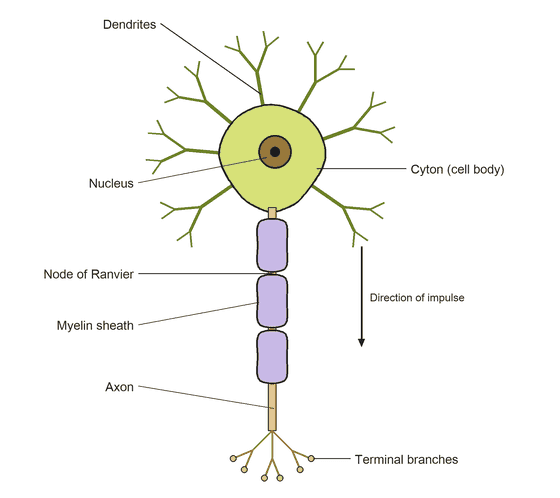
Concept: A nerve cell (neuron) has a cell body (cyton) with a nucleus and short branched dendrites, and one long axon covered by a myelin sheath with gaps (nodes of Ranvier), ending in terminal branches.
Step 1 — Draw the cell body and dendrites.
Draw a rounded cell body with a large nucleus in the middle, and several short, branched dendrites around it, which receive messages.
Step 2 — Draw the axon.
From the cell body draw one long axon. Cover it with segments of myelin sheath, leaving small gaps between them for the nodes of Ranvier, and end it in terminal branches. Show the direction of the impulse with an arrow, from the dendrites through the cell body and along the axon.
Step 3 — Label the parts.
Label the dendrites, nucleus, cyton (cell body), node of Ranvier, myelin sheath, axon and terminal branches.
Watch out: The impulse travels from the dendrites to the cell body and then away along the axon, never the other way.
Therefore, the labelled diagram shows the dendrites, nucleus, cyton, axon with myelin sheath and nodes of Ranvier, and terminal branches.
- 2612 marks
Question 26
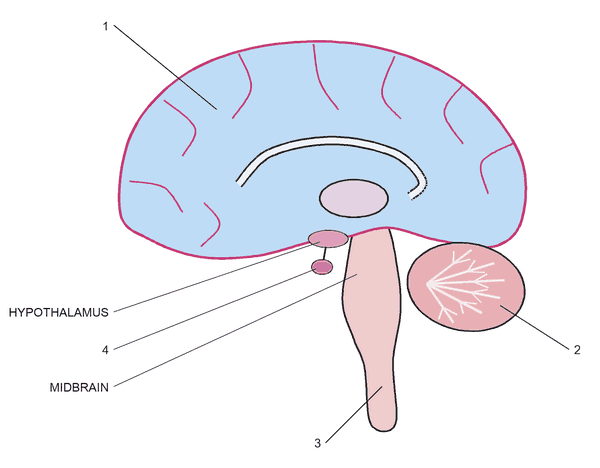
Given alongside is the figure of a median section of an organ. Study the same and answer the following questions :
(i) Name the organ and write its location in our body.
(ii) Label the guidelines 1 to 4.
(iii) Write one important function of hypothalamus.
(iv) Which of the structures from 1 to 4 is considered as the master gland of the body ?
(v) Mention the basic structural unit of the organ shown in the figure and the organ system to which it belongs.
Solve with AIWritten solution
Solution:
Concept: The figure is a median section of the human brain (cut down the middle and seen from the side, front on the left). The human brain has three main parts. The cerebrum (the largest part) is the seat of intelligence, memory and will power and controls voluntary actions; the cerebellum keeps the balance of the body and coordinates muscular activities; the medulla oblongata controls involuntary actions of the internal organs, such as the heart beat and breathing.
Step 1 — (i) Name and location.
The organ is the brain. It lies in the head, inside the cranium of the skull, covered by three membranes, the meninges.
Step 2 — (ii) Label the guidelines.
The labels follow from the shapes and positions of the parts.
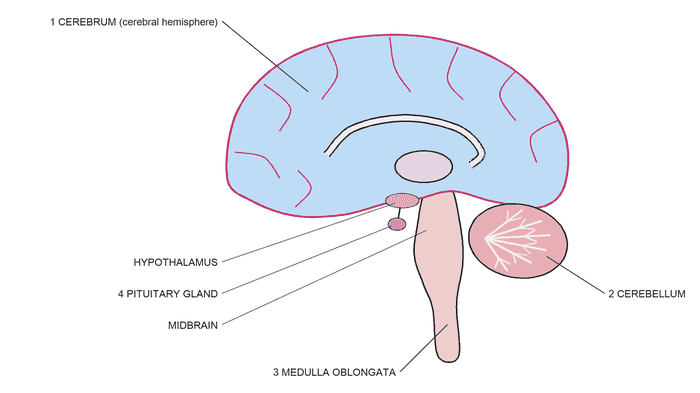
- 1 — Cerebrum (cerebral hemisphere): the large folded upper part.
- 2 — Cerebellum: the smaller part at the back, below the cerebrum.
- 3 — Medulla oblongata: the lowest part, which continues as the spinal cord.
- 4 — Pituitary gland: the small gland hanging below the hypothalamus.
Step 3 — (iii) Function of the hypothalamus.
The hypothalamus controls body temperature, hunger and thirst. It also controls the pituitary gland, linking the nervous system with the hormones.
Step 4 — (iv) Master gland.
The pituitary gland, labelled 4, is called the master gland, because its hormones control many other glands of the body.
Step 5 — (v) Unit and organ system.
The basic structural unit of the brain is the neuron (nerve cell). The brain belongs to the nervous system (its central part).
Watch out: The pituitary hangs below the brain; it is a gland, not a part of the cerebrum.
Therefore, (i) brain, in the cranium; (ii) 1 cerebrum, 2 cerebellum, 3 medulla oblongata, 4 pituitary gland; (iii) it controls body temperature, hunger and thirst; (iv) 4, the pituitary gland; (v) neuron, nervous system.
- 279 marks
Question 27
A part of our nervous system is shown alongside. Study the same and answer the following questions :

(i) Identify the figure and name it.
(ii) Define the structure shown.
(iii) Label the part shown as X.
(iv) Write the name of the protective, tubular covering of the structure shown.
(v) Mention the names of the three kinds of the structure that is shown in the figure.
Solve with AIWritten solution
Solution:
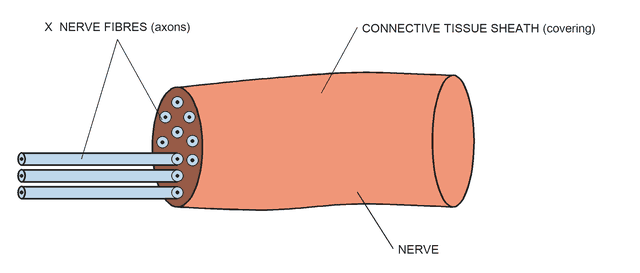
Concept: A nerve is a cable-like bundle of many nerve fibres (long axons of neurons), wrapped together in a protective tubular sheath of connective tissue. Each fibre inside has its own medullary (myelin) sheath.
Step 1 — (i) Identify the figure.
The figure shows a cut piece of a nerve: many nerve fibres grouped together inside a tube-like covering.
Step 2 — (ii) Define the structure.
A nerve is a bundle of nerve fibres (axons) enclosed in a protective, tubular sheath of connective tissue. It carries messages between the central nervous system and the body.
Step 3 — (iii) Label X.
The thin tubes marked X, coming out of the cut end, are the nerve fibres (axons).
Step 4 — (iv) The protective covering.
The whole nerve is wrapped in a tubular connective tissue sheath, which protects the fibres and holds them together.
Step 5 — (v) Kinds of nerves.
Nerves are of three kinds: sensory nerves, motor nerves and mixed nerves.
Watch out: A nerve is a bundle of fibres from many neurons, not a single neuron.
Note: This covering is sometimes called the medullary sheath, but the medullary (myelin) sheath actually wraps each nerve fibre inside the nerve. It insulates the fibre, keeps impulses in nearby fibres separate and makes impulses travel much faster.
Therefore, (i) a nerve; (ii) a bundle of nerve fibres in a protective sheath; (iii) X = nerve fibres (axons); (iv) the connective tissue sheath; (v) sensory, motor and mixed nerves.
- 283 marks
Question 28
Briefly describe the structure of the cerebrum in human brain and mention its functions.
Solve with AIWritten solution
Solution:
Concept: The human brain has three main parts. The cerebrum (the largest part) is the seat of intelligence, memory and will power and controls voluntary actions; the cerebellum keeps the balance of the body and coordinates muscular activities; the medulla oblongata controls involuntary actions of the internal organs, such as the heart beat and breathing.
Step 1 — Size and halves.
The cerebrum is the largest part of the brain. It is divided into two halves, the right and left cerebral hemispheres, joined by a thick band of nerve fibres. Each hemisphere has a fluid-filled cavity (ventricle) inside.
Step 2 — Folded surface.
The outer surface is folded into many ridges and grooves. The folds give a much larger surface, which holds a very large number of neurons: about 16 billion in the outer layer (cortex) of the cerebrum, out of about 86 billion in the whole brain.
Step 3 — Functions.
The cerebrum is the seat of intelligence, consciousness, memory and will power. It controls all voluntary actions, such as walking and writing, and it feels and understands sensations of sight, hearing, smell, taste and touch.
Watch out: The cerebrum controls voluntary actions; involuntary actions such as the heart beat are controlled by the medulla oblongata.
Note: Older figures of about 9 billion neurons in the cerebrum are outdated; today's count is about 16 billion in the cerebral cortex.
Therefore, the cerebrum is the largest, folded part of the brain made of two hemispheres, and it controls thinking, memory, will power, sensations and all voluntary actions.
- 296 marks
Question 29
During Sports Day, Arnav ran a 200-meter race. After finishing, his breathing became fast and deep. A few minutes later, his breathing returned to normal even without him consciously trying. His teacher explained that this automatic adjustment was managed by a particular nervous system in the body.
(i) Name the specific division of the nervous system involved in this automatic control.
(ii) State the two parts of this division.
(iii) Write one important role of each part.
(iv) Arnav's heartbeat and breathing rate increased during the race. Which gas was deficient in his blood at that moment?
(v) Mention the exact location of this nervous system within the body.
Solve with AIWritten solution
Solution:
Concept: The actions of the internal organs (heart, lungs, gut) go on automatically, without our will. They are adjusted by the autonomic nervous system, which has two parts with opposite effects.
Step 1 — (i) The division involved.
The heart rate and breathing settled down without Arnav trying, so the control was automatic. This is done by the autonomic nervous system.
Step 2 — (ii) Its two parts.
The autonomic nervous system has two parts: the sympathetic and the parasympathetic nervous systems.
Step 3 — (iii) Role of each part.
Each part has the opposite effect on the same organs.
- Sympathetic: prepares the body for action or emergency ("fight or flight"); for example, it speeds up the heart beat and breathing during the race.
- Parasympathetic: brings the body back to normal (rest); for example, it slows down the heart beat and breathing after the race.
Step 4 — (iv) The gas that was short.
During the race his muscles used up oxygen very fast to release energy, so the blood coming from them was short of oxygen and carried extra carbon dioxide. Faster heart beat and breathing bring in more oxygen and remove the carbon dioxide.
Step 5 — (v) Location.
The sympathetic system is a pair of chains of ganglia and nerves, one on each side of the spinal cord, along the backbone. The parasympathetic nerves come from the brain and from the lowest part of the spinal cord.
Watch out: Faster breathing after exercise is an automatic adjustment, not a voluntary action.
Note: The breathing rhythm itself is set by the breathing centre in the medulla oblongata. It reacts mostly to the build-up of carbon dioxide in the blood, and works together with the autonomic nervous system.
Therefore, (i) the autonomic nervous system; (ii) sympathetic and parasympathetic; (iii) the sympathetic speeds the body up and the parasympathetic brings it back to normal; (iv) oxygen; (v) beside the spinal cord along the backbone, with parasympathetic nerves from the brain and the lower spinal cord.
What Class 7 Biology Ch 6 covers
The sections of the chapter, in the order the book takes them. Every question above comes from one of these.
- 01Coordination
- 02Neuron – Structural and Functional Unit
- 03Types of Neurons
- 04Nerve
- 05Human Nervous System
- 06The Brain
More ways to study this chapter
The same chapter asked three other ways. Practise it, revise it, and see what the board has set on Ch 6 before.
Class 7 Biology Ch 6 questions students ask
How many questions are there in Class 7 Biology Ch 6?
29 questions. Every one is solved step by step on this page.
Are these Class 7 Biology solutions free?
Yes. Every question and its full working is free to read, with no account needed.
Can I download the Class 7 Biology Ch 6 solutions as a PDF?
There is no PDF to download. Every solution is on this page instead, which means it is searchable, always the current syllabus, and readable on a phone. Use your browser's print option if you want it on paper.