Solution:
Concept: A nerve is a cable-like bundle of many nerve fibres (long axons of neurons), wrapped together in a protective tubular sheath of connective tissue. Each fibre inside has its own medullary (myelin) sheath.
Step 1 — (i) Identify the figure.
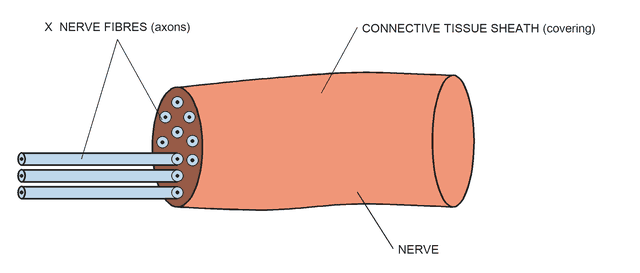
The figure shows a cut piece of a nerve: many nerve fibres grouped together inside a tube-like covering.
Step 2 — (ii) Define the structure.
A nerve is a bundle of nerve fibres (axons) enclosed in a protective, tubular sheath of connective tissue. It carries messages between the central nervous system and the body.
Step 3 — (iii) Label X.
The thin tubes marked X, coming out of the cut end, are the nerve fibres (axons).
Step 4 — (iv) The protective covering.
The whole nerve is wrapped in a tubular connective tissue sheath, which protects the fibres and holds them together.
Step 5 — (v) Kinds of nerves.
Nerves are of three kinds: sensory nerves, motor nerves and mixed nerves.
Watch out: A nerve is a bundle of fibres from many neurons, not a single neuron.
Note: This covering is sometimes called the medullary sheath, but the medullary (myelin) sheath actually wraps each nerve fibre inside the nerve. It insulates the fibre, keeps impulses in nearby fibres separate and makes impulses travel much faster.
Therefore, (i) a nerve; (ii) a bundle of nerve fibres in a protective sheath; (iii) X = nerve fibres (axons); (iv) the connective tissue sheath; (v) sensory, motor and mixed nerves.

