Solution:
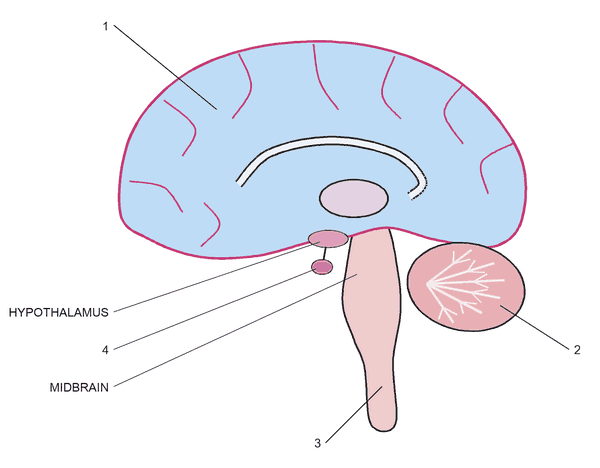
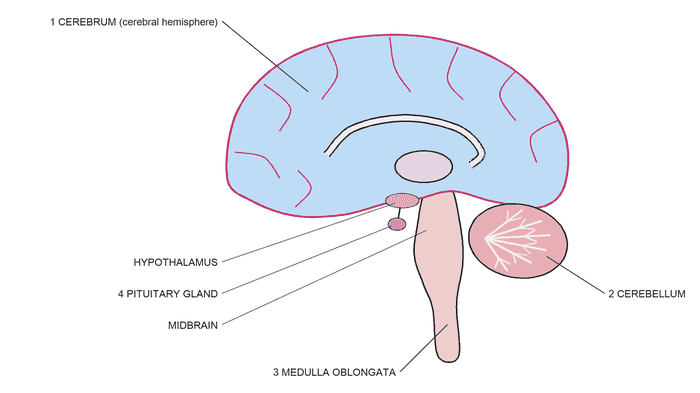
Concept: The figure is a median section of the human brain (cut down the middle and seen from the side, front on the left). The human brain has three main parts. The cerebrum (the largest part) is the seat of intelligence, memory and will power and controls voluntary actions; the cerebellum keeps the balance of the body and coordinates muscular activities; the medulla oblongata controls involuntary actions of the internal organs, such as the heart beat and breathing.
Step 1 — (i) Name and location.
The organ is the brain. It lies in the head, inside the cranium of the skull, covered by three membranes, the meninges.
Step 2 — (ii) Label the guidelines.
The labels follow from the shapes and positions of the parts.
- 1 — Cerebrum (cerebral hemisphere): the large folded upper part.
- 2 — Cerebellum: the smaller part at the back, below the cerebrum.
- 3 — Medulla oblongata: the lowest part, which continues as the spinal cord.
- 4 — Pituitary gland: the small gland hanging below the hypothalamus.
Step 3 — (iii) Function of the hypothalamus.
The hypothalamus controls body temperature, hunger and thirst. It also controls the pituitary gland, linking the nervous system with the hormones.
Step 4 — (iv) Master gland.
The pituitary gland, labelled 4, is called the master gland, because its hormones control many other glands of the body.
Step 5 — (v) Unit and organ system.
The basic structural unit of the brain is the neuron (nerve cell). The brain belongs to the nervous system (its central part).
Watch out: The pituitary hangs below the brain; it is a gland, not a part of the cerebrum.
Therefore, (i) brain, in the cranium; (ii) 1 cerebrum, 2 cerebellum, 3 medulla oblongata, 4 pituitary gland; (iii) it controls body temperature, hunger and thirst; (iv) 4, the pituitary gland; (v) neuron, nervous system.