
Opening your dashboard
Class 7 Biology Chapter 6 Nervous System: Competency-Based Questions (CBQ)
40 questions on Chapter 6, each worked through on its own page with the AI tutor. Class 7 Biology, ICSE 2026-27.
40 questions
1–5 marks · Mixed difficulty
- 11 mark
Question 1
Cognitive domain: Application
After an illness, Mr Khan can feel the warmth of a cup of tea placed in his right hand, and he can tell that it is too hot. But however hard he tries, he cannot make the fingers of that hand move to put the cup down. Which neurons supplying his right hand are most likely not working ?
- 21 mark
Question 2
Cognitive domain: Analysis
The figure shows two neurons through which a message passes one after the other. Four places are numbered 1 to 4.
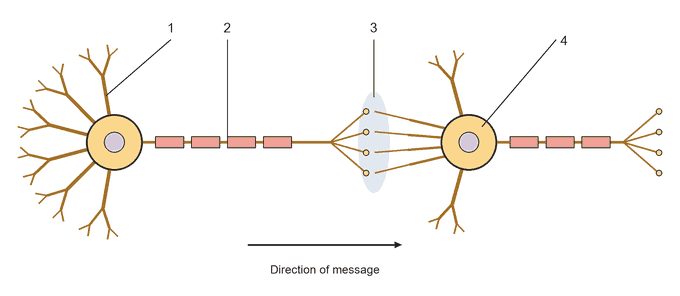
A certain chemical does not harm either neuron. It only stops the message from being handed over from the first neuron to the second. At which numbered place does this chemical act ?
- 31 mark
Question 3
Cognitive domain: Analysis
Anu watched her baby brother while he was fast asleep and made this table.
Activity Going on during deep sleep ? Beating of the heart Yes Breathing Yes Digestion of the milk he drank Yes Deciding to pick up a toy No Walking to his mother No Which statement best explains the pattern in the table ?
- 41 mark
Question 4
Cognitive domain: Application
An eye specialist examines a patient. His left eyeball looks healthy, and it can turn up, down and sideways normally. Yet he cannot see anything with that eye. Which nerve is most likely damaged, and what kind of nerve is it ?
- 51 mark
Question 5
Cognitive domain: Understanding
Assertion (A): A person whose spinal cord is badly injured in the middle of the back may not feel a pinprick on the feet.
Reason (R): Messages from the skin of the legs and feet reach the brain by travelling up through the spinal cord.
- 61 mark
Question 6
Cognitive domain: Analysis
Assertion (A): When a boy sees a bull charging at him and runs away, only chemical coordination is at work; the nervous system takes no part.
Reason (R): In an emergency, certain chemicals are released into the blood to provide extra energy and strength.
- 71 mark
Question 7
Cognitive domain: Application
Before stitching a deep cut on Rohan's palm, a doctor gave an injection near the cut. For the next hour, Rohan felt no pain or touch in that part of the palm, but he could still bend and straighten all his fingers when asked.
Complete the sentence :
The injection stopped the ______ neurons of that part from carrying impulses, while the ______ neurons of the hand went on working.
- 81 mark
Question 8
Cognitive domain: Understanding
A surgeon is about to operate on the bones of a patient's backbone. She tells her students, "The bones themselves are not my biggest worry. I am far more worried about the soft, delicate structure that runs inside them."
Complete the sentence :
The structure she is worried about is the ______, which lies within the vertebral column and, together with the brain, forms the ______ nervous system.
- 91 mark
Question 9
Cognitive domain: Application
A doctor shines a small torch into the eye of a patient who is unconscious. The pupil of the eye at once becomes smaller, although the patient knows nothing about it.
Complete the sentence :
This pupillary response is an ______ activity, and it is regulated by the ______ nervous system.
- 102 marks
Question 10
Cognitive domain: Evaluation
Before her exam, Diya's heart was pounding. She read that the sympathetic nervous system increases the heart rate. She said, "The sympathetic system only troubles us. Our body would work better without it."
Do you agree with Diya ? Justify your answer, and explain how her heartbeat came back to normal later.
- 112 marks
Question 11
Cognitive domain: Understanding
Kunal twisted his ankle while playing kabaddi. It hurt every time he tried to stand on it. He grumbled, "Pain is useless. I wish my body could not feel any pain at all."
Explain how the pain in his sprained ankle is actually helping him. Which type of coordination brings about this help ?
- 122 marks
Question 12
Cognitive domain: Evaluation
The nerve that goes to the tongue is a mixed nerve. Meera argues, "A mixed nerve is a bad design. Messages going to the brain and commands coming from the brain travel in the same nerve, so they must get mixed up."
Is Meera's argument correct ? Give reasons based on the structure of a nerve.
- 134 marks
Question 13
Cognitive domain: Application
Case: During a health check-up, Sara sits on a high table with her legs hanging freely. The doctor taps gently just below her knee with a small rubber hammer. At once her lower leg kicks forward. Sara laughs and says, "I did not do that ! My leg moved on its own, and I felt the tap only a moment later."
(a) Sara did not decide to kick. What is such an action called, and which part of the central nervous system controlled it ?
(b) Which type of neuron carried the message of the tap to the spinal cord, and which type carried the command from the spinal cord to the leg muscle ? Give a reason for each.
(c) Sara also felt the tap. Which function of the spinal cord made this possible ?
(d) A minute later the doctor says, "Now swing your leg ten times." Sara does so. How is the control of this action different from that of the kick ?
- 145 marks
Question 14
Cognitive domain: Analysis
Case: The figure shows the human brain in median section, with three parts marked P, Q and R.

Nandini is learning Kathak. Her teacher noted four things during one class :
Observation What happened 1 She remembered a long sequence of steps and decided when to begin. 2 She did ten fast spins and stopped without losing her balance. 3 After the dance, her heart was beating fast and she was breathing quickly, without trying to. 4 She stepped on a sharp hairpin and her foot jerked back at once. (a) Name the parts P, Q and R.
(b) For each of observations 1, 2 and 3, write the letter of the part that was mainly in control, and give a reason.
(c) Observation 4 was not controlled by P, Q or R. Which part of the central nervous system controlled it ? Where does this part lie ?
(d) "The cerebrum decides an action, whereas the cerebellum implements it." Explain this statement using Nandini's first spin.
- 155 marks
Question 15
Cognitive domain: Creativity
Case: For the school science assembly, Class 7 wants to act out, as a human chain, how the nervous system lets a goalkeeper see a football coming and dive to stop it. Each student will play one part of the pathway. A soft ball passed from student to student will stand for the message (impulse).
(a) List, in the correct order, the parts that the students should play, from the goalkeeper's eye to his muscles. Write one line on what each "part" will do in the act.
(b) How can the students show (1) a synapse and (2) the fact that the message moves in one direction only ?
(c) Suggest one more short scene with the same students that shows a reflex, and say how this scene will differ from the first one.
- 161 mark
Question 16
Cognitive domain: Application
The figure shows a neuron with four parts marked P, Q, R and S.

In a tall adult, one such neuron has its cell body inside the spinal cord in the lower back and carries commands to a muscle of the big toe, about one metre away. Which labelled part of the neuron covers almost all of this distance ?
- 171 mark
Question 17
Cognitive domain: Analysis
Meera touches a hot idli plate and pulls her hand away before she even realises it. The figure shows the three neurons P, Q and R that carry the message of this quick action from her skin to a muscle of her arm. The arrow heads show the direction in which the message travels.
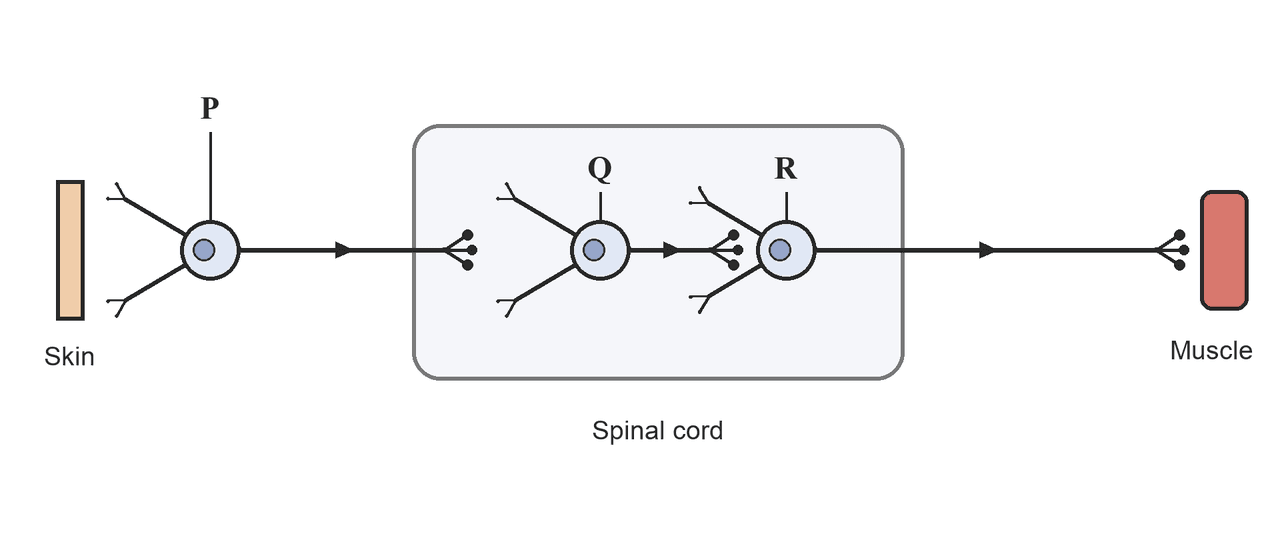
Suppose neuron Q alone stopped working, while P, R, her skin and her arm muscle stayed healthy. What would most likely happen when she touches the hot plate ?
- 181 mark
Question 18
Cognitive domain: Analysis
The figure shows cross-sections of three nerves X, Y and Z of the arm. Each nerve is a bundle of nerve fibres inside a sheath, and the sensory and motor fibres are coloured as shown.
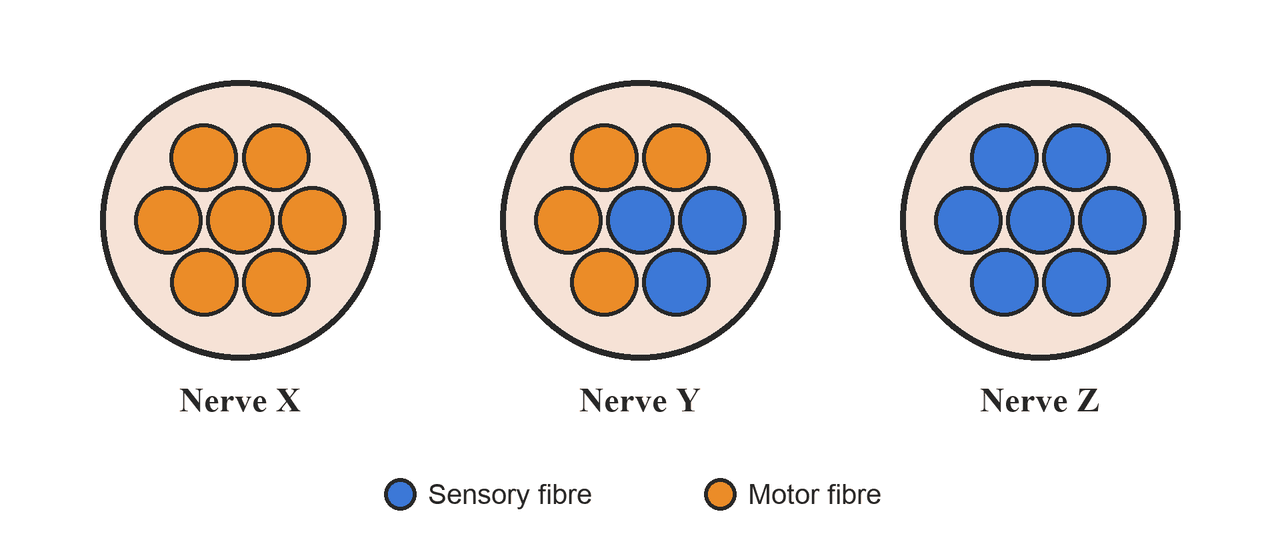
Before an operation, a doctor gives an injection that blocks one nerve in a patient's upper arm. For a while the patient cannot feel touch in the thumb and the first finger, and also cannot bend them. Which nerve is blocked, and what kind of nerve is it ?
- 191 mark
Question 19
Cognitive domain: Evaluation
Assertion (A): All the nerves of the peripheral nervous system belong to the somatic nervous system.
Reason (R): The somatic nervous system relays sensations from the body to the central nervous system and sends commands from the central nervous system to the skeletal (voluntary) muscles.
- 201 mark
Question 20
Cognitive domain: Analysis
Assertion (A): A message enters a neuron through its dendrites and leaves it through the terminal branches of its axon.
Reason (R): A typical neuron has many dendrites but only one axon.
- 211 mark
Question 21
Cognitive domain: Analysis
Kiran walks out of a dark cinema hall into bright afternoon sunlight. Within a second the pupils of her eyes become smaller. A moment later she decides to put on her sunglasses. Which statement best describes how her body coordinated these two responses ?
- 221 mark
Question 22
Cognitive domain: Understanding
Rhea makes a clay model of the human brain for her science fair. She joins three parts: the largest part forms the top of the model, a much smaller part lies under the large part, and the lowest part continues downwards to join the spinal cord. Which option names the three parts in this order ?
- 231 mark
Question 23
Cognitive domain: Application
A doctor notes that the nerves to Ravi's eye muscles arise directly from his brain, while the nerves to the muscles of his thigh arise from his spinal cord. Both groups of nerves carry commands to skeletal (voluntary) muscles. Which option describes them correctly ?
- 241 mark
Question 24
Cognitive domain: Analysis
A student made a summary table of the central nervous system. One row of the table contains a mistake.
Row Part Position Main function 1 Cerebrum Largest part, forms the top of the brain Intelligence, memory and will power 2 Cerebellum Under the cerebrum Balance of the body and muscular coordination 3 Medulla oblongata Lowest part of the brain Intelligence, memory and will power 4 Spinal cord Inside the vertebral column Controls reflexes below the neck Which row contains the mistake ?
- 251 mark
Question 25
Cognitive domain: Evaluation
A doctor wants to find out whether the spinal cord of a patient can still carry commands from the brain to the muscles of the legs. Which request to the patient is the best test ?
- 262 marks
Question 26
Cognitive domain: Application
Meena finds that she can hold her breath for a short time whenever she decides to, but she cannot stop or slow down her heartbeat just by deciding to. The muscles that move her chest when she breathes are skeletal (voluntary) muscles, while her heart is an internal organ.
Explain this difference, using the two divisions of the peripheral nervous system.
- 272 marks
Question 27
Cognitive domain: Application
In a hospital ward, four patients have the following injuries.
(i) A nerve in a finger cut by a knife
(ii) A blow that damaged the cerebellum
(iii) A fall that damaged the spinal cord in the neck
(iv) Damage to the nerve that goes to the tongue
Sort the injuries into those of the central nervous system and those of the peripheral nervous system. State the basis you used.
- 282 marks
Question 28
Cognitive domain: Analysis
In a laboratory study, two neurons were treated in different ways.
Neuron 1: a chemical stopped its dendrites from taking in messages, but its cell body and axon were unharmed.
Neuron 2: its axon was cut across in the middle, but its dendrites and cell body were unharmed.
For each neuron, say what happens to a message meant to pass through it, and why.
- 292 marks
Question 29
Cognitive domain: Evaluation
Ishaan says, "Association neurons are the least important kind of neuron, because they do not touch any sense organ or any muscle."
Do you agree with Ishaan ? Give two points in support of your answer.
- 302 marks
Question 30
Cognitive domain: Analysis
A cricket coach writes about two young batters. (Hypothetical case.)
Batter A: "Always picks the right shot for the ball, but his feet and arms do not move smoothly together, and he often loses his balance while playing it."
Batter B: "Moves smoothly and stays perfectly balanced, but often chooses the wrong shot for the ball."
Name the part of the brain whose job each batter does well, and the part whose job each needs to improve. Give a reason for each.
- 312 marks
Question 31
Cognitive domain: Creativity
Aarti compares the nervous system of the body with the computer network of a school.
Make your own comparison, using a different system from daily life (for example a post office, a railway system or a cricket team). Name the system you chose and match at least three parts of the nervous system with parts of it.
- 323 marks
Question 32
Cognitive domain: Application
A small nerve in a patient's lower leg has nerve fibres, of which are sensory fibres and are motor fibres. (Hypothetical data.)
(a) What kind of nerve is it ? Give a reason.
(b) What percentage of its fibres are sensory ?
(c) If all the motor fibres of this nerve were damaged, what would the patient lose and what would he keep ?
- 333 marks
Question 33
Cognitive domain: Evaluation
Dev says, "The brain lies inside the skull and the spinal cord lies inside the vertebral column. Every nerve of the arms and legs should be enclosed in bone in the same way."
(a) Give one reason why it is important that the central nervous system is enclosed in bone.
(b) Evaluate Dev's suggestion for the nerves of the arms and legs. Give two reasons.
- 343 marks
Question 34
Cognitive domain: Evaluation
Tara reads these figures for an adult at rest. (Hypothetical data.)
Item Value Mass of the whole body kg Mass of the brain kg Oxygen used by the whole body each minute mL Oxygen used by the brain each minute mL Every working cell needs oxygen to release energy. Tara says, "The brain is only a small part of the body, so it must use only a small part of the body's oxygen."
(a) What percentage of the body's mass is the brain, and what percentage of the body's oxygen does it use ?
(b) Evaluate Tara's statement, using your answers to (a).
(c) Give one reason, from what you know about the brain, why it needs so much oxygen even when the person is resting.
- 353 marks
Question 35
Cognitive domain: Analysis
Rohit's finger touches a hot iron. In this exercise, assume that messages travel along his nerves at m per second. (Hypothetical data.)
Path 1 (reflex): skin of the finger → spinal cord → arm muscle. Total length of nerve: m.
Path 2 (decision): skin of the finger → spinal cord → brain → spinal cord → arm muscle. Total length of nerve: m. On this path the brain also takes about s to decide.
(a) Find the time the message takes on Path 1.
(b) Find the total time on Path 2.
(c) Which path pulls his finger away first ? Explain why the body uses this path for such an emergency.
- 363 marks
Question 36
Cognitive domain: Application
When Raj's finger touches a thorn, his hand is pulled back at once. The message passes along this chain :
skin of the finger sensory neuron association neuron motor neuron arm muscle
(a) How many synapses (points of contact between one neuron and the next) does the message cross on its way, and in which part of the central nervous system do they lie ?
(b) Raj's friend Neel says the message could just as well travel back along the same chain, from the motor neuron to the sensory neuron. Explain, from the way two neurons meet at a synapse, why the message passes in one direction only.
(c) Which of the three neurons both receives the message from another neuron and passes it on to another neuron ?
- 374 marks
Question 37
Cognitive domain: Analysis
Case: A doctor pricks the sole of the foot of three patients, Q, R and S, with a pin, and notes what happens. (Hypothetical data.)
Patient Does the patient feel the prick ? Does the foot pull back at once ? Can the patient move the foot when asked ? Q Yes No No R No Yes No S No No Yes (a) In which patient are the sensory neurons from the foot most likely damaged ? Give a reason.
(b) Which neurons are most likely damaged in patient Q ? Give a reason.
(c) In patient R the foot pulls back, but he cannot feel the prick and cannot move the foot when asked. Which functions of the spinal cord are lost, and which is still working ?
- 384 marks
Question 38
Cognitive domain: Evaluation
Case: In a science club, students made a model of how the brain is protected. They placed an egg to stand for the brain and dropped it from increasing heights, noting the greatest height from which it did not crack. (Hypothetical data.)
Design How the egg was protected Greatest safe height 1 A hard box only cm 2 A hard box with three layers of cloth around the egg cm 3 A hard box, three layers of cloth and a water-filled bag around the egg cm (a) Which parts of the real head are stood for by the hard box, the three layers of cloth and the water ?
(b) By how many centimetres did the three layers of cloth raise the safe height, and by how many centimetres did the water-filled bag raise it further ?
(c) Give one way in which the model is a fair picture of the real head, and one way in which it is not.
- 395 marks
Question 39
Cognitive domain: Analysis
Case: Two workers, Ramesh and Suresh, fall from scaffolding at a building site. (Hypothetical case.) Doctors find that both have injured the spinal cord. In Ramesh the injury is in the neck. In Suresh it is in the lower back. Before the ambulance came, a trained first-aider at the site told everyone: "Do not lift them or sit them up. Keep the head and neck still, keep them warm, and call 112."
(a) Name the bony structure that protects the spinal cord, and explain why a fall that breaks it can harm the spinal cord.
(b) Using the functions of the spinal cord, predict which worker is likely to lose feeling and movement in more of his body, and explain why.
(c) Explain why the first-aider told everyone not to lift the workers or sit them up.
- 405 marks
Question 40
Cognitive domain: Creativity
Your class is planning two safe, simple demonstrations for the school science exhibition to show the difference between voluntary and involuntary actions.
(a) Describe one simple voluntary action that you would show, and name the part of the brain that controls it.
(b) Describe one safe involuntary action that can be watched in a classmate (nothing that hurts or frightens him), and name the part of the nervous system that regulates it.
(c) Draw the table in which visitors will record their observations, with a row for each demonstration, and write the conclusion that the table should lead to.