
Opening your dashboard
Class 7 Biology Chapter 5: Excretion in Humans Solutions
32 textbook questions with step-by-step answers, free to read, for ICSE 2026-27.
Get talked through Ch 5, not just shown the answer
Reading a finished solution is not the same as being able to do it. The AI tutor takes one question at a time and works it with you, in your own words, until you can.
- Ask it out loud, in your own words
- It gives you the next step, not the answer
- Stuck on part (ii)? Start there
32 questions with solutions
1–12 marks · Mixed difficulty
- 11 mark
Question 1
The kidneys are made up of tiny tubular units called :
Solve with AIAnswer
(A) glomerulus
- Correct
(B) nephrons
(C) capillaries
(D) neurons
Answer: (B) nephrons
Concept: Each kidney contains about one million nephrons. A nephron is a tiny tubule with a cup-shaped Bowman's capsule around a bunch of capillaries (the glomerulus); it filters the blood and forms urine.
Step 1 — Recall what a kidney is made of.
A kidney is packed with tiny tubes. Each of these tubes is a nephron, the structural and functional unit of the kidney.
Step 2 — Pick the option.
So the tiny tubular units of the kidney are the nephrons, option (B).
Watch out: The glomerulus is only one part of a nephron, not the whole unit.
Why the other options are wrong:
- (A) glomerulus: the glomerulus is a bunch of blood capillaries inside the Bowman's capsule; it is a part of a nephron, not the tubular unit itself.
- (C) capillaries: capillaries are the finest blood vessels; they surround the nephrons but are not tubules of the kidney.
- (D) neurons: neurons are nerve cells of the nervous system; they are not units of the kidney.
Therefore, the kidneys are made up of tiny tubular units called nephrons, option (B).
- 21 mark
Question 2
In human beings, urea is produced in :
Solve with AIAnswer
- Correct
(A) liver
(B) kidney
(C) spleen
(D) urinary bladder
Answer: (A) liver
Concept: Extra amino acids cannot be stored. The liver breaks them down and turns their nitrogen into urea; the blood carries the urea to the kidneys, which filter it out into the urine.
Step 1 — Find where amino acids are broken down.
Extra amino acids from the food reach the liver. The liver removes their nitrogen-containing part and turns it into urea.
Step 2 — Pick the option.
So urea is produced in the liver, option (A).
Watch out: The kidneys remove urea, but they do not make it; urea is made in the liver.
Why the other options are wrong:
- (B) kidney: the kidney only filters urea out of the blood into the urine; it does not make urea.
- (C) spleen: the spleen removes old red blood cells from the blood; it does not make urea.
- (D) urinary bladder: the urinary bladder only stores urine until it is passed out.
Therefore, in human beings, urea is produced in the liver, option (A).
- 31 mark
Question 3
Besides water, the urine mainly contains :
Solve with AIAnswer
- Correct
(A) urea
(B) nitric acid
(C) glucose
(D) bile pigments
Answer: (A) urea
Concept: Normal urine is about 95 % water. The main waste dissolved in it is urea; it also has some uric acid, creatinine and mineral salts.
Step 1 — Recall what urine carries out.
The kidneys filter urea, made in the liver, out of the blood. After water, urea is the largest part of urine.
Step 2 — Pick the option.
So besides water, urine mainly contains urea, option (A).
Watch out: Glucose is filtered in the kidney but is normally all taken back into the blood, so it is not in normal urine.
Why the other options are wrong:
- (B) nitric acid: nitric acid is not made in the body and is not present in urine.
- (C) glucose: the kidneys of a healthy person take all the glucose back into the blood; glucose in the urine is usually a sign of diabetes.
- (D) bile pigments: normal urine has no bile pigment. Its pale yellow colour comes from urochrome, a pigment formed from the breakdown of old red blood cells; bile pigment in urine is a sign of liver trouble such as jaundice.
Therefore, besides water, the urine mainly contains urea, option (A).
- 41 mark
Question 4
Filtration of excretory wastes from the blood occurs in :
Solve with AIAnswer
(A) collecting tubule
(B) ureter
(C) urinary bladder
- Correct
(D) nephrons
Answer: (D) nephrons
Concept: Each kidney contains about one million nephrons. A nephron is a tiny tubule with a cup-shaped Bowman's capsule around a bunch of capillaries (the glomerulus); it filters the blood and forms urine.
Step 1 — Find where the blood is filtered.
Blood enters the glomerulus of each nephron under pressure. Water, urea, salts and glucose are squeezed out of it into the Bowman's capsule; this is the filtration of wastes.
Step 2 — Pick the option.
So the filtration of excretory wastes from the blood occurs in the nephrons, option (D).
Watch out: The collecting tubule, ureter and bladder only handle urine that has already been formed.
Why the other options are wrong:
- (A) collecting tubule: the collecting tubule only collects the urine already formed in the nephrons and passes it to the pelvis.
- (B) ureter: the ureter only carries urine from the kidney to the urinary bladder.
- (C) urinary bladder: the urinary bladder only stores urine for some time.
Therefore, filtration of excretory wastes from the blood occurs in the nephrons, option (D).
- 51 mark
Question 5
The process of the breakdown of excessive amino acids occurs in :
Solve with AIAnswer
(A) Kidney
- Correct
(B) Liver
(C) Small intestine
(D) Lung
Answer: (B) Liver
Concept: Extra amino acids cannot be stored. The liver breaks them down and turns their nitrogen into urea; the blood carries the urea to the kidneys, which filter it out into the urine.
Step 1 — Recall the fate of extra amino acids.
The body cannot store extra amino acids. They are carried to the liver, where they are broken down and their nitrogen is turned into urea.
Step 2 — Pick the option.
So the breakdown of excess amino acids occurs in the liver, option (B).
Watch out: Making urea (liver) and removing urea (kidney) are two different jobs.
Why the other options are wrong:
- (A) Kidney: the kidney removes the urea from the blood, but it does not break down amino acids.
- (C) Small intestine: the small intestine digests proteins and absorbs the amino acids into the blood; the extra ones are broken down later, in the liver.
- (D) Lung: the lungs remove carbon dioxide and some water vapour; they do not break down amino acids.
Therefore, the breakdown of excess amino acids occurs in the liver, option (B).
- 61 mark
Question 6
The process of removal of nitrogenous waste products from the body of a living organism is called as :
Solve with AIAnswer
(A) Transpiration
- Correct
(B) Excretion
(C) Exudation
(D) Evaporation
Answer: (B) Excretion
Concept: Excretion is the removal of harmful and unwanted metabolic wastes (wastes made by the chemical reactions of the body) such as urea, uric acid, carbon dioxide and extra salts and water.
Step 1 — Match the description.
Nitrogenous wastes such as urea, uric acid and ammonia are made by the body's own chemical reactions. Removing them from the body is excretion.
Step 2 — Pick the option.
So the process is excretion, option (B).
Watch out: Removing undigested food (egestion) is not excretion, because that food was never part of the body's chemical reactions.
Why the other options are wrong:
- (A) Transpiration: transpiration is the loss of water vapour from the aerial parts of a plant.
- (C) Exudation: exudation is the oozing out of a liquid, such as gum or resin from a cut in a tree.
- (D) Evaporation: evaporation is the change of a liquid into its vapour; it does not remove nitrogenous wastes.
Therefore, the removal of nitrogenous waste products from the body is called excretion, option (B).
- 71 mark
Question 7
In human beings, urea is filtered out from :
Solve with AIAnswer
(A) Liver
(B) Skin
- Correct
(C) Kidney
(D) Lungs
Answer: (C) Kidney
Concept: Extra amino acids cannot be stored. The liver breaks them down and turns their nitrogen into urea; the blood carries the urea to the kidneys, which filter it out into the urine.
Step 1 — Follow the urea.
Urea made in the liver travels in the blood to the kidneys. The nephrons of the kidneys filter it out, and it leaves the body in the urine.
Step 2 — Pick the option.
So in human beings urea is filtered out from the kidney, option (C).
Watch out: The liver makes urea; the kidney filters it out.
Why the other options are wrong:
- (A) Liver: the liver produces urea; it does not filter it out of the blood.
- (B) Skin: the skin removes only small traces of urea in sweat; the main filtering organ is the kidney.
- (D) Lungs: the lungs remove carbon dioxide and water vapour, not urea.
Therefore, in human beings, urea is filtered out from the kidney, option (C).
- 81 mark
Question 8
The outermost protective covering of the kidneys is termed as :
Solve with AIAnswer
(A) Epithelium
(B) Pleura
- Correct
(C) Capsule
(D) Pericardium
Answer: (C) Capsule
Concept: Each kidney is wrapped in a thin, tough covering called the renal capsule, which protects it.
Step 1 — Recall the outer covering of the kidney.
In a section of the kidney, the thin outermost layer that covers the cortex is the capsule.
Step 2 — Pick the option.
So the outermost protective covering of the kidney is the capsule, option (C).
Watch out: Do not confuse the renal capsule (round the whole kidney) with the Bowman's capsule (round each glomerulus).
Why the other options are wrong:
- (A) Epithelium: epithelium is a kind of tissue that lines surfaces; it is not the name of the kidney's covering.
- (B) Pleura: the pleura is the double membrane round the lungs.
- (D) Pericardium: the pericardium is the membrane round the heart.
Therefore, the outermost protective covering of the kidneys is the capsule, option (C).
- 91 mark
Question 9
The process of regulation of water and salt content in the body is called as :
Solve with AIAnswer
(A) Filtration
- Correct
(B) Osmoregulation
(C) Ultrafiltration
(D) Osmosis
Answer: (B) Osmoregulation
Concept: Osmoregulation is keeping the amounts of water and salts in the blood and body fluids at the right level. In humans, the kidneys do it by passing out more or less water and salt in the urine.
Step 1 — See how the kidneys balance water.
When we drink a lot of water, the kidneys pass out more, dilute urine. When we sweat a lot, they save water and the urine is less and darker.
Step 2 — Pick the option.
This control of the body's water and salt content is osmoregulation, option (B).
Watch out: Osmosis is the movement of water; osmoregulation is the control of the body's water and salt.
Why the other options are wrong:
- (A) Filtration: filtration is only the separating out of substances from the blood; it is not the control of water and salt.
- (C) Ultrafiltration: ultrafiltration is the filtration of blood under pressure in the glomerulus, which is only the first step of making urine.
- (D) Osmosis: osmosis is the movement of water through a semi-permeable membrane from a dilute to a more concentrated solution; it is not the regulation of water and salt in the body.
Therefore, the regulation of water and salt content in the body is called osmoregulation, option (B).
- 101 mark
Question 10
The process of expulsion of urine from the body is termed as :
Solve with AIAnswer
(A) Excretion
(B) Secretion
- Correct
(C) Urination
(D) None of the above
Answer: (C) Urination
Concept: The urinary system has two kidneys (which make urine), two ureters (which carry it away), the urinary bladder (which stores it) and the urethra (which passes it out of the body).
Step 1 — Follow the urine to the end.
Urine collects in the urinary bladder. When the bladder is full, its muscular wall contracts and the urine is passed out through the urethra.
Step 2 — Pick the option.
Passing urine out of the body is called urination (micturition), option (C).
Why the other options are wrong:
- (A) Excretion: excretion is the whole removal of metabolic wastes by the kidneys, skin and lungs; passing urine out is only its last step.
- (B) Secretion: secretion is the release of useful substances, such as enzymes and hormones, by glands.
- (D) None of the above: urination is the correct term and it is listed, so ‘None of the above’ is wrong.
Therefore, the expulsion of urine from the body is termed urination, option (C).
- 111 mark
Question 11
Assertion (A): The human body produces many substances during different metabolic activities of which some are useful while others are useless. These unwanted substances must be removed from the body.
Reason (R): Excretory wastes must be removed from the body because their accumulation is harmful and disrupts normal body functioning.
Solve with AIAnswer
- Correct
(A) (1) Both A and R are true and R is the correct explanation of A.
(B) (2) Both A and R are true but R is not the correct explanation of A.
(C) (3) A is true but R is false.
(D) (4) A is false but R is true.
Answer: (A) (1) Both A and R are true and R is the correct explanation of A.
Concept: In an assertion-reason item, first judge the Assertion (A) and the Reason (R) separately as true or false; only when both are true do we ask whether R correctly explains A.
Step 1 — Judge the Assertion.
A is true. The chemical reactions of the body (metabolism) make useful products, and also useless ones such as urea, uric acid and carbon dioxide, which must be removed.
Step 2 — Judge the Reason.
R is true. If these wastes build up, they become poisonous and upset the normal working of the body.
Step 3 — Decide whether R explains A.
A says the wastes must be removed, and R gives the reason: their build-up is harmful. So R explains A, and the answer is option (A).
Why the other options are wrong:
- (B): R gives exactly why the wastes must be removed, so it does explain A.
- (C): R is true: collected wastes do harm the body.
- (D): A is true: metabolism makes useful as well as useless substances.
Therefore, both A and R are true and R is the correct explanation of A, option (A).
- 121 mark
Question 12
Assertion (A): Humans have a pair of kidneys for the process of filtration of blood. In these, the right kidney is located slightly lower than the left one.
Reason (R): Humans have a large gland i.e. liver towards the upper right side which pushes the right kidney slightly lower.
Solve with AIAnswer
- Correct
(A) (1) Both A and R are true and R is the correct explanation of A.
(B) (2) Both A and R are true but R is not the correct explanation of A.
(C) (3) A is true but R is false.
(D) (4) A is false but R is true.
Answer: (A) (1) Both A and R are true and R is the correct explanation of A.
Concept: In an assertion-reason item, first judge the Assertion (A) and the Reason (R) separately as true or false; only when both are true do we ask whether R correctly explains A.
Step 1 — Judge the Assertion.
A is true. We have two kidneys that filter the blood, and the right kidney usually lies a little lower than the left one.
Step 2 — Judge the Reason.
R is true. The liver, the largest gland of the body, lies in the upper right part of the abdomen, just above the right kidney.
Step 3 — Decide whether R explains A.
The liver takes up the space above the right kidney and pushes it down slightly. R gives the cause of the position stated in A, so the answer is option (A).
Watch out: The right kidney is the lower one, not the left.
Why the other options are wrong:
- (B): R gives the cause of the lower right kidney, so it does explain A.
- (C): R is true: the liver lies in the upper right part of the abdomen.
- (D): A is true: the right kidney is slightly lower than the left.
Therefore, both A and R are true and R is the correct explanation of A, option (A).
- 131 mark
Question 13
Assertion (A): The blood which enters the kidney through the renal artery is considered as 'impure' as it contains only unwanted waste substances in a large quantity.
Reason (R): This blood contains useful substances like oxygen as well but the term 'impure' is used as it contains nitrogenous unwanted wastes.
Solve with AIAnswer
(A) (1) Both A and R are true and R is the correct explanation of A.
(B) (2) Both A and R are true but R is not the correct explanation of A.
(C) (3) A is true but R is false.
- Correct
(D) (4) A is false but R is true.
Answer: (D) (4) A is false but R is true.
Concept: In an assertion-reason item, first judge the Assertion (A) and the Reason (R) separately as true or false; only when both are true do we ask whether R correctly explains A.
Step 1 — Judge the Assertion.
A is false. The blood in the renal artery does not contain only wastes. It also carries oxygen, glucose, amino acids and salts, which the body needs.
Step 2 — Judge the Reason.
R is true. This blood has useful substances, but it is called ‘impure’ because it carries nitrogenous wastes such as urea, which the kidneys will remove.
Step 3 — Pick the option.
A is false and R is true, so the answer is option (D).
Watch out: Watch for the word ‘only’ in an assertion; one counter-example makes it false.
Why the other options are wrong:
- (A): A is false, so R cannot explain it.
- (B): A is false, so ‘both true’ cannot be right.
- (C): this is the opposite of the truth: A is false and R is true.
Therefore, A is false but R is true, option (D).
- 141 mark
Question 14
Assertion (A): Skin is considered as an accessory excretory organ as sweat glands release out excess water, salts and traces of urea and uric acid from the body.
Reason (R): Sweat glands are located underneath the skin. Their major function is production of sweat which, on evaporation from the surface of skin, causes cooling. The amount of production of sweat varies according to climatic conditions.
Solve with AIAnswer
(A) (1) Both A and R are true and R is the correct explanation of A.
- Correct
(B) (2) Both A and R are true but R is not the correct explanation of A.
(C) (3) A is true but R is false.
(D) (4) A is false but R is true.
Answer: (B) (2) Both A and R are true but R is not the correct explanation of A.
Concept: In an assertion-reason item, first judge the Assertion (A) and the Reason (R) separately as true or false; only when both are true do we ask whether R correctly explains A.
Step 1 — Judge the Assertion.
A is true. Sweat glands pass out excess water, salts and traces of urea and uric acid, so the skin is called an accessory excretory organ.
Step 2 — Judge the Reason.
R is true. Sweat glands lie below the surface of the skin, sweat cools the body as it evaporates, and we sweat more in hot weather than in cold.
Step 3 — Decide whether R explains A.
A is about the skin removing wastes. R is about sweat cooling the body and how much is made, which does not say why the skin counts as an excretory organ. So R is not the explanation, and the answer is option (B).
Watch out: Both statements are about sweat, but only the waste-removal job makes the skin excretory.
Note: More exactly, sweat glands lie in the dermis, the inner layer of the skin, below its surface; that is the sense of ‘underneath the skin’ in R.
Why the other options are wrong:
- (A): R talks about cooling, not about removing wastes, so it does not explain A.
- (C): R is true: sweat does cool the body and its amount varies with the weather.
- (D): A is true: sweat carries out water, salts and traces of urea.
Therefore, both A and R are true but R is not the correct explanation of A, option (B).
- 151 mark
Question 15
Assertion (A): Diabetes mellitus is the hormonal disorder in which the sugar levels in the blood are much higher than the normal level.
Reason (R): A person who eats too many sweets or food items loaded with sugar, normally suffers from diabetes mellitus because these substances enhance the sugar levels in the urine as well as blood.
Solve with AIAnswer
(A) (1) Both A and R are true and R is the correct explanation of A.
(B) (2) Both A and R are true but R is not the correct explanation of A.
- Correct
(C) (3) A is true but R is false.
(D) (4) A is false but R is true.
Answer: (C) (3) A is true but R is false.
Concept: In an assertion-reason item, first judge the Assertion (A) and the Reason (R) separately as true or false; only when both are true do we ask whether R correctly explains A.
Step 1 — Judge the Assertion.
A is true. Diabetes mellitus is a hormonal disorder. The body makes too little insulin, or cannot use it properly, so the blood sugar stays much higher than normal and some sugar passes into the urine.
Step 2 — Judge the Reason.
R is false. Eating sweets does not by itself give a person diabetes. In a healthy person, insulin brings the blood sugar back to normal after a sweet meal, and no sugar appears in the urine.
Step 3 — Pick the option.
A is true and R is false, so the answer is option (C).
Watch out: A diet with too much sugar and too little exercise can lead to overweight, which raises the risk of type 2 diabetes; but the sweets themselves are not the direct cause, and R's claim that such a person ‘normally suffers’ from it is wrong.
Why the other options are wrong:
- (A): R is false, so it cannot explain A.
- (B): R is false, so ‘both true’ cannot be right.
- (D): A is true: high blood sugar is the main feature of diabetes mellitus.
Therefore, A is true but R is false, option (C).
- 165 marks
Question 16
Match the terms given in column A with those of column B :
Column A Column B (i) Beverages (a) Fat-soluble (ii) Vitamins B and C (b) Ammonia, Uric acid (iii) Vitamins A and D (c) Urea, Mineral salts (iv) Nitrogenous wastes (d) Tea, Coffee (v) Constituents of urine (e) Water-soluble Solve with AIWritten solution
Solution:
Concept: A match pairs each term with its example or property. Vitamins are grouped by what they dissolve in: water-soluble (B group and C) and fat-soluble (A, D, E and K).
Step 1 — (i) Beverages.
Beverages are drinks, so they match (d) tea, coffee.
Step 2 — (ii) Vitamins B and C.
These vitamins dissolve in water, so they match (e) water-soluble.
Step 3 — (iii) Vitamins A and D.
These vitamins dissolve in fats and oils, so they match (a) fat-soluble.
Step 4 — (iv) Nitrogenous wastes.
Wastes that contain nitrogen include ammonia and uric acid, so they match (b) ammonia, uric acid.
Step 5 — (v) Constituents of urine.
Urine contains urea and mineral salts dissolved in water, so it matches (c) urea, mineral salts.
Step 6 — Write the matched table.
The pairs are collected below.
Column A Column B (i) Beverages (d) Tea, Coffee (ii) Vitamins B and C (e) Water-soluble (iii) Vitamins A and D (a) Fat-soluble (iv) Nitrogenous wastes (b) Ammonia, Uric acid (v) Constituents of urine (c) Urea, Mineral salts Watch out: Most extra water-soluble vitamins pass out in the urine, but vitamin B12 is stored in the liver, so do not say they are never stored.
Therefore, (i) matches (d), (ii) matches (e), (iii) matches (a), (iv) matches (b) and (v) matches (c).
- 176 marks
Question 17
Name the following :
(i) The basic structural and functional unit of kidney.
(ii) The cup-shaped structure of nephron.
(iii) The part of nephron which collects urine from the convoluted tubule.
(iv) The process of filtration of blood through a machine, outside the human body.
(v) The disease which can be identified by the presence of glucose in the urine.
(vi) The blood vessel that brings blood to the kidneys.
Solve with AIWritten solution
Solution:
Concept: Each kidney contains about one million nephrons. A nephron is a tiny tubule with a cup-shaped Bowman's capsule around a bunch of capillaries (the glomerulus); it filters the blood and forms urine.
Step 1 — (i) Unit of the kidney.
The basic structural and functional unit of the kidney is the nephron.
Step 2 — (ii) Cup-shaped part.
The cup-shaped part at the start of the nephron, round the glomerulus, is the Bowman's capsule.
Step 3 — (iii) Part that collects urine.
Urine from the convoluted tubule flows into the collecting duct (collecting tubule), which carries it to the pelvis.
Step 4 — (iv) Filtering blood by a machine.
Cleaning the blood with a machine outside the body is dialysis (haemodialysis).
Step 5 — (v) Glucose in the urine.
Glucose in the urine is a sign of diabetes mellitus.
Step 6 — (vi) Vessel bringing blood to the kidney.
The renal artery, a branch of the aorta, brings blood to each kidney.
Watch out: The renal artery brings blood to the kidney; the renal vein takes it away.
Therefore, (i) nephron, (ii) Bowman's capsule, (iii) collecting duct, (iv) dialysis (haemodialysis), (v) diabetes mellitus, (vi) renal artery.
- 184 marks
Question 18
Write True (T) or False (F) for the following statements in the spaces provided. Rewrite the false statements in correct form .
(i) Removal of solid undigested food is excretion.
(ii) Medulla of kidney passes urine into urinary bladder.
(iii) Excess sugar in blood is a symptom of diabetes.
(iv) Urine is devoid of blood cells.
Solve with AIWritten solution
Solution:
Concept: Excretion is the removal of harmful and unwanted metabolic wastes (wastes made by the chemical reactions of the body) such as urea, uric acid, carbon dioxide and extra salts and water.
Step 1 — (i) Removal of undigested food.
False. Undigested food never took part in the body's chemical reactions, so removing it is not excretion. Correct statement: Removal of solid undigested food is egestion.
Step 2 — (ii) Where the medulla passes urine.
False. Urine from the pyramids of the medulla drains into the renal pelvis, and the ureter then carries it to the bladder. Correct statement: Medulla of kidney passes urine into the renal pelvis.
Step 3 — (iii) Excess sugar in blood.
True. A blood sugar level much above normal is the main sign of diabetes mellitus.
Step 4 — (iv) Blood cells in urine.
True. Blood cells are too large to be filtered out in the glomerulus, so normal urine has no blood cells. Blood in the urine points to an infection, a stone or kidney damage.
Watch out: Excretion removes wastes made by the body; egestion removes undigested food that was never absorbed.
Therefore, (i) False: removal of undigested food is egestion; (ii) False: the medulla passes urine into the renal pelvis; (iii) True; (iv) True.
- 193 marks
Question 19
Where in the urinary system do the following processes take place ?
(i) Urine formation
(ii) Transport of urine away from kidney
(iii) Temporary storage of urine
Solve with AIWritten solution
Solution:
Concept: The urinary system has two kidneys (which make urine), two ureters (which carry it away), the urinary bladder (which stores it) and the urethra (which passes it out of the body).
Step 1 — (i) Urine formation.
Urine is formed in the kidneys, in their nephrons, which filter the blood.
Step 2 — (ii) Transport away from the kidney.
The ureters carry the urine from each kidney down to the bladder.
Step 3 — (iii) Temporary storage.
The urinary bladder stores the urine until it is passed out.
Therefore, (i) kidneys (nephrons), (ii) ureters, (iii) urinary bladder.
- 205 marks
Question 20
Name :
(i) Three nitrogenous wastes of the body.
(ii) Four main organs of the human urinary system.
(iii) Three accessory excretory organs in humans.
(iv) Three crystalline substances which can cause kidney stones.
(v) Two water soluble vitamins.
Solve with AIWritten solution
Solution:
Concept: The chapter names the body's nitrogenous wastes, the organs that make and remove urine, the other organs that help in excretion, and the crystals that can form stones.
Step 1 — (i) Nitrogenous wastes.
The three nitrogenous wastes are urea, uric acid and ammonia.
Step 2 — (ii) Organs of the urinary system.
The four main organs are the kidneys, ureters, urinary bladder and urethra.
Step 3 — (iii) Accessory excretory organs.
Besides the kidneys, the skin (sweat), the lungs (carbon dioxide) and the liver (bile pigments, urea formation) help in excretion.
Step 4 — (iv) Crystals in kidney stones.
Stones are commonly formed of calcium oxalate, calcium phosphate and uric acid.
Step 5 — (v) Water-soluble vitamins.
Two water-soluble vitamins are vitamin B (the B group) and vitamin C.
Therefore, (i) urea, uric acid, ammonia; (ii) kidneys, ureters, urinary bladder, urethra; (iii) skin, lungs, liver; (iv) calcium oxalate, calcium phosphate, uric acid; (v) vitamin B and vitamin C.
- 2110 marks
Question 21
Define the following :
(i) Excretion
(ii) Excretory organs
(iii) Dialysis
(iv) Nephron
(v) Osmoregulation
Solve with AIWritten solution
Solution:
Concept: A definition says exactly what a term means in one or two clear sentences, using the key words of the chapter.
Step 1 — (i) Excretion.
Excretion is the process of removing harmful and unwanted metabolic wastes, such as urea, uric acid and carbon dioxide, from the body.
Step 2 — (ii) Excretory organs.
Excretory organs are the organs that remove these wastes from the body, for example the kidneys, skin and lungs.
Step 3 — (iii) Dialysis.
Dialysis is the cleaning of the blood by a machine outside the body, which removes urea, extra salts and water when the kidneys fail.
Step 4 — (iv) Nephron.
A nephron is the structural and functional unit of the kidney: a microscopic tubule that filters the blood and forms urine.
Step 5 — (v) Osmoregulation.
Osmoregulation is the control of the amounts of water and salts in the blood and body fluids, done mainly by the kidneys.
Watch out: Excretion removes metabolic wastes; do not define it as removing undigested food.
Therefore, excretion removes metabolic wastes, excretory organs do this work, dialysis cleans blood by a machine, a nephron is the kidney's unit, and osmoregulation controls water and salt.
- 2210 marks
Question 22
Write the exact location of each of the following :
(i) Kidney
(ii) Urinary bladder
(iii) Renal cortex
(iv) Renal medulla
(v) Pelvis
Solve with AIWritten solution
Solution:
Concept: Location means where a part lies, either in the body (kidney, bladder) or inside the kidney (cortex, medulla, pelvis).
Step 1 — (i) Kidney.
The kidneys lie in the upper part of the abdomen, against its back wall, one on each side of the backbone, just below the diaphragm. Their upper ends are partly protected by the last ribs, and the right kidney is slightly lower than the left.
Step 2 — (ii) Urinary bladder.
The urinary bladder lies in the lower abdomen (the pelvic region), below the kidneys and behind the pubic bone.
Step 3 — (iii) Renal cortex.
The renal cortex is the outer region of the kidney, just inside the capsule.
Step 4 — (iv) Renal medulla.
The renal medulla is the inner region of the kidney, between the cortex and the pelvis; it is made of cone-shaped pyramids.
Step 5 — (v) Pelvis.
The renal pelvis is a funnel-shaped space on the inner, concave side of the kidney, where the ureter begins.
Watch out: The cortex is outer and the medulla inner; the pelvis lies on the concave side, facing the backbone.
Therefore, the kidneys lie at the back of the upper abdomen on either side of the backbone, the bladder in the lower abdomen, the cortex outside, the medulla inside, and the pelvis on the inner concave side where the ureter starts.
- 2310 marks
Question 23
Write one important excretory function / role of each of the following :
(i) Kidney
(ii) Ureter
(iii) Urinary bladder
(iv) Urethra
(v) Skin
Solve with AIWritten solution
Solution:
Concept: The urinary system has two kidneys (which make urine), two ureters (which carry it away), the urinary bladder (which stores it) and the urethra (which passes it out of the body).
Step 1 — (i) Kidney.
The kidney filters the blood and removes urea, extra water and salts as urine.
Step 2 — (ii) Ureter.
The ureter carries urine from the kidney to the urinary bladder.
Step 3 — (iii) Urinary bladder.
The urinary bladder stores urine for some time.
Step 4 — (iv) Urethra.
The urethra passes urine out of the body.
Step 5 — (v) Skin.
The skin removes excess water, salts and traces of urea in sweat.
Therefore, the kidney forms urine, the ureter carries it, the bladder stores it, the urethra passes it out, and the skin removes wastes in sweat.
- 242 marks
Question 24
Why is excretion necessary in living beings ?
Solve with AIWritten solution
Solution:
Concept: Excretion is the removal of harmful and unwanted metabolic wastes (wastes made by the chemical reactions of the body) such as urea, uric acid, carbon dioxide and extra salts and water.
Step 1 — Wastes are made all the time.
The chemical reactions of the body keep producing useless and harmful substances such as urea, uric acid and carbon dioxide.
Step 2 — Wastes that stay become poisonous.
If these wastes are not removed, they build up in the blood. They then poison the cells and upset the working of the body, and in severe cases they can even cause death.
Step 3 — Excretion also keeps a balance.
Excretion also removes extra water and salts, so the body fluids stay at the right strength (osmoregulation).
Therefore, excretion is necessary to remove harmful wastes before they poison the body, and to keep its water and salt balance.
- 252 marks
Question 25
What are the two ways by which a person can get relief in case of kidney failure ?
Solve with AIWritten solution
Solution:
Concept: When both kidneys fail, urea and other wastes build up in the blood, so the blood must be cleaned in some other way.
Step 1 — Dialysis.
In dialysis (haemodialysis), the blood is passed through a machine that filters out urea, extra salts and water and returns the clean blood. It is done regularly, usually a few times a week, in a hospital.
Step 2 — Kidney transplant.
In a kidney transplant, a healthy kidney from a suitable donor is placed in the patient's body by an operation, and it takes over the work.
Therefore, a person with kidney failure can get relief by dialysis or by a kidney transplant.
- 262 marks
Question 26
How are kidney stones formed ?
Solve with AIWritten solution
Solution:
Concept: Urine carries dissolved salts. If a salt is present in more than the urine can keep dissolved, it comes out of solution as solid crystals.
Step 1 — Too much salt in too little water.
Kidney stones start when substances such as calcium oxalate, calcium phosphate and uric acid are present in the urine in larger amounts than the fluid can dissolve, for example when a person drinks too little water.
Step 2 — Crystals form and grow.
These substances then come out of solution as tiny crystals, which stick together and slowly grow into hard lumps called kidney stones.
Step 3 — Why water helps.
Drinking plenty of water keeps the urine dilute, so the substances stay dissolved and stones are less likely to form.
Watch out: A stone is not a lump of undigested food; it is made of crystals from the urine.
Therefore, kidney stones form when crystal-forming substances in concentrated urine come out as crystals that stick together into hard stones.
- 272 marks
Question 27
What are the symptoms of a urinary tract infection ?
Solve with AIWritten solution
Solution:
Concept: A urinary tract infection (UTI) happens when bacteria enter the urethra and multiply in the bladder or higher up the urinary tract.
Step 1 — Common symptoms.
The usual symptoms are:
- a strong and frequent urge to urinate, often passing only a little urine;
- a painful, burning feeling while urinating;
- cloudy or strong-smelling urine, and sometimes pain in the lower abdomen.
Step 2 — When it spreads.
If the infection reaches the kidneys, there may be fever and pain in the back. A doctor should be seen, as a UTI is usually treated with medicines the doctor prescribes.
Therefore, the main symptoms of a urinary tract infection are a frequent, strong urge to urinate and a burning pain while urinating.
- 2810 marks
Question 28
Distinguish between the following pairs on the basis of the words indicated in the brackets [ ] :
(i) Ureter and Uterus [Organ system]
(ii) Nephron and Neuron [Location in body/organ]
(iii) Lungs and Liver [Excretory products]
(iv) Blood of renal artery and renal vein [Nitrogenous wastes]
(v) Urinary bladder and urethra [Function]
Solve with AIWritten solution
Solution:
Concept: To distinguish a pair, compare the two items only on the point given in the brackets.
Step 1 — (i) Ureter and uterus by organ system.
The two words sound alike but belong to different systems.
Ureter Uterus Part of the excretory (urinary) system. Part of the female reproductive system. Step 2 — (ii) Nephron and neuron by location.
A nephron and a neuron are both units, but of different organs.
Nephron Neuron Found in the kidneys. Found in the brain, spinal cord and nerves. Step 3 — (iii) Lungs and liver by excretory products.
Each organ removes different wastes.
Lungs Liver Remove carbon dioxide and some water vapour. Forms urea from extra amino acids and passes out bile pigments in the bile; it also breaks down drugs and poisons. Step 4 — (iv) Renal artery and renal vein blood by nitrogenous wastes.
Blood is cleaned of much of its urea as it passes through the kidney.
Blood of renal artery Blood of renal vein More nitrogenous wastes such as urea. Much less nitrogenous waste, since the kidney has filtered out much of the urea. Step 5 — (v) Urinary bladder and urethra by function.
One stores the urine and the other passes it out.
Urinary bladder Urethra Stores urine for some time. Carries urine out of the body. Watch out: Ureter (urinary system) and uterus (womb) are easy to mix up because they sound alike.
Note: The blood of the renal vein is often described as free of nitrogenous wastes. It still has some urea, because the kidney removes only part of it on each pass, but much less than in the renal artery.
Therefore, (i) excretory vs reproductive system, (ii) kidney vs nervous system, (iii) carbon dioxide vs urea and bile pigments, (iv) more vs much less urea, (v) storing vs passing out urine.
- 293 marks
Question 29
Draw a neat diagram of the vertical section of a human kidney and label its five important parts : Capsule, Renal cortex, Renal medulla, Papilla of medulla and Renal pelvis.
Solve with AIWritten solution
Solution:
Concept: A vertical section of the kidney shows an outer cortex under the capsule, an inner medulla made of cone-shaped pyramids whose tips (papillae) open into a funnel-shaped pelvis, and the ureter leaving the pelvis.
Step 1 — Draw the section.
Draw a bean-shaped outline with the notch facing the backbone side. Inside it, shade the outer cortex, draw the pyramids of the medulla with their tips pointing inwards, and draw the funnel-shaped pelvis running out into the ureter.
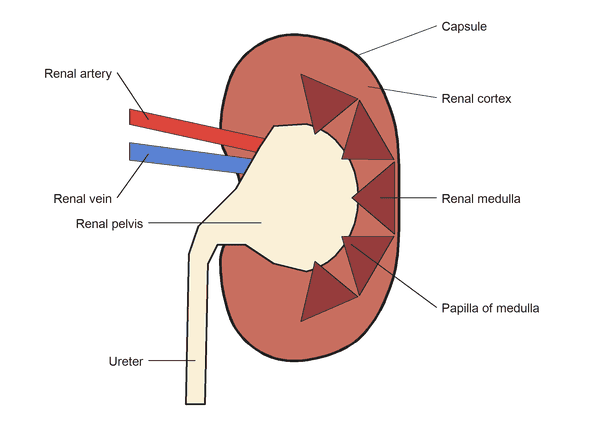
Step 2 — Label the five parts.
Label the capsule (outer covering), renal cortex (outer region), renal medulla (pyramids), papilla of medulla (tip of a pyramid) and renal pelvis (funnel). The ureter, renal artery and renal vein are also shown for reference.
Watch out: The papillae point inwards, into the pelvis, not outwards towards the capsule.
Therefore, the section shows the capsule, renal cortex, renal medulla, papillae of the medulla and the renal pelvis leading into the ureter.
- 309 marks
Question 30
Given alongside is the diagram of an organ system of humans. Study the same and answer the following questions :
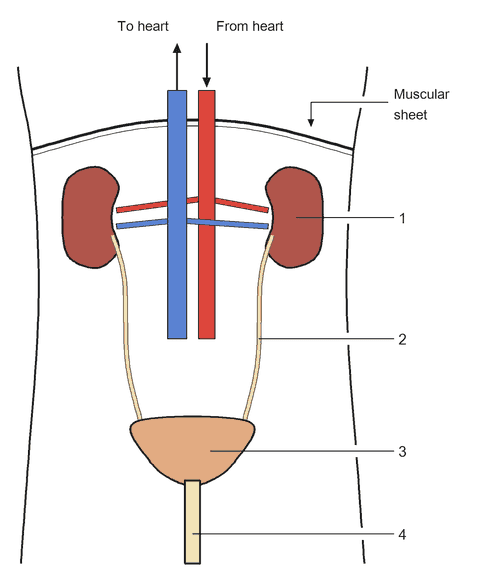
(i) Name the organ systems shown completely and partially respectively.
(ii) Label the guidelines 1 to 4.
(iii) Name the muscular sheet which divides the thorax and abdomen.
(iv) Mention the blood vessel which supplies blood from the heart to the kidney.
(v) Name the blood vessel which carries deoxygenated blood that is devoid of nitrogenous wastes.
Solve with AIWritten solution
Solution:
Concept: The urinary system has two kidneys (which make urine), two ureters (which carry it away), the urinary bladder (which stores it) and the urethra (which passes it out of the body).
Step 1 — (i) Organ systems shown.
The kidneys, ureters, bladder and urethra are all shown, so the excretory (urinary) system is shown completely. Only the main blood vessels are shown, so the circulatory system is shown partially.
Step 2 — (ii) Guidelines 1 to 4.
Reading each guideline in turn gives 1 – kidney, 2 – ureter, 3 – urinary bladder, 4 – urethra.
Step 3 — (iii) The muscular sheet.
The dome-shaped muscular sheet between the thorax and the abdomen is the diaphragm.
Step 4 — (iv) Vessel from the heart to the kidney.
The renal artery, a branch of the aorta, brings blood from the heart to each kidney.
Step 5 — (v) Vessel with deoxygenated, cleaned blood.
The renal vein carries blood away from the kidney. The kidney has used some oxygen and removed much of the urea, so this blood is deoxygenated and carries much less nitrogenous waste than the blood entering the kidney.
Watch out: The renal artery brings blood to the kidney and the renal vein takes it away to the vena cava.
Note: Renal-vein blood is not completely free of urea; it has much less than the blood of the renal artery.
Therefore, (i) excretory system completely and circulatory system partially; (ii) 1 kidney, 2 ureter, 3 urinary bladder, 4 urethra; (iii) diaphragm; (iv) renal artery; (v) renal vein.
- 3112 marks
Question 31
The figure shown alongside represents a process for the treatment of a person. Study the same and answer the following questions.
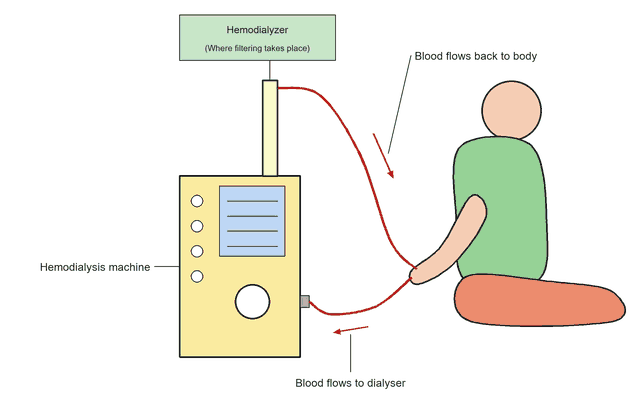
(i) Name the process.
(ii) In what condition of the patient, is this treatment suggested by the doctors ?
(iii) What other kind of treatment is suggested by the doctors, if both kidneys fail to work ?
(iv) Can a person survive normally with one kidney ?
(v) Write one important function of the Hemodialysis machine.
Solve with AIWritten solution
Solution:
Concept: When the kidneys fail, urea and other wastes build up in the blood. A machine can clean the blood instead: this is dialysis.
Step 1 — (i) The process.
The figure shows a patient's blood flowing to a haemodialysis machine and back, so the process is dialysis (haemodialysis).
Step 2 — (ii) When it is advised.
Doctors advise it when the patient has kidney failure, that is, when both kidneys stop working properly and wastes collect in the blood.
Step 3 — (iii) The other treatment.
The other treatment is a kidney transplant, in which a healthy kidney from a suitable donor is placed in the patient's body.
Step 4 — (iv) Living with one kidney.
Yes. One healthy kidney can do the work of filtering the blood, which is why a donor can live a normal life after giving one kidney (with regular check-ups).
Step 5 — (v) Function of the machine.
The haemodialysis machine filters the blood: it removes urea, extra salts and water and returns the cleaned blood to the body.
Watch out: Dialysis does not cure the kidneys; it has to be repeated regularly.
Therefore, (i) dialysis; (ii) kidney failure; (iii) kidney transplant; (iv) yes; (v) it filters wastes and extra water out of the blood.
- 327 marks
Question 32
Omar accompanied his uncle to the hospital after he complained of sharp pain in his lower back. An ultrasound revealed tiny stones in his kidneys. The doctor explained that waste materials had crystallised because they were not flushed out properly. He advised his uncle to drink more water to prevent future stone formation.
(i) Name two substances that commonly form crystals in the excretory system.
(ii) What happens when these crystals accumulate in the urinary tract?
(iii) How can such crystals be removed from the urinary tract?
(iv) Is the presence of excess uric acid in urine harmful? Why?
(v) Mention two other body parts where stone formation may occur apart from kidneys.
Solve with AIWritten solution
Solution:
Concept: Kidney stones are hard lumps of crystals from the urine. They form when crystal-forming substances are too concentrated, often because the person drinks too little water.
Step 1 — (i) Substances that form crystals.
Common stone-forming substances are calcium oxalate and uric acid (calcium phosphate is another).
Step 2 — (ii) When crystals build up.
The crystals stick together into stones. A stone can block the flow of urine and cause severe pain in the back or side, and sometimes blood in the urine.
Step 3 — (iii) Removing the crystals.
Small stones often pass out in the urine when the person drinks plenty of water. Larger ones are broken into small pieces by shock waves sent from outside the body, or removed through a thin tube passed up the urinary tract; an open operation is now rarely needed.
Step 4 — (iv) Excess uric acid.
Yes, it is harmful. Excess uric acid can form crystals that grow into stones and block the urinary tract; uric acid crystals in the joints also cause the painful disease gout.
Step 5 — (v) Other places for stones.
In the urinary tract, stones also occur in the ureters and the urinary bladder. Outside it, stones often form in the gall bladder (gallstones).
Watch out: Drinking plenty of water is the simplest way to prevent new stones.
Note: Most stones found in a ureter were formed in the kidney and moved down.
Therefore, (i) calcium oxalate and uric acid; (ii) they form stones that block urine and cause pain; (iii) by passing them with plenty of water, or by breaking or removing them with medical treatment; (iv) yes, it forms crystals and stones; (v) the ureters and urinary bladder (also the gall bladder).
What Class 7 Biology Ch 5 covers
The sections of the chapter, in the order the book takes them. Every question above comes from one of these.
- 01What Is Excretion
- 02Substances to Be Excreted
- 03The Excretory System
- 04Structure of the Kidney
- 05Nephrons
- 06Role of Kidneys in Urine Formation
More ways to study this chapter
The same chapter asked three other ways. Practise it, revise it, and see what the board has set on Ch 5 before.
Class 7 Biology Ch 5 questions students ask
How many questions are there in Class 7 Biology Ch 5?
32 questions. Every one is solved step by step on this page.
Are these Class 7 Biology solutions free?
Yes. Every question and its full working is free to read, with no account needed.
Can I download the Class 7 Biology Ch 5 solutions as a PDF?
There is no PDF to download. Every solution is on this page instead, which means it is searchable, always the current syllabus, and readable on a phone. Use your browser's print option if you want it on paper.