Solution:
Concept: When the kidneys fail, urea and other wastes build up in the blood. A machine can clean the blood instead: this is dialysis.
Step 1 — (i) The process.
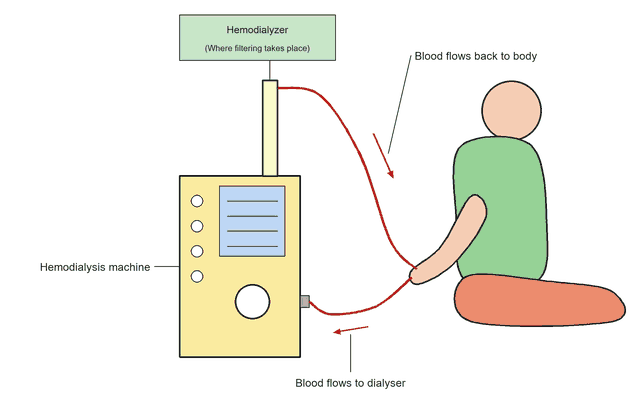
The figure shows a patient's blood flowing to a haemodialysis machine and back, so the process is dialysis (haemodialysis).
Step 2 — (ii) When it is advised.
Doctors advise it when the patient has kidney failure, that is, when both kidneys stop working properly and wastes collect in the blood.
Step 3 — (iii) The other treatment.
The other treatment is a kidney transplant, in which a healthy kidney from a suitable donor is placed in the patient's body.
Step 4 — (iv) Living with one kidney.
Yes. One healthy kidney can do the work of filtering the blood, which is why a donor can live a normal life after giving one kidney (with regular check-ups).
Step 5 — (v) Function of the machine.
The haemodialysis machine filters the blood: it removes urea, extra salts and water and returns the cleaned blood to the body.
Watch out: Dialysis does not cure the kidneys; it has to be repeated regularly.
Therefore, (i) dialysis; (ii) kidney failure; (iii) kidney transplant; (iv) yes; (v) it filters wastes and extra water out of the blood.