Solution:
Concept: The urinary system has two kidneys (which make urine), two ureters (which carry it away), the urinary bladder (which stores it) and the urethra (which passes it out of the body).
Step 1 — (i) Organ systems shown.
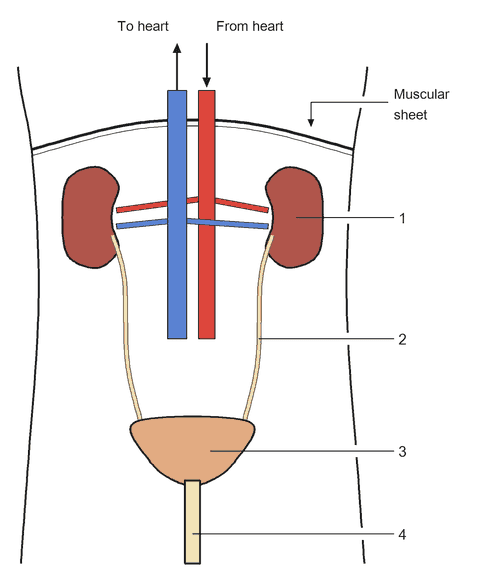
The kidneys, ureters, bladder and urethra are all shown, so the excretory (urinary) system is shown completely. Only the main blood vessels are shown, so the circulatory system is shown partially.
Step 2 — (ii) Guidelines 1 to 4.
Reading each guideline in turn gives 1 – kidney, 2 – ureter, 3 – urinary bladder, 4 – urethra.
Step 3 — (iii) The muscular sheet.
The dome-shaped muscular sheet between the thorax and the abdomen is the diaphragm.
Step 4 — (iv) Vessel from the heart to the kidney.
The renal artery, a branch of the aorta, brings blood from the heart to each kidney.
Step 5 — (v) Vessel with deoxygenated, cleaned blood.
The renal vein carries blood away from the kidney. The kidney has used some oxygen and removed much of the urea, so this blood is deoxygenated and carries much less nitrogenous waste than the blood entering the kidney.
Watch out: The renal artery brings blood to the kidney and the renal vein takes it away to the vena cava.
Note: Renal-vein blood is not completely free of urea; it has much less than the blood of the renal artery.
Therefore, (i) excretory system completely and circulatory system partially; (ii) 1 kidney, 2 ureter, 3 urinary bladder, 4 urethra; (iii) diaphragm; (iv) renal artery; (v) renal vein.