
Opening your dashboard
Class 7 Biology Chapter 5 Excretion in Humans: Competency-Based Questions (CBQ)
40 questions on Chapter 5, each worked through on its own page with the AI tutor. Class 7 Biology, ICSE 2026-27.
40 questions
1–5 marks · Mixed difficulty
- 11 mark
Question 1
Cognitive domain: Application
Little Pihu had a throat infection, and the doctor gave her an antibiotic syrup. The doctor also told her mother, "Give her plenty of water to drink." Any extra antibiotic that Pihu's body does not need will most likely leave her body :
- 21 mark
Question 2
Cognitive domain: Analysis
The figure shows the human excretory system. Four parts are marked P, Q, R and S.
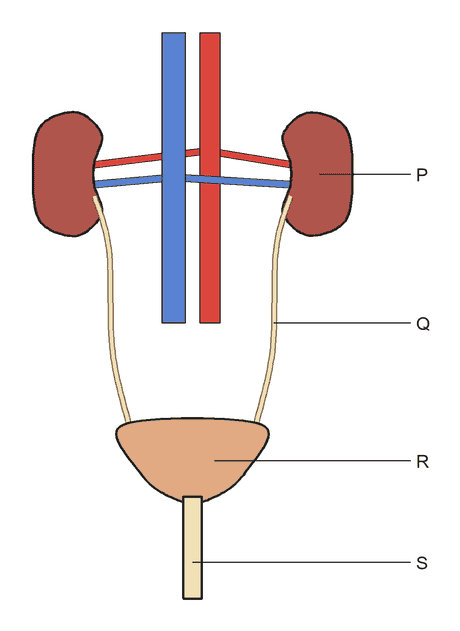
A patient is brought to a hospital. Tests show that both his kidneys are forming urine normally and his bladder is full, yet he is not able to pass any urine out of his body. A stone is most likely blocking the tube marked :
- 31 mark
Question 3
Cognitive domain: Analysis
A laboratory tested the urine of three people. The table shows what was found in each sample.
Person Substances found in the urine 1 Water, urea, uric acid, mineral salts 2 Water, urea, uric acid, mineral salts, glucose 3 Water, urea, uric acid, mineral salts, blood cells Which conclusion can be drawn from the table ?
- 41 mark
Question 4
Cognitive domain: Application
After a football match on a hot afternoon, Aarav hung his dark blue jersey out to dry. When it dried, he saw whitish patches on it, mostly around the collar and under the arms. What do these patches best show about the skin ?
- 51 mark
Question 5
Cognitive domain: Understanding
Assertion (A): A stone stuck in the left ureter can stop the urine of the left kidney from reaching the urinary bladder.
Reason (R): A ureter is a narrow tube that runs from the inner side of a kidney to the urinary bladder.
- 61 mark
Question 6
Cognitive domain: Analysis
Assertion (A): On a cold winter day, when we hardly sweat, we pass urine more often than on a hot summer day.
Reason (R): The kidneys remove urea and uric acid from the blood.
- 71 mark
Question 7
Cognitive domain: Understanding
To study a patient's kidneys, a doctor injects a harmless dye into the blood. The nephrons filter the dye out of the blood, and it travels with the urine. X-ray pictures taken every few minutes show where the dye has reached.
Complete the sentence :
Inside the kidney, the dye will be seen collecting in the funnel-shaped ______ just before it enters the ureter, and it will be seen last of all in the ______, where urine is stored for some time.
- 81 mark
Question 8
Cognitive domain: Application
For a class model, a teacher dissolved a little urea and some common salt in water and called the liquid "model urine". The class noticed that the liquid was colourless like water, whereas real urine has a yellowish tinge. So something that is present in real urine was missing from the model.
Complete the sentence :
The model urine has no yellowish tinge because it lacks the yellow pigment ______, which is formed in our body from the breakdown of old ______.
- 91 mark
Question 9
Cognitive domain: Application
During a cricket match, a hard ball hits a fielder on his back, to one side of the backbone, at the level of his last two ribs. He is taken to a doctor, who asks for a urine test.
Complete the sentence :
The doctor fears that the ball may have hurt a ______, and the urine is being tested for ______, whose presence may indicate damage to this organ.
- 102 marks
Question 10
Cognitive domain: Evaluation
Mr Verma drives a long-distance truck. To avoid stopping on the highway, he drinks very little water all day. He says, "Less water means less urine, so my kidneys get more rest. It is a healthy habit."
Do you agree with Mr Verma ? Give two reasons based on what you have learnt.
- 112 marks
Question 11
Cognitive domain: Evaluation
For a class model of a nephron, Sneha pours a mixture of water, salt, sugar and a few red beads through a kitchen sieve. The water, salt and sugar pass through into a bowl and the beads stay in the sieve. She says, "The liquid in the bowl is the urine. So my sieve shows exactly how a nephron works."
How good is Sneha's model ? State one thing it shows correctly and one important thing about the working of a nephron that it does not show.
- 122 marks
Question 12
Cognitive domain: Understanding
A single renal tubule is so thin that it can be seen only under a microscope, and it is just 4-5 cm long. Yet about 1 litre of blood flows through the kidneys every minute and gets cleaned.
Explain how such tiny tubules are able to clean so much blood.
- 134 marks
Question 13
Cognitive domain: Application
Case: Vikram has joined a gym. To build his muscles, he has started eating much more protein than his body needs - extra eggs, paneer and dal at every meal. Proteins are digested into amino acids. His body cannot store the excessive amino acids.
(a) In which organ are the excessive amino acids broken down ? Name the waste that is produced.
(b) Describe how this waste travels from the organ where it is made to the outside of the body.
(c) Why is it important that this waste does not stay in Vikram's body ?
(d) His trainer tells him to drink plenty of water every day. Explain why this is good advice for someone on such a diet.
- 145 marks
Question 14
Cognitive domain: Analysis
Case: Both kidneys of Mrs Fernandes have failed. She goes to a hospital for dialysis three times a week. A nurse measures the amount of urea in her blood just before and just after each session. In a healthy person, the amount stays close to 30 mg in 100 mL of blood all the time.
Day Urea in 100 mL of blood before dialysis Urea in 100 mL of blood after dialysis Monday 130 mg 45 mg Wednesday 125 mg 42 mg Friday 128 mg 44 mg (a) By how much did the urea in 100 mL of her blood fall during Monday's session ? What does the dialysis machine do to bring about this fall ?
(b) By how much did the urea rise between the end of Monday's session and the start of Wednesday's session ? Explain where this urea came from and why it stayed in her blood.
(c) Why does the urea in a healthy person's blood stay low all the time, without rising and falling like this ?
(d) Mrs Fernandes asks whether she can stop dialysis after a month. What would you tell her ? Name one alternative treatment.
- 155 marks
Question 15
Cognitive domain: Creativity
Case: Class 7 has read that "during summer, we urinate fewer times than in winter, and the urine passed is usually more concentrated, because we lose much water through sweat." Tanvi wants to check a part of this idea for herself during the summer holidays. She plans to compare two kinds of days - days when she plays outdoors and sweats a lot, and days when she stays indoors under a fan. She will only count and observe; she will not collect anything.
(a) What should Tanvi record on each day ? What must she try to keep the same on both kinds of days so that the comparison is fair ?
(b) Design a table in which she can record her observations for six days.
(c) What results would support the idea ? Name the process by which the kidneys bring about this change.
- 161 mark
Question 16
Cognitive domain: Understanding
Arnav's grandmother says, “The body makes waste substances only after we eat a heavy meal.” Which fact shows that she is wrong ?
- 171 mark
Question 17
Cognitive domain: Analysis
A laboratory compared the blood that enters a kidney through the renal artery with the blood that leaves it through the renal vein. The bar chart shows the amounts of three substances in mL of each sample. (Hypothetical data.)

Which conclusion do the readings support best ?
- 181 mark
Question 18
Cognitive domain: Application
In a rare condition, the nephrons of a boy filter his blood normally, but they cannot take back glucose from the filtered fluid. His blood sugar level is normal. What would a test of his urine most likely show ?
- 191 mark
Question 19
Cognitive domain: Understanding
For a class chart, Ananya wrote the path of urine through a kidney as “cortex, then renal pelvis, then medulla, then ureter”. Her teacher said that the order is wrong. Which order is correct ?
- 201 mark
Question 20
Cognitive domain: Analysis
Assertion (A): A kidney can still form urine even if a few of its nephrons are damaged.
Reason (R): A kidney has millions of nephrons, and each nephron filters the blood and forms urine.
- 211 mark
Question 21
Cognitive domain: Analysis
Four friends pass out the same amount, g, of crystal-forming substances in their urine each day. The table shows the volume of urine each of them passes in a day. (Hypothetical data.)
Friend Urine passed in a day Anil L Bina L Chetan L Dia L Who is most likely to form kidney stones, if everything else is the same ?
- 221 mark
Question 22
Cognitive domain: Analysis
Two healthy students of the same age sat in the same cool room for three hours. At the start, Ravi drank litre of water and Kiran drank nothing. The graph shows the volume of urine each of them passed in every minutes. (Hypothetical data.) A reading at minutes means the urine passed from to minutes.
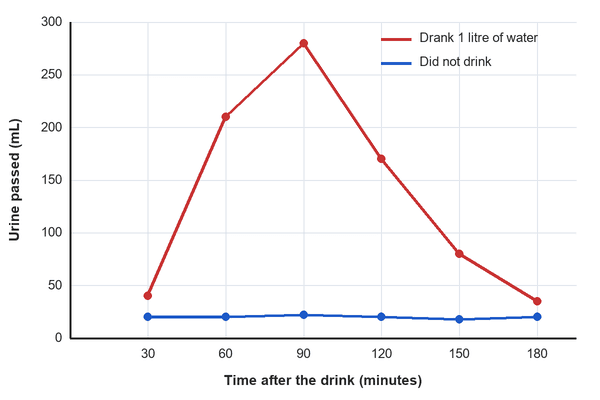
Which conclusion is supported by the graph ?
- 231 mark
Question 23
Cognitive domain: Application
Four patients visit a kidney clinic on the same day. (Hypothetical case.)
Patient Doctor's note Meera One kidney was removed after an accident; the other kidney is healthy Vikas Both kidneys have stopped working; his blood is getting loaded with urea Sunil A small stone in the urinary bladder blocks the flow of urine; both kidneys are healthy Zoya A mild urinary tract infection, with a burning feeling while passing urine Which patient needs regular dialysis, or else a kidney transplant ?
- 241 mark
Question 24
Cognitive domain: Evaluation
Assertion (A): The kidneys of a person can stop working properly only when the person grows very old.
Reason (R): The kidneys may stop working properly if they become infected, are seriously injured or are damaged for some other reason.
- 251 mark
Question 25
Cognitive domain: Analysis
The liver of Mr Das was damaged by a disease, and it can no longer break down the excess amino acids properly. His kidneys are healthy. What change would you expect in the amount of urea in his urine, and why ?
- 262 marks
Question 26
Cognitive domain: Evaluation
Kunal says, “The skin is an excretory organ only in summer, because we do not sweat at all in winter.”
Do you agree with Kunal ? Give two reasons from what you have learnt.
- 272 marks
Question 27
Cognitive domain: Understanding
State two differences between a ureter and the urethra.
- 282 marks
Question 28
Cognitive domain: Application
Ira's urinary bladder can comfortably hold about mL of urine. On a normal school day her kidneys form urine at about mL per minute. (Hypothetical data.)
(a) About how many hours does her bladder take to fill from empty ?
(b) After she drinks two large glasses of water, her kidneys form urine at mL per minute for a while. How long would the bladder now take to fill, and why do the kidneys form more urine ?
- 292 marks
Question 29
Cognitive domain: Application
The two kidneys of a person together have about million nephrons. After an accident, Ritu had to have one kidney removed. Assume that her two kidneys had equal numbers of nephrons.
(a) How many nephrons are left in her body, and what fraction of the original number is this ?
(b) Why can she still live a normal life ?
- 302 marks
Question 30
Cognitive domain: Analysis
A health camp doctor made two notes.
Patient P: a strong and frequent urge to urinate, and a painful, burning feeling while passing urine.
Patient Q: sudden, severe pain, and the flow of urine is blocked.
Name the most likely disorder of each patient and give one reason for each.
- 312 marks
Question 31
Cognitive domain: Application
Latha breathes out through a straw into a glass of clear limewater. Limewater turns milky when carbon dioxide passes through it. After a minute the limewater turns milky.
(a) Which waste product of the body has been shown to leave in her breath ?
(b) How is this waste made, and how does it reach the lungs ?
- 323 marks
Question 32
Cognitive domain: Analysis
The table shows how Arun's body lost the same total amount of water on a cool day and on a hot day. (Hypothetical data.)
Water lost through Cool day Hot day Urine L L Sweat L L Breath and stool L L (a) Find the total amount of water lost on each day.
(b) By what percentage did the volume of urine fall on the hot day ?
(c) Explain the change in the volume of urine with the help of osmoregulation.
- 333 marks
Question 33
Cognitive domain: Evaluation
Three students described the work of the kidneys.
Asha: “The kidneys take everything out of the blood and throw it all away as urine.”
Bilal: “The nephrons filter the blood and remove wastes such as urea, extra water and salts, but they take back useful substances such as glucose into the blood.”
Chitra: “The kidneys make urea from the extra amino acids in the blood and then pass it out.”
(a) Whose description is correct ?
(b) Point out one mistake each in the other two.
- 343 marks
Question 34
Cognitive domain: Application
Mrs Iyer has complete kidney failure, and she goes to a hospital for dialysis three times a week. Each session lasts hours. (Hypothetical data.)
(a) For how many hours is she on the machine in one week ?
(b) For how many hours, and for how many whole days of hours, in a year of weeks ?
(c) Give one advantage of a kidney transplant over regular dialysis.
- 353 marks
Question 35
Cognitive domain: Evaluation
For a science exhibition, Arjun builds a model of the excretory system. He joins two small plastic bottles by two straws to one balloon. From the balloon, a single straw with a clip leads outside.
(a) Which parts of the excretory system do the bottles, the two straws, the balloon and the last straw represent ?
(b) What does opening the clip represent ?
(c) State one way in which the model differs from the real system.
- 363 marks
Question 36
Cognitive domain: Analysis
A student compared the amount of urea in one litre of her sweat with that in one litre of her urine. (Hypothetical data.)
Sample Urea in 1 litre Sweat g Urine g (a) How many times as much urea is there in a litre of urine as in a litre of sweat ?
(b) Name one other substance found in both sweat and urine.
(c) Can the skin do the work of the kidneys if both kidneys fail ? Explain.
- 375 marks
Question 37
Cognitive domain: Analysis
Case: A hospital studied the kidneys of a healthy adult for hours. The nephrons filtered a large volume of fluid out of the blood, and part of this fluid became urine. The table gives some of the results. (Hypothetical data.)
Measurement Filtered fluid Urine Volume in hours L L Glucose in hours g g Urea in each litre g g (a) Which useful substance in the table was taken back completely, and where did it go ?
(b) Find the total mass of urea that the person passed out in the urine in hours.
(c) How many times as much urea is there in a litre of urine as in a litre of the filtered fluid ? Use what the nephrons do with water to explain why the urine is so rich in urea.
- 384 marks
Question 38
Cognitive domain: Application
Case: Two patients take the same medicine. Any extra amount of this medicine in the blood is passed out in the urine. Mr Rao has healthy kidneys, and Mr Sen's kidneys work poorly. A doctor measured the medicine in their blood. (Hypothetical data.)
Patient Medicine in the blood just after a dose Time for the amount to fall to half Mr Rao mg hours Mr Sen mg hours (a) Name the main organ through which this medicine leaves the body, and one accessory excretory organ that also helps to get rid of medicines.
(b) If no new dose is taken, how much medicine is left in the blood of each patient after hours ?
(c) The doctor gives Mr Sen a smaller dose than Mr Rao. Use your answer to (b) to explain why.
- 394 marks
Question 39
Cognitive domain: Creativity
Case: At a school health camp, the doctors want a simple “urine report card” that students can read. It is to show what normal urine contains and what the presence of some other substances may show.
(a) Design a table with the columns Substance, Normal in healthy urine ? and What it shows. Include the rows water, urea, uric acid, mineral salts, glucose and blood cells.
(b) Add one more row to your table for extra vitamin C, and fill in its two columns.
(c) The card must not be used on its own to say that a person has a disease. Give one reason from your table.
- 404 marks
Question 40
Cognitive domain: Analysis
Case: A school doctor treated five students who had a mild urinary tract infection. Each student was given an antibiotic prescribed by the doctor. The table shows the number of days after which the symptoms of each student went. (Hypothetical data.)
Student Days taken for the symptoms to go A B C D E (a) Find the mean number of days for the five students.
(b) How does this fit the time that a mild infection usually takes to be cured with antibiotics ?
(c) As soon as his symptoms went, Student E wanted to stop the medicine, although the doctor had asked him to continue it. Should he stop ? Give a reason.