
Opening your dashboard
Class 7 Biology Chapter 4: Photosynthesis and Respiration Solutions
35 textbook questions with step-by-step answers, free to read, for ICSE 2026-27.
Get talked through Ch 4, not just shown the answer
Reading a finished solution is not the same as being able to do it. The AI tutor takes one question at a time and works it with you, in your own words, until you can.
- Ask it out loud, in your own words
- It gives you the next step, not the answer
- Stuck on part (ii)? Start there
35 questions with solutions
1–15 marks · Mixed difficulty
- 11 mark
Question 1
Carbohydrates are stored by plants in the form of :
Solve with AIAnswer
- Correct
(A) Starch
(B) Proteins
(C) Fats
(D) Glucose
Answer: (A) Starch
Concept: Plants make glucose in photosynthesis. Glucose dissolves in water, so for storage the plant joins many glucose units into starch, which is insoluble and does not upset the water balance of the cells.
Step 1 — Recall the stored form.
Extra glucose is changed into starch and stored, for example in potato tubers and in grains of rice and wheat.
Step 2 — Pick the option.
So carbohydrates are stored by plants as starch, option (A).
Watch out: Glucose is a carbohydrate too, but it is the form that is made and used, not the stored form.
Why the other options are wrong:
- (B) Proteins: proteins are not carbohydrates; they are a different kind of food.
- (C) Fats: fats are not carbohydrates; some seeds store fats and oils, but that is not carbohydrate storage.
- (D) Glucose: glucose is soluble; it is used straight away or changed into starch for storage.
Therefore, carbohydrates are stored by plants as starch, option (A).
- 21 mark
Question 2
Stomata are present on the surface of :
Solve with AIAnswer
- Correct
(A) Leaves
(B) Roots
(C) Stem
(D) Flower petals
Answer: (A) Leaves
Concept: Stomata are tiny pores, found mainly on the lower surface of leaves. Each is bordered by two bean-shaped guard cells, which open the pore when they take in water and close it when they lose water.
Step 1 — Recall where stomata are found.
Stomata are found mainly on the surface of leaves, usually more on the lower surface. They let carbon dioxide in and oxygen and water vapour out.
Step 2 — Pick the option.
The organ that bears stomata is the leaf, option (A).
Watch out: Young green stems also have a few stomata, but the leaf is where they are mainly found.
Why the other options are wrong:
- (B) Roots: roots have no stomata; they take in water through root hairs.
- (C) Stem: young green stems do have a few stomata, but far fewer than leaves; the leaf is the main site.
- (D) Flower petals: petals have few or no working stomata; they are not organs of gas exchange.
Therefore, stomata are present on the surface of leaves, option (A).
- 31 mark
Question 3
Which one of the following is the immediate end-product of photosynthesis ?
Solve with AIAnswer
(A) Fructose
- Correct
(B) Glucose
(C) Cellulose
(D) Lactose
Answer: (B) Glucose
Concept: Photosynthesis is the process by which green plants make glucose from carbon dioxide and water, using sunlight trapped by chlorophyll, and give out oxygen.
Step 1 — Find the sugar made in photosynthesis.
In the chapter's equation the product of photosynthesis is glucose, .
Step 2 — See what happens to it next.
Glucose is later changed into starch for storage, sucrose for transport and cellulose for cell walls. So glucose is the immediate end-product, option (B).
Watch out: Starch appears in a leaf in the starch test, but it is made from glucose; it is not the immediate product.
Note: Strictly, small three-carbon sugars form first and are then built into glucose; at this level glucose is taken as the first product.
Why the other options are wrong:
- (A) Fructose: fructose is the sugar of fruits; the sugar the chapter gives as the product, and the one built into starch, is glucose.
- (C) Cellulose: cellulose is made later from glucose, to build cell walls.
- (D) Lactose: lactose is milk sugar, made by mammals, not by plants.
Therefore, the immediate end-product of photosynthesis is glucose, option (B).
- 41 mark
Question 4
The process by which green plants prepare their own food is known as :
Solve with AIAnswer
(A) Photorespiration
(B) Photolysis
- Correct
(C) Photosynthesis
(D) None of the above
Answer: (C) Photosynthesis
Concept: Photosynthesis is the process by which green plants make glucose from carbon dioxide and water, using sunlight trapped by chlorophyll, and give out oxygen. Photo means light and synthesis means putting together.
Step 1 — Recall the name of the food-making process.
Green plants prepare food from carbon dioxide and water in sunlight. This is photosynthesis.
Step 2 — Pick the option.
Photosynthesis is option (C).
Watch out: Words that begin with "photo" all involve light, but only photosynthesis makes food.
Why the other options are wrong:
- (A) Photorespiration: photorespiration is a process in which lit leaves take in oxygen and give out carbon dioxide; it makes no food.
- (B) Photolysis: photolysis is the splitting of water by light inside the chloroplast; it is one step of photosynthesis, not the whole food-making process.
- (D) None of the above: photosynthesis is listed, so "None of the above" is wrong.
Therefore, the process by which green plants prepare their food is photosynthesis, option (C).
- 51 mark
Question 5
In which of the following cellular structures does photosynthesis occur ?
Solve with AIAnswer
(A) Chromoplast
(B) Chromosome
- Correct
(C) Chloroplast
(D) Leukoplast
Answer: (C) Chloroplast
Concept: Plastids are small bodies in plant cells. Chloroplasts are green plastids containing chlorophyll; photosynthesis takes place inside them.
Step 1 — Recall which structure has chlorophyll.
Only the chloroplast contains chlorophyll, the pigment that traps sunlight.
Step 2 — Pick the option.
Photosynthesis occurs in the chloroplast, option (C).
Watch out: Chloroplast and chromoplast sound alike; only the chloroplast is green.
Why the other options are wrong:
- (A) Chromoplast: chromoplasts are coloured plastids that give yellow, orange or red colour to flowers and fruits; they have no chlorophyll.
- (B) Chromosome: chromosomes are thread-like bodies in the nucleus that carry genes.
- (D) Leukoplast: leucoplasts are colourless plastids that store food such as starch.
Therefore, photosynthesis occurs in the chloroplast, option (C).
- 61 mark
Question 6
Which of the following forms of carbohydrates is broken down during respiration ?
Solve with AIAnswer
(A) Cellulose
- Correct
(B) Glucose
(C) Starch
(D) Sucrose
Answer: (B) Glucose
Concept: Respiration is the breakdown of food (glucose) in living cells to release energy. It goes on in every living cell, day and night.
Step 1 — Recall the food broken down in respiration.
In respiration, glucose is broken down, with oxygen, into carbon dioxide and water, and energy is released.
Step 2 — Pick the option.
The carbohydrate broken down is glucose, option (B).
Watch out: Starch and sucrose can be used for energy only after they are first split into glucose.
Why the other options are wrong:
- (A) Cellulose: cellulose builds cell walls; plants do not break it down for energy.
- (C) Starch: starch is the stored form; it must first be changed into glucose.
- (D) Sucrose: sucrose is the form in which food is carried in the phloem; it is split into simpler sugars such as glucose before it is respired.
Therefore, the carbohydrate broken down during respiration is glucose, option (B).
- 71 mark
Question 7
Which of the following is an immediate product of photosynthesis ?
Solve with AIAnswer
- Correct
(A) Glucose
(B) Starch
(C) Sucrose
(D) Cellulose
Answer: (A) Glucose
Concept: Photosynthesis is the process by which green plants make glucose from carbon dioxide and water, using sunlight trapped by chlorophyll, and give out oxygen.
Step 1 — Find the first sugar formed.
The sugar formed in photosynthesis is glucose.
Step 2 — Separate the later products.
Starch (for storage), sucrose (for transport) and cellulose (for cell walls) are all made from glucose afterwards. So the immediate product is glucose, option (A).
Watch out: Starch is the product found by the iodine test, but it is made from glucose later.
Note: Strictly, small three-carbon sugars form first and are then built into glucose; at this level glucose is taken as the first product.
Why the other options are wrong:
- (B) Starch: starch is formed later when many glucose units join, for storage.
- (C) Sucrose: sucrose is formed later from glucose (and fructose), for transport through the phloem.
- (D) Cellulose: cellulose is formed later from glucose, to build cell walls.
Therefore, the immediate product of photosynthesis is glucose, option (A).
- 81 mark
Question 8
Which of the following is an end product of anaerobic respiration in plants ?
Solve with AIAnswer
(A) Ethane
(B) Ethylene
- Correct
(C) Ethanol
(D) Lactic acid
Answer: (C) Ethanol
Concept: Anaerobic respiration is respiration without oxygen. Glucose is broken down only partly, and little energy is released. In most plant tissues and in yeast the products are ethanol (alcohol) and carbon dioxide.
Step 1 — Write the products for plants.
Without oxygen, plant cells break glucose into ethanol and carbon dioxide.
Step 2 — Pick the option.
The end product among the options is ethanol, option (C).
Watch out: Lactic acid is the product in our muscles, not in most plants.
Why the other options are wrong:
- (A) Ethane: ethane is a fuel gas found in natural gas; it is not made in respiration.
- (B) Ethylene: ethylene is a gas made by plants as a hormone (for ripening), not a product of respiration.
- (D) Lactic acid: lactic acid is formed by anaerobic respiration in animal muscles and some bacteria, not in most plants.
Therefore, an end product of anaerobic respiration in plants is ethanol, option (C).
- 91 mark
Question 9
A glowing matchstick starts burning in the presence of :
Solve with AIAnswer
(A) Carbon dioxide gas
(B) Nitrogen gas
(C) Carbon monoxide gas
- Correct
(D) Oxygen gas
Answer: (D) Oxygen gas
Concept: Oxygen supports burning. A glowing matchstick (or splinter) put into oxygen bursts into flame; this is the test for oxygen.
Step 1 — Recall the test for oxygen.
A glowing matchstick needs more oxygen to start burning again. In pure oxygen it relights at once.
Step 2 — Pick the option.
So the glowing matchstick starts burning in oxygen gas, option (D).
Why the other options are wrong:
- (A) Carbon dioxide gas: carbon dioxide does not support burning; it puts out a flame.
- (B) Nitrogen gas: nitrogen does not support burning, so the matchstick goes out.
- (C) Carbon monoxide gas: carbon monoxide is a poisonous gas; it does not supply the oxygen a matchstick needs to burst into flame.
Therefore, a glowing matchstick starts burning in the presence of oxygen gas, option (D).
- 101 mark
Question 10
Which of the following chemicals is used to identify the presence of starch ?
Solve with AIAnswer
(A) Lime water
(B) Potassium hydroxide
- Correct
(C) Iodine solution
(D) Methylated alcohol
Answer: (C) Iodine solution
Concept: The starch test: when iodine solution is added to starch, it turns blue-black.
Step 1 — Recall the chemical for starch.
Iodine solution is brown; on starch it gives a blue-black colour.
Step 2 — Pick the option.
Starch is identified with iodine solution, option (C).
Why the other options are wrong:
- (A) Lime water: lime water turns milky with carbon dioxide; it is the test for carbon dioxide.
- (B) Potassium hydroxide: potassium hydroxide absorbs carbon dioxide; it is used to remove carbon dioxide in experiments.
- (D) Methylated alcohol: methylated spirit (alcohol) removes chlorophyll from a leaf before the starch test; it does not test for starch.
Therefore, starch is identified with iodine solution, option (C).
- 111 mark
Question 11
Assertion (A): Green plants are autotrophs and they use carbon dioxide and water as raw materials to prepare their own food.
Reason (R): Chlorophyll and sunlight are also essential in the process of photosynthesis but they are not utilized as raw materials.
Solve with AIAnswer
(A) (1) Both A and R are true and R is the correct explanation of A.
- Correct
(B) (2) Both A and R are true but R is not the correct explanation of A.
(C) (3) A is true but R is false.
(D) (4) A is false but R is true.
Answer: (B) (2) Both A and R are true but R is not the correct explanation of A.
Concept: In an assertion-reason item, first judge the Assertion (A) and the Reason (R) separately as true or false; only when both are true do we ask whether R correctly explains A.
Step 1 — Judge the Assertion.
A is true. Green plants make their own food (they are autotrophs), and the raw materials they use are carbon dioxide and water.
Step 2 — Judge the Reason.
R is true. Chlorophyll traps sunlight, and sunlight supplies the energy, but neither of them becomes part of the food, so they are not raw materials.
Step 3 — Check whether R explains A.
R adds another fact about photosynthesis; it does not explain why plants are autotrophs or why their raw materials are carbon dioxide and water. So the answer is option (B).
Watch out: "Needed" is not the same as "used up": raw materials are used up to make the product.
Why the other options are wrong:
- (A): R is true, but it does not explain A.
- (C): R is a true statement.
- (D): A is a true statement.
Therefore, both A and R are true but R is not the correct explanation of A, option (B).
- 121 mark
Question 12
Assertion (A): Stomata are tiny openings found mainly on the lower surface of the leaves.
Reason (R): They cannot be opened or closed for the process of photosynthesis when exposed to direct sunlight as guard cells become inactive in direct sunlight.
Solve with AIAnswer
(A) (1) Both A and R are true and R is the correct explanation of A.
(B) (2) Both A and R are true but R is not the correct explanation of A.
- Correct
(C) (3) A is true but R is false.
(D) (4) A is false but R is true.
Answer: (C) (3) A is true but R is false.
Concept: In an assertion-reason item, first judge the Assertion (A) and the Reason (R) separately as true or false; only when both are true do we ask whether R correctly explains A.
Step 1 — Judge the Assertion.
A is true. Stomata are tiny openings found mainly on the lower surface of leaves.
Step 2 — Judge the Reason.
R is false. Guard cells do not become inactive in sunlight. In light they take in water, become turgid and open the stomata, so carbon dioxide can enter for photosynthesis.
Step 3 — Pick the option.
A is true and R is false, so the answer is option (C).
Watch out: Stomata open in light and close in the dark in most plants; the guard cells control this all the time.
Why the other options are wrong:
- (A): R is false, so it cannot explain A.
- (B): R is false, so "both A and R are true" cannot be right.
- (D): A is true, not false.
Therefore, A is true but R is false, option (C).
- 131 mark
Question 13
Assertion (A): The extensive network of veins within the leaf lamina supplies water and minerals in every cell and also helps in the translocation of prepared food to the other parts of the plant.
Reason (R): The flow of fluids in the veins of leaves or veins of our body, both are unidirectional.
Solve with AIAnswer
(A) (1) Both A and R are true and R is the correct explanation of A.
(B) (2) Both A and R are true but R is not the correct explanation of A.
- Correct
(C) (3) A is true but R is false.
(D) (4) A is false but R is true.
Answer: (C) (3) A is true but R is false.
Concept: In an assertion-reason item, first judge the Assertion (A) and the Reason (R) separately as true or false; only when both are true do we ask whether R correctly explains A.
Step 1 — Judge the Assertion.
A is true. The network of veins brings water and minerals (in the xylem) to every leaf cell and carries the prepared food (in the phloem) away to other parts.
Step 2 — Judge the Reason.
R is false. In a leaf vein, water in the xylem flows into the leaf while food in the phloem flows out of it, and food in the phloem can travel up or down the plant. So the flow in a leaf vein is not one-way like the blood in our veins.
Step 3 — Pick the option.
A is true and R is false, so the answer is option (C).
Watch out: A leaf vein holds two tubes, xylem and phloem, carrying different fluids in different directions.
Why the other options are wrong:
- (A): R is false, so it cannot explain A.
- (B): R is false, so "both A and R are true" cannot be right.
- (D): A is true, not false.
Therefore, A is true but R is false, option (C).
- 141 mark
Question 14
Assertion (A): More energy is released (38 ATP) in the aerobic respiration as compared to anaerebic respiration during which only 2ATPs are produced by the breakdown of one molecule of glucose.
Reason (R): Complete oxidation of glucose occurs in presence of oxygen whereas glucose cannot be broken down completely in absence of oxygen. Hence, amount of energy proudced varies between the two kinds of respiration.
Solve with AIAnswer
- Correct
(A) (1) Both A and R are true and R is the correct explanation of A.
(B) (2) Both A and R are true but R is not the correct explanation of A.
(C) (3) A is true but R is false.
(D) (4) A is false but R is true.
Answer: (A) (1) Both A and R are true and R is the correct explanation of A.
Concept: In an assertion-reason item, first judge the Assertion (A) and the Reason (R) separately as true or false; only when both are true do we ask whether R correctly explains A.
Step 1 — Judge the Assertion.
A is true. Aerobic respiration releases far more energy than anaerobic respiration, which gives only 2 ATP for each glucose molecule.
Step 2 — Judge the Reason.
R is true. With oxygen, glucose is completely oxidised to carbon dioxide and water. Without oxygen it is broken only partly (to ethanol and carbon dioxide in plants), so much of its energy stays locked in the ethanol.
Step 3 — Check whether R explains A.
Complete breakdown releases much more of the energy stored in glucose, which is exactly why aerobic respiration gives more ATP. R explains A, so the answer is option (A).
Watch out: Anaerobic respiration releases less energy because the breakdown is incomplete, not because it is slower.
Note: The figure of 38 ATP per glucose is the older textbook value; current measurements give about 30 to 32 ATP. Anaerobic respiration gives 2 ATP, so aerobic respiration still releases many times more energy.
Why the other options are wrong:
- (B): R does explain A.
- (C): R is a true statement.
- (D): A is a true statement.
Therefore, both A and R are true and R is the correct explanation of A, option (A).
- 151 mark
Question 15
Assertion (A): Photosynthesis occurs in the cells of leaves which contain chloroplasts whereas respiration occurs in all other cells which lack chloroplasts.
Reason (R): The pigment chlorophyll traps solar energy for the process of photosynthesis whereas it does not participate in the process of respiration.
Solve with AIAnswer
(A) (1) Both A and R are true and R is the correct explanation of A.
(B) (2) Both A and R are true but R is not the correct explanation of A.
(C) (3) A is true but R is false.
- Correct
(D) (4) A is false but R is true.
Answer: (D) (4) A is false but R is true.
Concept: In an assertion-reason item, first judge the Assertion (A) and the Reason (R) separately as true or false; only when both are true do we ask whether R correctly explains A.
Step 1 — Judge the Assertion.
A is false. Photosynthesis takes place in green cells with chloroplasts, but respiration takes place in all living cells, including those green cells. It is not limited to cells without chloroplasts.
Step 2 — Judge the Reason.
R is true. Chlorophyll traps sunlight for photosynthesis; it takes no part in respiration.
Step 3 — Pick the option.
A is false and R is true, so the answer is option (D).
Watch out: A green leaf cell carries out both processes: photosynthesis in light and respiration all the time.
Why the other options are wrong:
- (A): A is false, so "both A and R are true" cannot be right.
- (B): A is false, so "both A and R are true" cannot be right.
- (C): this says A is true and R is false; in fact A is false and R is true.
Therefore, A is false but R is true, option (D).
- 166 marks
Question 16
Suppose we compare the leaf with a factory, match the items in Column A with those in Column B.
Column A (LEAF) Column B (FACTORY) (i) Cells in the leaf (a) Raw materials (ii) Chloroplast (b) Power (iii) Sunlight (c) Machinery (iv) Oxygen and water (d) End product (v) Carbon dioxide and water (e) By product (vi) Glucose (f) Work room Solve with AIWritten solution
Solution:
Concept: In a factory, raw materials are made into an end product by machinery in a work room, run by power, and a by-product is also formed. The leaf works the same way.
Step 1 — Match each part of the leaf.
The table gives each item with its factory match and the reason.
Column A (leaf) Column B (factory) Reason (i) Cells in the leaf (f) Work room The process takes place inside them (ii) Chloroplast (c) Machinery It does the actual work of making food (iii) Sunlight (b) Power It supplies the energy (iv) Oxygen and water (e) By product They are given out besides the food (v) Carbon dioxide and water (a) Raw materials They are used up to make food (vi) Glucose (d) End product It is the food that is made Watch out: Water appears twice: as a raw material taken in and as a by-product given out.
Therefore, (i) matches (f), (ii) matches (c), (iii) matches (b), (iv) matches (e), (v) matches (a) and (vi) matches (d).
- 174 marks
Question 17
State whether the following statements are True or False :
(i) Green plants prepare their food by using two raw materials, oxygen and water.
(ii) The chlorophyll enables the plants to use light energy.
(iii) The free oxygen in the atmospheric air is the result of photosynthesis.
(iv) Photosynthesis occurs only in chlorophyll-containing parts of the plant.
Solve with AIWritten solution
Solution:
Concept: Photosynthesis is the process by which green plants make glucose from carbon dioxide and water, using sunlight trapped by chlorophyll, and give out oxygen.
Step 1 — (i) Raw materials.
False. The two raw materials are carbon dioxide and water; oxygen is given out as a by-product.
Step 2 — (ii) Role of chlorophyll.
True. Chlorophyll absorbs light, so the plant can use light energy to make food.
Step 3 — (iii) Oxygen in the air.
True. Almost all the free oxygen in the air has been released by photosynthesis of plants and algae over a very long time.
Step 4 — (iv) Where photosynthesis occurs.
True. Only parts that contain chlorophyll (green parts) can carry out photosynthesis.
Therefore, (i) False, (ii) True, (iii) True, (iv) True.
- 182 marks
Question 18
Which gas is taken in and which one is given out by a green leaf in bright sunlight ?
(i) Taken in
(ii) Given out
Solve with AIWritten solution
Solution:
Concept: A green leaf both photosynthesises (takes in carbon dioxide, gives out oxygen) and respires (takes in oxygen, gives out carbon dioxide). In bright sunlight photosynthesis is much faster than respiration.
Step 1 — Find which process wins in bright light.
Photosynthesis uses up more carbon dioxide than respiration makes, and gives out more oxygen than respiration uses.
Step 2 — State the gases.
So, overall, the leaf takes in carbon dioxide and gives out oxygen.
Watch out: At night the exchange is the other way round, because only respiration goes on.
Therefore, (i) carbon dioxide is taken in and (ii) oxygen is given out.
- 195 marks
Question 19
Name the following :
(i) The cells which surround the openings of stomata.
(ii) The chemical energy stored in the cells.
(iii) The pigment which traps solar energy for the process of photosynthesis.
(iv) A non-chlorophyllous, unicellular plant that respires anaerobically.
(v) The process which maintains the coolness of the plant body.
Solve with AIWritten solution
Solution:
Concept: Each answer is one term from the chapter.
Step 1 — (i) Cells round the stoma.
The two bean-shaped cells around each stoma are guard cells.
Step 2 — (ii) Stored chemical energy.
Energy released in respiration is stored in the cell as ATP (adenosine triphosphate).
Step 3 — (iii) Light-trapping pigment.
The green pigment chlorophyll traps solar energy.
Step 4 — (iv) Non-green unicellular organism that respires anaerobically.
Yeast. It respires anaerobically, making alcohol and carbon dioxide, when oxygen is short.
Step 5 — (v) Process that cools the plant.
Transpiration: evaporation of water from the leaves cools them.
Note: The question calls yeast a plant, as older books did; today yeast is classed as a fungus, and it can also respire aerobically when oxygen is available.
Therefore, (i) guard cells, (ii) ATP, (iii) chlorophyll, (iv) yeast, (v) transpiration.
- 205 marks
Question 20
Note the relationship between the first two words and suggest a suitable word/phrase for the fourth place :
(i) Photosynthesis : Day time :: Respiration : ..........
(ii) Photo : light :: Synthesis : ..........
(iii) Xylem : Water and minerals :: Phloem : ..........
(iv) Palisade cells : Barrel-shaped :: Guard cells : ..........
(v) Photosynthesis : Chloroplast :: Respiration : ..........
Solve with AIWritten solution
Solution:
Concept: Find how the first two words are linked, then use the same link to complete the second pair.
Step 1 — (i) Photosynthesis : Day time.
Photosynthesis happens only in light, by day. Respiration goes on all the time, so the answer is day and night.
Step 2 — (ii) Photo : light.
The word part photo means light; synthesis means combining (putting together).
Step 3 — (iii) Xylem : Water and minerals.
Xylem carries water and minerals; phloem carries food (prepared food, mainly sugar).
Step 4 — (iv) Palisade cells : Barrel-shaped.
Palisade cells are barrel-shaped; guard cells are bean-shaped (kidney-shaped).
Step 5 — (v) Photosynthesis : Chloroplast.
Photosynthesis takes place in the chloroplast; respiration (its aerobic part) takes place in the mitochondria.
Therefore, (i) day and night, (ii) combining, (iii) food, (iv) bean-shaped, (v) mitochondria.
- 215 marks
Question 21
Fill in the blanks :
(i) Plants release .......... gas as a by product during photosynthesis.
(ii) Plants use .......... gas in the process of respiration during day time.
(iii) .......... gas turns lime water milky.
(iv) .......... is used to decolourise the leaf.
(v) Iodine solution turns .......... into blue-black colour.
Solve with AIWritten solution
Solution:
Concept: Each blank is a gas, a chemical or a food from this chapter's processes and tests.
Step 1 — (i) By-product of photosynthesis.
Plants release oxygen as a by-product.
Step 2 — (ii) Gas used in respiration.
Plants use oxygen in respiration, by day as well as by night.
Step 3 — (iii) Gas that turns lime water milky.
Carbon dioxide turns lime water milky.
Step 4 — (iv) Chemical that decolourises a leaf.
Methylated spirit (alcohol) removes the chlorophyll, so the leaf turns pale.
Step 5 — (v) Iodine test.
Iodine solution turns starch blue-black.
Watch out: Alcohol catches fire easily, so it is warmed only in a water bath, never directly over a flame.
Therefore, (i) oxygen, (ii) oxygen, (iii) carbon dioxide, (iv) methylated spirit, (v) starch.
- 225 marks
Question 22
Name :
(i) Two main modes of nutrition in the organisms.
(ii) Four essential requirements for the process of photosynthesis.
(iii) Two categories of cells in the mesophyll of leaves.
(iv) Two types of tissues of vascular system.
(v) Two types of respiration in the organisms.
Solve with AIWritten solution
Solution:
Concept: These are the basic groups and requirements named in the chapter.
Step 1 — (i) Modes of nutrition.
Autotrophic nutrition (making one's own food) and heterotrophic nutrition (depending on others for food).
Step 2 — (ii) Requirements for photosynthesis.
Water, carbon dioxide, chlorophyll and sunlight.
Step 3 — (iii) Cells of the mesophyll.
Palisade cells (long, tightly packed, below the upper epidermis) and spongy cells (loosely packed, with air spaces).
Step 4 — (iv) Tissues of the vascular system.
Xylem and phloem.
Step 5 — (v) Types of respiration.
Aerobic respiration (with oxygen) and anaerobic respiration (without oxygen).
Therefore, (i) autotrophic and heterotrophic; (ii) water, carbon dioxide, chlorophyll, sunlight; (iii) palisade and spongy cells; (iv) xylem and phloem; (v) aerobic and anaerobic.
- 2310 marks
Question 23
Define the following terms :
(i) Autotrophs
(ii) Photosynthesis
(iii) Respiration
(iv) Vascular system
(v) Stomata
Solve with AIWritten solution
Solution:
Concept: A definition says exactly what a term means in one or two clear sentences.
Step 1 — (i) Autotrophs.
Organisms, such as green plants, which prepare their own food are called autotrophs (auto = self, troph = nourishment).
Step 2 — (ii) Photosynthesis.
The process by which green plants make glucose from carbon dioxide and water in the presence of sunlight and chlorophyll, giving out oxygen.
Step 3 — (iii) Respiration.
The process in which food (glucose) is broken down in living cells, usually with oxygen, to release energy.
Step 4 — (iv) Vascular system.
The transport system of a plant, made of xylem (carries water and minerals up from the roots) and phloem (carries food from the leaves to other parts).
Step 5 — (v) Stomata.
Tiny pores, found mainly on the lower surface of leaves, each bordered by two bean-shaped guard cells. They let carbon dioxide in and oxygen and water vapour out.
Therefore, the five terms are autotrophs (self-feeders), photosynthesis (food-making in light), respiration (energy release from glucose), the vascular system (xylem and phloem) and stomata (leaf pores).
- 242 marks
Question 24
Why do leaves generally look green ?
Solve with AIWritten solution
Solution:
Concept: An object looks the colour of the light it reflects. Chlorophyll absorbs mainly red and blue light and reflects green light.
Step 1 — Name the pigment.
Leaf cells contain many chloroplasts filled with the green pigment chlorophyll.
Step 2 — Explain the colour.
Chlorophyll absorbs red and blue light for photosynthesis and reflects most of the green light, so the leaf looks green.
Therefore, leaves look green because their chlorophyll reflects green light.
- 251 mark
Question 25
What is the source of energy for photosynthesis ?
Solve with AIWritten solution
Solution:
Concept: Photosynthesis needs energy to build glucose from carbon dioxide and water.
Step 1 — Name the energy source.
This energy comes from sunlight (solar energy), which is trapped by chlorophyll.
Therefore, sunlight is the source of energy for photosynthesis.
- 262 marks
Question 26
Do the plants respire all day and night or only during the day ? Give reasons.
Solve with AIWritten solution
Solution:
Concept: Respiration is the breakdown of food (glucose) in living cells to release energy. It goes on in every living cell, day and night.
Step 1 — Answer the question.
Plants respire all day and night.
Step 2 — Reason 1: energy is needed all the time.
Every living cell needs energy all the time to stay alive, grow and do its work, and this energy comes from respiration.
Step 3 — Reason 2: respiration needs no light.
Respiration does not need sunlight, so it goes on at night too. Only photosynthesis stops in the dark.
Watch out: By day, photosynthesis hides respiration (more oxygen comes out than is used), but respiration has not stopped.
Therefore, plants respire day and night, because their cells need energy all the time and respiration does not need light.
- 272 marks
Question 27
What happens to the energy liberated during respiration ?
Solve with AIWritten solution
Solution:
Concept: Respiration is the breakdown of food (glucose) in living cells to release energy. It goes on in every living cell, day and night.
Step 1 — Part is trapped as ATP.
Part of the energy set free from glucose is trapped as chemical energy in ATP (adenosine triphosphate). ATP then supplies energy for all the activities of the cell, such as growth, cell division and the uptake of minerals.
Step 2 — The rest is lost as heat.
The rest of the energy escapes as heat.
Watch out: Not all the energy in glucose ends up in ATP; a good deal is always lost as heat.
Therefore, part of the released energy is stored in ATP for the cell's work and the rest is given off as heat.
- 282 marks
Question 28
What is the role of chlorophyll in photosynthesis ?
Solve with AIWritten solution
Solution:
Concept: Photosynthesis is the process by which green plants make glucose from carbon dioxide and water, using sunlight trapped by chlorophyll, and give out oxygen.
Step 1 — Chlorophyll traps light.
Chlorophyll absorbs (traps) sunlight, which provides the energy for photosynthesis.
Step 2 — The energy is turned into food energy.
This energy is used to split water and to build glucose from carbon dioxide. In this way light energy is changed into the chemical energy of food.
Therefore, chlorophyll traps light energy and lets the plant change it into the chemical energy of food.
- 292 marks
Question 29
Do plants need oxygen ? If so, what is its source ?
Solve with AIWritten solution
Solution:
Concept: Respiration is the breakdown of food (glucose) in living cells to release energy. It goes on in every living cell, day and night.
Step 1 — Do plants need oxygen.
Yes. Plants need oxygen for aerobic respiration, to break down glucose and release energy.
Step 2 — Where the oxygen comes from.
Leaves and stems take oxygen from the air through the stomata; roots take it from the air in the soil. By day, green cells can also use some of the oxygen made in photosynthesis.
Watch out: A waterlogged soil has little air, so roots can run short of oxygen.
Therefore, plants do need oxygen, which they get from the air (through stomata and from soil air) and, by day, from photosynthesis.
- 3010 marks
Question 30
Distinguish between the following pairs on the basis of the words indicated in the brackets [ ] :
(i) Photosynthesis and Respiration [Raw materials]
(ii) Aerobic and Anaerobic respiration in plants [End products]
(iii) Green and Variegated leaves [Examples]
(iv) Xylem and Phloem [Function]
(v) Glucose and Starch [Solubility in water]
Solve with AIWritten solution
Solution:
Concept: For each pair, compare the two only on the basis given in brackets.
Step 1 — (i) Raw materials.
Photosynthesis uses carbon dioxide and water; respiration uses glucose and oxygen.
Photosynthesis Respiration Carbon dioxide and water. Glucose (food) and oxygen. Step 2 — (ii) End products.
The products of the two kinds of respiration in plants differ.
Aerobic respiration Anaerobic respiration in plants Carbon dioxide, water and much energy (38 ATP). Ethanol, carbon dioxide and little energy (2 ATP). Step 3 — (iii) Examples.
Most leaves are green all over, while variegated leaves have green and non-green (white or yellow) patches.
Green leaves Variegated leaves Leaves of mango, peepal, spinach. Leaves of Coleus, croton. Step 4 — (iv) Function.
The two vascular tissues carry different materials.
Xylem Phloem Carries water and minerals upwards from the roots to the leaves. Carries food (as sucrose) from the leaves to other parts of the plant. Step 5 — (v) Solubility in water.
Glucose is a small sugar; starch is a very large molecule made of many glucose units.
Glucose Starch Soluble in water. Insoluble in water. Note: The figure of 38 ATP per glucose is the older textbook value; current measurements give about 30 to 32 ATP. Anaerobic respiration gives 2 ATP, so aerobic respiration still releases many times more energy.
Therefore, (i) carbon dioxide and water versus glucose and oxygen; (ii) carbon dioxide, water and much energy versus ethanol, carbon dioxide and little energy; (iii) mango versus Coleus; (iv) xylem carries water up, phloem carries food; (v) glucose is soluble, starch is insoluble.
- 3114 marks
Question 31
Draw a neat diagram of "opened and closed stomata" and answer the following questions :
(i) Label the following in the diagram : Guard cells, Stoma, Nucleus, Inner wall, Outer wall and Chloroplast.
(ii) Mention the condition of guard cells during open and closed stomata.
(iii) Write the specific location of these structures in the plant body.
(iv) Name three important processes of plants in which the stomata are involved.
(v) Are the stomata open or closed during the day and night respectively ?
Solve with AIWritten solution
Solution:
Concept: Stomata are tiny pores, found mainly on the lower surface of leaves. Each is bordered by two bean-shaped guard cells, which open the pore when they take in water and close it when they lose water.
Step 1 — (i) Draw and label the stomata.
The diagram shows a stoma open (A) and closed (B).
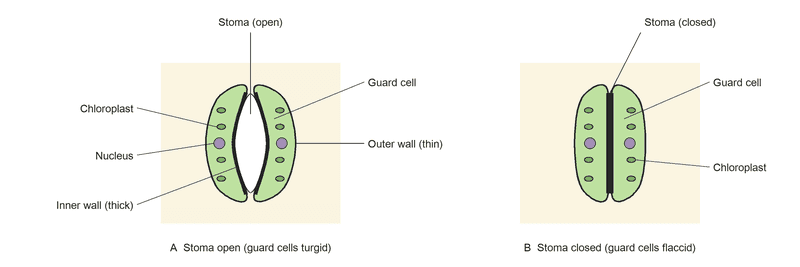
Labels: guard cells, stoma, nucleus, inner wall (thick, next to the pore), outer wall (thin) and chloroplasts.
Step 2 — (ii) Condition of the guard cells.
When the stoma is open, the guard cells have taken in water and are turgid (swollen); the thin outer walls stretch more than the thick inner walls, so the cells bend apart. When the stoma is closed, the guard cells have lost water and are flaccid (limp), and the pore closes.
Step 3 — (iii) Location.
Stomata are found mainly in the lower epidermis of leaves; a few are on the upper surface and on young green stems.
Step 4 — (iv) Processes involving stomata.
Photosynthesis (carbon dioxide enters), respiration (oxygen enters) and transpiration (water vapour leaves).
Step 5 — (v) Day and night.
In most plants the stomata are open during the day and closed at night.
Watch out: Desert plants such as cacti do the opposite: they open their stomata at night to save water.
Therefore, turgid guard cells open the stoma and flaccid ones close it; stomata are mainly on the lower surface of leaves, serve photosynthesis, respiration and transpiration, and are open by day and closed at night.
- 3213 marks
Question 32
The figure given below represents a process in plants. Study the same and answer the following questions :

(i) Identify the process and define it.
(ii) Write balanced equation depicting the entire process.
(iii) Name the organelle and pigment responsible for the process.
(iv) Mention two by-products of the process.
(v) What is the significance of the process ? State two points.
Solve with AIWritten solution
Solution:
Concept: Photosynthesis is the process by which green plants make glucose from carbon dioxide and water, using sunlight trapped by chlorophyll, and give out oxygen.
Step 1 — (i) Identify and define the process.
Sunlight, green leaves, carbon dioxide and water giving sugar and oxygen is photosynthesis: the process by which green plants make glucose from carbon dioxide and water in the presence of sunlight and chlorophyll, giving out oxygen.
Step 2 — (ii) Balanced equation.
Six molecules of carbon dioxide and twelve of water give one molecule of glucose, six of oxygen and six of water.
Step 3 — (iii) Organelle and pigment.
The organelle is the chloroplast; the pigment is chlorophyll.
Step 4 — (iv) By-products.
Oxygen and water are given out besides the glucose.
Step 5 — (v) Significance.
First, it makes food for the plant, and all animals depend on plants for food. Second, it releases oxygen into the air, which living things need for respiration.
Watch out: Count the atoms on both sides: 6 C, 24 H and 24 O on each side.
Therefore, (i) photosynthesis; (ii) the equation above; (iii) chloroplast and chlorophyll; (iv) oxygen and water; (v) it makes food for all and releases oxygen.
- 3313 marks
Question 33
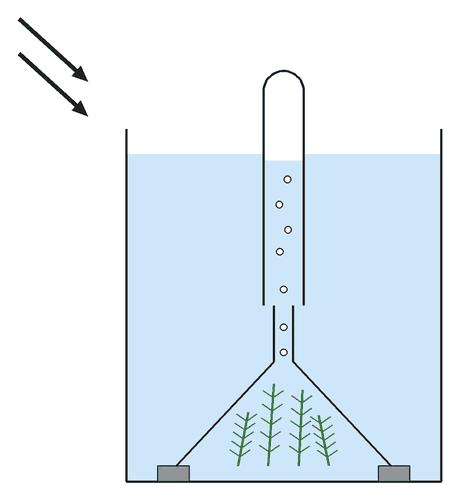
The experimental set-up shown alongside represents a process in plants. Study the same and answer the following questions :
(i) What is the aim of this experiment ?
(ii) Name a suitable plant which can be used for the experiment. What is the habitat of this plant mentioned by you ?
(iii) What is importance of the gas formed, shown by the bubbles, for us ?
(iv) How would you confirm the presence of the gas in the test tube ?
(v) Draw a neat and labelled diagram of the same experiment in its 'initial stage.'
Solve with AIWritten solution
Solution:
Concept: Photosynthesis is the process by which green plants make glucose from carbon dioxide and water, using sunlight trapped by chlorophyll, and give out oxygen.
Step 1 — (i) Aim.
The aim is to show that oxygen is given out during photosynthesis.
Step 2 — (ii) Plant and its habitat.
Hydrilla, a water plant that lives fully under water in fresh-water ponds and lakes.
Step 3 — (iii) Importance of the gas.
The gas in the bubbles is oxygen. Humans and most other living things need it for respiration, to break down food and get energy.
Step 4 — (iv) Testing the gas.
Close the mouth of the test tube with the thumb under water, take it out, and put a glowing matchstick (splinter) into it. If the matchstick bursts into flame, the gas is oxygen.
Step 5 — (v) Initial stage.
At the start the test tube is completely filled with water, and no gas has collected yet.
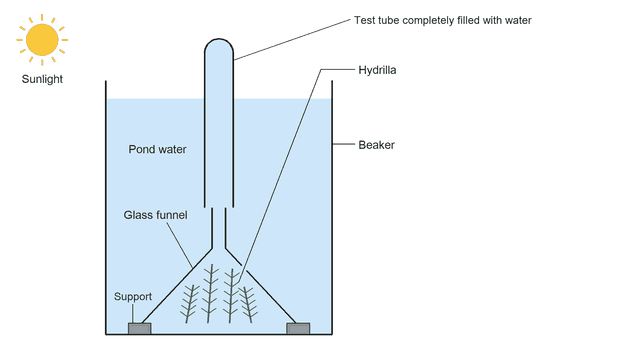
Labels: sunlight, beaker, pond water, glass funnel, Hydrilla, test tube completely filled with water, supports (to keep the funnel off the bottom).
Watch out: The funnel is raised on supports so that water can move freely round the plant.
Therefore, (i) to show that oxygen is released in photosynthesis; (ii) Hydrilla, a fresh-water pond plant; (iii) oxygen, needed for respiration; (iv) a glowing splinter relights; (v) the tube is full of water at the start.
- 3415 marks
Question 34
Write balanced equations for each of the following :
(i) Photosynthesis.
(ii) Aerobic respiration in animals.
(iii) Aerobic respiration in plants during daytime.
(iv) Aerobic respiration in plants during night.
(v) Anaerobic respiration in plants.
Solve with AIWritten solution
Solution:
Concept: Aerobic respiration has the same equation in animals and in plants, by day or by night; only what happens to its carbon dioxide differs.
Step 1 — (i) Photosynthesis.
Carbon dioxide and water form glucose, oxygen and water in sunlight.
Step 2 — (ii) Aerobic respiration in animals.
Glucose is oxidised completely by oxygen.
Step 3 — (iii) Aerobic respiration in plants by day.
The equation is the same; by day the carbon dioxide formed is mostly used again in photosynthesis.
Step 4 — (iv) Aerobic respiration in plants at night.
The equation is the same; at night there is no photosynthesis, so the carbon dioxide is given out into the air.
Step 5 — (v) Anaerobic respiration in plants.
Without oxygen, glucose is broken only partly into ethanol and carbon dioxide.
Step 6 — Energy released.
Aerobic respiration releases about 38 ATP per glucose in the book's figure (current estimates are about 30 to 32 ATP); anaerobic respiration releases only 2 ATP.
Watch out: Plants respire by day too; do not write a different equation for daytime respiration.
Therefore, the five balanced equations are as written above; the three aerobic ones are identical.
- 355 marks
Question 35
Rimjhim decided to do a small plant experiment at home. She covered one leaf of a hibiscus plant with black paper for a week. When she removed the cover, she observed that the covered leaf had turned pale yellow and felt softer. The other leaves were still bright green and firm. She wondered why the leaf looked unhealthy despite watering the plant regularly.
(i) Which process could not occur in the covered leaf?
(ii) State one important role of sunlight in this process.
(iii) What is the purpose of this process in plants?
(iv) Name the specific cells in a leaf where this process occurs.
(v) Which cell organelle carries out the above process?
Solve with AIWritten solution
Solution:
Concept: A leaf makes food only when light reaches its chlorophyll. Without light it cannot make food, and it also slowly loses its chlorophyll, so it turns pale.
Step 1 — (i) The process that stopped.
In the covered leaf, photosynthesis could not occur.
Step 2 — (ii) Role of sunlight.
Sunlight provides the energy for photosynthesis; this energy is trapped by chlorophyll.
Step 3 — (iii) Purpose of the process.
Photosynthesis makes food (glucose) for the plant, and it also gives out oxygen.
Step 4 — (iv) Cells where it occurs.
It occurs mainly in the mesophyll cells, especially the palisade cells, which are packed with chloroplasts.
Step 5 — (v) Organelle.
The chloroplast carries out photosynthesis.
Watch out: The leaf turned pale because it had no light, not because it lacked water; the plant was watered regularly.
Therefore, (i) photosynthesis; (ii) it supplies the energy; (iii) to make food (glucose); (iv) mesophyll (palisade) cells; (v) chloroplast.
What Class 7 Biology Ch 4 covers
The sections of the chapter, in the order the book takes them. Every question above comes from one of these.
- 01Photosynthesis
- 02Stomata
- 03How Does Photosynthesis Occur
- 04Factors Affecting Photosynthesis
- 05Significance of Photosynthesis
- 06What Is Respiration
More ways to study this chapter
The same chapter asked three other ways. Practise it, revise it, and see what the board has set on Ch 4 before.
Class 7 Biology Ch 4 questions students ask
How many questions are there in Class 7 Biology Ch 4?
35 questions. Every one is solved step by step on this page.
Are these Class 7 Biology solutions free?
Yes. Every question and its full working is free to read, with no account needed.
Can I download the Class 7 Biology Ch 4 solutions as a PDF?
There is no PDF to download. Every solution is on this page instead, which means it is searchable, always the current syllabus, and readable on a phone. Use your browser's print option if you want it on paper.