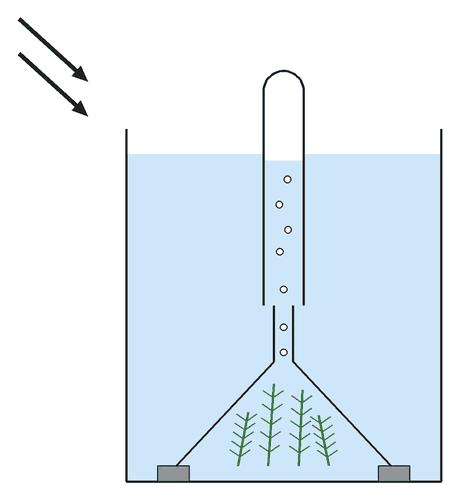
Solution:
Concept: Photosynthesis is the process by which green plants make glucose from carbon dioxide and water, using sunlight trapped by chlorophyll, and give out oxygen.
Step 1 — (i) Aim.
The aim is to show that oxygen is given out during photosynthesis.
Step 2 — (ii) Plant and its habitat.
Hydrilla, a water plant that lives fully under water in fresh-water ponds and lakes.
Step 3 — (iii) Importance of the gas.
The gas in the bubbles is oxygen. Humans and most other living things need it for respiration, to break down food and get energy.
Step 4 — (iv) Testing the gas.
Close the mouth of the test tube with the thumb under water, take it out, and put a glowing matchstick (splinter) into it. If the matchstick bursts into flame, the gas is oxygen.
Step 5 — (v) Initial stage.
At the start the test tube is completely filled with water, and no gas has collected yet.
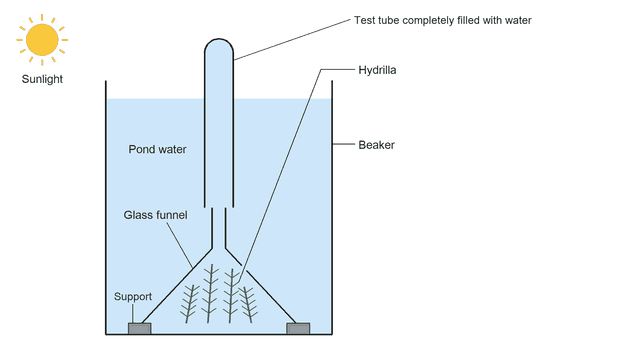
Labels: sunlight, beaker, pond water, glass funnel, Hydrilla, test tube completely filled with water, supports (to keep the funnel off the bottom).
Watch out: The funnel is raised on supports so that water can move freely round the plant.
Therefore, (i) to show that oxygen is released in photosynthesis; (ii) Hydrilla, a fresh-water pond plant; (iii) oxygen, needed for respiration; (iv) a glowing splinter relights; (v) the tube is full of water at the start.