
Opening your dashboard
Class 7 Biology Chapter 4 Photosynthesis and Respiration: Competency-Based Questions (CBQ)
40 questions on Chapter 4, each worked through on its own page with the AI tutor. Class 7 Biology, ICSE 2026-27.
40 questions
1–5 marks · Mixed difficulty
- 11 mark
Question 1
Cognitive domain: Application
Meenal keeps a money plant on a shelf in a dim corner of her room. She waters it regularly, the room is airy and the temperature stays near . Still, the plant has made very few new leaves in two months. Which change is most likely to help the plant make more food ?
- 21 mark
Question 2
Cognitive domain: Analysis
Arnav took two thin peels from the lower surface of the leaves of the same well-watered balsam plant - one at 12 noon and the other at midnight. He forgot to mark the slides. Under the microscope, the stomata in the two peels looked like X and Y.
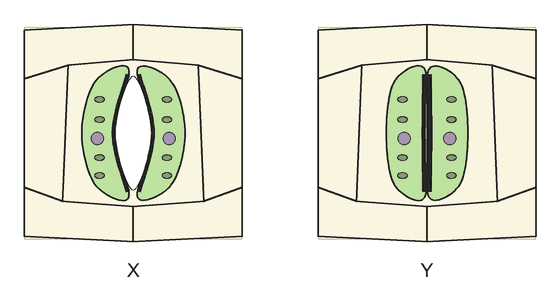
Which peel was taken at midnight, and why ?
- 31 mark
Question 3
Cognitive domain: Analysis
A teacher set up three identical airtight glass jars. Each jar had a small dish of clear lime water in it. After 6 hours the class noted the lime water.
Jar What was inside Where it was kept Lime water after 6 hours 1 A potted green plant In bright sunlight Stayed clear 2 A potted green plant Covered with a thick black cloth Turned milky 3 No plant In bright sunlight Stayed clear Which conclusion is best supported by these results ?
- 41 mark
Question 4
Cognitive domain: Application
Gurpreet helps his father dig up potatoes on their farm in Punjab. The potato tubers grew under the soil, in complete darkness, and they have no green colour. Yet they are packed with starch. Which statement best explains how the starch got there ?
- 51 mark
Question 5
Cognitive domain: Understanding
Assertion (A): Yeast cells can stay alive in a tightly closed jar of sugar solution that has no oxygen in it.
Reason (R): In anaerobic respiration, glucose is completely broken down into carbon dioxide and water.
- 61 mark
Question 6
Cognitive domain: Analysis
Assertion (A): A leaf plucked at sunrise and tested with iodine solution shows much less starch than a similar leaf of the same plant plucked at sunset on a bright day.
Reason (R): At night, the starch stored in a leaf is reconverted into soluble sugar, which is transported out of the leaf as sucrose.
- 71 mark
Question 7
Cognitive domain: Application
After the rains, Tenzin finds white mushrooms growing on a rotting log in a shady part of his garden. No part of a mushroom is green. He wonders whether a mushroom would make its own food if he moved the log into bright sunlight.
Complete the sentence :
Even in bright sunlight the mushroom cannot make its own food, because it has no ______ to absorb the sunlight, and so its mode of nutrition cannot be ______.
- 81 mark
Question 8
Cognitive domain: Application
Some bacteria live deep in the black mud at the bottom of a pond, where there is no oxygen. In a short time, one such bacterium breaks down 5 molecules of glucose by anaerobic respiration, as yeast does.
Complete the sentence :
From this glucose the bacterium gets only ______ ATP molecules, which is ______ ATP molecules fewer than the same glucose would give in aerobic respiration.
- 91 mark
Question 9
Cognitive domain: Understanding
A caterpillar chewed right through the thick main vein of a guava leaf, about halfway along the leaf. The leaf stayed on the tree. In a few days, the half of the leaf beyond the cut wilted and dried up, though it was still getting sunlight and air. The half nearer the stalk stayed fresh and green.
Complete the sentence :
The half beyond the cut dried up because it no longer received ______, which is brought up from the roots by the ______ tissue present in the veins.
- 102 marks
Question 10
Cognitive domain: Evaluation
Kabir wanted to show that light is necessary for photosynthesis. He picked a potted geranium that had been standing in the sunny school garden all week. He clipped a strip of black paper across one leaf and, the very same afternoon, plucked the leaf and did the starch test. The whole leaf turned blue-black, even the part under the black paper. Kabir wrote : "Light is not necessary for photosynthesis."
Is Kabir's conclusion acceptable ? Point out the mistake in his method and say how he should correct it.
- 112 marks
Question 11
Cognitive domain: Understanding
It is a hot, dry afternoon in May. The soil in a pot of tulsi has dried out, and the guard cells of its leaves have lost water. The sun is shining brightly.
Explain what happens to the stomata of the tulsi leaves, and how this affects photosynthesis even though there is plenty of light.
- 122 marks
Question 12
Cognitive domain: Evaluation
Jiya made a bottle garden. She put moist soil, a few small green plants and two tiny snails in a large glass jar, closed the lid tightly and kept the jar near a bright window. Her cousin said, "This will not work. With the lid closed, the snails will run out of oxygen and food in a day or two."
Do you agree with the cousin ? Justify your answer with two points about the green plants.
- 134 marks
Question 13
Cognitive domain: Application
Case: After a week of very heavy rain, Mr Das's field of brinjal plants in Assam stayed under standing water for many days. The spaces between the soil particles, which normally hold air, were filled with water. Although the plants had more water than ever, their leaves drooped and turned yellow.
(a) Which gas were the root cells unable to get from the flooded soil ?
(b) Name the process for which root cells need this gas. Write its word equation.
(c) Explain why the plants drooped even though there was plenty of water around their roots.
(d) When the water drained away, Mr Das loosened the soil around the plants. How would this help the roots ?
- 145 marks
Question 14
Cognitive domain: Analysis
Case: Farhan placed some Hydrilla plants under a glass funnel in a beaker of pond water and inverted a test tube full of water over the stem of the funnel. In a dark room he switched on a lamp that gives light but hardly any heat. He put the lamp at different distances from the beaker. At each distance he waited for five minutes and then counted the bubbles of gas rising in one minute. The temperature of the water stayed the same throughout.

Distance of lamp from beaker Bubbles in one minute 40 cm 8 20 cm 16 10 cm 30 5 cm 30 (a) Name the gas in the bubbles. How can Farhan test the gas collected in the test tube ?
(b) Farhan forgot to take a reading at 30 cm. Between which two numbers of bubbles should that reading lie ? What does the change from 40 cm to 10 cm tell you about light and photosynthesis ?
(c) When the lamp was moved from 10 cm to 5 cm, the number of bubbles did not rise. Suggest a reason.
(d) Why did Farhan use the same plants and keep the temperature of the water the same for all four readings ?
- 155 marks
Question 15
Cognitive domain: Creativity
Case: The science club has one potted Coleus plant. Its leaves are variegated - green in the middle with pale yellow patches along the edges. Ishaan wants to show, using just one leaf of this plant and one starch test, that a leaf makes starch only where it has both chlorophyll and light. He also has black paper, paper clips and the things needed for the starch test.
(a) Plan the experiment. Write the steps Ishaan should follow, up to the point where the leaf is plucked for the starch test.
(b) His leaf will have four kinds of regions. Draw a table listing the four regions and the result you predict for each with iodine solution.
(c) State one safety rule he must follow during the starch test, and write the conclusion he can draw if his predictions come true.
- 161 mark
Question 16
Cognitive domain: Understanding
Neha went on a nature walk to a village pond and noted four living things: a lotus growing in the water, green threads of Spirogyra (a green alga) floating on the surface, a fish, and a white mushroom on a rotting log nearby. Which two of these can make their own food by photosynthesis ?
- 171 mark
Question 17
Cognitive domain: Analysis
The graph shows how the rate of photosynthesis of a pond plant changed with temperature, when light and carbon dioxide were kept plentiful and constant. (Hypothetical data.)

Which conclusion is best supported by the graph ?
- 181 mark
Question 18
Cognitive domain: Understanding
The figure shows a section of a leaf in which four parts are marked P, Q, R and S.
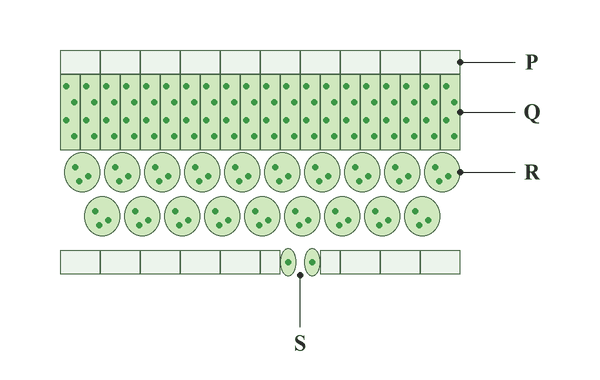
Which two marked parts, in this order, let carbon dioxide enter the leaf and absorb the most sunlight for photosynthesis ?
- 191 mark
Question 19
Cognitive domain: Analysis
On a capsicum farm in Himachal Pradesh, the vents of a polyhouse full of capsicum plants were kept shut for a whole day, and its soil beds were covered with plastic sheet. A sensor recorded the carbon dioxide in the polyhouse air every three hours. (Hypothetical data.)
Time Carbon dioxide in the polyhouse air (parts per million) 6 a.m. 600 9 a.m. 450 12 noon 300 3 p.m. 260 6 p.m. 340 9 p.m. 480 12 midnight 600 Which statement best explains why the carbon dioxide level rose between 3 p.m. and midnight ?
- 201 mark
Question 20
Cognitive domain: Understanding
Assertion (A): The energy that a rice plant uses at night to grow its roots first came from the Sun.
Reason (R): During the day, chlorophyll traps the energy of sunlight and stores it in glucose, which the plant's cells later break down by respiration to release energy.
- 211 mark
Question 21
Cognitive domain: Application
On a school trip to a lake, Devika sees lotus leaves floating flat on the water. The lower surface of each leaf rests on the water, and only the upper surface is open to the air. Where on such a floating leaf would you expect to find most of its stomata ?
- 221 mark
Question 22
Cognitive domain: Analysis
Karan boiled a sugar solution and let it cool to room temperature. He poured it into two test tubes, X and Y, and added a spoon of yeast to tube X only. He floated a thin layer of oil on both tubes to keep air out and left them in a warm place overnight. Next morning, tube X had froth and a faint smell of alcohol, and the gas collected above it turned lime water milky. Tube Y did not change.
Which conclusion is best supported by the observations ?
- 231 mark
Question 23
Cognitive domain: Application
A gardener removes a complete ring of bark, which contains the phloem, from around the trunk of a young guava tree. The wood inside, which contains the xylem, is not damaged.
Assertion (A): The roots of this tree stop receiving the food made in its leaves.
Reason (R): The xylem carries the glucose made in the leaves down to the roots.
- 241 mark
Question 24
Cognitive domain: Application
Plants need a constant supply of energy for the different processes that go on inside their cells. Which one of the following plant activities does not depend on the energy released in the cells by respiration ?
- 251 mark
Question 25
Cognitive domain: Evaluation
In bright light, the leaves of a young chilli plant make 12 units of glucose every hour by photosynthesis. All the living cells of the plant, in its leaves, stem and roots, break down 3 units of glucose every hour by respiration. (Hypothetical data.)
Four friends make claims about one full day of 24 hours, in which the hours without bright light are dark. Which claim is correct ?
- 262 marks
Question 26
Cognitive domain: Analysis
Mr Joshi grows spinach in pots on his terrace in Pune. He fixed a very bright lamp only 5 cm above one plant, so that it would "make food faster", and kept it on for several days. The leaves right under the lamp became pale and dry, and the plant grew less than its neighbours.
(a) Explain what went wrong.
(b) Suggest one change that would help the plant.
- 272 marks
Question 27
Cognitive domain: Analysis
Imran peeled a thin strip from the lower surface of a leaf that had been kept in water, and put it under the microscope. Its stomata were open. He then put a drop of very strong salt solution on the strip. After a few minutes the stomata had closed.
Explain what happened to the guard cells and why the stomata closed.
- 282 marks
Question 28
Cognitive domain: Evaluation
Kavya's grandmother says, "Plants have no lungs and never move about, so they do not respire like animals do. They only make food."
Do you agree that plants do not respire ? Give two points from your chapter to support your answer.
- 292 marks
Question 29
Cognitive domain: Application
During a 100 m race, the muscle cells in Rohit's legs use oxygen faster than his blood can bring it, so some of the glucose in these cells is broken down without oxygen.
(a) Name the substance formed in his muscle cells in this kind of respiration.
(b) Compare the energy obtained from one glucose molecule in these muscle cells with the energy it would give if oxygen were present.
- 302 marks
Question 30
Cognitive domain: Application
Aarav fixed a short candle inside each of two identical large glass jars, P and Q. He lit both candles and closed both jars tightly. After about a minute both flames went out. He then quickly opened jar P, put in a healthy sprig of mint standing in a small bottle of water, and closed it again. He opened jar Q for the same short time, put in only a small bottle of water with no plant, and closed it again. He kept both jars in bright sunlight for three days. Then he quickly opened each jar, relit its candle and closed the jar at once. The candle in jar P burned for about a minute, but the candle in jar Q went out almost at once.
(a) Why did the flames go out the first time ?
(b) Explain why the candle in jar P burned again but the one in jar Q did not. Why did Aarav open jar Q in the same way as jar P ?
- 312 marks
Question 31
Cognitive domain: Application
After a few sunny weeks, the walls and water of the uncovered overhead tank on Mrs Kulkarni's terrace become green and slimy. The neighbour's tank, which has a tight lid, stays clear.
The green slime is made of tiny algae. Name two things from the surroundings that the algae use in photosynthesis in the uncovered tank, and explain why the covered tank stays clear.
- 323 marks
Question 32
Cognitive domain: Analysis
Riddhi wrote four events that take place in a green leaf during photosynthesis on four cards, but the cards got mixed up.
Card Event P Hydrogen ions combine with carbon dioxide to form glucose. Q The xylem brings water from the roots to the cells of the leaf. R The phloem carries the food away from the leaf as sucrose. S Chlorophyll absorbs the energy of sunlight, and this energy splits water into hydrogen ions and hydroxyl ions. (a) Arrange the cards in the order in which the events take place.
(b) A potted plant is moved from bright sunlight into a dark room. Which card's event stops first ? Which other card's event then stops because of it ? Give the reason.
(c) Another plant stands in bright sunlight, but its soil has dried out completely, so its roots can take up no water. Which card's event fails first, and why can the event on card P not go on, even though the sunlight is bright ?
- 333 marks
Question 33
Cognitive domain: Analysis
Four identical glasshouses grow the same tomato plants. The conditions in each are given below. (Hypothetical data.)
Glasshouse Light Carbon dioxide Temperature A Bright Low 30 °C B Dim Plenty 30 °C C Bright Plenty 45 °C D Bright Plenty 30 °C (a) In which glasshouse is photosynthesis likely to be fastest ?
(b) For each of glasshouses A, B and C, name the factor that is limiting the rate of photosynthesis.
- 343 marks
Question 34
Cognitive domain: Analysis
Raju packed ripe mangoes tightly into an airtight plastic drum and kept it closed for a week. When he opened it, the mangoes had a strong smell of alcohol. Mangoes kept in an open basket for the same time did not.
(a) Which kind of respiration took place in the cells of the packed mangoes, and why ?
(b) Name the two products of this respiration, and say which one caused the smell.
(c) Why did the mangoes in the open basket not smell of alcohol ?
- 353 marks
Question 35
Cognitive domain: Evaluation
The organisers of a night-long cultural programme fill a closed hall with potted plants. They say, "The plants will give the audience fresh oxygen all night."
Evaluate their claim for (a) the night-time and (b) a bright midday programme in the same hall with large windows. Is the claim fully correct ?
- 363 marks
Question 36
Cognitive domain: Analysis
In a normal leaf, the palisade mesophyll lies just below the upper epidermis and the spongy mesophyll lies below it. Imagine a strange leaf in which the two layers have changed places, so that the spongy mesophyll lies just under the upper epidermis and the palisade mesophyll lies near the lower epidermis, where the stomata are.
(a) Why is the palisade layer placed just below the upper epidermis in a normal leaf ?
(b) Predict how well the strange leaf would photosynthesize compared with a normal leaf, and give a reason.
(c) Name the factor that would be limiting in the strange leaf, even if carbon dioxide were easily available.
- 374 marks
Question 37
Cognitive domain: Analysis
Case: A science club grew bean seedlings on wet cotton wool. Set L stood in bright sunlight by a window, and set D stood in a dark cupboard. Every four days the club dried a few seedlings of each set and found their dry mass (the mass of the solid matter, without water). The seed's stored food is part of the starting dry mass. (Hypothetical data.)
Day Dry mass of set L (g) Dry mass of set D (g) 0 1.00 1.00 4 0.80 0.80 8 0.90 0.60 12 1.30 0.40 (a) Both sets lost dry mass up to day 4. Name the process that used up the stored food and name the gas that carried part of the lost mass out of the cells.
(b) Explain why set L gained dry mass after day 4 while set D went on losing it.
(c) Predict what will happen to set D if it is kept in the dark for many more days, and why.
- 384 marks
Question 38
Cognitive domain: Analysis
Case: Anika set up three identical flasks, X, Y and Z, each with 100 mL of sugar solution and a spoon of yeast. She stood the flasks, without balloons, in water baths at different temperatures for ten minutes, so that the liquid and the air inside each flask reached the temperature of its bath. Then she fitted a balloon over the neck of each flask and left the flasks in their baths for one hour. Respiration in yeast is helped by enzymes, as in other cells. (Hypothetical data.)
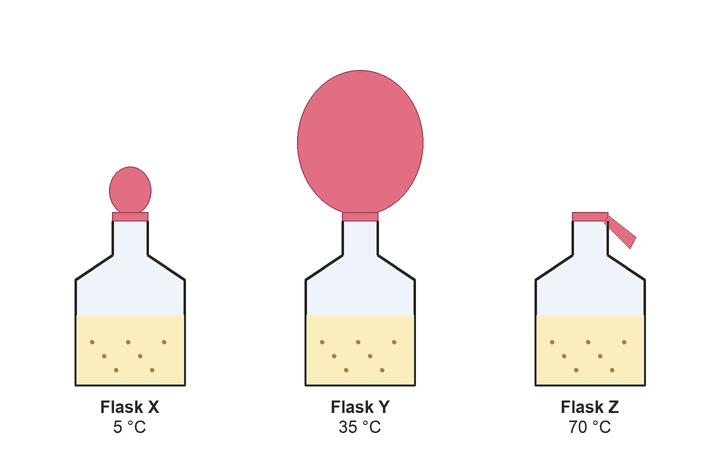
Flask Temperature of water bath Width of balloon after one hour X 5 °C 3 cm Y 35 °C 9 cm Z 70 °C 0 cm (balloon stayed limp) (a) Name the gas that filled the balloon on flask Y, and say how it can be tested.
(b) Why was the balloon of flask Y so much larger than that of flask X ?
(c) Why did the balloon of flask Z not fill at all, although it had the same sugar and yeast ?
- 395 marks
Question 39
Cognitive domain: Evaluation
Case: A school club set up three sealed glass tanks of the same size, X, Y and Z, each with the same amount of pond water, the same number of small fish and the same amount of fish food. The lids were closed so that no air could enter. The club noted the day on which the fish first began to gasp at the water surface, which shows that the oxygen in the water was running low. (Hypothetical data.)
Tank Contents Where it was kept Day on which the fish began to gasp X Fish + Hydrilla Bright window 14 days Y Fish + Hydrilla Covered with black cloth 2 days Z Fish only Bright window 4 days (a) In which tank did the fish last longest ? Explain, with reference to oxygen.
(b) Why did the fish in tank Y gasp sooner than those in tank Z, although Y also had plants ?
(c) A classmate says, "Plants in a closed tank always help the fish." Use the data to show that this is not always true.
- 405 marks
Question 40
Cognitive domain: Creativity
Case: The Rao family lives in a flat with three balconies, A (east), B (west) and C (north). They want to grow tomato and chilli plants in pots on one balcony. The table shows the direct sunlight each balcony gets in the day and its midday temperature in summer. (Hypothetical data.)
Balcony Direct sunlight Midday temperature in summer A about 4 h of direct sun 32 °C B about 5 h of direct sun 44 °C C about 0.5 h of direct sun 29 °C (a) Which balcony would you choose for the plants ? Support your choice with two factors that affect photosynthesis.
(b) Suppose the family could use only balcony C. Suggest two practical ways to give the plants more light there.
(c) Suppose instead the family keeps one tomato plant on balcony A and one on balcony C. After two weeks Mr Rao wants to compare how much food the two plants have made. Plan a simple test with one leaf from each plant, and say what result you expect if the plants on A are making more food.