Solution:
Concept: Stomata are tiny pores, found mainly on the lower surface of leaves. Each is bordered by two bean-shaped guard cells, which open the pore when they take in water and close it when they lose water.
Step 1 — (i) Draw and label the stomata.
The diagram shows a stoma open (A) and closed (B).
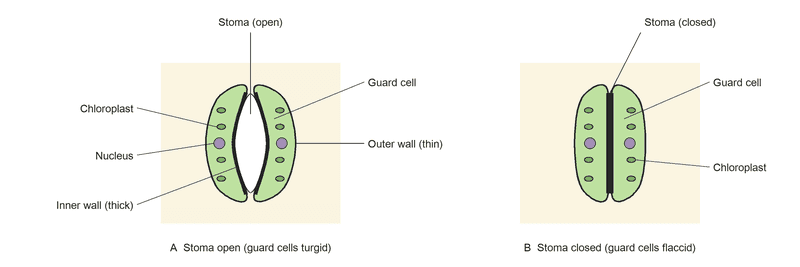
Labels: guard cells, stoma, nucleus, inner wall (thick, next to the pore), outer wall (thin) and chloroplasts.
Step 2 — (ii) Condition of the guard cells.
When the stoma is open, the guard cells have taken in water and are turgid (swollen); the thin outer walls stretch more than the thick inner walls, so the cells bend apart. When the stoma is closed, the guard cells have lost water and are flaccid (limp), and the pore closes.
Step 3 — (iii) Location.
Stomata are found mainly in the lower epidermis of leaves; a few are on the upper surface and on young green stems.
Step 4 — (iv) Processes involving stomata.
Photosynthesis (carbon dioxide enters), respiration (oxygen enters) and transpiration (water vapour leaves).
Step 5 — (v) Day and night.
In most plants the stomata are open during the day and closed at night.
Watch out: Desert plants such as cacti do the opposite: they open their stomata at night to save water.
Therefore, turgid guard cells open the stoma and flaccid ones close it; stomata are mainly on the lower surface of leaves, serve photosynthesis, respiration and transpiration, and are open by day and closed at night.
