
Opening your dashboard
Class 7 Biology Chapter 2: Classification of Plants Solutions
37 textbook questions with step-by-step answers, free to read, for ICSE 2026-27.
Get talked through Ch 2, not just shown the answer
Reading a finished solution is not the same as being able to do it. The AI tutor takes one question at a time and works it with you, in your own words, until you can.
- Ask it out loud, in your own words
- It gives you the next step, not the answer
- Stuck on part (ii)? Start there
37 questions with solutions
1–14 marks · Mixed difficulty
- 11 mark
Question 1
The two main categories of plants recognised on the basis of whether they produce fruits or not are :
Solve with AIAnswer
(A) Biennials and annuals
- Correct
(B) Angiosperms and gymnosperms
(C) Herbs and shrubs
(D) Bryophyta and pteridophyta
Answer: (B) Angiosperms and gymnosperms
Concept: Seed plants (phanerogams) are of two kinds. Angiosperms have their seeds enclosed in a fruit; gymnosperms have naked seeds and bear no fruits.
Step 1 — Look at the basis given.
The stem sorts plants by whether they produce fruits or not.
Step 2 — Pick the pair that fits.
Angiosperms make fruits and gymnosperms do not, so the answer is option (B).
Watch out: Options (A) and (C) are real plant groups too, but they are sorted by life span and size, not by fruits.
Why the other options are wrong:
- (A) Biennials and annuals: they are grouped by how long the plant lives, not by fruits.
- (C) Herbs and shrubs: they are grouped by size and the kind of stem.
- (D) Bryophyta and pteridophyta: bryophytes and pteridophytes produce neither seeds nor fruits, so fruits cannot separate them.
Therefore, plants are grouped into angiosperms and gymnosperms on the basis of fruits, option (B).
- 21 mark
Question 2
Unicellular organisms with a proper nucleus are included in the group :
Solve with AIAnswer
- Correct
(A) Protista
(B) Monera
(C) Fungi
(D) Algae
Answer: (A) Protista
Concept: Living things are classified into five kingdoms: Monera (bacteria: single cells with no proper nucleus), Protista (single cells with a proper nucleus), Fungi (no chlorophyll, body of thread-like hyphae), Plantae and Animalia.
Step 1 — Use both clues.
The organisms are unicellular and have a proper nucleus (enclosed by a nuclear membrane).
Step 2 — Find the kingdom.
Single-celled organisms with a proper nucleus, such as Amoeba, Paramecium and Euglena, are placed in Kingdom Protista, option (A).
Watch out: Bacteria are unicellular too, but they have no proper nucleus.
Why the other options are wrong:
- (B) Monera: monerans (bacteria) are unicellular but have no proper nucleus, only a nucleoid.
- (C) Fungi: most fungi, such as bread mould and mushrooms, are many-celled; yeast is the well-known one-celled fungus.
- (D) Algae: the chapter places algae in the plant kingdom, and many algae such as Spirogyra are many-celled; single-celled algae such as Chlamydomonas are put in Protista in the five-kingdom system.
Therefore, unicellular organisms with a proper nucleus are protists, option (A).
- 31 mark
Question 3
Amoeba belongs to :
Solve with AIAnswer
(A) Monera
- Correct
(B) Protista
(C) Fungi
(D) Algae
Answer: (B) Protista
Concept: Living things are classified into five kingdoms: Monera (bacteria: single cells with no proper nucleus), Protista (single cells with a proper nucleus), Fungi (no chlorophyll, body of thread-like hyphae), Plantae and Animalia.
Step 1 — Recall Amoeba.
Amoeba is a single cell with a well-developed nucleus. It has no cell wall and no chlorophyll.
Step 2 — Place it in a kingdom.
A single cell with a proper nucleus belongs to Kingdom Protista, option (B).
Why the other options are wrong:
- (A) Monera: it has organisms without a proper nucleus, such as bacteria; Amoeba has a proper nucleus.
- (C) Fungi: they have a cell wall and feed on dead matter; Amoeba has no cell wall and catches its food.
- (D) Algae: they have chlorophyll and make their own food; Amoeba cannot.
Therefore, Amoeba belongs to Kingdom Protista, option (B).
- 41 mark
Question 4
Which of the following is saprotrophic in nature ?
Solve with AIAnswer
(A) Amoeba
(B) Euglena
- Correct
(C) Mushroom
(D) Spirogyra
Answer: (C) Mushroom
Concept: A saprotroph (saprophyte) feeds on dead and decaying organic matter. It gives out digestive juices onto the dead matter and absorbs the dissolved food.
Step 1 — Check each organism's way of feeding.
A mushroom is a fungus with no chlorophyll. It grows on rotting wood, dung and humus and absorbs food from them.
Step 2 — Pick the option.
So the saprotroph is the mushroom, option (C).
Watch out: Euglena has chlorophyll; do not confuse a green protist with a fungus.
Why the other options are wrong:
- (A) Amoeba: Amoeba catches living food particles and digests them inside its body; it does not feed on decaying matter.
- (B) Euglena: Euglena has chlorophyll and mainly makes its own food; it can absorb dissolved food in the dark, but it is not a decomposer like the mushroom.
- (D) Spirogyra: Spirogyra is a green alga that makes its own food by photosynthesis.
Therefore, the mushroom is saprotrophic, option (C).
- 51 mark
Question 5
The more appropriate term/phrase for the nucleus in Monerans is :
Solve with AIAnswer
(A) Nucleolus
- Correct
(B) Nucleoid
(C) Premature nucleus
(D) Defective nucleus
Answer: (B) Nucleoid
Concept: Monerans (bacteria) are single cells with a cell wall but no proper nucleus: their nuclear material lies free in the cytoplasm in a region called the nucleoid, with no nuclear membrane.
Step 1 — Recall the bacterial cell.
A bacterium has DNA (nuclear material) but no nuclear membrane round it.
Step 2 — Name the region.
The region where this nuclear material lies is called the nucleoid ("nucleus-like"), option (B).
Why the other options are wrong:
- (A) Nucleolus: a nucleolus is a small body inside a true nucleus; bacteria do not have one.
- (C) Premature nucleus: "premature nucleus" is not a scientific term.
- (D) Defective nucleus: "defective nucleus" is not a scientific term either.
Therefore, the nucleus of monerans is better called a nucleoid, option (B).
- 61 mark
Question 6
The gelatinous, proteinaceous protective covering of a bacterial cell is termed as :
Solve with AIAnswer
(A) Plasmalemma
(B) Sheath
(C) Cell wall
- Correct
(D) Capsule
Answer: (D) Capsule
Concept: Many bacteria have a slimy, jelly-like layer outside the cell wall, called the capsule. It protects the cell from drying out and from attack.
Step 1 — Find the layer outside the wall.
Starting from inside, a bacterium has a cell membrane, then a cell wall, and in many bacteria a gelatinous capsule outside the wall.
Step 2 — Pick the option.
The gelatinous protective covering is the capsule, option (D).
Watch out: The cell wall is rigid; the gelatinous layer around it is the capsule.
Note: In most bacteria the capsule is made mainly of polysaccharides (sugars); only some, such as the anthrax bacterium, have a protein capsule.
Why the other options are wrong:
- (A) Plasmalemma: the plasmalemma is another name for the cell membrane, which lies inside the cell wall.
- (B) Sheath: a sheath is a tube-like covering found only round the chains of some filamentous bacteria; the gelatinous layer round a single cell's wall is called the capsule.
- (C) Cell wall: the cell wall is the firm layer; the gelatinous covering lies outside it.
Therefore, the gelatinous protective covering of a bacterial cell is the capsule, option (D).
- 71 mark
Question 7
Which of the following bacteria converts fruit juices into vinegar ?
Solve with AIAnswer
- Correct
(A) Acetobacter
(B) Rhizobium
(C) Lactobacillus
(D) None of the above
Answer: (A) Acetobacter
Concept: Vinegar is a dilute solution of acetic acid. It is made in two stages: yeast first ferments the sugar of fruit juice into alcohol, and then the bacterium Acetobacter changes the alcohol into acetic acid.
Step 1 — Recall the bacterium that makes acetic acid.
Acetobacter is the bacterium that turns the alcohol in fermented fruit juice into vinegar.
Step 2 — Pick the option.
So the answer is option (A).
Watch out: Acetobacter does not act on fresh juice directly; yeast must first make the alcohol.
Why the other options are wrong:
- (B) Rhizobium: Rhizobium lives in the root nodules of leguminous plants and fixes nitrogen.
- (C) Lactobacillus: Lactobacillus turns milk into curd by making lactic acid.
- (D) None of the above: one of the given bacteria, Acetobacter, does make vinegar.
Therefore, Acetobacter converts fruit juices into vinegar, option (A).
- 81 mark
Question 8
Tuberculosis is caused by a :
Solve with AIAnswer
(A) Virus
- Correct
(B) Bacterium
(C) Protozoan
(D) Protist
Answer: (B) Bacterium
Concept: Tuberculosis (TB) is caused by the bacterium Mycobacterium tuberculosis. It spreads through the air when a sick person coughs or sneezes.
Step 1 — Recall the cause of TB.
TB is a bacterial disease, caused by Mycobacterium tuberculosis.
Step 2 — Pick the option.
So the answer is option (B).
Why the other options are wrong:
- (A) Virus: viruses cause diseases such as COVID-19 and polio, not TB.
- (C) Protozoan: protozoans cause diseases such as malaria, not TB.
- (D) Protist: protists include the protozoans; TB is not caused by any of them.
Therefore, tuberculosis is caused by a bacterium, option (B).
- 91 mark
Question 9
The part of the seed which stores food is :
Solve with AIAnswer
(A) Seed coat
(B) Testa
- Correct
(C) Seed leaves
(D) Tegmen
Answer: (C) Seed leaves
Concept: A seed has a seed coat outside and an embryo inside. The embryo's cotyledons (seed leaves) store food in seeds such as pea, gram and bean, and this food feeds the young plant as it grows.
Step 1 — Find the food store.
When a soaked gram or pea seed is split, the two thick halves are the cotyledons, full of stored food.
Step 2 — Pick the option.
The seed leaves store the food, so the answer is option (C).
Watch out: In some seeds, such as maize and castor, most food is stored in the endosperm, not in the cotyledons.
Why the other options are wrong:
- (A) Seed coat: the seed coat only protects the seed.
- (B) Testa: the testa is the outer layer of the seed coat; it protects, it does not store food.
- (D) Tegmen: the tegmen is the inner layer of the seed coat; it does not store food.
Therefore, the part of the seed which stores food is the seed leaves (cotyledons), option (C).
- 101 mark
Question 10
Which of the following category of plants contains seeds inside the cones ?
Solve with AIAnswer
(A) Bryophyta
- Correct
(B) Gymnosperms
(C) Pteridophyta
(D) Angiosperms
Answer: (B) Gymnosperms
Concept: Kingdom Plantae is divided into algae (no true roots, stems or leaves), bryophytes (mosses: stems and leaves, but rhizoids instead of roots), pteridophytes (ferns: roots, stems and leaves, spores but no seeds), gymnosperms (naked seeds in cones) and angiosperms (flowering plants with seeds inside fruits).
Step 1 — Recall where gymnosperm seeds form.
Gymnosperms such as pine, fir and cedar bear no flowers or fruits. Their naked seeds lie on the scales of cones.
Step 2 — Pick the option.
So the answer is option (B).
Watch out: A cone is not a flower; gymnosperms bear no flowers.
Why the other options are wrong:
- (A) Bryophyta: bryophytes (mosses) have no seeds at all.
- (C) Pteridophyta: pteridophytes (ferns) reproduce by spores, not seeds.
- (D) Angiosperms: they bear seeds inside fruits, not cones.
Therefore, gymnosperms bear seeds inside cones, option (B).
- 111 mark
Question 11
Assertion (A): Monerans are unicellular, primitive organisms which contain an unorganised nucleus, called as nucleoid.
Reason (R): Nucleoid is the nuclear material which is enclosed in a gelatinous capsule instead of a nuclear membrane.
Solve with AIAnswer
(A) (1) Both A and R are true and R is the correct explanation of A
(B) (2) Both A and R are true but R is not the correct explanation of A
- Correct
(C) (3) A is true but R is false
(D) (4) A is false but R is true
Answer: (C) (3) A is true but R is false
Concept: In an assertion-reason item, first judge the Assertion (A) and the Reason (R) separately as true or false; only when both are true do we ask whether R correctly explains A.
Step 1 — Judge the Assertion.
A is true. Monerans are single-celled, simple (primitive) organisms whose nuclear material is not organised into a true nucleus; it lies in the nucleoid.
Step 2 — Judge the Reason.
R is false. The nucleoid is not enclosed by anything: there is no membrane round it. The capsule is the gelatinous layer outside the cell wall; it does not surround the nucleoid.
Step 3 — Pick the option.
A is true and R is false, so the answer is option (C).
Watch out: The capsule covers the whole cell from outside, never the nuclear material.
Why the other options are wrong:
- (A): R is false, so it cannot explain A.
- (B): R is false, so "both A and R are true" cannot be right.
- (D): A is true, not false.
Therefore, A is true but R is false, option (C).
- 121 mark
Question 12
Assertion (A): The locomotory structure of all protists is a pseudopodium which is formed temporarily by the organisms towards the direction of their movement.
Reason (R): Most of the protists are aquatic and they move with the help of water current. They may have cilia or flagella for their locomotion.
Solve with AIAnswer
(A) (1) Both A and R are true and R is the correct explanation of A
(B) (2) Both A and R are true but R is not the correct explanation of A
(C) (3) A is true but R is false
- Correct
(D) (4) A is false but R is true
Answer: (D) (4) A is false but R is true
Concept: In an assertion-reason item, first judge the Assertion (A) and the Reason (R) separately as true or false; only when both are true do we ask whether R correctly explains A.
Step 1 — Judge the Assertion.
A is false because of the word "all". Only some protists, such as Amoeba, move by pseudopodia. Paramecium moves by cilia and Euglena by a flagellum.
Step 2 — Judge the Reason.
R is true. Most protists live in water, are carried along by its currents, and many have cilia or flagella for movement.
Step 3 — Pick the option.
A is false and R is true, so the answer is option (D).
Why the other options are wrong:
- (A): A is false, so R cannot explain it.
- (B): A is false, so "both A and R are true" cannot be right.
- (C): this says A is true and R is false; in fact it is the other way round.
Therefore, A is false but R is true, option (D).
- 131 mark
Question 13
Assertion (A): Pteridophytes bear well-formed leaves, stems, roots but do not produce flowers and seeds for reproduction.
Reason (R): These plants bear small rounded bodies on the undersurface of their leaves. These bodies contain tiny spores which get scattered to produce new plants.
Solve with AIAnswer
- Correct
(A) (1) Both A and R are true and R is the correct explanation of A
(B) (2) Both A and R are true but R is not the correct explanation of A
(C) (3) A is true but R is false
(D) (4) A is false but R is true
Answer: (A) (1) Both A and R are true and R is the correct explanation of A
Concept: In an assertion-reason item, first judge the Assertion (A) and the Reason (R) separately as true or false; only when both are true do we ask whether R correctly explains A.
Step 1 — Judge the Assertion.
A is true. Ferns (pteridophytes) have true roots, stems and leaves, but they bear no flowers and no seeds.
Step 2 — Judge the Reason.
R is true. Small rounded bodies on the underside of fern leaves hold tiny spores, which are scattered and grow into new plants.
Step 3 — Check whether R explains A.
R tells us how ferns reproduce without flowers and seeds: spores do the job that seeds do in flowering plants. So R is the correct explanation of A, option (A).
Why the other options are wrong:
- (B): R does explain A: it shows that spores take the place of seeds.
- (C): R is a true statement.
- (D): A is a true statement.
Therefore, both A and R are true and R is the correct explanation of A, option (A).
- 141 mark
Question 14
Assertion (A): Most gymnosperms are evergreen and grow in mountain areas.
Reason (R): Mountainous areas have high wind velocity and heavy rainfall. So, gymnosperms shed their leaves periodically, but not all at once.
Solve with AIAnswer
(A) (1) Both A and R are true and R is the correct explanation of A
- Correct
(B) (2) Both A and R are true but R is not the correct explanation of A
(C) (3) A is true but R is false
(D) (4) A is false but R is true
Answer: (B) (2) Both A and R are true but R is not the correct explanation of A
Concept: In an assertion-reason item, first judge the Assertion (A) and the Reason (R) separately as true or false; only when both are true do we ask whether R correctly explains A.
Step 1 — Judge the Assertion.
A is true. Most gymnosperms we know, such as pine, fir, cedar and spruce, are evergreen and grow on hills and mountains.
Step 2 — Judge the Reason.
R is true as a set of facts. Mountains are often windy and wet, and gymnosperms do shed their old leaves a few at a time, not all at once, which is what evergreen means.
Step 3 — Check whether R explains A.
Wind and rain are not what makes these trees evergreen or makes them grow in the mountains; R only describes what evergreen means. So R is not the correct explanation of A, option (B).
Watch out: The word "So" in R joins two true facts, but the second does not follow from the first.
Note: If R is read as one claim, its "So" states a cause that is not real, and R would be false (A true, R false). Read as two true facts, the answer is both true, R not the explanation, option (B).
Why the other options are wrong:
- (A): R does not give the real cause of A.
- (C): R's facts are true, so (C) does not fit under this reading.
- (D): A is a true statement.
Therefore, both A and R are true but R is not the correct explanation of A, option (B).
- 151 mark
Question 15
Assertion (A): Monocotyledonous plants bear only one cotyledon in their seeds.
Reason (R): Monocot plants usually have long, narrow leaves with parallel veins.
Solve with AIAnswer
(A) (1) Both A and R are true and R is the correct explanation of A
- Correct
(B) (2) Both A and R are true but R is not the correct explanation of A
(C) (3) A is true but R is false
(D) (4) A is false but R is true
Answer: (B) (2) Both A and R are true but R is not the correct explanation of A
Concept: In an assertion-reason item, first judge the Assertion (A) and the Reason (R) separately as true or false; only when both are true do we ask whether R correctly explains A.
Step 1 — Judge the Assertion.
A is true. Monocots, such as rice, wheat, maize and grass, have one cotyledon in the seed.
Step 2 — Judge the Reason.
R is true. Monocots usually have long, narrow leaves with parallel veins.
Step 3 — Check whether R explains A.
The shape and veins of the leaves do not decide how many cotyledons the seed has; R is just another feature of monocots. So R is not the correct explanation of A, option (B).
Watch out: Two true facts about the same group need not explain each other.
Why the other options are wrong:
- (A): R is only another feature of monocots; it is not the reason for A.
- (C): R is a true statement.
- (D): A is a true statement.
Therefore, both A and R are true but R is not the correct explanation of A, option (B).
- 165 marks
Question 16
Name the following :
(i) The thread-like soft, delicate structures of bread mould.
(ii) The category of organisms which feed on dead and decaying organic matter.
(iii) The reproductive structure of Gymnosperms which bears seeds inside it.
(iv) The root-like structures of Bryophytes.
(v) The cellular structure which eliminates excess water from the body of Amoeba.
Solve with AIWritten solution
Solution:
Concept: Living things are classified into five kingdoms: Monera (bacteria: single cells with no proper nucleus), Protista (single cells with a proper nucleus), Fungi (no chlorophyll, body of thread-like hyphae), Plantae and Animalia.
Step 1 — (i) Threads of bread mould.
The soft, thread-like structures are hyphae; together they form the mycelium.
Step 2 — (ii) Feeders on dead matter.
Organisms that feed on dead and decaying matter are saprophytes (saprotrophs).
Step 3 — (iii) Seed-bearing structure of gymnosperms.
Gymnosperms bear their seeds on the scales of a cone (the female cone).
Step 4 — (iv) Root-like structures of bryophytes.
Mosses have no true roots; they have thin, root-like rhizoids.
Step 5 — (v) Water remover of Amoeba.
The contractile vacuole collects excess water and throws it out.
Therefore, (i) hyphae, (ii) saprophytes, (iii) cone, (iv) rhizoids, (v) contractile vacuole.
- 175 marks
Question 17
Correct the following statements by changing the first/last word only :
(i) Unicellular, prokaryotic organisms are termed as protists.
(ii) Animals do not possess a nervous system.
(iii) Mushroom is a unicellular fungus.
(iv) Rod-shaped bacteria are called cocci.
(v) Reserve food material in bacteria is starch.
Solve with AIWritten solution
Solution:
Concept: Living things are classified into five kingdoms: Monera (bacteria: single cells with no proper nucleus), Protista (single cells with a proper nucleus), Fungi (no chlorophyll, body of thread-like hyphae), Plantae and Animalia.
Step 1 — (i) Unicellular prokaryotes.
Prokaryotes have no proper nucleus; such single-celled organisms are monerans, not protists. Change the last word: "…are termed as monerans."
Step 2 — (ii) No nervous system.
Animals do have a nervous system; it is plants that have none. Change the first word: "Plants do not possess a nervous system."
Step 3 — (iii) Unicellular fungus.
A mushroom is many-celled; the one-celled fungus is yeast. Change the first word: "Yeast is a unicellular fungus."
Step 4 — (iv) Rod-shaped bacteria.
Cocci are round; rod-shaped bacteria are bacilli. Change the last word.
Step 5 — (v) Reserve food in bacteria.
Bacteria store food mainly as glycogen, not starch. Change the last word.
Watch out: Change only the first or the last word, as the question asks.
Therefore, (i) monerans, (ii) Plants, (iii) Yeast, (iv) bacilli, (v) glycogen.
- 185 marks
Question 18
Match the terms in column A with those of column B.
Column A Column B (i) Retting (a) Curd (ii) Tanning (b) Vinegar (iii) Lactobacillus (c) Cowdung (iv) Acetobacter (d) Fibres (v) Biogas (e) Leather Solve with AIWritten solution
Solution:
Concept: Each item in Column A is a use of bacteria (or a bacterium); match it with what it acts on or makes.
Step 1 — Match each item.
The table gives each item of Column A with its partner from Column B.
Column A Column B (i) Retting (d) Fibres (ii) Tanning (e) Leather (iii) Lactobacillus (a) Curd (iv) Acetobacter (b) Vinegar (v) Biogas (c) Cowdung Step 2 — Reasons for the matches.
Retting loosens and separates jute fibres; tanning cures animal hides into leather; Lactobacillus turns milk into curd; Acetobacter turns the alcohol of fermented juice into vinegar; biogas (gobar gas) is made when microbes break down cow dung without air.
Therefore, (i) matches (d), (ii) matches (e), (iii) matches (a), (iv) matches (b), (v) matches (c).
- 195 marks
Question 19
Given below are sets of four terms. Choose the odd one and write the category for the remaining terms.
(i) Typhoid, Tuberculosis, COVID-19, Cholera
(ii) Amoeba, Bacteria, Paramecium, Chlamydomonas
(iii) Penicillium, Agaricus, Mucor, Spirogyra
(iv) Pine, Fir, Deodar, Cedar
(v) Brinjal, Rice, Grass, Maize
Solve with AIWritten solution
Solution:
Concept: In each set, three terms share one category. Find that category first; the term outside it is the odd one.
Step 1 — (i) Typhoid, tuberculosis, COVID-19, cholera.
Typhoid, tuberculosis and cholera are bacterial diseases. COVID-19 is caused by a virus, so it is the odd one.
Step 2 — (ii) Amoeba, bacteria, Paramecium, Chlamydomonas.
Amoeba, Paramecium and Chlamydomonas are single cells with a proper nucleus, that is, protists. Bacteria are monerans, so they are the odd one.
Step 3 — (iii) Penicillium, Agaricus, Mucor, Spirogyra.
Penicillium, Agaricus (mushroom) and Mucor are fungi. Spirogyra is an alga with chlorophyll, so it is the odd one.
Step 4 — (iv) Pine, fir, deodar, cedar.
All four are cone-bearing, mostly evergreen gymnosperms, so there is no clear odd one by group. If one must be picked, deodar stands out because it is itself a kind of cedar (Cedrus deodara), while pine and fir belong to other genera.
Step 5 — (v) Brinjal, rice, grass, maize.
Rice, grass and maize are monocots. Brinjal is a dicot, so it is the odd one.
Therefore, the odd ones are (i) COVID-19 (rest bacterial diseases), (ii) bacteria (rest protists), (iii) Spirogyra (rest fungi), (iv) deodar, a kind of cedar (all are gymnosperms), (v) brinjal (rest monocots).
- 204 marks
Question 20
Name the categories of the following :
(i) Plants which do not have roots, stems, and leaves : ..........
(ii) Plants with no roots, but have stems and leaves : ..........
(iii) Plants with roots, stems, and leaves, and which bear spore-producing bodies : ..........
(iv) The amphibians of the plant kingdom ..........
Solve with AIWritten solution
Solution:
Concept: Kingdom Plantae is divided into algae (no true roots, stems or leaves), bryophytes (mosses: stems and leaves, but rhizoids instead of roots), pteridophytes (ferns: roots, stems and leaves, spores but no seeds), gymnosperms (naked seeds in cones) and angiosperms (flowering plants with seeds inside fruits).
Step 1 — (i) No roots, stems or leaves.
Plants whose body is a simple thallus are algae.
Step 2 — (ii) Stems and leaves but no roots.
Mosses (bryophytes) have stems and leaves but only rhizoids instead of roots.
Step 3 — (iii) Roots, stems, leaves and spore-bodies.
Ferns (pteridophytes) have all three and bear spore-producing bodies under their leaves.
Step 4 — (iv) Amphibians of the plant kingdom.
Bryophytes (mosses) live on land but need water to reproduce.
Therefore, (i) algae, (ii) bryophytes (mosses), (iii) pteridophytes (ferns), (iv) bryophytes.
- 215 marks
Question 21
Match the items given under column I with those given under column II :
Column I Column II (i) Bread mould (a) Has chlorophyll (ii) Spirogyra (b) Leaves with spores (iii) Moss (c) Naked seeds (iv) Fern (d) Saprophyte (v) Gymnosperm (e) Has rhizoids Solve with AIWritten solution
Solution:
Concept: Living things are classified into five kingdoms: Monera (bacteria: single cells with no proper nucleus), Protista (single cells with a proper nucleus), Fungi (no chlorophyll, body of thread-like hyphae), Plantae and Animalia. Kingdom Plantae is divided into algae (no true roots, stems or leaves), bryophytes (mosses: stems and leaves, but rhizoids instead of roots), pteridophytes (ferns: roots, stems and leaves, spores but no seeds), gymnosperms (naked seeds in cones) and angiosperms (flowering plants with seeds inside fruits).
Step 1 — Match each organism with its feature.
The table pairs each item of Column I with its special feature.
Column I Column II (i) Bread mould (d) Saprophyte: it feeds on bread and other dead matter. (ii) Spirogyra (a) Has chlorophyll: it is a green alga. (iii) Moss (e) Has rhizoids: it has no true roots. (iv) Fern (b) Leaves with spores: spore bodies lie under its leaves. (v) Gymnosperm (c) Naked seeds: its seeds are not in a fruit. Therefore, (i) matches (d), (ii) matches (a), (iii) matches (e), (iv) matches (b), (v) matches (c).
- 2210 marks
Question 22
Define the terms given below :
(i) Classification
(ii) Binary fission
(iii) Pseudopodia
(iv) Symbiosis
(v) Mycelium
Solve with AIWritten solution
Solution:
Concept: A definition gives the exact meaning in one or two sentences, with the key words that set the term apart.
Step 1 — (i) Classification.
Classification is the arranging of living organisms into groups on the basis of their similarities and differences.
Step 2 — (ii) Binary fission.
Binary fission is reproduction in which a full-grown single-celled organism such as Amoeba splits into two: first its nucleus divides, then its cytoplasm, giving two daughter cells.
Step 3 — (iii) Pseudopodia.
Pseudopodia ("false feet") are temporary, finger-like projections of the cytoplasm and cell membrane of Amoeba that help in movement and in capturing food.
Step 4 — (iv) Symbiosis.
Symbiosis is a close relationship in which two different organisms live together and both benefit, for example Rhizobium bacteria in the root nodules of pea plants.
Step 5 — (v) Mycelium.
Mycelium is the network of thread-like hyphae that forms the body of a fungus such as bread mould.
Therefore, classification groups organisms by likeness, binary fission splits one cell into two, pseudopodia are false feet, symbiosis is living together with benefit to both, and a mycelium is a network of hyphae.
- 235 marks
Question 23
Give two examples of each of the following :
(i) Gymnosperms
(ii) Multicellular fungi
(iii) Monerans
(iv) Protists
(v) Leguminous plants
Solve with AIWritten solution
Solution:
Concept: Living things are classified into five kingdoms: Monera (bacteria: single cells with no proper nucleus), Protista (single cells with a proper nucleus), Fungi (no chlorophyll, body of thread-like hyphae), Plantae and Animalia.
Step 1 — (i) Gymnosperms.
Pine and cedar (fir and spruce also fit).
Step 2 — (ii) Multicellular fungi.
Mushroom (Agaricus) and bread mould (Rhizopus); Penicillium also fits.
Step 3 — (iii) Monerans.
Bacteria such as Lactobacillus and Rhizobium.
Step 4 — (iv) Protists.
Amoeba and Paramecium (Euglena also fits).
Step 5 — (v) Leguminous plants.
Pea and bean (gram also fits); their roots carry nodules with nitrogen-fixing bacteria.
Therefore, (i) pine, cedar; (ii) mushroom, bread mould; (iii) Lactobacillus, Rhizobium; (iv) Amoeba, Paramecium; (v) pea, bean.
- 245 marks
Question 24
Name :
(i) Five kingdoms according to the recent system of classification.
(ii) Four categories of bacteria according to their shapes.
(iii) Five bacterial diseases.
(iv) Five categories of plants in kingdom Plantae.
(v) Two categories of Phanerogams.
Solve with AIWritten solution
Solution:
Concept: Living things are classified into five kingdoms: Monera (bacteria: single cells with no proper nucleus), Protista (single cells with a proper nucleus), Fungi (no chlorophyll, body of thread-like hyphae), Plantae and Animalia.
Step 1 — (i) The five kingdoms.
The five-kingdom system (proposed by R. H. Whittaker in 1969) has Monera, Protista, Fungi, Plantae and Animalia.
Step 2 — (ii) Shapes of bacteria.
Coccus (round), bacillus (rod), spirillum (spiral) and vibrio (comma).
Step 3 — (iii) Bacterial diseases.
Typhoid, tuberculosis, pneumonia, cholera and diphtheria (most pneumonia is bacterial, though viruses can also cause it).
Step 4 — (iv) Groups of Kingdom Plantae.
Algae, bryophytes (mosses), pteridophytes (ferns), gymnosperms and angiosperms.
Step 5 — (v) Groups of phanerogams.
Seed plants are gymnosperms and angiosperms.
Therefore, (i) Monera, Protista, Fungi, Plantae, Animalia; (ii) coccus, bacillus, spirillum, vibrio; (iii) typhoid, tuberculosis, pneumonia, cholera, diphtheria; (iv) algae, bryophytes, pteridophytes, gymnosperms, angiosperms; (v) gymnosperms and angiosperms.
- 255 marks
Question 25
Write scientific names of the causing agent for each of the following diseases :
(i) Typhoid
(ii) Tuberculosis
(iii) Pneumonia
(iv) Cholera
(v) Diptheria
Solve with AIWritten solution
Solution:
Concept: All five diseases are caused by bacteria. A scientific name has two parts, the genus and the species, and is written in italics.
Step 1 — (i) Typhoid.
Salmonella typhi, the name used in the book; its current full name is Salmonella enterica serovar Typhi.
Step 2 — (ii) Tuberculosis.
Mycobacterium tuberculosis.
Step 3 — (iii) Pneumonia.
Streptococcus pneumoniae (earlier called Diplococcus pneumoniae), the commonest cause of bacterial pneumonia.
Step 4 — (iv) Cholera.
Vibrio cholerae, a comma-shaped bacterium.
Step 5 — (v) Diphtheria.
Corynebacterium diphtheriae.
Watch out: The disease is spelt diphtheria, with "ph" after the "i".
Therefore, (i) Salmonella typhi, (ii) Mycobacterium tuberculosis, (iii) Streptococcus pneumoniae, (iv) Vibrio cholerae, (v) Corynebacterium diphtheriae.
- 2614 marks
Question 26
Give two characterists and one example for each of the following :
(i) Algae
(ii) Fungi
(iii) Monocot
(iv) Dicot
(v) Bryophyta
(vi) Pteridophyta
(vii) Gymnosperms
Solve with AIWritten solution
Solution:
Concept: Living things are classified into five kingdoms: Monera (bacteria: single cells with no proper nucleus), Protista (single cells with a proper nucleus), Fungi (no chlorophyll, body of thread-like hyphae), Plantae and Animalia. Kingdom Plantae is divided into algae (no true roots, stems or leaves), bryophytes (mosses: stems and leaves, but rhizoids instead of roots), pteridophytes (ferns: roots, stems and leaves, spores but no seeds), gymnosperms (naked seeds in cones) and angiosperms (flowering plants with seeds inside fruits).
Step 1 — (i) Algae.
Two features of algae are given below.
- They have chlorophyll and make their own food.
- They are mostly aquatic, and the body is a thallus, not divided into root, stem and leaves.
- Example: Spirogyra.
Step 2 — (ii) Fungi.
Two features of fungi are given below.
- They have no chlorophyll, so they cannot make their own food; most are saprophytes (some are parasites).
- The body is made of thread-like hyphae forming a mycelium.
- Example: bread mould (Rhizopus).
Step 3 — (iii) Monocot.
Two features of monocots are given below.
- The seed has one cotyledon.
- The leaves have parallel veins and the plant has fibrous roots.
- Example: maize.
Step 4 — (iv) Dicot.
Two features of dicots are given below.
- The seed has two cotyledons.
- The leaves have a network of veins (reticulate) and the plant has a tap root.
- Example: pea.
Step 5 — (v) Bryophyta.
Two features of bryophytes are given below.
- They have stems and leaves but no true roots; rhizoids fix them and absorb water.
- They grow in damp places and need water to reproduce (amphibians of the plant kingdom).
- Example: moss.
Step 6 — (vi) Pteridophyta.
Two features of pteridophytes are given below.
- They have well-formed roots, stems and leaves, but no flowers or seeds.
- They reproduce by spores formed in small bodies on the underside of the leaves.
- Example: fern.
Step 7 — (vii) Gymnosperms.
Two features of gymnosperms are given below.
- They bear naked seeds, not enclosed in a fruit; they have no flowers or fruits.
- The seeds are borne in cones, and most are evergreen trees.
- Example: pine.
Therefore, each group is marked by its own two features, with examples Spirogyra, bread mould, maize, pea, moss, fern and pine.
- 2710 marks
Question 27
Distinguish between the following pairs on the basis of the words indicated in the brackets [ ].
(i) Monera and Protista [nucleus]
(ii) Algae and Fungi [modes of nutrition]
(iii) Bryophytes and Pteridophytes [vegetative parts of the plant]
(iv) Gymnosperms and Angiosperms [reproductive structures]
(v) Prokaryotes and Eukaryotes [examples]
Solve with AIWritten solution
Solution:
Concept: Compare each pair only on the basis given in the brackets, and write the two sides as matching points.
Step 1 — Set out the comparison.
The table compares the two terms of each pair on the given basis.
Basis First term Second term (i) Nucleus Monera: no proper nucleus; the nuclear material lies in a nucleoid with no nuclear membrane. Protista: a well-developed nucleus bound by a nuclear membrane. (ii) Modes of nutrition Algae: have chlorophyll; autotrophic, making their own food by photosynthesis. Fungi: no chlorophyll; heterotrophic, mostly saprophytes feeding on dead and decaying matter (some are parasites). (iii) Vegetative parts Bryophytes: stems and leaves but no true roots; rhizoids instead. Pteridophytes: well-formed roots, stems and leaves. (iv) Reproductive structures Gymnosperms: cones (male and female) that bear naked seeds. Angiosperms: flowers; the seeds form inside a fruit. (v) Examples Prokaryotes: bacteria, e.g. Lactobacillus, Rhizobium. Eukaryotes: Amoeba, bread mould, plants and animals. Therefore, (i) Monera have a nucleoid, Protista a true nucleus; (ii) algae make food, fungi absorb it; (iii) bryophytes lack true roots, pteridophytes have them; (iv) cones versus flowers; (v) bacteria versus Amoeba, fungi, plants and animals.
- 2813 marks
Question 28
Draw a neat, generalized diagram of a bacterium and label its six important parts. Answer the following questions.
(i) Name the kingdom to which it belongs.
(ii) Write two characteristic features of the kingdom.
(iii) Name the gelatinous, proteinaceous covering which surrounds the cell wall.
(iv) Mention two cellular organelles which are absent in bacterium.
(v) Write the scientific name of a comma-shaped bacterium.
Solve with AIWritten solution
Solution:
Concept: Monerans (bacteria) are single cells with a cell wall but no proper nucleus: their nuclear material lies free in the cytoplasm in a region called the nucleoid, with no nuclear membrane.
Step 1 — Draw the bacterium.
Draw a rod-shaped cell with a wall and membrane, cytoplasm with stored food granules, coiled nuclear material in the middle and flagella at one end, and label six parts.
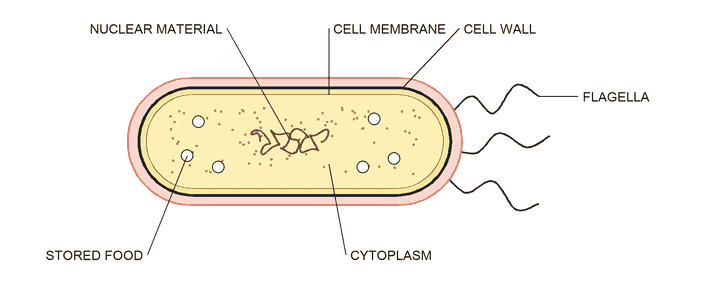
Labels: cell wall, cell membrane, cytoplasm, nuclear material, stored food, flagella.
Step 2 — (i) Kingdom.
A bacterium belongs to Kingdom Monera.
Step 3 — (ii) Two features of the kingdom.
Two features of Monera are given below.
- They are microscopic, single-celled organisms with a cell wall.
- They have no proper nucleus; the nuclear material lies in a nucleoid without a nuclear membrane (they are prokaryotes).
Step 4 — (iii) The gelatinous covering.
The layer that surrounds the cell wall is the capsule.
Step 5 — (iv) Organelles absent.
A bacterium has no mitochondria and no plastids (it also has no nuclear membrane or nucleolus).
Step 6 — (v) A comma-shaped bacterium.
Vibrio cholerae, which causes cholera.
Watch out: The capsule lies outside the cell wall; it is not drawn as one of the six parts asked for.
Therefore, (i) Monera; (ii) single-celled with a cell wall, and no proper nucleus; (iii) capsule; (iv) mitochondria and plastids; (v) Vibrio cholerae.
- 2910 marks
Question 29
Given alongside is the figure of an organism. Study the same and answer the following questions.
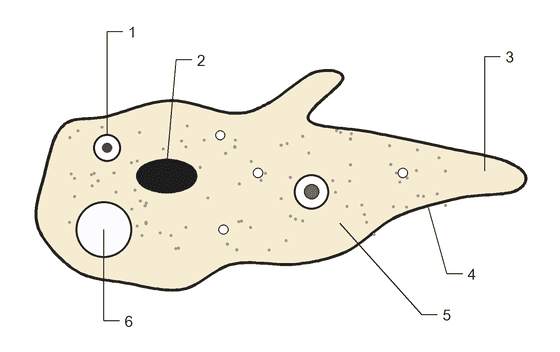
(i) Identify the organism.
(ii) Is it a plant/animal ? Give reason in support of your answer.
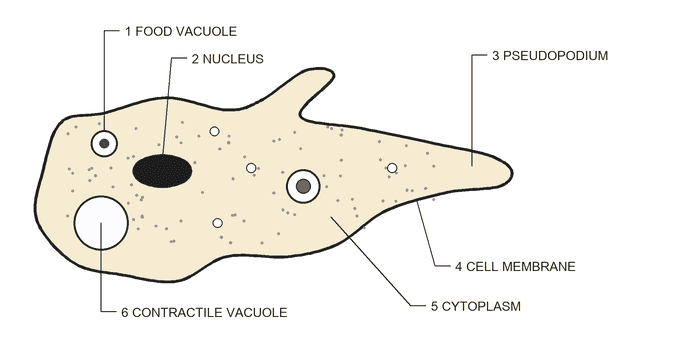
(iii) Label the guidelines 1 to 6 shown in the figure.
(iv) Which kingdom does it belong to ?
(v) Write one important role of the parts shown as 3 and 6.
Solve with AIWritten solution
Solution:
Concept: Amoeba is a single-celled protist with no fixed shape. It moves and catches food with pseudopodia and removes excess water with a contractile vacuole.
Step 1 — (i) Identify the organism.
An irregular single cell with false feet, a nucleus and vacuoles is Amoeba.
Step 2 — (ii) Plant or animal.
Amoeba is animal-like (it was earlier placed among animals). It has no chlorophyll and no cell wall, it cannot make its own food, and it moves about to catch food.
Step 3 — (iii) Label the guidelines.
The parts are labelled below.
1 — Food vacuole, 2 — Nucleus, 3 — Pseudopodium, 4 — Cell membrane, 5 — Cytoplasm, 6 — Contractile vacuole.
Step 4 — (iv) Kingdom.
A single cell with a proper nucleus belongs to Kingdom Protista.
Step 5 — (v) Roles of parts 3 and 6.
The roles of the two parts are given below.
- 3 (pseudopodium): helps in movement and in capturing food by flowing round it.
- 6 (contractile vacuole): collects excess water that enters the cell and pumps it out, so the cell does not burst.
Watch out: The contractile vacuole's main job is to remove water; most of the waste ammonia leaves through the cell membrane by diffusion.
Therefore, (i) Amoeba; (ii) animal-like, as it has no chlorophyll or cell wall and moves to catch food; (iii) 1 food vacuole, 2 nucleus, 3 pseudopodium, 4 cell membrane, 5 cytoplasm, 6 contractile vacuole; (iv) Protista; (v) 3 helps movement and feeding, 6 removes excess water.
- 3011 marks
Question 30
Study the figure given alongside and answer the following questions :
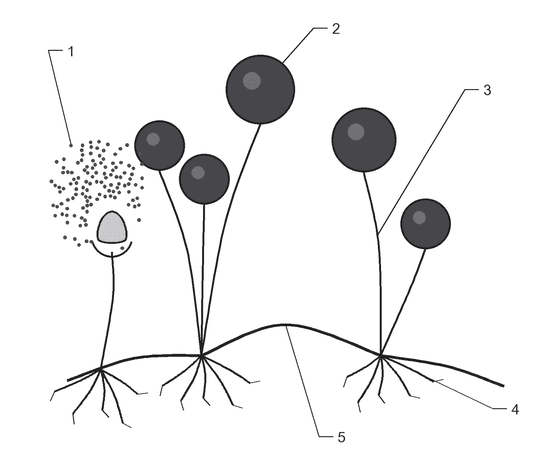
(i) Identify the organism. Write its common name as well as scientific name.
(ii) Label the guidelines 1 to 5.
(iii) Which kingdom does it belong to ?
(iv) Write one important role of a part shown as 2.
(v) Mention one very specific feature of this category of plants.
Solve with AIWritten solution
Solution:
Concept: Bread mould (Rhizopus) is a fungus. Its body is a mycelium of hyphae; upright sporangiophores carry round sporangia full of spores, and rhizoids fix it to the bread.
Step 1 — (i) Identify the organism.
The common name is bread mould; the scientific name is Rhizopus.
Step 2 — (ii) Label the guidelines.
The parts are labelled below.
1 — Spores, 2 — Sporangium, 3 — Sporangiophore, 4 — Rhizoids, 5 — Stolon (hypha).
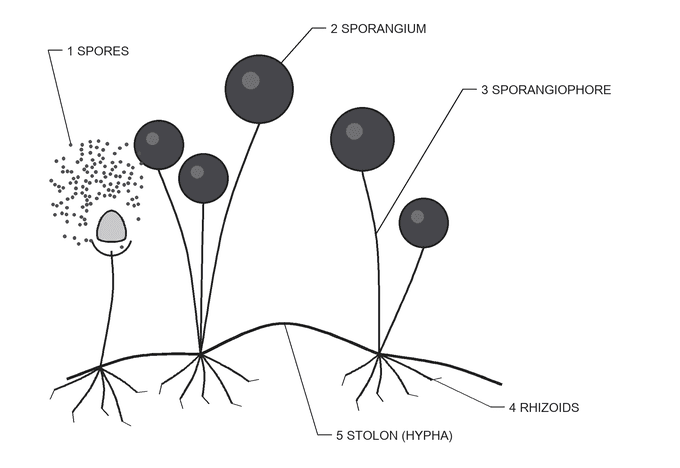
Step 3 — (iii) Kingdom.
Bread mould belongs to Kingdom Fungi.
Step 4 — (iv) Role of part 2.
The sporangium makes and holds the spores. When it bursts, the spores are scattered by air, and each grows into a new mycelium. So it helps in reproduction.
Step 5 — (v) A special feature of this group.
Fungi have no chlorophyll, so they cannot make their own food. They are saprophytes: they pour digestive juices onto dead matter and absorb the dissolved food.
Note: The question calls fungi "plants", as older books did; today fungi form a kingdom of their own.
Therefore, (i) bread mould, Rhizopus; (ii) 1 spores, 2 sporangium, 3 sporangiophore, 4 rhizoids, 5 stolon; (iii) Fungi; (iv) the sporangium makes spores for reproduction; (v) no chlorophyll, so they live as saprophytes.
- 313 marks
Question 31
Briefly explain four types of bacteria on the basis of their shape.
Solve with AIWritten solution
Solution:
Concept: Bacteria are grouped by the shape of their cells into four common forms.
Step 1 — Coccus.
Cocci (Greek kokkos, a berry) are round or oval bacteria.
Step 2 — Bacillus.
Bacilli are rod-shaped bacteria; they may occur singly, in pairs or joined end to end in chains.
Step 3 — Spirillum.
Spirilla are spiral (corkscrew) shaped bacteria.
Step 4 — Vibrio.
Vibrios are comma-shaped bacteria, for example Vibrio cholerae, which causes cholera.
Therefore, the four types are coccus (round), bacillus (rod), spirillum (spiral) and vibrio (comma).
- 324 marks
Question 32
Give reasons for the following :
(i) Bryophytes are called amphibians of plant kingdom.
(ii) Amoeba does not have any regular shape.
Solve with AIWritten solution
Solution:
Concept: A reason links the fact to its cause.
Step 1 — (i) Bryophytes as amphibians.
Bryophytes (mosses) live on land in damp places, but their male cells must swim through a film of water to reach the egg. Like frogs, they depend on both land and water, so they are called the amphibians of the plant kingdom.
Step 2 — (ii) Amoeba's irregular shape.
Amoeba has no cell wall, only a thin, flexible cell membrane. It keeps pushing out and pulling in pseudopodia to move and feed, so its shape keeps changing.
Therefore, (i) bryophytes live on land but need water to reproduce; (ii) Amoeba has no cell wall and keeps forming pseudopodia.
- 333 marks
Question 33
What is a contractile vacoule ? State its function in amoeba.
Solve with AIWritten solution
Solution:
Concept: Water keeps entering Amoeba by osmosis, because its cytoplasm is more concentrated than the pond water around it. The contractile vacuole removes this extra water.
Step 1 — What it is.
The contractile vacuole is a clear, rounded, fluid-filled vacuole in the cytoplasm of Amoeba. It slowly swells as it fills with water and then contracts to empty it.
Step 2 — Its function.
It collects the excess water from the cytoplasm and expels it out of the body. This keeps the right amount of water in the cell, so the cell does not swell and burst.
Watch out: The contractile vacuole's main job is water balance; most waste ammonia leaves through the cell membrane by diffusion.
Therefore, the contractile vacuole is a water-filled vacuole that collects and throws out excess water from Amoeba.
- 343 marks
Question 34
List out five uses each of bacteria and fungi in our lives.
Solve with AIWritten solution
Solution:
Concept: Many bacteria and fungi are useful to us, in food, medicine, farming and industry.
Step 1 — Five uses of bacteria.
Bacteria are useful in these ways.
- Medicines: antibiotics such as streptomycin come from soil bacteria, and killed or weakened bacteria are used to make vaccines.
- Lactobacillus turns milk into curd.
- Acetobacter turns the alcohol of fermented fruit juice into vinegar.
- Retting of jute fibres and tanning of leather.
- Rhizobium in the root nodules of legumes fixes nitrogen and makes the soil fertile; microbes also make compost and biogas from wastes.
Step 2 — Five uses of fungi.
Fungi are useful in these ways.
- Some mushrooms, such as Agaricus and Morchella, are edible.
- Yeast is used in bakeries to make bread rise.
- Yeast is used to make alcohol, and it is a good source of B vitamins.
- The antibiotic penicillin is obtained from the fungus Penicillium (Fleming's mould was Penicillium notatum).
- Penicillium moulds ripen cheeses such as Roquefort and Camembert, and fungi act as decomposers that return nutrients to the soil.
Therefore, bacteria give us medicines, curd, vinegar, fibres and leather, and fertile soil; fungi give us food, bread, alcohol, penicillin and cheese.
- 353 marks
Question 35
“Bacteria are harmful to human beings.” Briefly explain this statement.
Solve with AIWritten solution
Solution:
Concept: Some bacteria are harmful: they spoil food and cause diseases.
Step 1 — Spoilage of food.
Bacteria grow in milk, meat, fish and cooked food and make them go bad. Food kept too long, food past its expiry date, and tins that are bulging or damaged can carry bacteria and their poisons, so such food should not be eaten.
Step 2 — Diseases.
Many bacteria cause human diseases, such as typhoid (Salmonella typhi), tuberculosis (Mycobacterium tuberculosis), pneumonia, cholera (Vibrio cholerae) and diphtheria.
Watch out: The statement is true only for some bacteria; many others are useful to us.
Therefore, bacteria are harmful because some of them spoil food and cause diseases.
- 363 marks
Question 36
Briefly describe the binary fission in Amoeba.
Solve with AIWritten solution
Solution:
Concept: Binary means two and fission means splitting; in binary fission one Amoeba splits into two.
Step 1 — The parent grows.
A full-grown Amoeba stops moving and becomes rounded, ready to divide.
Step 2 — The nucleus divides.
First the nucleus divides into two daughter nuclei.
Step 3 — The cytoplasm divides.
Then the cytoplasm pinches in the middle, so that each half gets one daughter nucleus.
Step 4 — Two daughter cells.
Two daughter amoebae are formed. Each lives on its own, grows to full size and divides again.
Watch out: The nucleus divides first, then the cytoplasm.
Therefore, in binary fission the nucleus of a full-grown Amoeba divides, then its cytoplasm, giving two daughter amoebae.
- 376 marks
Question 37
During a school trip to a hill station, students of class 7 walked past tall trees with needle-like leaves. They collected dry cones scattered beneath these trees. When Anunay gently shook one cone, tiny winged seeds slipped out. He noticed that the seeds were not enclosed in fruits but lay exposed on the scales of the cones.
(i) Do these trees belong to flowering plants ? If not, which group do they belong to ?
(ii) Give two examples of plants that belong to the same category.
(iii) These plants are evergreen. What does the term ‘evergreen’ mean ?
(iv) Mention two types of cones commonly found on such trees.
(v) How are these cone-bearing plants different from fruit-bearing plants like mango or guava ?
Solve with AIWritten solution
Solution:
Concept: Needle-like leaves, cones and naked seeds lying on the cone scales show that the trees are gymnosperms.
Step 1 — (i) Flowering plants or not.
No, they bear no flowers. They belong to the gymnosperms.
Step 2 — (ii) Two examples.
Pine and fir (cedar and spruce also fit).
Step 3 — (iii) Evergreen.
Evergreen means the tree does not shed all its leaves at one time; old leaves fall a few at a time, so it stays green all the year.
Step 4 — (iv) Two types of cones.
Male cones, which make pollen, and female cones, which bear the seeds.
Step 5 — (v) Difference from fruit-bearing plants.
The difference is given below.
- Cone-bearing plants (gymnosperms) have no flowers and no fruits; their seeds are naked, lying on the scales of cones.
- Fruit-bearing plants such as mango and guava (angiosperms) bear flowers, and their seeds are enclosed in a fruit formed from the ovary.
Therefore, (i) no, they are gymnosperms; (ii) pine and fir; (iii) the tree never loses all its leaves at once; (iv) male and female cones; (v) gymnosperms bear naked seeds in cones, angiosperms seeds inside fruits.
What Class 7 Biology Ch 2 covers
The sections of the chapter, in the order the book takes them. Every question above comes from one of these.
- 01Classification and Its Need
- 02Advantages of Classification
- 03Classification of Living World
- 04Kingdom Monera
- 05Kingdom Protista
- 06Kingdom Fungi
More ways to study this chapter
The same chapter asked three other ways. Practise it, revise it, and see what the board has set on Ch 2 before.
Class 7 Biology Ch 2 questions students ask
How many questions are there in Class 7 Biology Ch 2?
37 questions. Every one is solved step by step on this page.
Are these Class 7 Biology solutions free?
Yes. Every question and its full working is free to read, with no account needed.
Can I download the Class 7 Biology Ch 2 solutions as a PDF?
There is no PDF to download. Every solution is on this page instead, which means it is searchable, always the current syllabus, and readable on a phone. Use your browser's print option if you want it on paper.