Solution:
Concept: Amoeba is a single-celled protist with no fixed shape. It moves and catches food with pseudopodia and removes excess water with a contractile vacuole.
Step 1 — (i) Identify the organism.
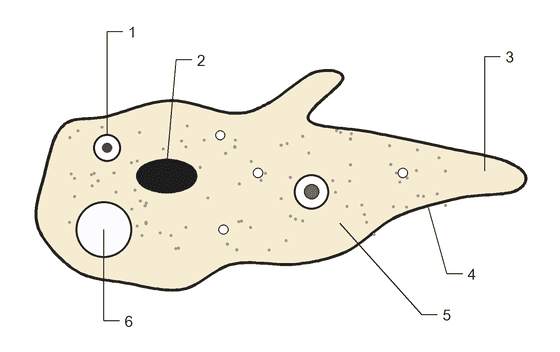
An irregular single cell with false feet, a nucleus and vacuoles is Amoeba.
Step 2 — (ii) Plant or animal.
Amoeba is animal-like (it was earlier placed among animals). It has no chlorophyll and no cell wall, it cannot make its own food, and it moves about to catch food.
Step 3 — (iii) Label the guidelines.
The parts are labelled below.
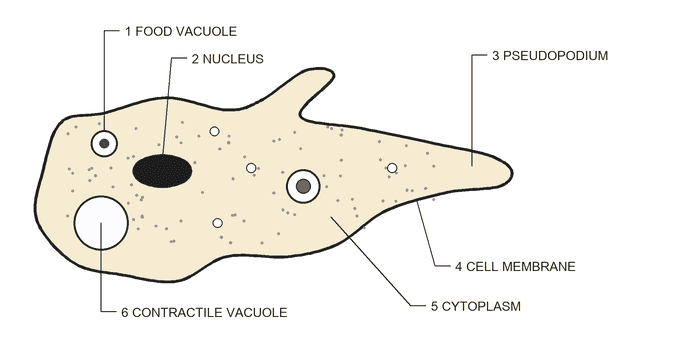
1 — Food vacuole, 2 — Nucleus, 3 — Pseudopodium, 4 — Cell membrane, 5 — Cytoplasm, 6 — Contractile vacuole.
Step 4 — (iv) Kingdom.
A single cell with a proper nucleus belongs to Kingdom Protista.
Step 5 — (v) Roles of parts 3 and 6.
The roles of the two parts are given below.
- 3 (pseudopodium): helps in movement and in capturing food by flowing round it.
- 6 (contractile vacuole): collects excess water that enters the cell and pumps it out, so the cell does not burst.
Watch out: The contractile vacuole's main job is to remove water; most of the waste ammonia leaves through the cell membrane by diffusion.
Therefore, (i) Amoeba; (ii) animal-like, as it has no chlorophyll or cell wall and moves to catch food; (iii) 1 food vacuole, 2 nucleus, 3 pseudopodium, 4 cell membrane, 5 cytoplasm, 6 contractile vacuole; (iv) Protista; (v) 3 helps movement and feeding, 6 removes excess water.