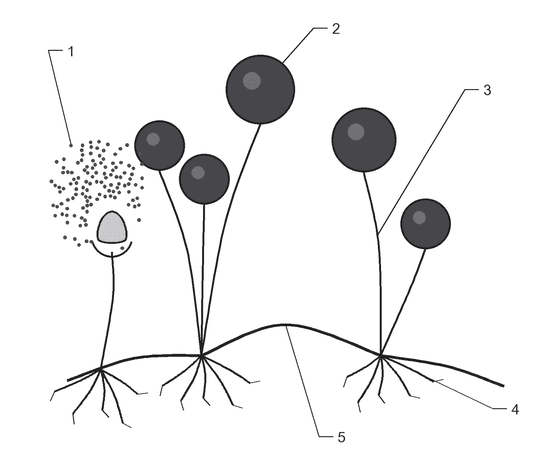
Solution:
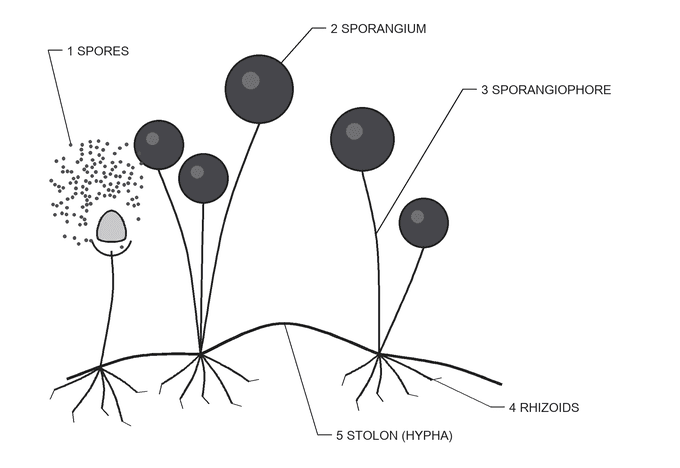
Concept: Bread mould (Rhizopus) is a fungus. Its body is a mycelium of hyphae; upright sporangiophores carry round sporangia full of spores, and rhizoids fix it to the bread.
Step 1 — (i) Identify the organism.
The common name is bread mould; the scientific name is Rhizopus.
Step 2 — (ii) Label the guidelines.
The parts are labelled below.
1 — Spores, 2 — Sporangium, 3 — Sporangiophore, 4 — Rhizoids, 5 — Stolon (hypha).
Step 3 — (iii) Kingdom.
Bread mould belongs to Kingdom Fungi.
Step 4 — (iv) Role of part 2.
The sporangium makes and holds the spores. When it bursts, the spores are scattered by air, and each grows into a new mycelium. So it helps in reproduction.
Step 5 — (v) A special feature of this group.
Fungi have no chlorophyll, so they cannot make their own food. They are saprophytes: they pour digestive juices onto dead matter and absorb the dissolved food.
Note: The question calls fungi "plants", as older books did; today fungi form a kingdom of their own.
Therefore, (i) bread mould, Rhizopus; (ii) 1 spores, 2 sporangium, 3 sporangiophore, 4 rhizoids, 5 stolon; (iii) Fungi; (iv) the sporangium makes spores for reproduction; (v) no chlorophyll, so they live as saprophytes.